Iran to resume nuclear talks with European envoys in Geneva, says local media
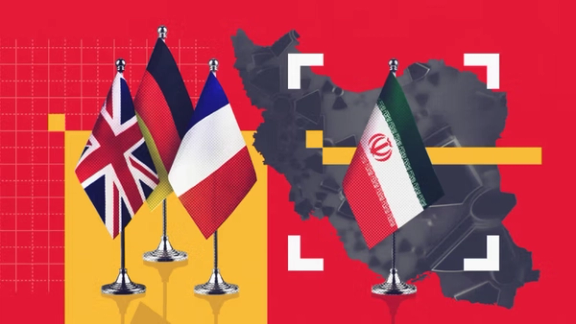
A new round of nuclear talks between the Islamic Republic and three European states will take place Tuesday, in Geneva, with Deputy FM Majid Takht-Ravanchi heading the Iranian delegation, Iran’s Tasnim News reported Monday.
Deputy foreign ministers from Germany, France and the UK will also attend, the Revolutionary Guards-affiliated outlet said citing an informed source.
“The agenda of these negotiations is nuclear issues and the lifting of sanctions,” the source said.
Foreign Minister Abbas Araghchi on Friday spoke with his counterparts in the three European capitals and the European Union’s foreign policy chief over the phone, where the snapback mechanism was discussed. The calls led to agreement to continue talks on Iran’s nuclear program.
Snapback debate intensifies
In recent days speculation has mounted over the future of Tehran’s nuclear activities, with the European trio weighing activation of the snapback provision and the Islamic Republic signaling possible responses.
The looming expiry of UN Security Council Resolution 2231’s legal framework has spurred Iranian officials and allies to step up legal consultations aimed at blocking the mechanism.
Britain, France and Germany — the so-called E3 — have warned Iran that unless it returns to nuclear talks by the end of August, they will trigger the mechanism that could reimpose all UN sanctions lifted under the 2015 nuclear deal.
Ali Larijani, secretary of the Supreme National Security Council, also warned that Germany, France and the UK may move to trigger snapback mechanism, but said “important countries” remain divided on how to proceed.
He raised the possibility of Iran’s withdrawal from the Nuclear Non-Proliferation Treaty, saying, “This assumption has always existed. The reality is that the NPT has had no benefit for us.”
Before the 12-day war, Tehran and Washington held five rounds of nuclear talks, but negotiations collapsed when Islamic Republic officials insisted uranium enrichment must continue inside Iran.
Supreme Leader Ali Khamenei on Sunday rejected calls by Tehran moderates for direct negotiations with the United States, insisting that Washington’s hostility cannot be resolved through talks.
Iran is prepared to scale back uranium enrichment from 60% to 20% in a bid to prevent further airstrikes and the reimposition of UN sanctions, the Telegraph reported on Sunday citing unnamed Iranian officials.
Under efforts led by the country's new top security official Ali Larijani, Tehran is willing to soften its hardline stance to avoid further military strikes from Israel and the United States, the report added citing Iranian officials.
Before US airstrikes on its nuclear facilities in June, Iran’s uranium enrichment was approaching weapons grade, heightening international concern over its nuclear ambitions.
The United Kingdom, France, and Germany (E3) have warned Iran they would restore UN sanctions by the end of August by triggering the so-called snapback mechanism unless Tehran reengages in talks on its nuclear program immediately and produced concrete results.
The “snapback mechanism” is part of UN Security Council Resolution 2231, which endorsed the 2015 nuclear deal known as the Joint Comprehensive Plan of Action (JCPOA).
Under Resolution 2231, any party to the accord can file a complaint accusing Iran of non-compliance. If no agreement is reached within 30 days to maintain sanctions relief, all previous UN sanctions automatically “snap back,” including arms embargoes, cargo inspections, and missile restrictions.
On Friday, a phone call between Iran's Foreign Minister Abbas Araghchi, his E3 counterparts and European foreign policy chief Kaja Kallas failed to make any progress.
An Axios report said the call started "in a confrontational tone with the Iranian foreign minister ranting about whether E3 have the right to trigger snapback."
“After E3 pushback, Araghchi expressed some openness to an extension of the snapback but stressed this is for the United Nations Security Council to decide, not for Iran,” the report said citing an unnamed source.
"Europe is committed to a diplomatic solution to the nuclear issue. With the deadline for the snapback mechanism fast approaching, Iran’s readiness to engage with the US is crucial. Iran must also fully cooperate with the IAEA," Kallas wrote in a post on X.
The talks between Iran and the E3 are expected to resume in Vienna on Tuesday.
Nearly 75 percent of Britain’s Labour voters back designating Iran’s Revolutionary Guards as a terrorist group, a poll cited by the Telegraph shows, increasing pressures on the prime minister to fulfill his party’s pre-election pledge.
The survey of more than 1,500 adults by pollster JL Partners found that 75% of Labour voters and 65% of the wider public back a ban on the IRGC, while only 5% of Labour voters opposed it, the Telegraph reported on Sunday.
Three-quarters of Labour supporters said the group posed a threat to Britain’s national security.
The findings follow MI5 disclosures that security services and police have foiled at least 20 Iran-linked assassination and kidnap plots in Britain over the past two years.
“The British public are rightly under no illusions about the nature of the Iranian regime. It is clearer than ever that the IRGC poses a threat to the safety and security of everyone in Britain,” the Telegraph quoted Labour MP Jon Pearce as saying.
Senior Conservative figures also urged the government to act. Lord Arbuthnot, a former chair of parliament’s defense select committee, was quoted as saying: “With MI5 telling us they have foiled at least 20 state-sponsored attacks by Iran in the UK, what on earth is holding the Government back from proscribing the IRGC?”
The IRGC, a branch of Iran’s armed forces, is already under British financial sanctions, but critics argue those measures are insufficient.
The poll showed that 51% of the public believe sanctions have failed to curb the group’s activities, and 46% doubt authorities are doing enough to counter IRGC-linked operations in the UK.
As an alternative to proscription, Home Secretary Yvette Cooper has backed proposals for new legislation to give ministers powers to blacklist state agencies such as the IRGC, the newspaper said.
The poll was commissioned by the Iranian Front for the Revival of Law and National Sovereignty, founded by Vahid Beheshti, a political activist and journalist who has staged a protest for more than 900 days outside the Foreign Office.
The debate in Britain comes as other Western allies have already taken action. The United States designated the IRGC as a foreign terrorist organization in 2019, while Canada added the group to its terrorist list in 2023.
Israel says it launched airstrikes against the positions of Yemen's Houthis in Sanaa on Sunday, shortly after the group fired a ballistic missile allegedly armed with a cluster bomb warhead at Israel.
The Israeli military said the strikes hit “military infrastructure of the Houthi terrorist regime” in the Sanaa area, including a military site housing the presidential palace, the Hizaz and Asar power plants, and a fuel storage facility.
Israeli media reported that 10 Air Force jets took part in the strikes in Sanaa, dropping about 35 munitions.
Earlier on Sunday, Israeli media reported that an investigation by the Israeli military found that Yemen’s Iran-backed Houthi militant group used a ballistic missile armed with a cluster bomb warhead in its attack on Israel on Friday.
One of the munitions from the strike hit the yard of a house in the central Israeli town of Ginaton, causing minor damage.
The reports said that while an investigation is under way by the Israeli military into the failure to intercept the missile, the probe is not related to the type of warhead it carried.
Reuters reported citing an Israeli Air Force official as saying on Sunday that the missile most likely carried several sub-munitions “intended to be detonated upon impact.”
“This is the first time this type of missile has been launched from Yemen,” the official was quoted as saying.
A day earlier, Ynet wrote that Israeli Air Force is probing why defenses failed to stop Houthi missile that struck near Tel Aviv, and whether it carried cluster munitions like those Iran used in June war.
Such payloads complicate interception and increase the risk of civilian harm.
Five interceptor systems, including THAAD, Arrow, David’s Sling and Iron Dome, engaged the projectile, which initial reviews suggest fragmented in mid-air, Ynet quoted authorities as saying.
Familiar Iranian design
One of the best-known weapons of this type is the Iranian Khorramshahr-4, unveiled in May 2023, with the capacity to scatter dozens of small warheads resembling Grad rockets. Tehran says it can carry a payload of up to two tons over a range of 2,000 kilometers.
During the June war, Iran launched missiles fitted with submunitions designed to disperse small explosives over urban areas to maximize civilian harm.
Most were intercepted, but in May another missile came close to Ben Gurion’s perimeter. The military said its probe would examine how to adapt defenses against cluster-type payloads, which pose a growing challenge as Iran’s allies escalate attacks.
Iran’s Supreme Leader Ali Khamenei on Sunday rejected calls by Tehran moderates for direct negotiations with the United States, insisting that Washington’s hostility cannot be resolved through talks.
“Those who say, ‘Why don’t you negotiate directly with the United States and solve the issues,’ are superficial; because the reality is different," Khamenei said during a meeting with his supporters in Tehran.
"Given America’s true objective in its hostility toward Iran, these issues are unsolvable."
“The enemies, after facing the steadfast unity of the nation, officials, and armed forces, and after suffering heavy defeats in military attacks, have realized that Iran and the Islamic system cannot be subdued by war or forced into obedience," he said.
Khamenei added that enemies had underestimated Iran’s resilience and wrongly believed attacks would separate the people from the state.
The 86-year-old ruler's remarks came one week after Iran's Reform Front issued a controversial statement urging direct negotiations with Washington, suspension of uranium enrichment, and acceptance of full IAEA monitoring in exchange for sanctions relief.
Regime change
The Supreme Leader, who was absent for 22 days after the June war, accused the United States of preparing for the Islamic Republic's collapse following the June attack.
“On June 13 Iran was attacked; a day later, some American agents met in a European capital to discuss an alternative to the Islamic Republic — that’s how confident they were."
"One day after the attack began, they sat and discussed what government should rule Iran after the Islamic Republic. They even appointed a king, deciding who should be the Shah of Iran. This is how they imagined Iran.”
“They thought this attack would create distance between the people and the system, weaken the system, and allow them to impose their vile and malicious goals,” Khamenei said.
Israel and regional conflict
Khamenei argued that Washington’s enmity was openly acknowledged. “The reason for America’s hostility toward us was revealed by the man in office there today, who said: ‘Our confrontation with Iran, with the Iranian nation, is because Iran must be obedient to the United States.’”
“The Iranian nation is deeply offended by such a grave insult and will stand with full strength against those who hold such a false expectation,” he added.
Turning to Israel, Khamenei said: “Today our enemy, the one standing against us — the Zionist regime — is the most despised government in the world."
He said "the path of aiding the Zionist regime must be cut off, and what the brave people of Yemen are doing today is the right course.”
The Houthis, who control much of Yemen’s population, announced a maritime blockade in the Red Sea in November 2023 after a call by Khamenei to support Hamas in Gaza. Since then, they have fired dozens of ballistic missiles and drones toward Israel as well as commercial vessels navigating the region.
“We are ready for whatever possible for the Islamic Republic,” he continued, pledging readiness to “uproot this deep, malignant cancer [Israel] from the region.”
Israel is threatening Muslim nations, Iran's foreign minister said on Sunday in an op-ed on a pan-Arab daily newspaper, urging Islamic countries to impose sanctions and form an international coalition against Iran's archenemy.
Abbas Araghchi accused Israel of pursuing expansionist policies in Gaza, the West Bank, Lebanon and Syria, in his opinion piece published Sunday by the London-based Asharq Al-Awsat.
The Iranian official urged international bodies to prosecute Israeli leaders and said the upcoming extraordinary meeting of the Organization of Islamic Cooperation (OIC) in Jeddah must go “beyond issuing statements and words of condemnation.”
At Iran's request, an extraordinary OIC meeting will be held in Saudi Arabia on Monday to discuss the situation in Gaza. Turkish Foreign Minister Hakan Fidan will chair the meeting, according to the Turkish Foreign Ministry.
“The illusion of Greater Israel is an existential danger and a threat to international peace and security,” Araghchi wrote.
Araghchi also warned OIC states against reliance on initiatives like the Abraham Accords.
“Any doubt, weakness, or illusion based on trust in deceptive promises such as the Abraham Accords will lead to great harm for the Islamic nation,” he wrote.
US President Donald Trump on August 8 said Iran’s nuclear arsenal had been “totally obliterated” and called on Middle Eastern nations to join the Abraham Accords, framing the strikes as a pathway to regional peace.
“Now that the nuclear arsenal being ‘created’ by Iran has been totally OBLITERATED, it is very important to me that all Middle Eastern Countries join the Abraham Accords,” Trump wrote in a post on Truth Social. “This will ensure PEACE IN THE MIDDLE EAST.”