Iran, European powers to resume nuclear talks on Tuesday
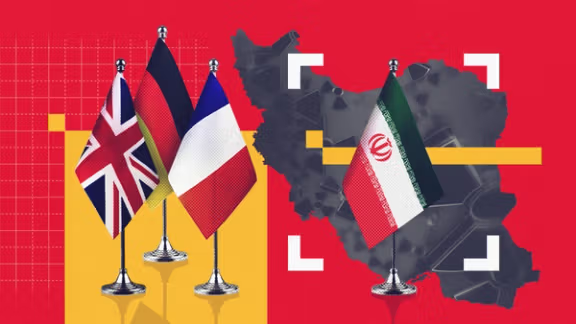
Iran and three European powers will resume nuclear talks on Tuesday, Iran’s foreign minister said, following a phone call with his counterparts from Britain, France and Germany as well as the European Union’s foreign policy chief.
During the call, Foreign Minister Abbas Araghchi outlined Tehran’s position on the so-called “snapback” mechanism in the 2015 nuclear deal, warning the European powers and the EU against what he called their lack of legal authority to invoke the measure.
He cautioned that resorting to such a step would have serious consequences.
Araghchi said Iran remained committed to diplomacy but would continue to defend its rights and interests.
“Just as the Islamic Republic acts firmly in self-defense, it has never abandoned diplomacy and is prepared for any solution that guarantees the rights and interests of the Iranian people,” he said, according to a statement by the ministry.
Responding to European suggestions of extending UN Security Council Resolution 2231 to allow more time for negotiations, Araghchi said such a decision lay with the Council itself.
He added Tehran would continue consultations with its partners at the United Nations on the implications of such a move.
The European ministers and EU foreign policy chief Kaja Kallas reiterated their readiness to pursue a diplomatic solution, the statement said.
Iran must engage with US and IAEA
The EU foreign policy chief on Friday urged Iran to engage with the US and cooperate with the IAEA to avert the return of UN sanctions, following what she called an important phone call with the foreign ministers of Iran, UK, France and Germany.
"Europe is committed to a diplomatic solution to the nuclear issue. With the deadline for the snapback mechanism fast approaching, Iran’s readiness to engage with the US is crucial. Iran must also fully cooperate with the IAEA."
The talks between Iran and the so-called E3 will resume in Vienna on Tuesday at the level of deputy foreign ministers.
Ahmad Khatami, Tehran’s interim Friday prayer leader and a representative of the Supreme Leader, criticized the Reform Front’s recent manifesto, saying its proposal for suspending uranium enrichment mirrored US demands.
“Suspending enrichment is the American prescription in this statement,” Khatami told worshippers at Tehran’s Imam Khomeini Mosalla, according to state media.
He added: “Nuclear energy is the energy of the future, and people have repeatedly said nuclear energy is the nation’s inalienable right.”
Khatami also rejected the manifesto’s suggestion of direct talks with Washington, saying: “How can we negotiate with America, which martyred General Soleimani, attacked our country, violated all international agreements, and struck our nuclear centers?”
Iran’s Reform Front has urged sweeping political and foreign policy changes, including a temporary suspension of uranium enrichment, release of political prisoners, and direct negotiations with Washington in return for sanctions relief. The reformist push has drawn fierce backlash from conservatives.
“The Iranian people will never surrender to America — hayhat minna al-dhilla,” he said, invoking a famous phrase from Shi’ite Islam Imam Hussein’s sermon on the day of Ashura, which means ‘far be it from us to accept humiliation.’ The expression, rooted in Hussein’s rejection of submission to Ibn Ziyad in 680 AD, has come to symbolize choosing death with dignity over life in disgrace.
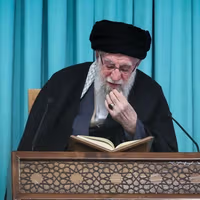
Citing remarks by Ali Khamenei last year, Khatami said: “The Leader has already said negotiations with America are neither rational nor honorable. This statement recommends dishonor, and the Iranian nation will not accept such a humiliating recipe.”
Khatami further denounced the reformist document as divisive, calling it a “black letter that translates Netanyahu’s words into Persian.”
He argued that Iranians had voted 47 times since the 1979 revolution and dismissed claims of repression of dissent, insisting that media and social networks were active and free.
A senior Iranian diplomat warned Europe that triggering the UN’s “snapback” mechanism to restore sanctions would squander its leverage and harden Tehran’s nuclear stance.
Deputy Foreign Minister Saeed Khatibzadeh told Germany’s Frankfurter Allgemeine Zeitung on Thursday that Europe had no right to reimpose lapsed sanctions under the 2015 nuclear deal.
“Such an action would only waste Europe’s last card and further diminish its credibility as a mediator,” he said.
He warned that any future talks on Iran’s nuclear program would be “armed negotiations.” “If we return to negotiations, it will be an armed negotiation. We will all have our fingers on the trigger, because we do not trust the other side,” he said.
Khatibzadeh rejected again US demands for “zero enrichment.” “Iran will not be treated as an exception to international law. The right to enrichment is non-negotiable, although the level and details can be discussed,” he said.
Tehran insists it will resist pressure and has warned that activating snapback sanctions could push it to leave the Nuclear Non-Proliferation Treaty.
Britain, France and Germany — the so-called E3 — have warned Iran that unless it returns to nuclear talks by the end of August, they will trigger the mechanism that could reimpose all UN sanctions lifted under the 2015 nuclear deal.
Tehran has accused Washington of seeking through diplomacy what it failed to achieve with June’s military strikes, with Foreign Minister Abbas Araghchi saying this week that talks with the United States have not yet reached a “mature stage.”
Israel’s June 13 offensive and subsequent US strikes on Esfahan, Fordow and Natanz ended oversight of Iran’s facilities, though Araghchi said limited cooperation with the IAEA will continue under tighter national controls.
Iran said Friday that Araghchi would hold a telephone conference call with his French, German and British counterparts.Parallel to planned call, International Atomic Energy Agency officials are due to meet Iranian counterparts in Vienna.
International Atomic Energy Agency (IAEA) officials will travel to Washington next week for consultations with the United States as concerns grow over their inability to account for Iran’s stockpile of near-bomb grade uranium, Bloomberg reported.
Citing diplomats familiar with the matter, the report said the move follows the failure of IAEA safeguards chief Massimo Aparo to secure Iranian approval earlier this month to resume monitoring after Israel and Iran’s 12-day conflict in June.
Inspectors were expelled during the fighting, effectively halting international oversight of Tehran’s nuclear program. A few days after the war ended, Iran’s parliament passed a bill suspending cooperation with the agency, including inspections.
Diplomats told Bloomberg that Iran has continued to deny access to its main nuclear-fuel complex, citing chemical and radiological hazards from US and Israeli strikes. Tehran has suggested limited access may be possible to unaffected facilities, including its Russian-built Bushehr nuclear power plant on the Persian Gulf.
Iran’s Foreign Minister Abbas Aragchi said in an interview published Wednesday by state media: “We have not reached the point of cutting off cooperation with the agency, but future cooperation will certainly not resemble the past.”
The IAEA has not verified Iran’s inventory of highly enriched uranium since June 13, when Tehran informed inspectors it was prepared to move 409 kilograms of material enriched up to 60% to an undisclosed location, Bloomberg said.
Iran has repeatedly denied seeking nuclear arms, and both IAEA inspectors and US intelligence agencies have said there is no evidence of a weapons program since the early 2000s.
The consultations in Washington come as European powers warn Tehran that failure to resume negotiations and allow inspections by the end of August could trigger the snapback of UN sanctions.
Iran has dismissed the threat and warned it could withdraw from the Nuclear Non-Proliferation Treaty if sanctions are restored.
According to Bloomberg, the IAEA is compiling a dossier highlighting inspector experience working in hazardous environments, citing precedents from Fukushima and Ukraine. But the agency faces budget strains, with member states questioning whether the $23 million earmarked for Iran monitoring should continue if inspections remain suspended.
Britain, France and Germany cannot reimpose UN sanctions on Iran under Resolution 2231, Russia’s envoy in Vienna said on Wednesday.
The three European states were threatening Iran with the snapback mechanism by the end of August, Russia’s representative to international organizations in Vienna wrote on X. Such a move would restore all UN sanctions but lacked legal basis, he said.
“The UK, Germany and France try to blackmail Iran and threaten to launch by the end of August the so-called Snapback mechanism which is envisaged in the UNSC resolution 2231 and can restore all previous economic sanctions against Iran. But there is a serious obstacle on the way of implementing this threat. The above-mentioned European states are themselves in violation of resolution 2231 and the JCPOA,” said Mikhail Ulyanov.
International law bars a state from invoking rights under an agreement while failing to meet its own obligations, he argued.
He cited a 1971 advisory opinion of the International Court of Justice on South Africa’s presence in Namibia, adding: “An attempt by the E3 to trigger snapback despite their own non-compliance would contradict the fundamental principles of international law,” said Ulyanov.
What the texts say
Neither the 2015 nuclear accord, known as the JCPOA, nor UN Security Council Resolution 2231 stipulates that a state alleged to be in non-compliance is barred from invoking snapback.
Both documents say that any JCPOA participant may notify the Security Council of “significant non-performance” after pursuing the dispute-resolution mechanism. Unless the Council adopts a resolution to extend sanctions relief within 30 days, all previous sanctions automatically return.
The right to invoke snapback expires in October 2025 when Resolution 2231 sunsets. The main requirement in the texts is to be a JCPOA participant. In 2020, a US attempt at snapback was dismissed not for non-compliance but because Washington had formally ceased participation in the accord.
Iranian and Chinese reactions
Snapback, if activated, would not drastically alter the country’s economic situation, though its consequences would be serious and heavy, said Iran’s Foreign minister Abbas Araghchi in an interview with IRNA published on Wednesday.
“We have for years been in talks with China and Russia on ways to prevent snapback… though we may not succeed,” said the Iranian foreign minister. Europe has “no legal, political, or moral right” to trigger the mechanism, said Araghchi.
China’s permanent mission to the UN also filed a note with the Security Council on Wednesday, saying that attempts to activate the snapback could have "unpredictable and catastrophic" consequences, destroying all the diplomatic achievements of recent years.
The document said any attempt by some countries to activate the snapback without following the legal process would be an abuse of the Security Council's powers and duties and would be invalid.
What snapback means
When the snapback mechanism is activated under UN Security Council Resolution 2231, it automatically reimposes all UN sanctions on Iran that were lifted as part of the 2015 Joint Comprehensive Plan of Action (JCPOA).
This happens because the mechanism is designed to be veto-proof -- no Security Council member, including permanent members like China or Russia, can block it once a JCPOA participant files a complaint of “significant non-performance” by Iran.
The reimposed measures include the arms embargo, restrictions on nuclear enrichment and ballistic missile programs, asset freezes, travel bans on designated individuals, and inspections of shipments suspected of carrying prohibited materials.
Essentially, it restores the entire set of pre-JCPOA UN sanctions as if the nuclear deal had never been reached. These sanctions remain in force until the Security Council decides otherwise.
Tehran on Wednesday accused Washington of seeking through diplomacy what it failed to achieve with military strikes, suggesting that talks with the United States have not yet reached a “mature stage.”
Foreign minister Abbas Araghchi said the US wants to ensure Iran’s nuclear activities are completely disabled, and is pressing Tehran to sign a binding agreement since that has not happened.
“One of our problems, both during previous negotiations and now, is that we have not heard a coherent statement from the Americans. Their statements constantly change, and the messages we receive are contradictory,” Araghchi said.
“Sometimes the messages differ from each other, and sometimes they differ from the interviews. I think perhaps the Americans have not yet reached a final conclusion and may be caught up in other issues,” he added.
Iran’s national security chief Ali Larijani said last week that talks with the US are possible, but only if aimed at a genuine resolution.
Negotiations under the Trump administration began with a 60-day ultimatum to Iran.
On the 61st day, June 13, Israel launched a surprise military campaign. Less than two weeks later, on June 24, the United States struck three major nuclear sites in Esfahan, Fordow, and Natanz, claiming Iran’s facilities had been “obliterated.”
Strained relations with watchdog
Araghchi said Tehran is also negotiating with the International Atomic Energy Agency (IAEA), stressing that unless Iran withdraws from the Non-Proliferation Treaty, cooperation will continue.
“We cannot completely cut off cooperation with the Agency,” he added. “In about a month, it’s time to replace the fuel at the Bushehr power plant, and this must be done in the presence of Agency inspectors.”
But that would not mean a return to pre-war arrangements, he stressed quickly.
“This new cooperation with the Agency will definitely not be like before, especially since, according to parliament’s law, all matters must go through the Supreme National Security Council, which decides where and how inspections will take place, or whether they will happen at all.”
“For several years, we’ve been working with China and Russia on this issue. We’ve held numerous joint meetings and designed a set of joint measures to implement if snapback is triggered,” he said.
The snapback mechanism, part of UN Security Council Resolution 2231 that endorsed the 2015 nuclear deal, allows any party to restore sanctions if Iran is accused of non-compliance.
France, the UK and Germany have warned Iran they will restore UN measures unless talks resume and produce results by the end of August.
“Regarding solutions to ultimately prevent snapback, discussions have taken place among our three countries, and we have some measures in mind, though we may not succeed,” Iran’s foreign minister said.