Majority of Iranians reject Islamic Republic, survey finds
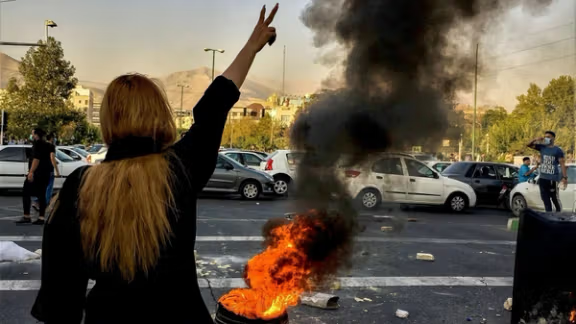
An Iranian protester
A survey conducted by a Netherlands-based institute found that the majority of Iranians would vote for either a regime change or a structural transition away from the Islamic Republic, highlighting growing demands for political change across Iran.
The Group for Analyzing and Measuring Attitudes in Iran (GAMAAN), which conducted the survey in June 2024, said it polled more than 77,000 respondents inside Iran, weighting the results to represent the literate adult population.
“A majority of the population opposes the Islamic Republic and supports changing or transforming the political system,” the report’s author Ammar Maleki said.
Only around 20 percent of respondents want the Islamic Republic to remain in power, according to the survey.
Support for the principles of the 1979 revolution and the Supreme Leader fell to 11 percent, down from 18 percent in 2022. By contrast, some 40 percent of participants said regime change was a precondition for reform, while another 24 percent favored a structural transition away from the current system.
Opposition is strongest among young, educated, and urban Iranians. More than 74 percent of university graduates rejected the Islamic Republic, compared to 66 percent among those without higher education. In rural areas, however, support for the current system reached 28 percent—nearly double the level found in cities.
When asked about forms of governance, 89 percent of Iranians said they supported democracy. Yet the survey also showed that 43 percent of respondents were open to the idea of rule under a strong leader, a view more common among rural and less-educated citizens.
Religious rule and military government, meanwhile, were decisively rejected, with two-thirds opposing clerical rule and more than 70 percent opposing military control.
Divided over future systems
The survey found no single consensus on what system should replace the current order. A secular republic was backed by 26 percent of respondents, while 21 percent supported a monarchy. Another 22 percent said they lacked enough information to decide, and 11 percent said that the form of an alternative system was not important so long as change occurred.
Support for a federal structure was concentrated in minority regions, with 15 percent nationally endorsing either a federal republic or a federal monarchy. These preferences reflected regional demands for decentralization, particularly in Kordestan, West Azarbaijan, and Sistan and Baluchestan.
Asked about political parties, 37 percent of Iranians preferred platforms prioritizing individual freedoms and human rights. Social justice and workers’ rights drew 33 percent support, while 26 percent favored nationalist parties. Only 5 percent backed groups emphasizing traditional and religious values.
Younger and more educated Iranians leaned heavily toward human rights, environmental, and economic liberalization platforms. By contrast, nationalist orientations were strongest among monarchy supporters.
Leadership support
Among Islamic Republic-affiliated figures, Supreme Leader Ali Khamenei and former president Mahmoud Ahmadinejad each polled at 9 percent. Among opposition figures, exiled prince Reza Pahlavi was the most popular with 31 percent, followed by rapper Toomaj Salehi at 6 percent and jailed Nobel laureate Narges Mohammadi at 5 percent.
Pahlavi’s support was higher among men and older, less-educated Iranians, peaking in Gilan province at 42 percent. But in Kurdish and Azeri regions, his support fell below 20 percent.
“The demand for a democratic government is widespread among Iranians, though at the same time, a notable portion of society shows an inclination toward individual authoritarianism,” Maleki said.
“No political or civil figure currently enjoys majority support in society. Each political cluster represents only a portion (between 5% to 35%) of the population, and no single opposition force is capable of representing the full diversity present within the country.”
Since June 2024, when the GAMAAN survey was conducted, major developments — including the 2024 presidential election and the 2025 twelve-day war between Iran and Israel — have taken place that may further influence Iranian public opinion.
Iran’s former intelligence minister Mahmoud Alavi warned that domestic injustices and political exclusion risk eroding national cohesion, saying Iranians should not be treated as if unity is only demanded in wartime.
Alavi, now a senior adviser on ethnic and religious affairs to President Masoud Pezeshkian, said the 12-day conflict with Israel and the United States in June showed that Iranians of all ethnic and religious backgrounds can stand together. But he cautioned that this unity could be undermined if people feel ignored or excluded.
“Do not let injustice, discrimination or unprofessional politics erode this social capital,” he said in an interview with state news agency IRNA. “People must not feel they are only wanted for war, not for building the country.”
The cleric added: “We must make ethnic and religious justice a reality, and give all Iranians equal opportunity and security regardless of their identity.”
Tehran is embracing the very nationalism it suppressed for much of its existence in the wake of a punishing 12-day war with Israel and the United States, signaling authorities' keenness to drum up unity among a weary populace.
Iran’s former intelligence minister Mahmoud Alavi
Narrative battle and state media
Alavi devoted much of his remarks to Iran’s media shortcomings during the conflict, acknowledging that foreign broadcasters shaped global perceptions.
Referring to public criticism voiced online, he said:“People on social media ask, ‘Why must our story only be heard through hostile or so-called neutral media?’ The national broadcaster must act more nationally.”
The former minister directly accused Persian-language channels abroad of aiding Iran’s enemies.
“Hostile media like Iran International, Voice of America and similar outlets played exactly the role that the enemy sought on the battlefield -- to create division between people and the state, weaken morale with exaggerated or false reports of casualties, incite ethnic and sectarian tensions with racist narratives, and push polarization between ‘the people and the front’ or between ‘defense and freedom,’” Alavi said.
He accused such outlets of using “psychological operations to portray Iran’s legitimate defense as reckless adventurism and to damage domestic cohesion.”
Iranian authorities have threatened dozens of journalists at London-based broadcaster Iran International and hundreds of their relatives in a campaign to force resignations, Forbes reported earlier in August.
Lawyers from Doughty Street Chambers and Howard Kennedy said 45 reporters and 315 family members were targeted over the past six weeks, warning they would be killed if they did not quit by deadlines that have since passed.
Iran International, which covers events in Iran and the region, said staff have faced harassment since its 2017 launch, including assassination and kidnapping threats, assaults, online abuse and hacking.
British lawmakers have warned that Iran is among foreign governments carrying out transnational repression in the UK.
The broadcaster last week filed an urgent appeal to UN experts, urging action against Tehran over risks to its journalists worldwide and relatives inside Iran.
A reformist call to suspend uranium enrichment, release political prisoners, and curb the Revolutionary Guards’ power has intensified debate over Iran’s future at a moment of heightened pressure.
The Reformist Front’s 11-point statement, released just weeks after the 12-day war with Israel, demanded sweeping shifts in both foreign and domestic policy, including reconciliation with the West and curbs on the IRGC’s role in politics and the economy.
The appeal was the boldest in years from a faction once central to Iranian politics but now largely marginalized.
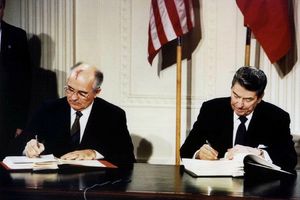
Kayhan daily branded the proposals “capitulation,” while IRGC-linked Tasnim News Agency warned of a “Gorbachev moment” that could unravel the state. The backlash underscored how sensitive the demands were, cutting at the very pillars of Supreme Leader Ali Khamenei’s power structure.
Alex Vatanka of the Middle East Institute says that reformists are testing the waters precisely because they sense the Islamic Republic is battered by sanctions and the war with Israel.
“The Islamic Republic is under strain like never before,” he told Iran International, “but reformists don’t have the street behind them.”
The moderates are laying the groundwork for further challenges if ignored, Vatanka said, insisting the letter should not be read as mere symbolism but as a signal of intent.
“This is just the beginning,” he added, cautioning that without broad public support, their leverage remains limited.
Others place the statement in the context of succession politics.
Historian and author Arash Azizi described it as part of a “post-Khamenei world,” with rival factions already maneuvering for influence after the 85-year-old leader.
By openly calling for suspending enrichment and curbing the Revolutionary Guards, he argued, reformists are staking out ground in anticipation of change at the top.
They are not naïve,” Azizi said. “They know these demands won’t be met tomorrow. But they want to shape what comes next.”
But the gulf between elite politics and public sentiment remains wide.
Behnam Ben Taleblu of the Foundation for Defense of Democracies (FDD) cautioned that while such statements attract attention in Washington, they resonate little inside Iran.
“This is politically significant in the sense of who said it, but it won’t have impact,” he said.
For many Iranians, he added, the reformist project has lost credibility after years of unmet promises.
A vision beyond hardline rule
The Reformist Front’s roadmap also included calls to end the house arrests of Green Movement leaders Mir-Hossein Mousavi and his wife Zahra Rahnavard.
Whether such demands gain traction will depend on whether they can move beyond closed-door debates and find resonance in a weary society.
Meanwhile, pressure on Tehran is mounting.
European governments have threatened to trigger the UN’s snapback sanctions if nuclear talks stall, a move that could plunge Iran deeper into recession.
Despite the boldness of their demands, few expect Iran’s ruling elite to bend.
The Supreme Leader has shown little tolerance for compromise, and the Revolutionary Guards remain entrenched across politics and the economy.
Yet Azizi argues the statement with its sweeping demands should not be dismissed as irrelevant.
“It is a mini earthquake,” Azizi told Iran International. “Even if it doesn’t lead to immediate change, it tells us how reformists are imagining a post-Khamenei Iran.”
Whether the letter proves to be a turning point or just another forgotten appeal may depend less on reformist leaders than on whether ordinary Iranians are willing to rally behind them.
A section of Tehran’s largest cemetery holding executed dissidents from the early 1980s has been turned into a parking lot, Iranian officials have confirmed.
Lot 41 in Behesht-e Zahra Cemetery contains the remains of members of groups who opposed Ayatollah Khomeini’s rule following Iran’s 1979 revolution—especially the Mujahedin-e Khalq Organization (MEK)—as well as Baha’is and wealthy individuals accused of “corruption on earth.”
“Lot 41, where hypocrites were buried early in the revolution, was left untouched,” Tehran’s deputy mayor Davoud Goudarzi told reporters, using the pejorative for MEK in the Islamic Republic’s lexicon.
“We suggested to the relevant authorities and later to the provincial supply council that, since people frequently visit Lot 42 and parking was needed, this plot could be converted. We received permission and did it.”
News of the conversion quickly sparked criticism from human rights advocates and families of those buried in Lot 41.
“Destruction of these graves is a serious human rights violation as it hinders future investigations into the mass executions carried out by the Islamic Republic,” Shahin Milani, Executive Director of the Iran Human Rights Documentation Center, told Iran International on Tuesday.
‘Curse-land’
For decades, Lot 41 has been heavily guarded, monitored around the clock with cameras and personnel. Some Iranians call it the “section of the executed” or “curse-land,” while the cemetery officials refer to it as the “scorched section.”
Authorities have tried to erase its traces over the decades by breaking headstones, concealing grave markers, burning trees and leveling the ground.
Tehran municipality established Lot 42 at the end of June to bury those killed during Israel’s 12-day military campaign against Iran.
According to Iranian media, Israeli strikes killed dozens of senior security officials and several nuclear scientists. Government figures put the overall toll at more than 1,000 Iranians, including hundreds of military personnel and civilians.
“We turned Lot 41 … into a parking lot for visitors to Lot 42,” cemetery chief Mohammad Javad Tajik told Shargh daily on August 16.
In the aftermath of the 1988 massacre of political prisoners, many bodies were never identified or returned to families.
Calls for justice continue to this day, led by survivors, relatives, and human rights groups—who see the destruction of Lot 41 as part of a deliberate effort to erase evidence of past crimes.
“This action violates the dignity and respect of the dead and denies their families the possibility to honor their loved ones,” Milani said.
The state funeral of renowned miniature artist and "national treasure" Mahmoud Farshchian drew large crowds in Isfahan on Monday, reigniting heated debates on Persian social media over the notion of “state-affiliated artists.”
Farshchian, 95, passed away on August 9 in Englewood Cliffs, New Jersey, where he had lived since 1983. His body was returned to his hometown for burial beside the poet Saeb Tabrizi, in accordance with his wishes.
At the funeral, mourners filled the streets as Farshchian’s coffin was carried from the Conservatory of Fine Arts. Culture Minister Seyyed Abbas Salehi praised him as both a “sage of artists” and a creative genius who gave “a special color and flavor to Iranian art.” President Masoud Pezeshkian also issued condolences, underscoring his stature as a national figure.
The tributes highlighted Farshchian’s towering legacy, even as questions over his relationship with the Islamic Republic continue to spark controversy online.
Asr-e Ashura (Evening of Ashura) by Mahmoud Farshchian
Public reactions
On social media, responses ranged from praise to condemnation.
“He held the hands of those from whose hand the blood of the country’s youth flowed,” one post on X read. “The people’s historical memory never fades. We will neither forgive nor forget.”
“Without a doubt, the Islamic Republic used him for its propaganda, and sadly, he complied and showed no resistance,” another user wrote.
Others defended him: “Farshchian has painted several panels from the Shahnameh, each more beautiful than the other. His beliefs are his own. We don’t have the right to question his art even if we assume he was a government-affiliated artist. Leonardo da Vinci and Michelangelo were also court artists, serving the monarchy and the Christian Church.”
Panel depicting a scene from Shahnameh, Iran's national epic
Themes in Farshchian’s work
His miniatures often explore Shiite traditions, while others interpret Persian literature, including the national epic Shahnameh. He also designed new metal lattice enclosures for Shiite shrines in Mashhad and Karbala.
Farshchian’s works are on permanent display at a museum named after him in Tehran’s Saadabad Palace.
Iran's polarized cultural landscape
Collaboration or opposition to the state carries heavy personal and professional consequences in Iran.
Artists who work with state entities, like television, are often labeled “state-affiliated” by dissidents and exiled communities, while appearing with political leaders can spark backlash.
A notable case is singer Alireza Eftekhari, whose embrace of the populist President Mahmoud Ahmadinejad during a concert went viral and provoked outrage among critics, resulting in his isolation in the artistic community and loss of his fans.
Conversely, artists challenging the official narrative risk being blacklisted, banned from work, or imprisoned.
One prominent example was the legendary traditional vocalist Mohammad Reza Shajarian.
He performed a song urging security forces to lay down their weapons during the widespread anti-government protests of 2009. This act of defiance drew the ire of authorities.
The state media banned the broadcast of Shajarian’s songs, image, and his name. Even his iconic Ramadan prayer performance—beloved among religious audiences—was permanently removed from radio and television broadcasts, and he was barred from concerts or album releases.
"Curse the Islamic Republic, which always pits the people against each other … Artists like Farshchian or Shajarian—whatever they may have been—were ultimately artists. The Islamic Republic has even violated the very concept of art and the artist," a post on X stated.
Court cases against Iranian teachers detained in protests remain unresolved and the administration of President Masoud Pezeshkian has not altered its approach toward labor demands, a teachers’ union spokesman told the reformist daily Sharq.
Mohammad Habibi, spokesman for the Coordinating Council of Teachers’ Trade Associations, said on Monday there was no clear figure for how many teachers had been dismissed since the 2022 protests, as many avoided publicizing their cases.
He said some teachers arrested during a Teachers’ Day rally in Tehran in May were later released on bail but still face trial, while union activists in provincial towns have been summoned or briefly detained.
“The current administration has made no change in the policy toward independent unions, and so far there has been no invitation from the administration or the education ministry to hear our criticisms and demands,” Habibi was quoted as saying.
In recent years, numerous teachers were detained and faced harsh prison sentences over holding protest rallies.