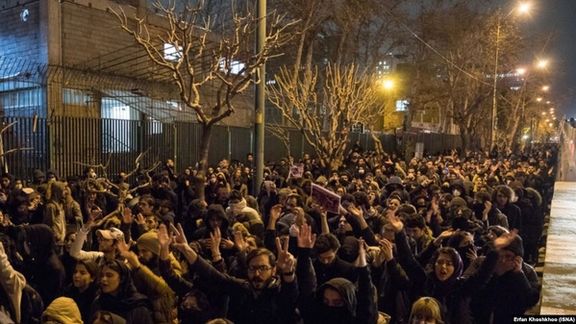
A prominent sociologist in Tehran has warned that Iran could face widespread protests if the government fails to improve the country’s worsening financial situation and curb rising prices.
Taghi Azad Armaki told Etemad, a pro-reform newspaper supporting President Masoud Pezeshkian, that without lifting US sanctions a wave of protests over socio-economic issues is likely.
He criticized the government for converting social and economic problems into security issues by criminalizing actions such as protests and opposition to social media censorship, rather than addressing the underlying problems.
Armaki emphasized that soaring prices, especially in housing and healthcare, along with the rapid depreciation of the Iranian currency and widespread poverty, are placing immense pressure on Iranians. He noted that while government officials occasionally acknowledge these issues, they have yet to propose any meaningful solutions.
The sociologist warned, “If this situation continues, protests are likely to erupt in the near future.” He criticized the government for downplaying serious issues in energy, housing, poverty, and social delinquency.
He urged the government to acknowledge its limitations and focus its resources on meeting the nation’s basic needs, such as ensuring the proper distribution of essentials like bread, water and energy.
Former Interior Minister Abdolreza Rahmani Fazli echoed these concerns, telling the press that “the extent of accumulated demands and dissent in Iran is a serious cause for concern.” He noted that the current situation is even more troubling than in 2019, when hundreds of thousands protested against rising fuel prices.
During that sudden wave of unrest in over 100 cities, the government swiftly responded with military and vigilante forces, resulting in the deaths of 1,500 protesters, according to a Reuters estimate.
Meanwhile, the IRGC-linked newspaper Javan criticized hardliners in the parliament (Majles), warning that “while protests more intense than those of 2019 loom on the horizon, opponents of President Pezeshkian and even some who backed him in the election are wasting time and energy trying to unseat him and his ministers.”
Javan warned that this could trigger a series of deep-rooted political crises in the upcoming Iranian year, which begins in about four weeks. The newspaper suggested that the situation could worsen if combined with “foreign operations,” likely referring to potential Israeli attacks on Iran’s nuclear sites.
In a similar vein, conservative commentator Mohammad Mohajeri criticized hardline lawmakers for pushing to impeach Economy Minister Abdolnaser Hemmati, accusing him of “failing to improve the country’s economic situation.”
Mohajeri criticized the hardline lawmakers, saying, “The MPs think that dismissing the minister will improve the economic situation, but their approach is like an ugly man trying to calm a crying baby by making faces—his appearance only made the baby cry even harder.” He added, “You are the problem. It’s your actions that have created these insurmountable challenges.”
Several reports in Iranian media on Monday highlighted the severity of Iran’s economic crisis and the financial struggles facing its citizens. The conservative Nameh News website noted, “The government's inefficiency is worsening the economic crisis, compounded by significant shortcomings in sectors such as energy, housing, and healthcare.”
Economic expert and a well-known businessman, Majid Reza Hariri, told Nameh News that when he questioned some MPs about their push to impeach the economy minister, they admitted, “The situation might get worse, but we need to show our voters that we are just as dissatisfied with the current state of affairs.”
Commenting on the Pezeshkian administration's weaknesses, Hariri remarked, “I believe we effectively have no government, as no one is willing to take responsibility for the economic problems.”
Iran's highest-ranking military officer has publicly advocated for privatization as the nation faces chronic energy shortages and rampant inflation.
“The model for the country's salvation is to turn to the people. If we want to solve the economy, the solution is to turn to the private sector and entrust work to the people," Major General Mohammad Bagheri said.
Iran's armed forces, the Islamic Revolution Guard Corps (IRGC) in particular, have benefited from previous waves of privatisation, taking over fully or in part the companies and businesses that the government puts up for sale.
Bagheri's call comes amid reports that the Iranian Armed Forces, including the IRGC, will receive a substantial 51% (approximately €12 billion) of the government's €24 billion oil and gas export revenues in the upcoming budget.
The budget bill for the next Iranian year (starting March 21) details that while 37.5% of oil and gas revenue goes to the government, over half of that portion funds the military.
Last year, a Reuters report indicated that the IRGC already controls up to half of Iran's oil exports, funding military operations and allies.
Recent Central Bank statistics also show a significant decline in private sector involvement in foreign trade, replaced by government entities that receive the majority of foreign currency.
Customs data further shows that government-controlled petrochemical, steel, oil, and gas products dominate exports.
The country’s new budget allows the Oil Ministry to contract with third parties for oil and gas field operations to settle debts, raising fears that these contracts will fall into the hands of the so-called "Khosoulati" entities—quasi-state organizations controlled by insiders of the ruling system, rather than genuine private sector businesses.
HamMihan newspaper warned last year that such a policy risks transferring national resources to entities lacking the necessary capacity and resources, further entrenching government-linked organizations in the economy.
Ultra-hardliner Saeed Jalili and his allies—widely regarded as President Masoud Pezeshkian’s chief rivals—are maneuvering to expand their political influence through upcoming city and village council elections, according to Iranian media.
While Jalili only briefly referenced the importance of these elections in a speech last week, his public appearances and speeches have notably increased in recent months. In these speeches, Jalili emphasized that the development budget allocated to the country’s top cities exceeds the national development budget, pointing to the significance of these local councils.
“It appears that Jalili’s statements should be considered a signal of the [active] participation of him and his supporters in the seventh city council elections,” an article published by Rozan Online read on Saturday.
The publication’s report also argued that these elections could intensify rivalries within the hardliner/ultra-hardliner camp, particularly in cities like Tehran, where Parliament Speaker Mohammad-Bagher Ghalibaf, a former mayor of the capital, and his supporters still wield some influence in the municipality.
Jalili and his supporters’ plans for the elections on June 19 will not only heighten competition among three factions—led by Jalili, incumbent Tehran Mayor Alireza Zakani, and Ghalibaf—but could also lead to new coalitions or deeper divisions within this political faction, Rozan’s piece noted.
Ghalibaf has been relatively supportive of Pezeshkian’s “national unity” government and is often accused by Jalili’s supporters on social media of betraying the “revolutionary cause.”
Jalili has no executive experience. He led Iran’s nuclear negotiations during the presidency of populist Mahmoud Ahmadinejad and currently represents Supreme Leader Ali Khamenei in the Supreme National Security Council (SNSC). Additionally, he serves on the Expediency Discernment Council (EDC), also by Khamenei’s appointment.
“The Jalili circle has become hyperactive in parliament and on social media in unison with him,” a piece by Khabar Online read – a media outlet linked to former conservative parliamentary speaker Ali Larijani.
The publication speculated on Saturday that securing control over city and village councils could be a stepping stone for Jalili’s presidential ambitions in the next election.
Khabar Online’s report also suggested that if Jalili’s supporters gain a majority in the Tehran City Council, he could position himself as the mayor of the capital, following Ahmadinejad’s footsteps, who later became president.
Jalili, who competed against Pezeshkian in the June 2024 runoff presidential election, does not formally lead any political party. However, he has strong backing from the ultra-hardliner Paydari Party and its allies, including the Iran Morning Front (Jebhe-ye Sobh-e Iran), a political party established only a year ago. Both parties officially endorsed and campaigned for Jalili in the recent presidential election.
Jalili and his supporters are staunchly opposed to any negotiations with the United States regarding Iran's nuclear program, missile capabilities, and regional influence. They also reject Iran's accession to Financial Action Task Force (FATF) conventions, which could help remove Iran from the global money-laundering watchdog’s blacklist.
The ultra-hardliner Paydari Party, a small but influential faction in parliament, has been behind several controversial legislative efforts, including the strict hijab law and the recent attempt to impeach Economy Minister Abdolnasser Hemmati. The Paydari Party and the Iran Morning Front also have a strong presence in key state institutions, including the state-run broadcasting organization (IRIB), where Jalili’s brother, Vahid Jalili, serves as a cultural deputy. In this role, he wields significant influence over IRIB’s policy direction.
The city and village council elections are the only elections in Iran that do not require candidate vetting by the ultra-hardliner Guardian Council, allowing for broader participation than in parliamentary and other elections.
In smaller towns and villages, competition in local government council elections is often driven by ethnic and tribal factors which may bring more voters to the ballot boxes.
However, in major cities like Tehran, where political concerns take precedence, voter turnout could be very low like in last year’s parliamentary elections.
Government offices, banks, and schools across most of Iran remained closed on Monday as a worsening energy crisis forced authorities to shut down public services in at least 22 of Iran's 31 provinces.
The closures, driven by severe gas shortages and electricity cuts, have left Iranians accustomed to working weeks of just two or three days.
With snow, rain, and plunging temperatures further straining the country’s already fragile energy infrastructure, provincial officials announced the shutdowns late Sunday, impacting regions including Tehran, Mazandaran, Gilan, Golestan, Isfahan, Markazi, Kerman, Hamedan, etc.
In Tehran, schools, courts, and government offices suspended operations entirely, with authorities mandating that all heating systems be turned off to conserve fuel.
“This isn’t about bad weather,” said Nima, a wholesaler of car spare parts in the capital. “The government announces these closures to cover up its energy failures. They know if they don’t shut things down, people will protest over the lack of heating and electricity,” he told Iran International.
A large number of Iranians said on social media that in some provinces, schools were declared closed without arrangements for online classes. However, many said that virtual education is unreliable anyway, as power outages also disrupt internet access.
The country’s aging telecommunications infrastructure lacks backup battery systems, further limiting connectivity.
The frequent shutdowns have hit businesses hard, particularly as Iran nears Nowruz, the Persian New Year, when many retailers rely on a seasonal surge in consumer spending. Hamid, 38, who runs a clothing boutique in Tehran’s Gisha neighborhood, said sales have plummeted.
“We wait 11 months for this last stretch before Nowruz to make a profit, but every week, we lose two or three working days,” he told Iran International. “This morning, I sold just two pairs of pants and a shirt, which were already discounted. Meanwhile, my bounced checks are piling up.”
Iran’s work week has long been out of sync with the global economy, with weekends falling on Thursday and Friday instead of Saturday and Sunday. Nima said the latest wave of shutdowns has made the situation even worse.
“Iranian businesses already struggle because we only overlap with the international market for three days a week,” he said. “Now, with these extra closures, we’re essentially shut down half the month. How can there be an economy in a country that’s closed for business?”
Compounding the crisis, the Iranian rial continues to weaken against the US dollar amid economic pressures from US sanctions. The falling currency has further eroded purchasing power, leaving many consumers unable to afford even discounted goods.
Public sector closures have become a frequent occurrence in Iran, with schools and offices repeatedly shut in recent months due to pollution, dust storms, cold weather, and fuel shortages.
While officials cite weather conditions for the latest round of shutdowns, weather tracking services have not predicted subzero temperatures or heavy snowfall for many of the affected provinces.
For business owners like Hamid and Nima, the pattern is clear. “It’s not about the cold,” Nima said. “It’s about the country running on empty.”
An Iranian economist has warned that hyperinflation could take hold unless effective negotiations with the United States lead to the lifting of sanctions.
“Without easing sanctions through productive negotiations, reducing inflation seems unlikely,” Ghodratollah Emamverdi told Etemad newspaper on Monday. He cautioned that if monthly inflation reaches 50%, Iran could face hyperinflation. Currently, monthly inflation is at four percent, while annual inflation is estimated to be over 40%.
On Sunday, the only government agency reporting inflation figures announced an annual rate of 35%. However, labor groups and analysts contend that the government downplays negative economic news, suggesting the real inflation rate is much higher.
Emamverdi noted that although Iran’s inflation rate has not yet reached the critical 50% threshold, continued sanctions and internal political tensions could push the economy into hyperinflation.
Majid-Reza Hariri, former head of Iran’s chamber of commerce, criticized the presidential administration’s inability to address the current crisis, saying the government is effectively paralyzed.
“We either have a government or we don’t, and I personally believe we are facing a state of no government. If the government cannot solve economic problems, no one is forced to be president or minister,” Hariri said. He added that everyone in the current administration was aware of the situation by mid-2024 but still chose to run for office or accept ministerial positions.
President Masoud Pezeshkian has argued that Iran’s complex and deep-seated economic problems are too vast for his administration to resolve, implicitly pointing to the impact of sanctions. Following Supreme Leader Ali Khamenei’s ban on negotiations with the United States in early February, Pezeshkian expressed his support for the decision, aligning himself with Iran’s ultimate political authority. As the new Iranian year approaches on March 20, the government faces the challenge of setting pay raises for millions of workers, including those in government and quasi-public enterprises. Workers are demanding wage increases of up to 70% to keep pace with soaring inflation.
The Iranian rial has lost more than 50% of its value in the past six months, driving expectations of even higher inflation. Currently, the minimum wage stands at about $120 per month, while semi-official estimates indicate that at least $400 per month is needed to support a family of three.
The government is considering a wage increase of less than 50%, which would still leave workers struggling to afford basic necessities. However, even a smaller pay hike could further fuel inflation.
Iran is on the cusp of a possible revolution, exiled crown prince Reza Pahlavi said in an interview with The Telegraph published Sunday, calling on Western countries to brace for the historic change.
“Iran is in a revolutionary, or at the very least, a pre-revolutionary fervor," the son of Iran's last monarch said.
"It’s escalating every day. All the chants you hear on the streets, all the protests, all the demonstrations that specifically call for an end to this regime, death to the dictator, death to the Islamic Republic.”
"There is a critical window of opportunity to change history. It may only be open for a few months,” he added, calling on Western governments to support the momentum seen in Iran as the government faces its lowest legitimacy since the founding of the Islamic Republic in 1979.
Pahlavi rejected military intervention, arguing that Western powers should instead apply pressure on the Iranian government and the people's movement.
“What we’ve been saying to the Americans, the Europeans, is let’s not jump directly from failed diplomacy to contemplating conflict and war,” he said. “There’s a third option and [it is] the best option – the Iranian people.”
Pahlavi also emphasized the importance of defections from within the Iranian state, including military and security personnel, to ensure a transition with minimal bloodshed.
“We don’t want to encourage a scenario that leads to anarchy, rather a controlled implosion,” he said. “But it cannot happen unless you have the tacit collaboration of military and paramilitary forces.”
He said justice will be brought to the people involved in Iran's mass crackdowns which have seen record numbers of executions since 2022 and hundreds killed in protests sparked by the death in custody of Mahsa Amin.
“Those who have their hands soiled with the blood of the people will have to face justice one day. But I’m not talking about kangaroo trials,” he said.
Pahlavi also said he supports US President Donald Trump’s “maximum pressure” policy on Iran but believes it should be paired with “maximum support” for opposition movements.
“Is there a historic opportunity for change to happen? We believe yes,” he said. “But I think that the failure of Western policymakers to catch up to where Iran is now could impede our success in finding a resolution to the ultimate problem.”