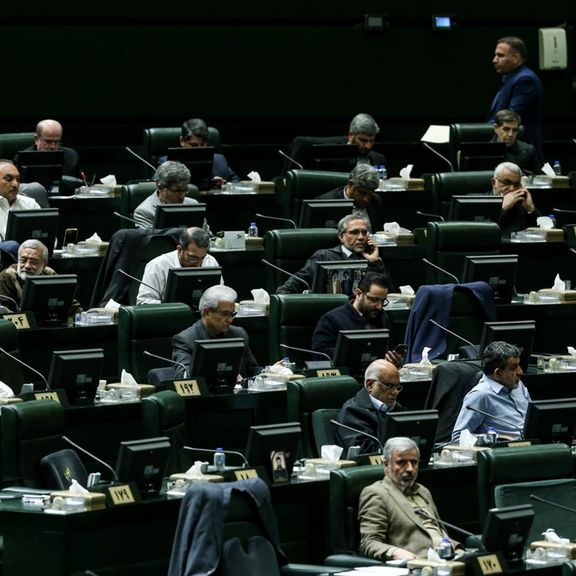
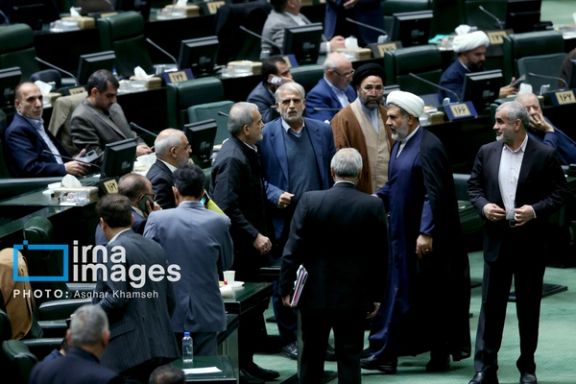
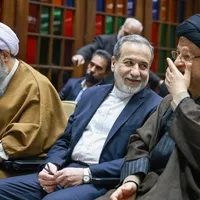
A session of the Iranian parliament on February 18, 2024
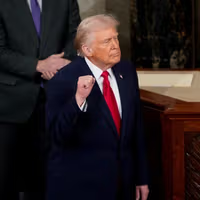
The dramatic fall in the value of the Iranian currency over the past few months, particularly since President Donald Trump took office in the United States, is likely to claim victims from among the president's cabinet members.
As economic pressure mounts, Iran’s parliament moves toward impeachments | Iran International
The rial has depreciated by approximately 50% against the US dollar since September, a sharp decline that is expected to further drive up Iran’s already high inflation by increasing the cost of both domestic production and imports.
Iran’s hardliner-dominated parliament (Majles) appears determined to impeach Economy Minister Abdolnasser Hemmati and push Pezeshkian to dismiss Central Bank Governor Alireza Farzin. Energy Minister Aliabadi is also on the impeachment list, facing scrutiny over his ministry’s failure to secure adequate fuel for power plants during the winter months.
Amid Supreme Leader Ali Khamenei’s repeated calls for unity within the government and his criticism of discord between the president and parliament, lawmakers held a closed-door meeting on Tuesday to brief Pezeshkian on the rial’s depreciation—despite the president already being well aware of the deeper causes of Iran’s chronic economic crisis.
“The Majles has vowed to hasten Hemmati’s impeachment if he and Pezeshkian fail to convince parliament that they are taking effective action to address the crisis and improve people’s livelihoods,” Iranian media quoted parliamentary officials as saying on Monday.
A session of the Iranian parliament on February 18, 2024
Media outlets in Tehran, including Khabar Online, reported that while the primary reasons for the motions against Aliabadi and Farzin are power shortages and rising exchange rates, respectively, some in parliament may also be pushing for their removal due to their ties to former President Ebrahim Raisi’s administration.
Pezeshkian has faced repeated criticism from the media for reinstating officials from the previous government. Given this, it is easy to conclude that he might not oppose their dismissal, as it could help project the appearance of the much-sought "change" in his administration.
However, Hemmati presents a different challenge. His outspoken approach, as demonstrated in the past, has the potential to create problems for both parliament and the president. During Raisi’s three-year tenure, he frequently criticized the government's economic performance, making him a persistent and vocal opponent.
Analysts and commentators in Iran have long argued that chronic inflation and declining economic indicators stem from US sanctions imposed since 2018 and the state-controlled nature of the economy. While officials occasionally attribute economic hardships to sanctions, they more often emphasize Iran’s ability to circumvent them through innovative measures. Less frequently discussed, however, is the country’s unique and intertwined political-economic system, which fosters monopolies and enables corruption among insiders.
Regarding Aliabadi’s case, Pezeshkian has acknowledged that he himself bears responsibility for the fuel and power shortages, admitting to mistakes in assessing the issue.
Hemmati, meanwhile, has partly attributed the rial’s decline to "regional developments." However, according to Khabar Online, most Iranian media outlets place the blame on Pezeshkian and his appointment of ultraconservatives to key positions as the main drivers of the country’s financial and energy crises.
The Rouydad24 website has noted that Trump's return to power has intensified Iran’s economic crisis. It reported that his renewed threats of "maximum pressure" on Tehran have contributed to rising exchange rates and soaring gold prices in the Iranian market.
Fathollah Tavassoli, a member of the Majles economic committee, insisted that "those pushing for Hemmati’s impeachment are independent MPs" and that the move is not driven by political or factional motives. However, another lawmaker, Mohammad Mehdi Shahryari, countered that "hardliners are pressuring independent MPs to support the impeachment motion."
So far, 89 lawmakers out of 290 have signed the motion—far exceeding the 10 signatures required for the Majles presidium to proceed with impeachment.
The Paydari Party, positioned at the far right of the Islamic Republic's political spectrum, remains relatively small but has significantly expanded its influence in Parliament and key state institutions in recent years.
Who leads the Paydari Party?
Since its official registration with the Interior Ministry in October 2020, the Paydari Party has been led by Sadegh Mahsouli.
Yet, Mahsouli—a former Islamic Revolutionary Guard Corps (IRGC) officer and business tycoon—rarely makes public statements or represents the party in the media. He previously served in Mahmoud Ahmadinejad’s administration, first as Minister of Interior and later as Minister of Welfare and Social Security.
The party’s Central Council Chairman, Morteza Agha-Tehrani, is a mid-ranking cleric (Hojjat ol-Eslam) who has been a lawmaker multiple times since 2008. A former close associate of Ahmadinejad, Agha-Tehrani was once appointed as the president’s “ethics advisor.” Currently, he chairs the Parliament’s Cultural Committee and has played a key role in pushing controversial hardline bills, including the Hijab and Chastity Law.
What are the party’s origins?
The Paydari Party traces its roots to the Islamic Revolution’s Paydari Front, an electoral alliance formed ahead of the 2012 parliamentary elections. It emerged as a hardline faction that split from Ahmadinejad’s camp after his power struggle with Supreme Leader Ali Khamenei over the dismissal of intelligence minister Heydar Moslehi.
After Ahmadinejad refused to acknowledge Khamenei’s reinstatement of Moslehi, his once-loyal allies who later formed the Paydari Party turned against him, branding him and his inner circle as “the deviant current.”
What does the Paydari Party stand for?
The Paydari Party and its affiliates promote a radical, apocalyptic interpretation of Shiism, centering on the belief in the Mahdi, the Twelfth Imam. According to their doctrine, this messianic figure—believed to have been in occultation since 941 CE—will eventually reappear to rid the world of sin and corruption.
Mesbah-Yazdi, often considered the spiritual father of the Islamic Republic's ultraconservatives, was held in very high esteem by Supreme Leader Ali Khamenei.
Politically, the party is staunchly opposed to:
Any nuclear agreement with world powers
Diplomatic engagement with the United States and other Western countries
Iran’s accession to Financial Action Task Force (FATF) anti-money laundering conventions
Lifting of internet restrictions and censorship
Leniency in the enforcement of hijab rules
Despite its hardline ideology, the Paydari Party has successfully expanded its grip on Iranian politics, shaping policies that increasingly isolate Iran on the international stage while tightening domestic repression.
How powerful is the Paydari Party?
In the current Parliament (inaugurated May 27, 2024), the Paydari Party and its allies—including the Iran Morning Front (Jebhe-ye Sobh-e Iran), led by ultra-hardliner Ali-Akbar Raefipour—form one of the three dominant factions.
The party frequently clashes with other conservatives aligned with Parliament Speaker Mohammad-Bagher Ghalibaf, as well as the much smaller faction of “independent” and “reformist” lawmakers who were permitted to run for office by the Guardian Council.
The March 2024 parliamentary elections, along with the May runoffs, saw historically low voter turnout amid widespread public and political boycotts following the 2022–2023 Women, Life, Freedom protests. The Guardian Council faced accusations of mass disqualifications—including some conservatives—allegedly to pave the way for Paydari-backed candidates.
In Tehran, for example, Mahmoud Nabavian, a Paydari candidate, secured the first place with less than six percent of eligible votes.
The party also backed former nuclear negotiator Saeed Jalili in the June 2024 snap presidential elections, another vote marked by boycotts and low turnout. Jalili ultimately lost to Masoud Pezeshkian, winning 44.3 percent of the vote in the runoff.
The party currently wields great influence in many state organizations including the state broadcasting organization, the IRIB. Vahid Jalili, Saeed Jalili’s brother, is the cultural deputy of IRIB.
Tehran has reacted with suspicion to a report suggesting regional rival Saudi Arabia may mediate between Iran and US President Donald Trump, in the latest twist to a drama over whether Iran would accept Trump's overtures for a nuclear deal.
CNN reported on Sunday that Riyadh is open to brokering discussions between the US and Iran to curb Tehran’s nuclear program.
The kingdom is concerned, the US network reported, that Iran might pursue nuclear weapons more aggressively after Israel battered regional allies which had acted as Iran's deterrent to a direct Israeli attack for decades.
Asked about the CNN report at his weekly press briefing Monday, Iran's foreign ministry spokesman Esmaeil Baghaei denied any knowledge and said these were only “media speculations.”
An article titled "Will Saudi Arabia Mediate Iran-US Negotiations?" published by Nour News on Monday outlined key obstacles to Saudi mediation. It highlighted Iran's deep mistrust of the US, shaped by the policies of former President Donald Trump, who withdrew from the 2015 nuclear deal. The article also pointed to conflicting Iranian and Saudi interests in regional matters, including Lebanon, Iraq, and Syria, as additional challenges to mediation efforts.
Iranian authorities are “seeking strong guarantees of reduction of sanctions before entering new talks,” the media outlet close to former Iranian national security chief Ali Shamkhani, wrote.
Despite these challenges, Nour News acknowledged the potential for reduced tensions and even a new agreement if Saudi Arabia facilitates balanced, pressure-free negotiations.
Foreign affairs expert Ali Bigdeli, speaking to Nameh News on Sunday, noted that Saudi Arabia’s diplomatic influence had grown, citing an upcoming US-Russia meeting in Riyadh as evidence. He suggested Iran might view Saudi mediation positively. “Mr. Araghchi’s visit to Oman may not be unrelated to this matter,” he added.
Bigdeli also argued that Saudi mediation would differ significantly from that of Qatar, given Saudi Arabia’s dominant role in the Persian Gulf.
Iran's Supreme Leader Ali Khamenei repeatedly asserted in the past that the Islamic Republic would never engage in negotiations with the Trump administration. He also notably declined to respond to a message from Trump, delivered by former Japanese Prime Minister Shinzo Abe in June 2019.
In a speech on February 7, after Trump issued an executive order to reinstate his “maximum pressure” sanctions on Iran, Khamenei emphatically rejected talks with the United States.
Meanwhile, US Secretary of State Marco Rubio arrived in Riyadh on Monday ahead of planned talks between Trump and Russian President Vladimir Putin, to be hosted by Saudi Crown Prince Mohammed bin Salman. While Iran’s nuclear program may be discussed, no official announcements have been made.
On Sunday, US National Security Advisor Mike Waltz said President Donald Trump is willing to engage in talks with Iran only on condition that Tehran fully abandon its nuclear program.
"The President has also expressed a willingness to take whatever action is necessary. All options are on the table," Waltz told Fox News on Sunday, leaving the option of diplomatic channels open.
Oman acted as a mediator between Iran and the United States before the talks that led to the 2015 nuclear deal, and Qatar has recently offered to mediate new talks.
Speculation has risen that this topic may feature in the upcoming visit of Qatari Emir Tamim bin Hamad Al Thani to Tehran. However, Iranian Foreign Ministry spokesman Esmaeil Baghaei denied these claims during his weekly briefing on Monday.
Iran and Saudi Arabia restored diplomatic ties in 2023, facilitated by Iraq and China. The Saudi Embassy in Tehran reopened in August of that year, seven years after vigilantes attacked and torched the building in protest to the execution of dissident Shia cleric Nimr Baqir al-Nimr in Saudi Arabia.
The Iranian government has licensed 205 matchmaking websites in a bid to boost declining marriage rates among young Iranians, according to ILNA news agency.
"The government will be accountable for any problems these centers may cause," said Alireza Rahimi, Deputy Minister of Sports and Youth Affairs. He added that an expert group has been formed to evaluate the effectiveness of these websites in increasing marriage rates.
While Rahimi acknowledged what he called “some abuses" at these centers, he did not elaborate on the details of possible problems and oversight mechanisms. He added that the police are responsible for dealing with unlicensed matchmaking services.
The move comes as Iran faces a declining marriage rate and rising divorce rate. Government efforts to encourage higher birth rates have failed to produce results, according to data from the National Organization for Civil Registration.
According to the latest data from Iran's Civil Registration Organization, nearly 39% of marriages in the first seven months of the Iranian year 1403 (March to September 2024) ended in divorce. Data from the Statistical Center of Iran also reveals a 46% decrease in marriages between 2010 and 2023.
Economic hardship, rising awareness of individual and family rights, and access to legal and counseling services are among the factors contributing to young people's reluctance to marry.
In January, Iran's Science Ministry announced it is removing educational content discouraging childbearing and offering new incentives to boost declining fertility rates. These include more married student dorms, on-campus kindergartens, and increased financial aid for housing, loans, and other benefits for married students with children.
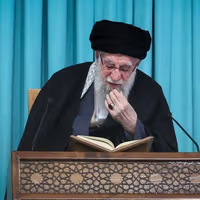
Supreme Leader Ali Khamenei said on Monday that Iran could fend off an attack by its enemies, days after US newspapers reported Israel was considering strikes this year on Iran’s nuclear sites.
“Today, in terms of strong defense and confronting hard threats from the enemy, we have no worries or problems. Our capability to counter hard threats is at an excellent level, and for that reason, the people feel secure,” he said.
The Wall Street Journal and The Washington Post reported last week citing US intelligence assessments from last month that Israel saw an opening for an attack on Iranian nuclear sites as early as the first of this year.
Israel is basing its assessment, the papers reported, on Iran's weakness after an Oct. 26 Israeli attack knocked out much of its air defenses and a greater perceived receptiveness to military action from US President Donald Trump.
Khamenei did not directly address the idea of an Israeli attack or potential talks between Iran and the US following the restoration of President Donald Trump's "maximum pressure" campaign.
Earlier this month, while announcing a hasher sanctions policy on Tehran, Trump also signaled a willingness to negotiate a deal with Iran—a proposal that Khamenei has publicly rejected.
His speech in the city of Tabriz, delivered during the month-long commemoration of the Islamic Republic’s 46th anniversary, was claimed by state-run broadcasters to have drawn thousands, although this figure could not be independently verified.
“The Islamic Revolution has managed to preserve itself as an independent identity and as a vast, hopeful base for the peoples of the region and even beyond. The reason for the anger of arrogant and colonialist forces around the world towards the Islamic Republic is the steadfastness and resistance of the Iranian nation in confronting them,” Khamenei told the gathering.
Relative moderate President Masoud Pezeshkian, who was also in attendance, recently backed Khamenei’s opposition to dialogue with the US. Iran’s Supreme Leader is the ultimate decision-maker on foreign and domestic policy.
Since Trump’s announcement, Iranian hardliners have steadfastly resisted any talks, while a few voices have pushed for easing the stance to relieve economic pressure by lifting sanctions.
Over the past year, Israel’s repeated military operations targeting Iranian-backed militant proxies in Gaza, Lebanon, and Syria have significantly eroded Tehran’s regional influence. With the fall of Assad’s government—once a critical ally—these external pressures have left Iran in what analysts describe as its most fragile state.
Talks with Washington now appear distant as US-led sanctions deepen hardship and discontent for Iranians grappling with a worsening economy.
Days after the 46th anniversary of the 1979 Islamic Revolution, media in Tehran are sounding the alarm over deep flaws in the governing system and a worsening economic crisis, warning that the Islamic Republic's survival is increasingly at risk.
A leading article in the Jomhouri Eslami newspaper, a conservative outlet owned by Supreme Leader Khamenei's office, noted last week that 46 years after its establishment, the Islamic Republic has yet to restore justice in Iranian society. "The people are still suffering from injustice and discrimination," the daily wrote.
The article also criticized the governing system for undermining the independence and freedom it has long promoted. Highlighting "the divide between the people and the ruling clerics," the newspaper stressed that "the people should be the driving force and focal point in the Islamic Republic" and posed a pointed question: "What is the people's role and status in the government?"
Although Iran holds regular elections, political parties and the media face severe restrictions, and only approved candidates are allowed to run.
Jomhouri Eslami also criticized the stark contrast between officials leading lavish lifestyles—driving luxury cars under tight security to pay respects at the mausoleum of the Islamic Republic's founder—and ordinary people who struggle to reach them to voice their concerns.
The daily criticized the disparity between officials and the public, noting that officials earn several times more than ordinary citizens and enjoy government-funded travel and luxury while advocating austerity. The daily warned that such a lifestyle and governance approach could undermine the political system's stability.
Meanwhile, the pro-reform website Fararu warned, "A catastrophe is on its way as half of the population in Iran is getting poorer on a day-to-day basis."
It cautioned that the situation is becoming increasingly dire, particularly for low-income groups, due to rising inflation, soaring exchange rates, price fluctuations, and ongoing economic crises. The website argued that many Iranians are struggling to make ends meet amid the financial turmoil.
"At the same time, all initiatives aimed at improving the situation have failed and remained futile. This has caused a general dissatisfaction among the public and has led to serious questions about the government's ability to tackle the current crisis," the website wrote.
Fararu cited market expert Hamid Haj Esmaili, who attributed the worsening economic situation over the past two decades not only to sanctions but also to government inefficiency in resource distribution, which has exacerbated the crisis.
Haj Esmaili noted that nearly half of Iran's population relies on government support to survive, while the government must take stronger action against corruption. He emphasized that these challenges are all linked, in some way, to the impact of sanctions and urged authorities to engage with other countries to address the crisis.
Meanwhile, the pro-reform daily Setareh Sobh published a commentary last week by former lawmaker Yadollah Eslami, who highlighted "the wide gap between the people and the government." He argued that "the officials' indifference to people's increasing problems has made many people distance themselves from the government."
Eslami also criticized officials "for the arrogance in their rhetoric when they address the nation," describing their tone as "a mixture of insult and violence." He warned that "unfortunately, some Iranian officials believe that insults and violence are a virtue for them; and in this situation, what is being sacrificed is truth, justice, and freedom."