Iran's top judge threatens to prosecute reformists over call for US talks
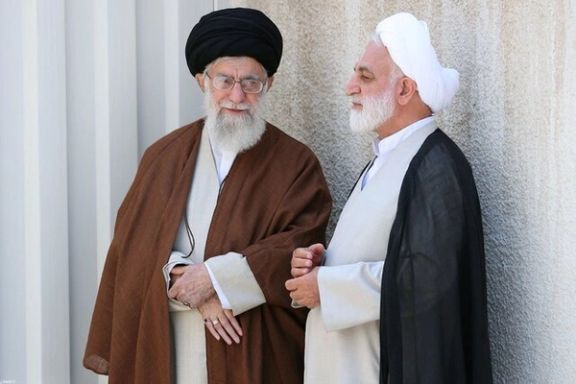
Iran's Supreme Leader Ali Khamenei and judiciary chief Gholamhosein Mohseni Ejei.
Iran’s judiciary chief on Monday warned of legal action against Tehran moderates advocating direct talks with the United States over its nuclear program, a day after Supreme Leader Ali Khamenei accused them of sowing discord in the country.
“Those who, out of negligence or with certain motives, issued a statement should admit their mistake and retract this disgraceful act,” Judiciary Chief Gholamhosein Mohseni Ejei said Monday, reacting to a call by Iran's Reform Front for direct US talks and full IAEA monitoring.
"Tehran's prosecutor will act according to his legal duty in this matter," Ejei added, speaking in a meeting of the Supreme Council of the Judiciary.
Ejei's warning comes after Iran’s Reform Front, on August 17, called for major political and nuclear policy shifts, including a voluntary suspension of uranium enrichment.
The coalition of 27 reformist organizations, in a statement, said “Iran’s social fabric was deeply wounded, with public life overshadowed by despair and anxiety.”
The statement urged the government to declare readiness for suspending enrichment and to accept full International Atomic Energy Agency (IAEA) monitoring in exchange for the lifting of sanctions.
Such a step, it said, could open the way for “comprehensive, direct negotiations with the United States and normalization of relations.”
“Those who say, ‘Don’t chant slogans against America, they’ll get upset and become hostile toward you,’ are superficial. Those who argue, ‘Why don’t you negotiate directly with the United States and solve your problems?’ are, in my view, also superficial. That’s not the reality of the matter; this issue cannot be resolved," Khamenei said.
Iran's Supreme Leader said the enemies of the Islamic Republic seek to create division inside the country and to sow discord from within in order to bring about a regime change.
"They have agents inside: agents of Zionism and of America, present here and there in the country. Through them — or through those who are heedless of what they say and write — they try to create divisions among the people and generate discordant voices in the nation," he said in an apparent reference to the moderate critics of his policies.
Iranian officials with sensitive information on their phones were easy targets for Israeli cyber operations during June's 12-day war, Iran’s former communications minister said, adding that Israel exploited platforms such as WhatsApp to track them.
“In the recent war, those who had information and were of interest to Israel were easy prey for hacking,” former minister Mohammad Javad Azari Jahromi said. He did not identify those targeted.
"WhatsApp has low resistance to cyberattacks and low security, and Israel has used this tool," he added.
He said that using WhatsApp for exchanging confidential information was not permitted for officials and military personnel.
His remarks come as Iranian authorities face scrutiny over security lapses following the assassination of senior commanders in June during the war with Israel.
Mahdieh Shadmani, daughter of slain commander Ali Shadmani, has publicly disputed official claims that mobile applications exposed locations that led to Israeli strikes, saying her father carried no smart devices.
“My father’s location changed every few hours. He carried no smart devices or phones. Security protocols were followed, yet during his time commanding the war headquarters, he was repeatedly targeted for assassination by Israel,” she said on July 4.
Jahromi's comments come two months after Israel launched a surprise military campaign on June 13 targeting military and nuclear sites, killing hundreds of military personnel, nuclear scientists and civilians.
The Islamic Republic says 1,062 people were also killed by Israel during the conflict, including 786 military personnel and 276 civilians.
Tehran responded with missile strikes that killed 31 civilians and one off-duty soldier, according to official figures published by the Israeli government.
On June 22, the US carried out airstrikes on Iran’s key nuclear sites at Fordow, Natanz, and Isfahan. A US brokered ceasefire came into effect on June 24, which ended the 12-day air war.
Iran’s former deputy parliament speaker on Monday dismissed his past remarks about pursuing a nuclear bomb as a personal opinion, after U.S. President Donald Trump shared a video of the comments and state media criticized him as “inconsiderate.”
On Sunday, Trump shared a video on his Truth Social platform showing Ali Motahari saying in a 2022 interview that Tehran’s initial goal in pursuing nuclear activities was to build a bomb.
“When we first entered nuclear activities, our real goal was to build a bomb. No point denying it… the whole system, everyone who started this. We had started and we wanted to go all the way. If we could keep it secret and test the bomb, it would be over,” Motahari said in the widely shared video interview in April 2022.
On Monday, Motahari responded to Trump’s post, saying he had held no official role in parliament or Iran’s nuclear decision-making team at the time.
“Trump has posted my interview as if it reflects the official decision of the Islamic Republic to build a nuclear bomb. It shows how empty-handed he is when he relies on the personal opinion of an ordinary individual, not an official report,” Motahari said.
Iran’s foreign ministry spokesperson Esmaeil Baghaei also weighed in, accusing Trump of ignoring US intelligence assessments that Iran is not building a nuclear weapon and instead relying on “the personal analysis of an Iranian citizen from 2022.”
In March, US director of national intelligence Tulsi Gabbard told a congressional hearing that Iran was not building nuclear weapons but discourse in Tehran urging the acquisition of a bomb was emboldening advocates for such a move in decision-making circles.
Iran has long denied seeking nuclear weapons, citing a religious edict by Supreme Leader Ali Khamenei banning their use, and says its nuclear activities are entirely peaceful.
Motahari's resurfaced comments, however, sparked backlash inside Iran, with IRGC-affiliated Tasnim news agency publishing a commentary that accused the former Iranian official of handing ammunition to Israel and the West.
Tasnim said Motahari's 2022 remarks, that Iran would have built a bomb if secrecy could have been maintained, “sound more like news than analysis” and could be as destructive “as the missiles of the Zionist regime.”
The outlet also stressed that political figures in senior institutions carry greater weight than ordinary analysts and must be more considerate, warning their words can reverberate domestically and regionally.
Tasnim also criticized Mohammad Sadr, a Khamenei-appointed member of Iran’s Expediency Council, who said on Sunday the assassination of Iran's President Ebrahim Raisi was the work of Israel.
Raisi was killed along with Foreign Minister Hossein Amirabdollahian and other officials in May 2024 when their helicopter went down in mountainous terrain near the border with Azerbaijan. Iranian authorities have consistently said poor weather caused the crash and denied any suggestion of foul play.
Iran’s President Masoud Pezeshkian had a phone conversation with Vladimir Putin on Monday ahead of critical nuclear talks with European powers in Geneva, as the end-August deadline for the reimposition of UN sanctions looms.
In the phone call, Putin expressed optimism that talks on the "snapback" mechanism would reach a “desirable result," according to Iran's readout of the call.
Pezeshkian's conversation with Putin took place on the eve of a meeting between the deputy foreign ministers and political directors of Iran, France, Britain, and Germany Geneva.
Iran’s foreign ministry spokesman said the Geneva talks would focus on the UN Security Council Resolution 2231, Iran’s nuclear program, and the removal of sanctions, as Europe’s deadline for restoring UN sanctions on Iran under the Resolution's "snapback" mechanism nears.
A French diplomat told Al Arabiya that the Tuesday talks with Tehran in Geneva represent “Iran’s last open window.”
In his phone call with Putin, Pezeshkian thanked Moscow for supporting Tehran’s “right to enrichment,” reiterating that Iran has never sought nuclear weapons under its religious and defensive doctrine.
Russian Foreign Minister Sergey Lavrov earlier held a separate phone call with his Iranian counterpart Abbas Araghchi, according to the Russian foreign ministry.
Lavrov expressed Moscow’s readiness to participate in efforts to secure an agreement on Tehran’s nuclear program and help normalize the situation.
Moscow stressed its willingness to continue “effective participation in diplomatic efforts” to strengthen stability and security in the Middle East.
Araghchi, in turn, briefed Lavrov on his Friday talks with counterparts from EU, Britain, Germany, and France regarding the nuclear file.
On Friday, EU foreign policy chief urged Iran to engage with the United States and cooperate with the IAEA to avert the return of UN sanctions, following what she called an important phone call with the foreign ministers of Iran, UK, France and Germany.
"Europe is committed to a diplomatic solution to the nuclear issue. With the deadline for the snapback mechanism fast approaching, Iran’s readiness to engage with the US is crucial. Iran must also fully cooperate with the IAEA."
Before the 12-day war, Tehran and Washington held five rounds of nuclear talks, but negotiations collapsed when Islamic Republic officials insisted uranium enrichment must continue inside Iran.
Supreme Leader Ali Khamenei on Sunday rejected calls by Tehran moderates for direct negotiations with the United States, insisting that Washington’s hostility cannot be resolved through talks.
A second round of conflict with Iran is imminent, a former Israeli intelligence officer said on Sunday, two months after a US-brokered ceasefire ended a 12-day war between the two archenemies.
“There is a sense that a war is coming, that Iranian revenge is in the works. The Iranians will not be able to live with this humiliation for long,” Jacques Neriah told 103FM.
Israel launched a surprise military campaign on June 13 targeting Iran's military and nuclear sites, killing 1,062 people including 276 civilians.
Iran responded with missile strikes that killed 31 civilians and one off-duty soldier, according to official figures published by the Israeli government.
Jacques Neriah said that operatives from Lebanon’s Iran-backed Hezbollah had been instructed to distance themselves from their phones in what he believes might be a sign of a looming conflict.
In 2024, thousands of pagers and walkie-talkies distributed to Hezbollah operatives were discovered to have been booby-trapped with explosives by Israel, resulting in a deadly, large-scale attack that disrupted Hezbollah’s operational capability and revealed critical vulnerabilities in their communication network.
Iran seeks to rebuild ‘Ring of Fire’
The Jerusalem Center for Security and Foreign Affairs wrote in an analysis that Iran is working to bolster ties with its “Ring of Fire” proxy forces following what it described as a humiliating defeat by Israel’s military.
The Israeli military launched the operation against Iran months after weakening Iran's regional proxies including Hamas, Hezbollah and the Houthis.
The regime change in Syria also ended the rule of Iran's staunch ally Bashar al-Assad, dealing a heavier blow to Iran's influence in Arab countries.
The Islamic Republic is now dissatisfied with the Syrian government and wants to see it overthrown, Neriah said.
“Syria under the rule of Ahmed al-Sharaa has managed to break the chokehold that Iran tried to place around Israel. The fall of Bashar al-Assad led to the collapse of Hezbollah as a regional force. Iran views the al-Sharaa regime as something that needs to be toppled.”
A new round of nuclear talks between the Islamic Republic and three European states will take place Tuesday, in Geneva, with Deputy FM Majid Takht-Ravanchi heading the Iranian delegation, Iran’s Tasnim News reported Monday.
Deputy foreign ministers from Germany, France and the UK will also attend, the Revolutionary Guards-affiliated outlet said citing an informed source.
“The agenda of these negotiations is nuclear issues and the lifting of sanctions,” the source said.
Foreign Minister Abbas Araghchi on Friday spoke with his counterparts in the three European capitals and the European Union’s foreign policy chief over the phone, where the snapback mechanism was discussed. The calls led to agreement to continue talks on Iran’s nuclear program.
Snapback debate intensifies
In recent days speculation has mounted over the future of Tehran’s nuclear activities, with the European trio weighing activation of the snapback provision and the Islamic Republic signaling possible responses.
The looming expiry of UN Security Council Resolution 2231’s legal framework has spurred Iranian officials and allies to step up legal consultations aimed at blocking the mechanism.
Britain, France and Germany — the so-called E3 — have warned Iran that unless it returns to nuclear talks by the end of August, they will trigger the mechanism that could reimpose all UN sanctions lifted under the 2015 nuclear deal.
Ali Larijani, secretary of the Supreme National Security Council, also warned that Germany, France and the UK may move to trigger snapback mechanism, but said “important countries” remain divided on how to proceed.
He raised the possibility of Iran’s withdrawal from the Nuclear Non-Proliferation Treaty, saying, “This assumption has always existed. The reality is that the NPT has had no benefit for us.”
Before the 12-day war, Tehran and Washington held five rounds of nuclear talks, but negotiations collapsed when Islamic Republic officials insisted uranium enrichment must continue inside Iran.
Supreme Leader Ali Khamenei on Sunday rejected calls by Tehran moderates for direct negotiations with the United States, insisting that Washington’s hostility cannot be resolved through talks.