European states due to pursue Iran sanctions on Thursday - Reuters
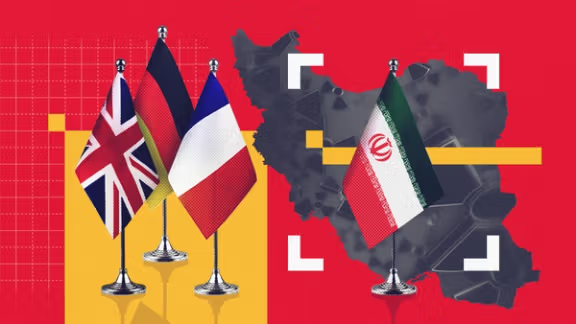
Britain, France and Germany are likely to begin a process to trigger the so-called snapback of international sanctions on Iran over its nuclear program after talks with Tehran yielded little progress, Reuters reported citing sources.
The trio dubbed the E3 is due to initiate the sanctions as early as Thursday, four diplomats cited by Reuters said, but hopes Iran will make diplomatic concessions within the next 30 days.
The snapback mechanism, part of UN Security Council Resolution 2231 — which endorsed the 2015 nuclear deal called the Joint Comprehensive Plan of Action (JCPOA) — allows any party to the accord to file a complaint accusing Iran of non-compliance.
If no resolution is reached within 30 days, all previous UN sanctions would automatically resume and would include arms embargoes, cargo inspections and missile restrictions.
A round of nuclear talks involving Iran and France, Germany and the United Kingdom concluded in Geneva on Tuesday, with tangible progress announced.
Deputy foreign ministers from the four countries took part in the meetings which followed a previous round held in Istanbul in July.
The European powers have pressed Iran to resume talks with the United States and cooperation with International Atomic Energy Agency inspectors.
Both were put on hold amid a 12-day war launched by Israel on Iran which was capped off with US strikes on three key Iranian nuclear sites.
Iran denies seeking nuclear weapons but Israel and Western powers doubt its intentions.
Triggering the UN sanctions is likely to lead to complex, fast-paced diplomacy.
“There will be intense negotiation, diplomats say, over the form of that resolution. Among the questions are: will 2231 be extended and for how long, and will snapback clearly be allowed at a later date,” Wall Street Journal reporter Laurence Norman said on X Wednesday.
“The fundamental point is if there’s snapback tomorrow (Thursday), it’s not the end of diplomacy. It’s just going to proceed for a short period under new rules of the game,” he added.
Tehran on Wednesday warned of unspecified consequences if the countries triggered the sanctions mechanism and asserted they had no right to do so.
"In Geneva, we explained to the Europeans that, for legal reasons, they have no right to use the snapback mechanism, and that if such a thing happens, it will have consequences for them," Iran's foreign ministry spokesman Esmail Baghaei said.
"It was agreed that contacts between Iran and the European side would continue in the coming days," he added.
The return of IAEA inspectors was approved by Iran’s Supreme National Security Council and was for supervising a fuel swap at the Bushehr nuclear plant, Foreign Minister Abbas Araghchi said on Wednesday.
Araghchi stressed that no agreement had yet been finalized with the UN nuclear watchdog regarding a broader framework for cooperation.
He also said the law passed by parliament after the June Israeli and US strikes — requiring all IAEA inspections to be approved by the Supreme National Security Council — had been observed. “All IAEA requests go to the Supreme National Security Council, which makes decisions in accordance with the law,” he said.
Parliament Speaker Mohammad Bagher Ghalibaf also defended the move, saying on Wednesday that the inspectors’ return was lawful and complied with the terms of the new legislation. “The law passed by parliament in this regard has been observed,” he said.
Hardline lawmakers push back
Despite these assurances, several lawmakers sharply criticized the decision. MP Amirhossein Sabeti said a document claiming to outline the terms of a new deal between Iran and the IAEA had reached parliament and called it “a disaster.”
“If it’s false, deny it — we’ll be glad,” he said. “But if it’s true, this agreement guarantees the next war,” warning that the document required Iran to hand over pre- and post-attack data that could guide future Israeli strikes.
Kamran Ghazanfari also objected, saying the return of inspectors violated the parliament’s legislation. “This is a clear breach of the law,” he said, warning that legal action could be taken against the head of the SNSC if cooperation continued without meeting parliamentary conditions.
No finalized text with IAEA, Araghchi says
Addressing these concerns, Araghchi emphasized that no finalized agreement—referred to by some as a new “modality” framework—had been reached with the IAEA. “Some texts have been exchanged and positions presented, but no draft has been finalized,” he told Khaneye Mellat, parliament’s official outlet.
“I don’t know where the text referenced by the lawmaker came from, but it is not a negotiated or agreed document,” Araghchi added.
IAEA inspections resume amid international pressure
IAEA Director General Rafael Grossi confirmed on Tuesday that the agency’s inspectors had returned to Iran for the first time since their expulsion during the June conflict. “Now the first team of IAEA inspectors is back in Iran, and we are about to restart,” he said.
France, Germany, and the UK are tying Iran’s cooperation with the IAEA to their decision on whether to trigger the UN snapback sanctions mechanism by the end of August. Tehran has rejected the legality of such a move.
The presence of International Atomic Energy Agency inspectors in Iran is in line with existing legislation, Parliament Speaker Mohammad Bagher Ghalibaf said on Wednesday, responding to criticism from some lawmakers.
“The law passed by parliament in this regard has been observed,” Speaker Mohammad Bagher Ghalibaf said during the open session, according to IRNA.
The legislation was passed after the June 22 military strikes by the US and Israel on Fordow, Natanz, and Isfahan. The law stipulates that any future inspection by the International Atomic Energy Agency must receive approval from the Supreme National Security Council.
Several lawmakers, including Amirhossein Sabeti and Kamran Ghazanfari, argued that the return of inspectors violated the law and lacked transparency.
Sabeti said a copy of the reported agreement with the IAEA and the government had reached lawmakers and called it "a disaster." He said the text required Iran to share sensitive information from before and after Israeli strikes, which he said could enable future attacks. “If it’s false, deny it — we’ll be glad. But if it’s true, this agreement guarantees the next war,” he said.
Ghazanfari said any such cooperation without meeting the parliament's conditions would be a "clear violation" of the law and warned legal action could be pursued against the head of the Supreme National Security Council.
Ghalibaf was responding to lawmaker Mohammad Taghi Naghdali, who questioned whether the safeguards for Iran’s sovereignty and scientists had been ensured.
Naghdali said parliament had approved a measure requiring all cooperation with the UN watchdog to be suspended unless Iran’s territorial integrity, the safety of its nuclear scientists, and its inherent rights were fully guaranteed.
“If anyone acts against this law, they are committing a crime,” he said, warning that violators would face penalties under Iran’s criminal code.
IAEA Director General Rafael Grossi confirmed on Tuesday that inspectors had returned to Iran for the first time since their expulsion during a short war with Israel and the United States.
“Now the first team of IAEA inspectors is back in Iran, and we are about to restart,” Grossi told Fox News, while noting there was no set timeline for resuming full monitoring.
Germany, Britain, and France have tied Iran’s return to full cooperation with the IAEA to their decision on whether to trigger the UN sanctions snapback mechanism at the end of August. Tehran has rejected the legitimacy of such a move.
Iran’s embassy in London on Wednesday rejected a British media report saying Tehran was prepared to scale back uranium enrichment.
“The embassy of the Islamic Republic of Iran in London expresses deep concern about the repeated publication of biased and unfounded reports on Iran by the Daily Telegraph,” the mission said in a statement carried by IRNA.
“These articles, based on vague and unreliable sources, lack credibility and present a distorted and misleading picture of realities in Iran.”
The Telegraph reported on Sunday that Iranian officials were considering reducing enrichment from 60% to 20% under the guidance of Ali Larijani, the country’s new security chief, in order to avert further Israeli and US airstrikes and avoid the reimposition of UN sanctions.
Citing unnamed officials, the paper said Larijani was trying to convince Iran’s leadership that lowering enrichment levels could ease external pressure.
The embassy dismissed the report. “These unfounded claims are categorically rejected,” it said.
Foreign ministry spokesman Esmail Baghaei had earlier criticized the newspaper’s reporting practices, saying that the outlet had previously attributed news to “nonexistent informed sources” when producing stories on Iran.
The report coincided with Supreme Leader Ali Khamenei’s rejection of proposals from within Tehran’s reformists camp for direct talks with Washington.
Meanwhile, the United Kingdom, France, and Germany have warned Iran they will trigger a snapback of UN sanctions by the end of August unless Tehran reenters negotiations and delivers concrete results on its nuclear program.
The snapback is part of UN Security Council Resolution 2231, which endorsed the 2015 nuclear deal known as the Joint Comprehensive Plan of Action (JCPOA).
Under Resolution 2231, any party to the accord can file a complaint accusing Iran of non-compliance. If no agreement is reached within 30 days to maintain sanctions relief, all previous UN sanctions automatically return, including arms embargoes, cargo inspections, and missile restrictions.
Iran should retaliate against Britain following Australia’s expulsion of Iranian diplomats, the hardline Iranian newspaper Kayhan said on Wednesday in a commentary that linked the Australian action to British influence.
The hardline daily Kayhan said Australia is tied to Britain through the monarchy and, Britain should be held responsible. “When a dog bites someone, the owner is punished,” the piece said, comparing Canberra’s actions to those of a subordinate power.
The column described Australia’s decision as a move to “please the Zionist regime” following “massive protests by hundreds of thousands of Australians against genocide and the crimes of the Zionist regime,” and called it “a show to cover up pressure from the people.”
Australia accuses Iran of directing attacks on Jewish sites
Prime Minister Anthony Albanese said on Tuesday that Iran’s Revolutionary Guards orchestrated two arson attacks in 2024, one at the Adass Israel Synagogue in Melbourne and another at the Lewis Continental Kitchen, a kosher restaurant in Sydney.
“These were extraordinary and dangerous acts of aggression orchestrated by a foreign nation on Australian soil,” Albanese said.
He added that Iran’s ambassador and three diplomats had been ordered to leave the country, and that Australia’s embassy in Tehran had suspended operations. It was the first expulsion of a foreign envoy by Canberra since World War II.
Tehran rejects charges, says Canberra is scapegoating
Foreign Minister Abbas Araghchi denied the allegations and said Iran was being punished for public support for Palestine. “Iran is paying the price for the Australian people’s support for Palestine,” he said on social media.
Araghchi said it made “zero sense” to accuse Iran of attacking Jewish sites abroad while it protects synagogues at home, and repeated criticism of Albanese. Quoting Israeli Prime Minister Benjamin Netanyahu, he wrote, “I am not in the habit of joining causes with wanted war criminals, but Netanyahu is right about one thing: Australia's PM is indeed a weak politician.”
Netanyahu says pressure worked, Australia denies link
Netanyahu’s spokesperson said the Israeli prime minister’s criticism of Australia’s recognition of Palestinian statehood may have pushed Canberra to act. “It’s welcome that after the prime minister’s intervention, these actions were taken,” the spokesperson said.
Australian Home Affairs Minister Tony Burke rejected that claim. “Complete nonsense,” he said. “There was not a minute between us receiving this assessment and working through our response.”
Court hears case tied to Melbourne synagogue fire
A 20-year-old man appeared in court in Melbourne on Wednesday in connection with the synagogue fire that caused millions of dollars in damage and destroyed sacred texts. Two other suspects have also been charged.
Burke said the individuals were unlikely to have known they were acting under Iranian direction, but added that this did not diminish the seriousness of the case.
The UN nuclear watchdog’s inspectors have returned to Iran after their expulsion during a brief war with Israel and the US, IAEA chief Rafael Grossi said Tuesday, amid reports he has been placed under 24/7 protection following Iran's threat to his life.
"Now the first team of IAEA inspectors is back in Iran, and we are about to restart," International Atomic Energy Agency (IAEA) director general Grossi told Fox News in an interview.
Grossi, who was in Washington DC for the annual meeting of the Institute of Nuclear Materials Management, stopped short of saying there was an agreement or timeline for them to resume their work.
"When it comes to Iran, as you know, there are many facilities. Some were attacked, some were not. So we are discussing what kind of modalities, practical modalities, can be implemented in order to facilitate the restart of our work there."
Resuming full cooperation with the IAEA is one of the conditions three European countries - Germany, Britain and France - have put forward to Iran as a deadline for their triggering of UN sanctions at the end of August looms.
Under UN Security Council Resolution 2231, all sanctions lifted under a 2015 nuclear deal could automatically be reimposed if one party accuses Iran of non-compliance.
Tehran argues that the European countries no longer have legal standing to trigger the measure and has rejected the legitimacy of such a move.
"The reconstruction of (US-Iran) dialogue, conversation is more difficult, but it's not impossible. It's not at all impossible," Grossi added.
"Our work, the work of the inspectors, is indispensable, because without us in there checking what is going on, you cannot enter any serious negotiation without knowing what is really happening in countries."
Hardline opposition to IAEA work
The Iranian parliament's National Security and Foreign Policy Commission issued a statement on Tuesday expressing distrust of the IAEA ahead of the inspectors' return.
Iran would demand conditions such as “full respect for the national sovereignty and territorial integrity of the Islamic Republic of Iran” in order to cooperate with the agency in any form, the statement asserted.
Grossi has been under round-the-clock protection in recent weeks following a specific Iranian threat, The Wall Street Journal reported on Tuesday citing informed sources.
"The elite unit of Austria’s security services is protecting Grossi after the country’s intelligence agency received information of a threat to the International Atomic Energy Agency chief from a third party," the report said citing one source.
In July, deputy head of Iran’s judiciary said the country may try Grossi in absentia over his alleged role in enabling attacks on the country’s nuclear facilities.
A hardline Iranian newspaper even called for Grossi’s arrest and execution, accusing him of acting as an Israeli agent.
Britain, France and Germany condemned those threats at the time and expressed full support for Grossi and the IAEA in fulfilling its mandate.