Iran envoy says delegation to hold IAEA talks in Vienna on Friday
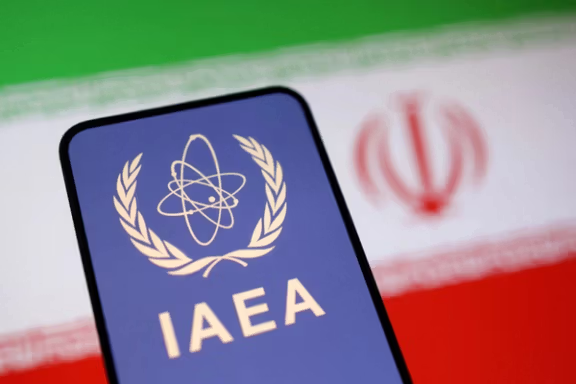
International Atomic Energy Agency (IAEA) logo and Iranian flag is seen in this illustration taken June 16, 2025.
A new round of talks between an Iranian delegation and the International Atomic Energy Agency will be held in Vienna on Friday, Iran’s ambassador to international organizations in the city said, according to state media.
Reza Najafi said the negotiations continue consultations on defining cooperation “within the framework of parliament’s law under new conditions.” He added the talks will determine “a new form of cooperation between Iran and the IAEA.”
Following Israeli and US military strikes on Iran in June, parliament passed a bill suspending cooperation with the IAEA and imposing new restrictions on inspections. Any arrangement for renewed access must now be approved by Iran’s Supreme National Security Council, and no agreement for inspections or resumption of the IAEA’s broader work has yet been reached.
On Thursday, Foreign Minister Abbas Araghchi met EU foreign policy chief Kaja Kallas in Doha. Araghchi said the European move to restore UN sanctions was “illegal and unjustifiable” and stressed that Tehran expects the EU “to play its role in fulfilling its responsibilities to neutralize moves against diplomacy.”
The two sides agreed to continue consultations in the coming days and weeks.
IAEA warns on uranium stockpile
The International Atomic Energy Agency said this week that Iran’s inventory of uranium enriched to 60% remains “a matter of serious concern” because inspectors lost visibility after the June war.
In a confidential report seen by reporters, the agency said Iran had 440.9 kilograms of 60% enriched uranium as of June 13, an increase of more than 30 kilograms since May. That material is only a short step from weapons-grade levels. The total stockpile stood at nearly 9,875 kilograms.
The report also confirmed that two inspectors mistakenly took documents from the Fordow site back to Vienna, which the agency called an “error” but not a security breach. Tehran subsequently barred them from returning.
Grossi urges quick progress
IAEA chief Rafael Grossi told Reuters that another round of talks with Iran would take place in Vienna this week and said the issue “cannot drag on for months.”
“It would be ideal to reach an agreement before next week,” Grossi said, stressing the need to verify that Iran’s highly enriched uranium remains under control. “I believe there is a general understanding that the material is likely still there, but it must be verified.”
Grossi added: “We have reminded our Iranian counterparts that domestic laws create obligations for Iran, not the IAEA.”
Limited access after war
Since the June conflict, inspectors have only been allowed into the Bushehr nuclear power plant, where they observed a fuel replacement in late August. Bushehr operates with Russian assistance and was not struck during the war.
Iran’s atomic energy chief Mohammad Eslami confirmed that inspectors entered the country with authorization from the Supreme National Security Council. He accused the IAEA leadership of acting under Western pressure, saying, “Our enemies always find excuses to pressure the Iranian nation.”
Snapback sanctions in play
The European powers Britain, France and Germany triggered the UN “snapback” mechanism on August 28, seeking to restore sanctions lifted under the 2015 nuclear deal. They demanded that Iran return to talks, grant inspectors wider access, and account for its uranium stockpile.
The snapback mechanism, created under Resolution 2231, automatically restores sanctions after 30 days unless the UN Security Council votes otherwise. The provision expires in October.
Tehran has rejected the step, with officials warning that Iran could even withdraw from the Nuclear Non-Proliferation Treaty if pressure mounts further.
Iran’s Deputy Foreign Minister Saeed Khatibzadeh has denied reports quoting him as saying the likelihood of fresh conflict with Israel was “very high,” the ISNA news agency reported on Friday.
Some outlets, including IRGC-affiliated Tasnim, had cited Khatibzadeh as making the remark during a visit to Baghdad. He told ISNA he did not use that phrasing in his interview.
Khatibzadeh said Israel “has violated all norms and international laws for two years” and that Iran’s response to recent attacks had been “painful.”
He added that the fighting “changed realities on the ground, particularly on the nuclear issue, and the International Atomic Energy Agency was unable to protect Iranian facilities.”
The June conflict began with a surprise Israeli strike on Iranian military and nuclear sites on June 13. Tehran said 1,062 people were killed, including 786 military personnel and 276 civilians. Israel said it killed more than 30 senior Iranian security officials and 11 nuclear scientists. Iran retaliated with missile strikes that killed 31 civilians and one off-duty Israeli soldier.
Khatibzadeh said Iran could target “any location” in Israel during the war and accused Tel Aviv of relying on “terror and media manipulation.”
Iran vows escalation if war returns
Parliament Speaker Mohammad Bagher Ghalibaf said last month that Iran would abandon restraint if another war erupts. “In the next possible war, our restraint will end. New geographic areas and targets will be added to our response,” he told lawmakers. He warned that the conflict could also expand “into economic and political arenas.”
Ghalibaf said Iran’s armed forces had addressed weaknesses exposed in June and pointed to naval missile drills as a signal meant to prevent “enemy miscalculation.”
Israeli voices call for striking Iran’s leadership
In Israel, former defense minister Yoav Gallant said the country must prepare for another round and ensure that Supreme Leader Ali Khamenei is killed if fighting resumes. “Although Khamenei was not eliminated in this round, his elimination must be part of any plan of the State of Israel if a campaign against us is launched,” Gallant told Channel 12.
Gallant said Iran will rebuild some of its strength, particularly its missile arsenal, and warned Israel must be ready for a different war.
Israeli Prime Minister Benjamin Netanyahu and US President Donald Trump also mooted killing Khamenei at the height of the June conflict, and Trump hinted at favoring regime change in Tehran.
Iran has sought new ways to move cash to Hezbollah, including a request to Baghdad for unusual access at a western border crossing with Syria, Asharq Al-Awsat reported on Thursday.
An unnamed senior Iraqi official told the paper he “did not respond to the Iranian message because of political and security complications.” The report said Iranian networks of smugglers in Syria and Lebanon have recently stepped up attempts to deliver funds despite tighter monitoring.
Asharq Al-Awsat, citing political sources, said US Senator Lindsey Graham told Lebanese lawmakers last month that Washington had intelligence of millions of dollars reaching Hezbollah and wanted to know how the funds were smuggled.
In 2020, the US State Department estimated that Iran gave Hezbollah $700 million a year.
Pressure to disarm Hezbollah
The report comes as Lebanon faces internal and external pressure over Hezbollah’s arsenal. Last month, President Joseph Aoun told visiting Iranian security chief Ali Larijani that no group should bear arms or rely on foreign backing. He warned against interference while affirming openness to cooperation based on sovereignty and mutual respect, according to Al Arabiya.
Larijani responded by saying Iran did not interfere in Lebanon’s affairs and that “any decision taken by the Lebanese government in consultation with the resistance is respected by us.” He urged Beirut to “always appreciate the value of resistance,” describing Israel as Lebanon’s real enemy.
Hezbollah rejects disarmament
Days later, Hezbollah leader Naim Qassem warned that efforts to strip the group of weapons could lead to war. “The resistance will not hand over its weapons,” he said at a rally in Baalbek, vowing a “Karbala-like battle” if necessary.
Qassem described Hezbollah’s arsenal as central to Lebanon’s sovereignty and credited Iran for its financial, military and political support. He also warned the Lebanese government against confronting the group, saying such action would leave “no life” in the country.
Lebanon’s cabinet had ordered the army last month to collect Hezbollah’s weapons, the most detailed disarmament push yet, with US backing. Tehran strongly criticized the move, calling it a Western-imposed plan.
The United States is considering new restrictions on foreign delegations attending this month’s UN General Assembly, including measures that would further limit the movements of Iranian diplomats in New York, the Associated Press reported on Friday.
One proposal would prevent Iranian officials from shopping at wholesale clubs such as Costco and Sam’s Club without State Department permission. The AP said such stores have long been favored by Iranian diplomats, who buy large quantities of goods unavailable in Iran and send them home.
Three years ago, footage of then-President Ebrahim Raisi’s delegation in New York drew wide attention on social media, showing aides loading piles of goods with US retail labels into a truck outside their hotel.
The internal memo seen by AP also outlined possible curbs on delegations from Sudan, Zimbabwe and Brazil.
The report follows the Trump administration’s decision to revoke visas for Palestinian President Mahmoud Abbas and more than 80 officials, blocking them from the UN meeting. Palestinian diplomats accredited to the UN mission were allowed to remain.
Security review for Iran
The State Department said last week that visas for Iran’s UNGA delegation are subject to a security review. In response to a query from Iran International, a spokesman said Washington “will not waver in upholding American law and the highest standards of national security and public safety in the conduct of our visa process.”
The spokesman added that ensuring foreign visitors pose no threat to US national security “remains a paramount priority.” The Department declined to say whether Iranian officials will be issued visas this year, citing visa confidentiality rules.
The decision to admit President Masoud Pezeshkian and his delegation last year drew criticism from Iranian diaspora groups and activists, despite their movements being restricted to a few blocks around the UN headquarters.
In 2019, then-Foreign Minister Mohammad Javad Zarif was granted a visa under similar limits. The US has also refused visas in past years, including to Iran’s 2014 UN ambassador nominee over his role in the 1979 embassy takeover.
Syria waiver highlights contrast
The AP memo said the Trump administration last week lifted long-standing travel restrictions on Syria’s delegation to the UN. The move followed the ouster of President Bashar Assad last year and Washington’s effort to integrate Damascus into the Middle East.
Government wheat procurement in Iran dipped by over a third this year due to declining production, officials said on Thursday, as drought and financial woes continue to plague the economy.
In Iran, the term “guaranteed purchase of wheat” refers to a government program whereby the Government Trading Corporation (GTC) commits to buying wheat from domestic farmers at a pre-established, fixed price.
The government says the policy shields farmers from volatile market prices and ensures a stable income by offering a predictable price while also enabling the government to manage reserves of the staple crop and guarantee supply.
However, state-guaranteed purchases had dropped to 700,000 tons, Attaollah Hashemi, head of the National Wheat Farmers Foundation, told ISNA news agency on Thursday.
'Risks ahead'
“This year’s guaranteed purchases have decreased by 35 percent compared to last year, a decline that is a direct result of reduced production caused by drought and insufficient rainfall,” he said.
The government still owes some farmers payments for wheat deliveries but promised settlement soon, Hashemi added. He warned that “reliance on wheat imports could bring serious risks for the country.”
According to US Department of Agriculture data, the country's wheat production for the 2024/25 season is projected at around 16 million metric tons.
Despite these figures, Iran’s import needs can vary: the FAO projects wheat import requirements for the 2024/25 marketing year (April–March) at 1.3 million tons.
However, due to drought-induced production shortfalls, imports are expected to rise in the current calendar year to about 4.5 million tons, according to state media.
Traditional flood irrigation of agricultural land in Iran
Water crisis
Agriculture Minister Gholamreza Nouri Ghezaljeh recently described the situation as unprecedented. “From the perspective of food security, we are in the most difficult circumstances,” he said, citing poor economic conditions and what he called the worst droughts in memory.
Production had fallen by 35 to 40 percent due to energy shortages and irrigation problems, Ghadamali Bourbour, deputy head of the Wheat Farmers Foundation, said in late August.
“This decline is rare in Iran’s agricultural history,” he said, adding that the trend would also push up dairy and meat prices.
Despite repeated water cuts across cities, official data show that 80 to 90 percent of Iran’s consumption still goes to agriculture, much of it under traditional methods.
With procurement falling and drought intensifying, the government faces rising pressure to reform or risk deeper food insecurity.
Iranian President Masoud Pezeshkian on Thursday criticized the lack of a merit-based system in public management and threatened to cut the budgets of underperforming government bodies.
His comments appeared aimed at addressing widespread frustration with rising costs of living and other woes set to deepen if European powers succeed in triggering international sanctions on Iran due at the end of the month.
Speaking at a meeting with the board of Iran’s Academy of Medical Sciences, Pezeshkian raised concerns over the management of resources in healthcare and other public services.
“Why should the country’s resources be handed over without reason to institutions and bodies that have no benefit or usefulness? If we correct this situation, we will have no problem in securing resources,” state media cited Pezeshkian as saying.
Pezeshkian, a cardiac surgeon by profession, argued that a merit-based system should be introduced in governance, adding that bureaucrats in the capital should not get complacent.
“Many protests stem from the fact that individuals and groups have not received their fair share, and parts of society feel their rights have not been fulfilled. Meanwhile, a few in the capital, imagining themselves to be all-knowing, make decisions for everyone,” he said.
“If appointments were made on the basis of merit and justice, all people would step forward with a sense of responsibility,” he added.
Iran is currently grappling with energy shortages, struggling to provide water and electricity nationwide.
“Managers at senior, mid-level, and frontline levels lack adequate training in core management competencies, such as strategic planning, resource management, and leadership skills,” the study found.
Using the Management Competency Assessment Partnership (MCAP) tool, the survey covered managers at 162 public hospitals across 19 provinces.
While focused on healthcare, the findings point to systemic shortcomings across the public sector, including outdated recruitment practices and limited investment in professional management training.
“When an organization produces no output, why should it receive money from the taxpayers and treasury? The people should not have to pay the price for the incompetence of managers,” Pezeshkian said.
“One of our problems is that we view everything politically and, instead of solving issues, everyone seeks to change people,” he added.
Iran ranks among the most corrupt countries globally, scoring 23 out of 100 and placing 151st of 180 countries in the 2024 Corruption Perceptions Index (CPI) by Transparency International.
Former Iranian president Hassan Rouhani on Wednesday called for the exit of intelligence and security forces from the economy on Wednesday in a rare sweeping call for reform by a former key player in Tehran's political and security establishment.