Israel must kill Khamenei in next round of Iran war, ex-defense chief says
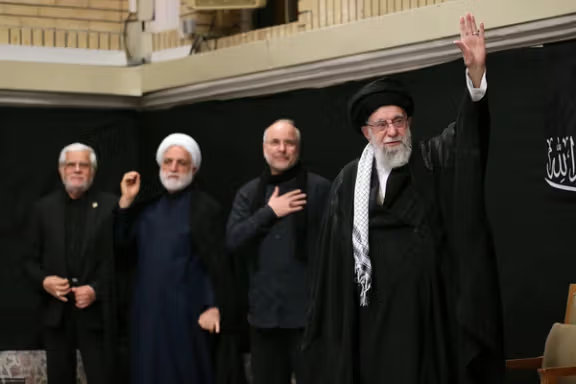
Iran's Supreme Leader Ali Khamenei attends a mourning ceremony in Tehran on July 5, 2025
Israel must prepare for another round of confrontation with Iran and ensure that Supreme Leader Ali Khamenei will be killed in the next campaign, former defense minister Yoav Gallant said on Saturday, over two months after the archenemies' 12-day war.
“Although Khamenei was not eliminated in this round, his elimination must be part of any plan of the State of Israel if a campaign against us is launched,” Gallant said in an interview with Israeli Channel 12's Meet the Press.
He added that Iran will rebuild some of its strength, particularly its ballistic missile arsenal, and that Israel must be ready for a different war.
Israel launched a 12-day air campaign against Iran in June, striking nuclear facilities and killing senior military officials and scientists. The Israeli military said the operation crippled much of Iran’s air defense system and damaged its missile capabilities.
“The main thing that is not talked about is that the Iranians do not understand how we penetrated them in terms of intelligence, and they do not know what we know,” said Gallant.
Israeli Prime Minister Benjamin Netanyahu and US President Donald Trump both mooted killing Khamenei at the height of the conflict and Trump hinted at favoring Iranian regime change.
"It’s not politically correct to use the term, 'Regime Change,' but if the current Iranian Regime is unable to MAKE IRAN GREAT AGAIN, why wouldn’t there be a Regime change??? MIGA!!!" Trump said in a post on Truth Social in late June.
“Today our enemy, the one standing against us — the Zionist regime — is the most despised government in the world,” said Khamenei in a speech last week.
Khamenei added that enemies had underestimated Iran’s resilience and wrongly believed attacks would separate the people from the state.
Israel must kill Khamenei in next round of Iran war, ex-defense chief says | Iran International
Israel managed to pinpoint the location of Iran’s top authorities during June’s 12-day war by hacking the mobile phones carried by their bodyguards, The New York Times reported Saturday, citing Iranian and Israeli officials.
“We know senior officials and commanders did not carry phones, but their interlocutors, security guards and drivers had phones, they did not take precautions seriously and this is how most of them were traced,” the report said citing Iran's former deputy vice-president Sasan Karimi.
An Israeli defense official told the paper: “Using so many bodyguards is a weakness that we imposed on them, and we were able to take advantage of that.”
The tactic enabled Israeli warplanes on June 16 to strike a bunker in western Tehran where President Masoud Pezeshkian, the heads of the judiciary and intelligence ministry, and senior commanders were holding an emergency security meeting, the report added.
Earlier this month, the chief of staff to Iran's president said Israel’s attack on a Supreme National Security Council (SNSC) meeting on June 16 was a targeted attempt to kill Masoud Pezeshkian, who escaped with a minor injury.
Israel targeted the building’s entrances and exit points with six bombs to block escape routes and cut off airflow, Revolutionary Guards affiliated Fars News reported last month.
None of the leaders were killed, but several guards died outside, according to The Times.
Bodyguards had long been excluded from strict phone bans imposed on top commanders, even after earlier assassinations of nuclear scientists and military figures, The New York Times reported.
Lapse now addressed
That lapse has since been addressed, with guards now restricted to carrying only walkie-talkies, the report said.
The strikes formed part of a broader Israeli campaign that killed at least 30 senior commanders and more than a dozen nuclear scientists during the war’s first week.
Iranian officials later said dozens of suspects from the military and government had been arrested or placed under house arrest on suspicion of spying for Israel.
President Pezeshkian, who was lightly injured in the attack, later told clerics: “There was only one hole, and we saw there was air coming and we said, we won’t suffocate. Life hinges on one second.”
He added that if the leadership had been killed, “people would have lost hope.”
Yemen’s Houthi rebels confirmed on Saturday that their prime minister, Ahmad Ghaleb al-Rahwi, and several ministers were killed in an Israeli airstrike on a building in the capital, Sanaa.
The announcement was made by Mahdi al-Mashat, head of the group’s Supreme Political Council.
According to the Houthis, al-Rahawi and his colleagues were holding a cabinet meeting when the strike took place.
Al-Rahawi had served as prime minister since 2024, though his role was seen largely as administrative. The council announced that Mohamed Ahmad Moftah has been appointed as acting prime minister.
The Israeli military said on Friday that its air force carried out a broad operation against Houthi positions in Sanaa, targeting senior political and military leaders.
Slain Houthi Prime Minister Ahmad Ghaleb al-Rahawi
Israel’s Channel 12 reported the strike likely killed the entire Houthi cabinet, including al-Rahawi and up to 12 ministers.
The fresh airstrikes came after the Israeli military concluded that the Houthis had used cluster munitions in one of their ballistic missile attacks on the Jewish State.
Houthis ready to fight back
After confirming the deaths of the group’s senior officials, the Houthi defense minister announced that the Houthis are ready to confront Israel.
The Houthis have been launching attacks on international shipping in the Red Sea, the Bab al-Mandab strait, and the Gulf of Aden since the outbreak of the Gaza war. Their operations, which have also extended into the Indian Ocean, have repeatedly disrupted maritime security.
The group has also launched missiles and drones toward Israel, framing its attacks as support for Palestinians. While the United States says it recently secured a halt to Houthi strikes on American vessels, the Houthis have said the truce does not apply to Israel and vowed to continue their attacks.
An attack by Israeli-linked hackers on Iran's top cryptocurrency exchange amid a 12-day war in June focused their targeting on accounts held by officials and their so-called hot and cold wallets, a source told Iran International on Friday.
The Western-sanctioned Nobitex exchange was hit on June 18 by the hacking group Predatory Sparrow and $90 million dollars in its currency was destroyed, according to independent monitors. Nobitex has denied any military or government connections.
Hackers analyzed the stolen data and identified assets, networks, and transactions linked to Iranian officials, distinguishing them from those of civilians and ordinary users, the source said.
Nobitex announced after the attack that losses were limited to hot wallets only. However, a source told Iran International that both hot and cold wallets had been affected.
Hot wallets are internet-connected digital wallets designed for quick transactions but vulnerable to hacks. Cold wallets—offline hardware devices or paper keys—offer higher security but are slower and less convenient for daily use.
Determining whether destroyed assets were in hot or cold wallets can be done by examining transaction patterns and blockchain data tagged by analysis firms.
The United States sanctioned Nobitex in September 2022, followed by Canada in December 2022 and New Zealand in 2023, citing the exchange’s role in arms cooperation with Russia and drone transfers in the Ukraine war.
While the released data suggested extensive sanctions-evasion activities, the Nobitex team insisted it is merely a startup and denied any illegal conduct.
During the June conflict, Israel-linked hackers launched some of the most disruptive cyberattacks of the campaign.
The Predatory Sparrow claimed responsibility for destroying $90mn from Iran’s Nobitex cryptocurrency exchange and crippling services at Bank Sepah and Bank Pasargad by disabling their main and backup data centers.
“During the Nobitex hack, the asset withdrawals specifically occurred from high-frequency addresses, typically associated with hot wallets, and were transferred to burn addresses,” Mehdi Saremi Far, a science and technology journalist, told Iran International.
Iran’s cryptocurrency market is estimated at $5–12 billion, with Nobitex handling about 87% of its transaction volume.
TRM Labs, which specializes in detecting and disrupting blockchain-based illicit activity such as ransomware and money laundering, announced in July that Nobitex was not only used for illicit activities but also served as a surveillance tool.
“The Nobitex breach showed that the exchange’s internal infrastructure was designed to evade detection by the US Treasury Department’s Financial Crimes Enforcement Network (FinCEN) and US-based blockchain intelligence firms. This included modules for generating stealth addresses, obfuscating transactions, and evading surveillance,” TRM Labs said.
Eight people were arrested on suspicion of attempting to pass sensitive information about military officials and strategic sites to Israel’s Mossad, Iran’s Revolutionary Guards announced on Saturday.
“These individuals, who had received their specialized training online from agents of Mossad, had sent the coordinates of vital and sensitive centers, as well as information related to prominent military figures, to Mossad intelligence officers during the 12-day war,” read the announcement.
Israel launched the 12-day air campaign against Iran in June, with brief support from the United States, targeting nuclear sites and killing senior military officials and nuclear scientists. The strikes crippled much of Iran’s air defense network and damaged a significant portion of its ballistic missile arsenal, Israel said.
The people were arrested in northeastern Razavi Khorasan province before carrying out their plans, according to the statement. Authorities said they seized equipment for producing explosives, bombs and booby traps.
The announcement follows a broader crackdown in the wake of the June war. State media reported that police detained as many as 21,000 people during the 12-day conflict with Israel, though no details were given about the charges. Security forces also expanded their street presence during the brief war, which ended in a US-brokered ceasefire after Iran launched missile barrages on Israeli cities and military sites.
Earlier this month, Iran hanged nuclear scientist Rouzbeh Vadi, accusing him of providing intelligence to Israel about another scientist later killed in Israeli strikes. In total, at least eight people have been executed in recent months on espionage-related charges.
Human rights groups argue Tehran often uses espionage allegations and swift trials to stifle dissent and tighten control, particularly during periods of conflict.
According to Amnesty, Iran was responsible for 64 percent of all recorded executions worldwide in 2024 and has carried out 612 hangings in the first half of 2025 alone.
A Yale University course on US-Iran relations features former US diplomat Robert Malley as instructor and lists guest speakers with ties to the Islamic Republic, according to an op-ed published by the Jewish News Syndicate (JNS).
The fall 2025 course, titled Adversaries by Design: Deconstructing the Iran-US Relationship, is described in Yale’s course catalogue as an examination of more than four decades of tension between Washington and Tehran, beginning with the 1979 Islamic Revolution. The class will explore each government’s worldview and ask students to take the perspective of US and Iranian decision-makers. Topics include regional politics, US sanctions, and nuclear talks.
The syllabus says the course will feature guest lecturers presenting both Iranian and US perspectives.
In the JNS op-ed, a Yale student who arrived from Tehran in 2023 wrote that the class lists Mohammad Javad Zarif, Hossein Mousavian, and Ali Vaez as speakers. All three have previously held positions or advised on policy within or linked to Iran’s government. “Malley purports to offer Iranian perspectives, but the class will likely only feature Islamic Republic officials and supporters,” the author wrote.
Malley, a longtime figure in US Middle East policy, served as US special envoy for Iran under President Joe Biden and was a key architect of the 2015 Joint Comprehensive Plan of Action (JCPOA) during the Obama administration. He was placed on leave and had his security clearance suspended in 2023.
According to a Wall Street Journal report published last September, the FBI viewed Malley’s handling of classified material as “sloppy,” while the State Department did not consider his conduct to constitute serious misconduct.
In 2023, Iran International and Semafor investigation uncovered the Iran Experts Initiative (IEI) - a network formed under then-Foreign Minister Zarif to promote Iran's foreign policy and nuclear strategy through scholars based abroad. Ali Vaez was named as one of its key members.
Hossein Mousavian, one of the listed guest speakers, recently ended his 15-year tenure at Princeton University, which the university described as a retirement. Activists, however, said it followed pressure over his past role as an Iranian diplomat and nuclear negotiator, and alleged ties to state-linked assassinations and propaganda efforts.