Iran hangs nuclear scientist over alleged espionage for Israel’s Mossad
The image released by Iranian media of nuclear scientist Rouzbeh Vadi
Iran’s judiciary announced on Wednesday that Rouzbeh Vadi, a nuclear scientist and member of the Nuclear Science and Technology Research Institute under the Atomic Energy Organization of Iran, had been executed for allegedly spying for Israel.
Iran hangs nuclear scientist over alleged espionage for Israel’s Mossad | Iran International
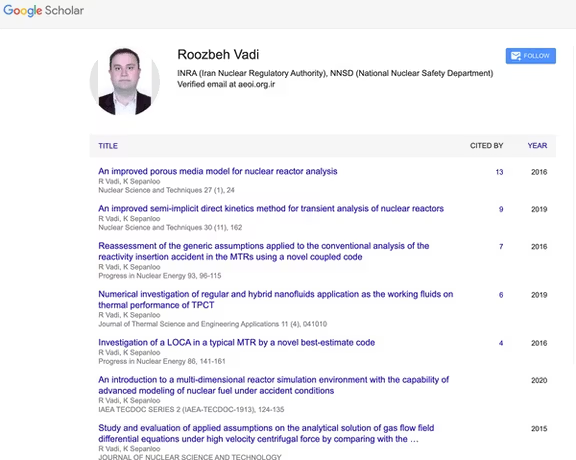
Vadi, who held a doctorate in reactor engineering, had co‑authored a 2011 research paper with senior Iranian nuclear experts later killed during the June conflict with Israel, according to his Google Scholar profile.
According to the Telegram channel of Amir Kabir University, Vadi was a doctoral graduate of the university. He co-authored a paper with Abdolhamid Minouhchehr and Ahmad Zolfaghari, two prominent nuclear specialists killed during the 12-day war.
The judiciary said he was convicted of transferring classified information about one of the scientists killed in those attacks to Mossad.
Its official outlet Mizan reported that Vadi “knowingly and deliberately” cooperated with Israel’s intelligence service.
A screengrab from Rouzbeh (Roozbeh) Vadi's profile page at Google Scholar
'Paid crypto'
Officials alleged he was recruited online, vetted by a Mossad officer using the alias Alex, and later assigned to a handler known as Kevin.
After his evaluation, Mossad allegedly determined that Vadi’s workplace and level of access made him a high‑value source,according to the judiciary.
He was then introduced to “one of Mossad’s top divisions.” At his request, payments were made monthly via a cryptocurrency wallet rather than a reward‑per‑mission system.
According to the case file, Vadi was instructed to buy a dedicated phone, laptop, and two flash drives to establish secure communications. After receiving technical training, he was tasked with gathering and transmitting sensitive and classified materials.
Widespread crackdown
Iran would “deal decisively and legally with spies,” referring to ongoing investigations following the June conflict with Israel, Judiciary chief Gholamhossein Mohseni Ejei said on Tuesday during a visit to North Khorasan Province.
Ejei recently said that more than 2,000 people had been arrested during and after the 12-day war, some of whom face the death penalty on charges of “organizational collaboration with the enemy.”
Amnesty International condemned the surge in executions and warned of further imminent deaths.
Iran Human Rights reported that 21 people were executed during the June conflict period, including six men charged with spying for Israel.
According to Amnesty, Iran was responsible for 64 percent of all recorded executions worldwide in 2024, and has carried out 612 hangings in the first half of 2025 alone.
Meetings in Vienna
Following initial data transfers, Vadi was reportedly sent to Vienna, where he had previously attended professional training, to meet Mossad officers in person.
On five occasions, he allegedly met them in Austria’s capital under what Iranian authorities described as “high‑level security protocols,” including multiple location changes, vehicle swaps, body searches, and use of “special meeting clothing” before talks began.
During these meetings, Vadi underwent psychological testing and a polygraph exam to assess loyalty and information accuracy. He was then re‑tasked to provide weekly updates on organizational developments and answer technical questions, with payments adjusted accordingly.
The judiciary said Vadi resisted instructions to send large batches of data all at once but ultimately transferred a collection of classified material, including information on the slain nuclear scientist.
Arrest and trial
Iran’s intelligence services said they placed Vadi under surveillance after one of his trips to Vienna. He was eventually arrested in Tehran, and prosecutors charged him with “espionage and intelligence cooperation with the Zionist regime in exchange for a specified payment.”
The court, citing Article 6 of the Law on Combating Hostile Actions of the Zionist Regime Against Peace and Security, along with other articles of the Islamic Penal Code, sentenced him to death for “extensive crimes against domestic and foreign security” and for “causing serious disruption to public order.”
The Supreme Court upheld the verdict, and the sentence was carried out on August 5, 2025.
The lawyer of man on death row over a high-profile protest case said on Monday that Iran’s Supreme Court has yet to respond to six defendants' appeal and the court has declined to meet with families or attorneys.
A lawyer representing Hossein Nemati, one of six defendants sentenced to death, said that courts typically respond within two months but after three official inquiries over nine months there had still been no reply.
“On July 30, we went to the relevant branch along with some of the families, but we were told that neither the lawyers nor the families would be allowed in for this case,” Payam Dorfeshan was quoted as saying by Telegram news channel Emtedad.
The so-called Ekbatan case involves multiple defendants, six of whom face execution after being convicted of killing a member of Iran's domestic enforcement militia in Tehran amid nationwide anti-government protests in 2022.
They deny the charges.
“Our clients have now reached the legal limit of two years in pretrial detention. The law clearly states that pretrial detention cannot exceed two years under any circumstances,” Dorfeshan said.
The six detainees facing execution are Milad Armon, Alireza Bormarzpournak, Amir Mohammad Khosheghbal, Alireza Kafaei, Navid Najaran and Hossein Nemati.
On October 26, 2022, during the Woman, Life, Freedom protests, a member of Iran’s Revolutionary Basij militia, Arman Alivardi, was injured in a building complex in Tehran called Shahrak-e Ekbatan and died two days later.
Following Alivardi’s death, security forces conducted mass arrests of more than 50 young residents of the complex and indictments were issued against several of them.
On July 29, Amnesty International warned that Armon, Bormarzpournak, Khosheghbal, Kafaei, Najaran and Nemati are at risk of execution.
Iran International on Tuesday filed an urgent appeal with United Nations experts urging them to take action against Iran over serious risks to the lives and safety of their journalists worldwide and relatives inside Iran.
Over the past six weeks, the Iranian authorities have intimidated and threatened 45 journalists and 315 of their family members with death unless they stop working for Iran International by specific deadlines, Iran International said in a statement.
All of those deadlines given by Iran's Ministry of Intelligence and Security have now passed, it added.
Iran International is a London-based Persian-language broadcaster and multilingual digital news operation that is a key source of news in Iran amid a closely policed media environment inside the country.
Iran International’s legal team has filed an urgent appeal over what it called an “alarming and unprecedented escalation” in risk to Iran International journalists and their families with five UN Special Rapporteurs.
These include experts Irene Khan responsible for freedom of expression; Morris Tidball-Binz for extra-judicial, summary or arbitrary executions; Professor Ben Saul for counter-terrorism; Dr. Alice Edwards for torture and Mai Sato for Iran.
Call for urgent action
"Iran International journalists, their families in Iran and their families outside Iran are being threatened and harassed as never before in an unprecedented and concerted campaign to force them off air," Iran International’s General Manager Mahmoud Enayat said in the statement.
"I ask the UN experts to urgently investigate and take action. Iran International will continue to stand by our journalists, targeted for their important work reporting on Iran - which is needed now more than ever."
Since its formation in 2017, Iran International journalists have been targeted by the Iranian authorities for their reporting. This has included threats of assassination, assault and abduction against staff based in Britain, the United States and Europe.
The journalists have also long faced online abuse, harassment and hacking as well as asset sequestration and attacks via Iranian State media amid Tehran's designation of Iran International as a terrorist organization.
Postwar escalation
But since the start of a 12-day war between Iran and Israel in mid-June, Iran International says the situation has deteriorated rapidly and there is now a real risk to the lives of multiple Iran International staff and to their family members.
The network added its urgent appeal comes as it faces “an alarming and unprecedented escalation” in which Iranian authorities systematically began to falsely accuse Iran International journalists of being spies for Israel responsible for providing information about Iranian infrastructure to Israeli intelligence.
Iran International journalists in seven countries - the UK, the USA, Canada, Sweden, Germany, Turkey and Belgium - have been subject to threats, the network said.
Iran International is an independent Persian-language satellite TV news channel broadcasting live 24/7 from London and Washington DC.
It started in 2017 and has become the most watched Persian-language TV channel within and outside Iran on both satellite and online platforms. With bureaux in 14 countries, its journalists are drawn from a wide background in TV, radio, news agencies and newspapers within Iran and in other countries.
An Iranian delegation including nuclear scientists with ties to a sanctioned military research unit travelled to Russia last year to visit institutes producing dual-use technologies, the Financial Times reported on Tuesday.
The visit, in August 2024, was led by Ali Kalvand, a 43-year-old Iranian nuclear physicist, who arrived in Moscow on a diplomatic service passport along with four others, according to the report.
While Kalvand said they represented a private consulting firm, Western officials told the newspaper the delegation included a military counter-intelligence officer and members linked to Iran’s Organization of Defensive Innovation and Research (SPND), described by the US as “the direct successor organization to Iran’s pre-2004 nuclear weapons program.”
Iran has long denied seeking nuclear weapons, citing a religious edict by Supreme Leader Ali Khamenei banning their use, and says its nuclear activities are entirely peaceful. Khamenei said last month that the West uses Tehran’s nuclear program as an excuse for confrontation.
Iran International reported last year, citing three independent sources in Iran, that the Islamic Republic was advancing its secret nuclear weapons program by restructuring the SPND.
According to the Financial Times, the Iranian delegation met with Russian companies that manufacture dual‑use components, including electron accelerators and klystrons — equipment used in nuclear implosion simulations.
The delegation’s members also included experts in neutron generators – devices with civilian and military applications – and radiation testing, as well as a former head of a company sanctioned by Washington for acting as a procurement front for SPND.
Tritium request raises concern
The Iranian delegation also sought access to radioactive isotopes such as tritium, a substance with civilian uses but strictly controlled under global non‑proliferation rules because of its role in enhancing the yield of nuclear warheads.
The report said it reviewed a letter from Kalvand’s firm to a Russian supplier in May 2024 expressing interest in acquiring several isotopes, including tritium.
“It’s disturbing that these types of people can have this type of meeting in Russia, given the state Russia and Iran are in,” said Pranay Vaddi, a former senior director for non-proliferation at the US National Security Council.
“Regardless of whether the Russians are sharing components or technology, SPND is an organization who would be applying that specifically to nuclear weapons work.”
David Albright, head of the Institute for Science and International Security, told the paper: “We consider that a type of nuclear weapons program — to shorten the timeline... The leadership didn’t want to make a decision to build a weapon for various reasons. This sort of research activity allowed the leadership to say there was no nuclear weapons program.”
What is SPND?
SPND was established in 2011 by Mohsen Fakhrizadeh, who Western intelligence agencies believed oversaw Iran’s earlier nuclear weapons program, known as the Amad Plan, before it was halted in 2003. The US and the International Atomic Energy Agency (IAEA) consider SPND its institutional successor.
The US has repeatedly sanctioned SPND and affiliated companies, citing their role in “dual-use research and development activities applicable to nuclear weapons and nuclear weapons delivery systems.”
In 2024, Iran’s parliament formally recognized SPND under Iranian law, placing it under the defense ministry and exempting its budget from parliamentary oversight.
During Israeli attacks on Iran in June, Saeed Borji, a senior Iranian explosives expert and key figure in Iran’s nuclear-related defense programs, was killed. He headed the Center for Explosion and Impact Technology Research (known by its Persian acronym Metfaz), a subsidiary of the SPND.
Also among the delegates was Soroush Mohtashami, a neutron‑generator specialist trained under Fereydoon Abbasi‑Davani, who was also killed in the June attacks that, according to Israel, left at least nine scientists dead.
At the time, the military said all those killed had worked on the complex engineering mechanism that triggers the uranium core’s nuclear explosion.
Ian Stewart, head of the Washington office of the James Martin Center for Nonproliferation Studies, told the newspaper: “While there could be benign explanations for these visits, the totality of the information available points to a possibility that Iran’s SPND is seeking to sustain its nuclear weapons-related knowhow by tapping Russian expertise.”
A US senator’s proposal to bar all Iranian students from American universities is due to pile another obstacle in the way of aspiring scholars already effectively blocked from entry by Trump administration travel restrictions.
Republican Senator Tommy Tuberville introduced legislation that would ban Iranian and Chinese nationals from studying at US universities, arguing students from adversary states pose a national security threat and displace American applicants.
The so-called Student Visa Integrity Act would restrict visas from Iran, cap overall international student enrollment and increase penalties for visa fraud.
"We want to do away with Iran ... nationals getting into this country and learning how to destroy the United States of America and our allies," Tuberville said on Fox News on Friday. “We are funding our own demise.”
Tuberville, from Alabama, serves on Senate committees focused on education and immigration.
Hopes 'shattered'
Even before the proposal, many Iranian students faced steep barriers to studying in the United States. Zanko, a PhD‑bound software engineer living in Iran whose identity Iran International is concealing for his safety, was accepted into a top American university, with classes scheduled to begin in August 2024.
He completed his visa interview last year at a US embassy in a nearby country— a costly, logistically challenging trip from Iran, where there is no US embassy — in hopes of fulfilling his dream.
Zanko says the immigration officer told him his application was under “administrative processing,” an extensive background check. He postponed his admission to August 2025, but his visa appears no closer - a limbo endured by hundreds of other Iranian students.
“Emotionally and professionally, it has been frustrating to know that despite being qualified and committed, external political factors are shaping the course of my future,” Zanko told Iran International.
The situation, Zanko said, “shattered all of my hopes.”
Search for a better life
Leila Mansouri, a US immigration lawyer, told Iran International it has been extremely difficult for Iranians to get a visa.
Even if Tuberville’s bill doesn’t pass, she warned, the government could still block applications by instructing the State Department to stop approvals.
“Behind the scenes they can tell the consulate not to approve the applications like what we saw with the first Trump travel ban that passed in 2017,” said Mansouri, adding that male applicants face especially tough scrutiny.
Much of that additional scrutiny stems from mandatory military service for Iranian men, during which many serve in units affiliated with the Islamic Revolutionary Guard Corps (IRGC) — an organization designated by the US as a foreign terrorist organization. Even routine, non‑combat roles during conscription triggers outright visa denials.
Senator Tuberville has argued that some Iranian students have questionable backgrounds. One example often raised in such debates is the 2017 case of Seyed Mohsen Dehnavi, an Iranian medical researcher turned away at a US airport. Former classmates and activists alleged he was a senior member of the Basij, a paramilitary force tied to the IRGC, and had targeted reformist students. US border officials said his denial was for “reasons unrelated” to the travel ban in place at the time.
Mansouri emphasized that such cases are rare, noting that most Iranian students have no military or security ties. With an existing ban on Iranian military members, including those with past IRGC service, she said this route is already closed.
Iranian students have made significant contributions to American society, Mansouri said, and the US could do a better job of vetting without shutting them out. She described most applicants as “innocent people just trying to have a better life.”
About 10,800 Iranian students studied in the US in 2022–23, up from the year before but still below the 2017–18 peak of nearly 12,800. In 2024, only 2,166 student visas were issued to Iranians — down 42% from 2023 — with denial rates climbing to 41%.
'Collective punishment'
The obstacles deprive the United States of Iranian talents and isolates an entire generation of Iranians, said Siamak Aram, a Sharif University graduate and active member of the Iranian academic community in the US.
“This proposal amounts to collective punishment. It fails to distinguish between the Iranian people and the oppressive regime they are fighting against,” Aram told Iran International.
“It inadvertently aligns with the goals of the Islamic Republic. So-called ‘Supreme Leader’ Ali Khamenei has long sought to limit Iranians’ interaction with the outside world, especially through academic and cultural channels.”
The human impact has also been highlighted by Iranian-American tech entrepreneur Hadi Partovi, co-founder of Code.org, who posted on X on June 30 that he and his twin brother Ali “received hundreds of messages from Iranian students who were accepted into PhD programs in the USA, only to have their legal immigration papers rescinded.”
Partovi, whose family immigrated legally in 1984, wrote, “Iran’s most precious resource is its talent, not its oil,” and pointed to relatives such as Uber CEO Dara Khosrowshahi as examples of how admitting ambitious students can translate into job creation and economic growth.
“Surely America can find a way to protect its security and its borders while also preserving the values and ideals that make it great,” he said.
The surge in visa denials — many issued after nearly a year of administrative processing — comes amid a broader immigration crackdown in the United States.
For Iranian students like Zanko, delays and silence from authorities have been compounded by Section 212(f), a presidential authority typically invoked for national security, applied this spring. Many fear Tuberville’s bill would add yet another hurdle, effectively formalizing a ban on Iranian students.
Neither the US State Department nor Tuberville’s office immediately responded to an Iran International request for comment.
Two young men have been sentenced to death for involvement in the 2022 Woman, Life, Freedom protest movement, Norway-based rights group Hengaw said on Monday.
Mohammad Darvish Narouei, 22, and Yasin Kebdani, 21, were convicted by a court in Zahedan in southeastern Iran of “waging war against God” and “corruption on Earth,” the rights group reported, adding they face imminent execution if the sentences are upheld.
A third detainee, Benyamin Kouhkan, who was 16 at the time of his arrest, has also been tried and placed in solitary confinement with his verdict pending.
All three were tortured and denied access to legal counsel, the group said.
Separately on Monday, Norway-based rights group Iran Human Rights (IHR) reported that two other Baloch political prisoners, Farhad Baranzahi, 24, and Omran Aghal, 22, have been sentenced to death in Zahedan on charges of "membership in armed opposition groups."
Both men were allegedly tortured into confessing and remain held in Zahedan Central Prison, according to IHR.
The unrest was sparked by the death in morality police custody of a young woman, Mahsa Amini. Protests were quashed with deadly force.
At least eleven protesters have been executed in Iran in connection with the 2022 uprising, with the most recent execution carried out in June.
On June 11, Iranian authorities executed Mojahed (Abbas) Kourkour, who was detained in connection with the November 2022 protests in the southwestern city of Izeh.
Last week, the US-based Abdorrahman Boroumand Center for Human Rights reported on that at least 730 people have been executed in Iranian prisons over the past seven months, including 102 in July alone.