Iranian lawmakers urge review of defense doctrine, call for nuclear weapons
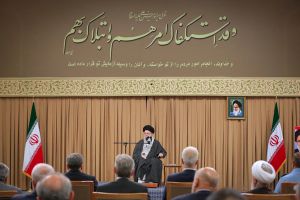
A session of the Iranian parliament
Dozens of Iranian lawmakers have called for a fundamental shift in the country’s defense policy, urging authorities to consider building a nuclear weapon as a deterrent, Iranian media reported on Monday.
Seventy-one members of parliament signed a letter to Iran’s Supreme National Security Council and the heads of the executive, legislative, and judicial branches, demanding a “review of the Islamic Republic’s defense doctrine,” according to the daily Hamshahri Online.
In their letter, the lawmakers wrote, “We respectfully request that, since the decisions of that council acquire validity with the endorsement of the Leader of the Revolution, this matter be raised without delay and the expert findings communicated to the parliament.”
The lawmakers argued that while the use of nuclear weapons would contradict a 2010 religious edict by Supreme Leader Ali Khamenei prohibiting them, developing and maintaining such weapons “as a deterrent is another matter,” the outlet said.
“In Shia jurisprudence, a change in circumstances and conditions can alter the ruling. Moreover, safeguarding Islam -- which today is bound to the preservation of the Islamic Republic -- is among the paramount obligations. On this basis, the original prohibition can, as a secondary ruling, be transformed into a permissibility.”
The initiative was led by Hassan-Ali Akhlaghi Amiri, a lawmaker from the holy city of Mashhad, Hamshahri reported.
Iran has long insisted that its nuclear program is for peaceful purposes only and cites Khamenei’s fatwa against nuclear weapons as proof of its intentions. The United States and its European allies accuse Tehran of seeking the capability to produce nuclear arms, a charge Iran denies.
The calls from lawmakers come as Iran faces the prospect of renewed United Nations sanctions under a “snapback” mechanism set to take effect on September 28, after European powers accused Tehran of failing to honor the 2015 nuclear deal.
Iran is not known to have made any decision to pursue nuclear weapons, and the government has not commented on the lawmakers’ letter.
Iran’s armed forces warned on Monday they are prepared to respond to any threat with overwhelming force, saying recent clashes showed the country could turn aggression into an opportunity to display regional and international power.
Major General Mousavi, chief of the General Staff of the Armed Forces, said in a message marking Defense Week that Tehran’s military and defensive capabilities blunted enemy plans during the recent 12-day conflict and that Iran would not remain passive in the face of new threats.
Sacred Defense Week, which begins on September 22, is Iran’s annual commemoration of the 1980–88 Iran-Iraq war, marked by military parades and other war-themed events.
Major General Mousavi, chief of the General Staff of the Armed Forces of Iran
State news outlets quoted Mousavi as saying that “the armed forces,relying on strategic surprises, were ready to deliver a timely, decisive and beyond imagination response to any acts of aggression.”
Mousavi urged quicker development of advanced defense technologies and stronger deterrence, and called for preparations to counter so-called hybrid threats, especially cognitive and information warfare, which he said should be a priority for planners.
The comments came after a meeting between senior commanders of the Islamic Revolutionary Guard Corps and the regular army, where unity and coordinated action were stressed.
The Islamic Revolutionary Guard Corps commander Mohammad Pakpour (left) and Army Commander Amir Hatami during a meeting on September 22, 2025
Army Commander Amir Hatami, quoted by state media, said any smallest aggression would be met by a unified, rapid and forceful response from both services and said that national interests would not be negotiated away.
“This unity is the iron shield that protects our country against plots and conspiracies. We proved again in the 12-day war that we will not bargain over our national interests.”
“From the very beginning of the Islamic revolution in 1979, the enemies have demanded that the Iranian nation give up its rightful goals, but our people, with sacrifices and martyrs, have resisted and will continue to resist,” he said.
IRGC commander Mohammad Pakpour underscored the need for “jihad-style” mobilization of public capacities across education, media and civil institutions to shape public narratives and resilience against external influence, remarks that reflect Tehran’s focus on combining military and non-military tools in its defense posture.
“The events of this imposed war were exactly reminiscent of September 1980 and the national unity forged at the start of the Sacred Defense,” he said
He added that “in the early hours, several of our senior commanders were martyred, but with the Supreme Leader’s wise leadership, successors were appointed and the battle was managed until the enemy was forced to request a ceasefire.”
One hundred Mossad operatives were deployed inside Iran to install and operate smuggled heavy missile systems, which were used to disable missile launchers and air-defense batteries at the start of June’s 12-day war, according to a documentary by Israel’s Channel 13.
“I told him: 'We have to do it.’ And he said, ‘You’re right, it’s gotta be done,’” Prime Minister Benjamin Netanyahu recalled of informing US President Donald Trump about the planned operation, according to the documentary.
The new Channel 13 documentary describes what it calls an unprecedented mission — both in scale and technical demands.
Specially trained agents deployed inside Iran installed and operated smuggled heavy missile systems, which were then used to strike the Islamic Republic’s ballistic missile launchers and air-defense batteries, aiding Israel’s broader campaign, the report said.
Negotiations over Iran’s nuclear program began under Trump’s administration with a 60-day ultimatum. On day 61, June 13, Israel launched its surprise 12-day campaign, coinciding with the eve of the sixth round of talks with Washington.
By the ninth day of fighting, the US carried out strikes on three Iranian nuclear sites, with Trump later boasting they had “obliterated” the program.
The Israeli operation involved about 100 foreign operatives, raising major logistical and command challenges, the report said. Channel 13's interviews with senior ministers suggest broader aims beyond disabling equipment: damaging underground facilities, weakening command structures and shaping events to sway US policy.
According to the report, leaders even discussed targeting Iran’s supreme leader if the chance arose.
Defense Minister Israel Katz is quoted as saying, “If there had been an opportunity, we would have [targeted him].”
Netanyahu reportedly told defense officials: “We are going to destroy the Iranian nuclear project as best we can. We aren’t waiting for a green light from the US, and it doesn’t matter if they say no.”
Secrecy, risk and the politics of optics
Secrecy was paramount, the documentary said. Foreign Minister Gideon Sa’ar recounted discussing a friend’s daughter’s upcoming wedding even as he knew it would not go ahead due to the looming offensive. Even families of top officials were mostly kept uninformed.
Brig. Gen. Gilad Keinan, the Israeli Air Force operations chief, said confidence was high in recovering downed crews, but extracting them from Iran was less certain. He added that many Iranian jets stayed grounded for fear of being shot down by their own defenses.
Cabinet transcripts revealed concern with optics. Strategic Affairs Minister Ron Dermer suggested images of destruction would help persuade Trump.
Netanyahu agreed, urging strikes on fuel tanks and a Basij facility, vowing to deliver a “birthday greeting” to the US president in the form of a decisive blow, according to the documentary.
Channel 13 said nuclear and missile sites were damaged and nuclear materials partly destroyed in the operation.
Air attacks killed nuclear scientists along with hundreds of military personnel and civilians.
Tehran answered with over 500 ballistic missiles and 1,100 drones, inflicting heavy casualties and widespread destruction, killing 31 Israeli civilians and one off-duty soldier.
The value of the US dollar surged to an unprecedented 1,060,000 rials in Iran’s free market on Sunday, setting a new all-time record as fears of renewed UN sanctions deepened.
By mid-afternoon, the rate had reached 1,062,600 rials, continuing a sharp climb that added more than 30,000 rials since Saturday. The jump comes amid heightened expectations that the snapback mechanism will be activated, reinstating international sanctions previously suspended under the 2015 nuclear deal.
On September 20, the dollar opened trading at around 1,013,000 rials and rose to above 1,035,000 by midday, immediately after the UN Security Council rejected a South Korean draft resolution that would have permanently lifted sanctions. With the measure defeated, all restrictions are now set to reimpose automatically from September 27.
The rial has faced repeated shocks since Donald Trump returned to the White House. The latest surge follows months of volatility, with the dollar climbing to 1,058,900 rials in April when US B-2 bombers were deployed to the region. Optimism over nuclear talks briefly brought the exchange rate down to 820,000 rials after a second round of negotiations in Rome, but subsequent Israeli strikes on Iranian targets reignited the currency’s slide.
Even after a ceasefire was announced, the US dollar remained high at 930,000 rials and later climbed back above 940,000 on speculation over snapback sanctions. Despite occasional dips, the overall trend has been steadily upward, culminating in Sunday’s record high.
The collapse of the rial underscores Iran’s deepening economic vulnerability as diplomatic isolation grows, with markets responding sharply to both international pressure and the stalled state of nuclear negotiations.
Iran’s Ministry of Education introduced the recent 12-day war with Israel into school lessons with special content on the conflict to be included across all school levels in the new academic year, Education Minister Alireza Kazemi announced Sunday.
“We have prepared three special issues for primary, middle, and high school students in the form of a book, which will provide students with an extraordinary and beautiful narrative of the 12-day war,” he said.
Figures including the Supreme Leader and commanders in the Revolutionary Guards have declared the war a victory for Iran.
Kazemi added that 20 educational packages were being rolled out in addition to the 12-day war, including themes such as the Iran’s missile program, and a unit called “Hard Slap.”
The phrase was first used to describe Iran’s limited missile strike on the US Ain al-Asad base in Iraq following the killing of Quds Force commander Qassem Soleimani.
School books were later updated to include tributes to the slain commander. Other material added to textbooks includes references to militants killed in Syria, officially commemorated by the Islamic Republic as “defenders of the shrine.”
US president Donald Trump on Saturday night boasted of ordering the bombing run that he said destroyed Iran’s enriched uranium stockpiles, praising American pilots for carrying out the long-planned mission.
“I also obliterated Iran's nuclear hopes by totally annihilating their enriched uranium,” Trump told a dinner hosted by the conservative American Cornerstone Institute. He described the B-2 stealth bombers that executed the raid as “beautiful” and said the pilots flew for 37 hours with the support of 52 refueling tankers.
“Every single one of those bombs hit its targets. It was absolutely amazing and they were the heroes,” he said.
Trump recounted meeting the pilots and mechanics after the mission, comparing them to film star Tom Cruise. According to his account, the airmen said they had practiced the strike for more than two decades and told him he was “the only president that had the courage to let us go and do our thing.”
His remarks come as the dispute over uranium enrichment remains the central obstacle in nuclear talks. Iranian officials insist their country’s right to enrich uranium on its own soil is non-negotiable under the Nuclear Non-Proliferation Treaty, framing it as a matter of sovereignty. The United States argues that enrichment inside Iran poses an unacceptable proliferation risk and maintains Tehran can meet civilian nuclear needs through international supply.
Negotiations have stalled over this gap, with Tehran refusing to sign any accord without recognition of its enrichment rights, while Washington and European allies see such recognition as legitimizing a path to weaponization.
The deadlock has deepened after US strikes in June shut down Iran’s nuclear facilities, halting production and leaving the fate of hundreds of kilograms of enriched uranium unclear.
The European push to trigger the UN snapback mechanism this month means sanctions suspended under the 2015 deal will now return, further isolating Tehran.