Senior commander says Iran defeated Israel, could've fought on for 12 years
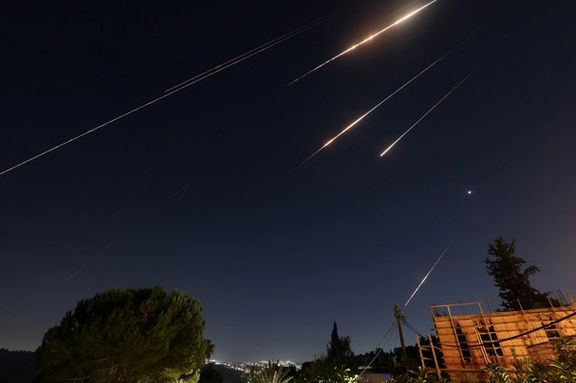
Missiles launched from Iran are seen from Jerusalem, June 13, 2025.
A senior commander in Iran’s Islamic Revolutionary Guard Corps (IRGC) and aide to the IRGC’s chief said the 12-day war with Israel ended with an absolute win for Tehran, adding Iran could have carried on the fight for years if necessary.
“We achieved a 100% victory in this war. Do not doubt it. Our victory was very significant, and we definitely came out as the winner,” Ahmad Vahidi told Fars News in an interview published Thursday.
When asked how he defined victory, Vahidi pointed to public opinion and the circumstances surrounding the ceasefire.
“In all the surveys, the judgment of our people is that we were victorious. The opinion of the people and global public sentiment is the same,” he said, without citing specific evidence.
“If we hadn’t won, and if the enemy hadn’t been crushed, then why did they ask for a ceasefire? It’s those who are defeated who request a ceasefire. For us, those 12 days were not a problem — we could have continued for 12 years.”
Israeli airstrikes and drone attacks during the June war killed hundreds of Iranians, including civilians, military personnel, and nuclear scientists. Missile strikes launched by Iran killed 27 Israeli civilians.
On June 22, the United States entered the conflict by striking Iran’s nuclear facilities in Isfahan, Natanz, and Fordow using long-range bombers and submarine-launched missiles.
A US-brokered ceasefire was announced on June 24 after Iran launched retaliatory airstrikes on a US airbase in Qatar.
Asked about the level of Israeli infiltration in Iran, Vahidi acknowledged limited human espionage but attributed most of Israel’s intelligence advantage to technological superiority.
“We don’t deny they have spies. But that they had someone at that level, in that position? I do not confirm that,” he said. “Much of their intelligence comes from advanced technology and satellite surveillance.”
During the war, Israel reportedly killed several high-ranking IRGC officials, including Armed Forces Chief of Staff Mohammad Bagheri, IRGC Commander Hossein Salami, IRGC Aerospace Force Commander Amir Ali Hajizadeh, and IRGC Deputy for Operations Mehdi Rabbani.
A senior White House official said the Trump administration has no plans to topple the Islamic Republic by force but said Washington hoped what he described as the people of Persia would ultimately "liberate themselves".
“We are not in the business of deploying the 82nd Airborne to do regime changes anywhere,” Sebastian Gorka, deputy assistant to the president and senior director for counterterrorism at the White House, told an event at Washington DC thinktank the Foundation for Defense of Democracies.
“We would like the people of Persia, including all the minorities in Persia, to eventually liberate themselves.”
A ceasefire late last month ended a 12-day conflict between Israel and Iran that was capped off by US strikes on Iranian nuclear sites.
Israeli Prime Minister Benjamin Netanyahu and US President Donald Trump both mooted killing Iran's Supreme Leader Ali Khamenei at the height of the conflict and Trump hinted at favoring Iranian regime change.
"It’s not politically correct to use the term, 'Regime Change,' but if the current Iranian Regime is unable to MAKE IRAN GREAT AGAIN, why wouldn’t there be a Regime change??? MIGA!!!" Trump said in a post on Truth Social in late June.
Israel’s prime minister also said on Tuesday that Iran’s clerical leadership will fall from within not through any foreign military intervention.
“Everybody talks about regime change and they envision the American army and Israeli forces invading Iran — boots on the ground and all that stuff people spew. No,” Netanyahu said in an interview with the Full Send Podcast.
Israel's surprise campaign of airstrikes and drone attacks killed hundreds of Iranians including civilians, military personnel and nuclear scientists. Iran's retaliatory missile strikes killed 27 Israeli civilians.
Diplomats from Iran, Russia, and China met in New York to coordinate their positions on the recent Israeli and US military campaigns and UN Security Council Resolution 2231 -- the basis that can bring back sanctions lifted under the 2015 nuclear deal, Iranian media reported.
UN Security Council Resolution 2231, adopted on July 20, 2015, endorses the Joint Comprehensive Plan of Action (JCPOA), the nuclear agreement between Iran and the P5+1 countries. The US unilaterally withdrew the accord in 2018.
The resolution includes provisions for monitoring Iran's compliance and sets a timeline for the eventual end of UN sanctions, provided Iran upholds its commitments.
“We held a joint meeting with the ambassadors and permanent representatives of China and Russia to review developments and adopt shared positions,” said Kazem Gharibabadi, Iran’s deputy foreign minister for legal and international affairs.
“We always coordinate our positions on key international issues, especially those concerning Iran.”
The meeting took place at Iran’s permanent mission to the United Nations on the sidelines of Gharibabadi’s trip to attend Security Council sessions.
A high-level meeting with Russian and Chinese officials was also held in Tehran on Tuesday, as reported by IRNA state news agency. This was part of a diplomatic effort to shield the country from the threat of reimposed UN sanctions under the 2015 nuclear deal’s snapback mechanism.
Gharibabadi also warned Wednesday that if European powers trigger the snapback mechanism, “leaving the NPT remains an option.”
Tehran has also agreed to host a technical team from the International Atomic Energy Agency in the coming weeks to discuss what Gharibabadi called a “new model for cooperation.”
“The delegation will come to discuss this framework,” he said. “They will not be inspecting nuclear sites.”
Late in June, Iran’s parliament voted to suspend cooperation with the IAEA after the ceasefire with Israel, demanding security guarantees.
Red lines for talks with Washington
The Iranian diplomat said talks could resume if Washington builds trust, pledges not to use negotiations as a pretext for military action, and recognizes Iran’s rights under the Nuclear Non-Proliferation Treaty.
"To enter negotiations with the American side, several principles are essential: building Iran’s trust — as Iran has absolutely no trust in the United States; ensuring that talks are not used as a platform for hidden agendas such as military action, even though Iran will remain fully prepared; and respecting and recognizing Iran’s rights under the Non-Proliferation Treaty, including enrichment in accordance with its desired needs," he wrote in a post on X Thursday.
Gharibabadi will lead the Iranian delegation for talks with European powers in Istanbul on Friday - in what appears to be a last-ditch effort to salvage a deal and avert a return of United Nations sanctions against Iran.
Washington confirmed on Tuesday that it is coordinating closely with the E3 (Britain, France and Germany) ahead of the Istanbul talks, while remaining "ready to talk directly" to Tehran.
Iranian forces violated international humanitarian law by firing cluster munitions into Israeli cities during the June fighting, Amnesty International said in a statement Thursday following analysis of impact footage and blast remnants.
“Cluster munitions are inherently indiscriminate weapons that must never be used,” said Erika Guevara Rosas, Amnesty’s Senior Director for Research, Advocacy, Policy and Campaigns.
“By using such weapons in or near populated residential areas, Iranian forces endangered civilian lives and demonstrated clear disregard for international humanitarian law.”
According to Amnesty, Iranian ballistic missiles dispersed dozens of submunitions over the densely populated Gush Dan metropolitan area on 19 June, with additional strikes verified in Beersheba on 20 June and Rishon LeZion on 22 June. One of the submunitions struck the basketball court of a school in Beersheba. No injuries were reported, but remnants found at the scene matched cluster bomblets documented in the earlier Tel Aviv-area attack.
“Civilians, particularly children, are most at risk of injury or death from unexploded submunitions,” Guevara Rosas added.
Amnesty emphasized that the high dud rate of many submunitions leaves behind long-term threats. Some ordnance may remain explosive for years, posing risks to residents returning to affected areas.
Indiscriminate weapons and legal implications
Cluster munitions, which scatter small explosive devices over a wide area, are widely banned under the Convention on Cluster Munitions. Neither Iran nor Israel is party to the treaty. Amnesty urged both governments to accede to the convention.
International humanitarian law forbids indiscriminate attacks, particularly those involving weapons that cannot be precisely directed at a specific military target. Launching such attacks into areas where civilians are present constitutes a war crime.
Amnesty said the ballistic missiles used by Iranian forces attacks were inaccurate by design. Previous assessments of similar strikes, including those launched in October 2024, found targeting errors averaging more than 500 meters.
The organization also cited past incidents suggesting Iran’s possession and testing of cluster submunitions. A similar munition landed in Gorgan, northern Iran, in September 2023 after what the Iranian Defense Ministry described as a failed weapons test. Though the ministry denied testing cluster ordnance, photographs published by state-aligned media closely resemble the bomblets found in Israel last month.
No Iranian response
Amnesty said it submitted formal inquiries to Iranian authorities on July 15 regarding the use of cluster munitions. No response had been received at the time of publication.
The 12 Day War between Iran and Israel in June resulted in the deaths of at least 1,062 people in Iran, including 786 military personnel and 276 civilians, according to the Iranian government spokesman.
"We have presented 1,062 martyrs in this war, including 102 women and 38 children," Fatemeh Mohajerani said in her weekly press briefing. She added that five paramedics, five nurses, and seven emergency responders were also among the casualties.
In Israel, at least 29 people, including women and children were killed as reported by the Israeli Health Ministry.
An Iranian satellite is set to launch into orbit aboard a Russian Soyuz rocket on Friday, IRGC-linked Tasnim News Agency reported, marking Tehran’s second space-related operation this week.
The launch is scheduled for 9:54 a.m. Tehran time from Russia’s Vostochny Cosmodrome and will carry two primary satellites, Ionosfera-M 3 and 4, alongside 18 smaller payloads, including the unnamed Iranian satellite. Russian media did not mention Iran but said 17 of the small satellites are Russian-made CubeSats, and one is being launched “for the benefit of a foreign customer.”
On Monday, Iran also carried out a suborbital test of its Qased satellite launcher, which Tasnim described as part of ongoing efforts to develop space technologies. Experts say the test, led by the IRGC, also signaled defiance after the 12-day war with Israel and served as a platform for refining ballistic missile capabilities.
“The same rocket that launches satellites can launch missiles; it's the identical technology,” said Fatima Al-Asrar, a Yemeni-American policy analyst. Iran insists its space program is peaceful, but analysts warn that each test advances dual-use military know-how.
“The timing shows Iran wants to project strength despite its recent setbacks,” said Middle East analyst Sina Azodi. Other observers say the launches may be calibrated to stop short of triggering military retaliation while keeping pressure on Western powers.
Such tests have drawn Western concern due to their dual-use potential — the same technology used to launch satellites can also deliver ballistic missiles. In January 2024, the European Troika, Britain, France, and Germany, condemned Iran’s launch of the Soraya satellite aboard the Qaem 100 rocket, warning it used the same base as long-range missile systems.
Iran's president said that the country is ready for further conflict with Israel as tensions continue to simmer in the wake of the 12-day war, saying that he does not believe that the fragile ceasefire is final.
“We are fully prepared for any Israeli military action, and our forces stand ready to strike deep into the occupied territories once again,” Masoud Pezeshkian told Al Jazeera Arabic, stressing however that the country does not want war.
The conflict between Iran and Israel was triggered by Israeli airstrikes on June 13 that hit military, nuclear, and civilian sites across Iran. Among those killed were senior Iranian military commanders and nuclear scientists.
Iran retaliated with ballistic missile and drone attacks on Israel.
Iran says 1,062 people were killed during the 12-day conflict with Israel, including 786 military personnel and 276 civilians.
Israeli medical officials say a total of 28 people were killed and over 3,000 were wounded by Iranian attacks.
Pezeshkian said Tehran holds Washington partly responsible for the attacks after the US conducted follow-up strikes to Israel's opening attacks on three major Iranian nuclear facilities, later saying to have "obliterated" them. A ceasefire between Iran and Israel took effect on June 23.
Iran says its nuclear program is peaceful. Pezeshkian repeated the same position in the interview, adding that the Islamic Republic has no intention of acquiring nuclear weapons.
“We categorically reject possessing nuclear weapons,” he said. “This is our political, religious, human, and strategic position.”
The president also disputed US President Donald Trump's statement that Iran’s nuclear capabilities had been destroyed, calling the claims an "illusion".
“Nuclear capability resides in the minds of our scientists, not in our facilities," he said.
Diplomatic negotiations on Iran’s nuclear program are expected to resume Friday in Istanbul, where Iranian officials will meet representatives of the E3—France, Germany, and the UK. Talks between Iran and the US, previously channeled through Oman, remain suspended following last month’s escalation.
The three European states, known as E3, have said they would restore international sanctions on Iran by the end of August if the country did not enter productive talks on its nuclear program with Western powers.
Pezeshkian said Tehran remains open to diplomacy but added that “Any future negotiations must be based on a win-win logic.”