Iran’s rial weakens on fears of looming snapback sanctions
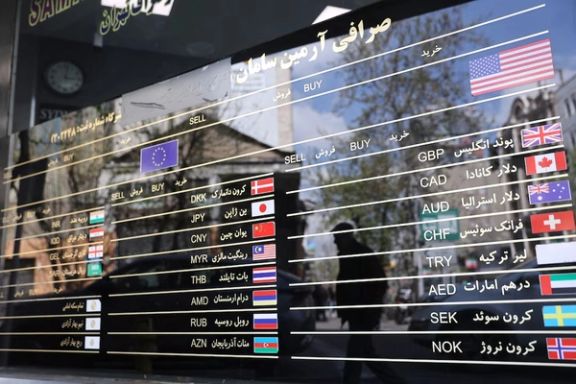
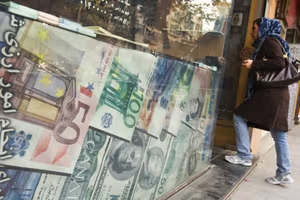
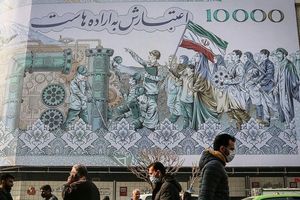
A sign board at a currency exchange in Tehran
The Iranian rial fell sharply on Wednesday as markets braced for the reimposition of UN sanctions under the snapback mechanism, with the US dollar trading above 1,074,000 rials on the open market, more than 2% higher than a day earlier.
Sterling climbed to 1,440,000 rials, while the price of the “Emami” gold coin rose 3.5% to 1,070,000,000 rials, reflecting heightened demand for hard assets amid economic uncertainty.
On Tuesday, Iran’s central bank governor Mohammadreza Farzin sought to reassure business leaders that the country’s foreign exchange and gold reserves remain secure.
Also on Wednesday, Oil Minister Mohsen Paknejad said that reimposition of UN sanctions will not add "new burdensome restrictions" on the country’s oil sales.
"In the last years, we have faced such severe restrictions from the unjust and unilateral US sanctions that, in practice, [UN sanctions] won't add much to this situation," Paknejad said after a cabinet meeting.
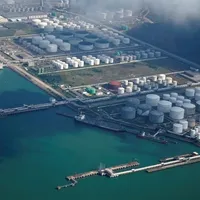
The oil and petrochemical sector contributed roughly a quarter of Iran’s GDP in 2024, making continued exports critical to Tehran’s economy as sanctions loom.
Reuters also reported on Wednesday that the revival of sanctions is unlikely to halt Tehran’s vital crude exports but could hand Chinese refiners a lucrative advantage, giving them greater access to discounted Iranian oil.
The looming revival of UN sanctions on Iran is unlikely to halt Tehran’s vital crude exports but could hand Chinese refiners a lucrative advantage, giving them greater access to discounted Iranian oil, Reuters reported on Wednesday.
Britain, France and Germany triggered the 30-day “snapback” process on August 28, accusing Iran of breaching the 2015 nuclear deal. If no agreement is reached, restrictions including an arms embargo, asset freezes and bans on nuclear-related technology will return at the end of the month.
The move would also provide a legal basis for the EU and Britain to reimpose banking, shipping and energy curbs.
But as Reuters’ columnist Ron Bousso writes, past experience shows Western sanctions have had limited lasting impact on Iranian oil flows.
Exports collapsed to 444,000 barrels per day (bpd) in 2020 after Washington reimposed sanctions but have since rebounded to 1.6 million bpd this year, with nearly 80% going to China, according to data from analytics firm Kpler.
Despite years of US efforts to expand restrictions on tankers, traders and refiners, Iran has developed an opaque network of intermediaries, uninsured vessels and ship-to-ship transfers to keep crude flowing.
“These whack-a-mole efforts have had little and often short-lived impact,” Bousso wrote.
Analysts say the snapback may deter some Asian buyers but not Beijing, which has already defied Western sanctions by importing sanctioned Russian LNG cargoes. Chinese refiners could even gain leverage to secure Iranian oil at steeper discounts, further undermining the effectiveness of Western sanctions.
The oil and petrochemical sector contributed roughly a quarter of Iran’s GDP in 2024, making continued exports critical to Tehran’s economy as sanctions loom.
Iran's push to modernize its oil industry through artificial intelligence and advanced drilling techniques faces daunting old obstacles from restricted access to technology to mounting financial constraints which have dogged exports for years.
National Iranian Oil Company (NIOC) chief Hamid Bord in a February speech set an ambitious target of raising production by 400,000 barrels per day (bpd) this year, putting AI and digital reservoir management at the center of the plan.
These tools use data modeling and automation to map underground reserves, optimize drilling, and improve recovery rates from aging fields.
Bord urged Iran’s knowledge-based firms to launch pilot projects for smart drilling and enhanced recovery, hoping to boost output despite sanctions and isolation.
More than six months later the vision remains unrealized, with exports roughly steady at around 1.7 million bpd with stiff US sanctions only increasing since the return of US President Donald Trump and his so-called maximum pressure sanctions in January.
Major obstacles
The gap between high-tech ideas and field-level execution remains wide.
Early trials have already exposed operational problems and underscored the heavy responsibility on NIOC to turn innovation into results.
The cash required for such projects is also scarce. Whatever capital is available is drained away by aging infrastructure, maintenance backlogs, surging domestic demand and sanctions that block access to equipment.
Iran hemorrhages the value of about four out of every five barrels of oil it manages to export, a former senior US Treasury official told Iran International last week, as sanctions forced funds to be lost in corrupt smuggling networks.
Tehran casts this push as part of a broader sanctions-resilience strategy.
By investing in high-tech solutions and formalizing technology integration, it hopes to build an advanced, adaptable export network more resilient to blockade or interception.
Expanding capacity through digitization also carries geopolitical stakes: more barrels could strengthen Iran’s position within OPEC and global markets, offsetting its diplomatic isolation.
But scaling innovations in Iran’s difficult oilfields is another matter.
Many startups lack the resources and experience to apply their technologies at scale, leaving NIOC to supervise integration in hostile operating conditions.
Rising gas consumption—already above one billion cubic meters daily—is adding to the strain, diverting investment from oil exports and worsening supply-demand imbalances.
Big prize, little chance
If those hurdles can be overcome, the payoff would be significant.
Advanced drilling and AI-driven recovery could extend the life of aging fields, stabilize revenues and reduce reliance on costly new reserve exploration. Building a knowledge-based ecosystem might also diversify the economy, generate jobs, and spur research and development.
Limited international partnerships, including with European universities, provide channels for technology transfer and best practices, blending local innovation with selective global input.
Iran’s tech-driven oil strategy reflects determination to sustain its role in global energy despite sanctions and isolation. But its success hinges on closing the gap between vision and implementation while managing surging domestic demand—a tall order as UN sanctions are set to snap back within days.
Iran and European powers held last-ditch talks in New York on Tuesday to try to prevent the revival of UN sanctions on Tehran, though diplomats on both sides cautioned that chances of success remain slim.
Foreign ministers of Iran, Britain, France and Germany – the so-called E3 – met on the sidelines of the UN General Assembly, joined by EU foreign policy chief Kaja Kallas, amid warnings that a 30-day “snapback” process to reimpose sanctions will expire on September 27.
In the meeting between Iranian and European top diplomats in New York, "some ideas and proposals for continuing diplomacy were raised, and it was decided that consultations with all involved parties would continue," according to Iran's Foreign Ministry.
"The course of discussions over the past month aimed at finding diplomatic solutions regarding Iran’s nuclear issue and preventing an escalation of tensions was reviewed in the meeting," according to the Foreign Ministry statement.
The E3 triggered the process on August 28, accusing Iran of failing to comply with a 2015 nuclear deal designed to prevent it from developing nuclear weapons. Tehran denies it seeks such arms, insisting its nuclear program is for peaceful purposes.
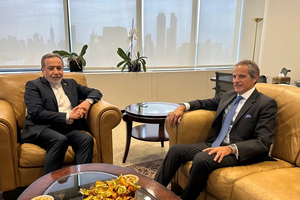
“Iran has been in contact with E3/EU officials and (the UN nuclear chief Rafael) Grossi since this morning at the UN Different ideas have been raised and discussed,” a senior Iranian official told Reuters on Tuesday.
Another Iranian official said “everyone seems to be trying” to find a resolution.
Iranian Foreign Minister Abbas Araghchi warned European states to choose “cooperation or confrontation.”
Speaking on state TV, he said: “They have tested Iran repeatedly and know we do not respond to the language of pressure and threat ... I hope we can find a diplomatic solution in the coming days, otherwise Tehran will take appropriate measures.”
According to diplomats, the E3 have offered to delay reinstating sanctions for up to six months if Iran restores access for UN inspectors, addresses concerns over its stockpile of enriched uranium and agrees to talks with the United States.
But two European envoys said Iran’s leaders have yet to meet these conditions. “The ball is in Iran’s camp,” one diplomat said. “It is up to it to quickly take the concrete steps in the coming days to avert snapback. If not, then sanctions will be reimposed.”
Another diplomat added, “The minimum would be for Iranians to present the special report and allow some token visit of inspectors to some sites, but even then that probably won’t fly – and chances are the US would veto.”
If no extension is agreed, all pre-2015 UN sanctions will automatically return on September 28, compounding economic pressures from US and European measures already in place.
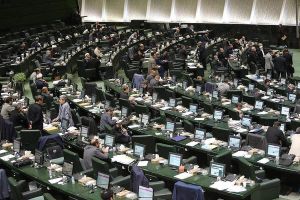
President Masoud Pezeshkian said on Saturday that Iran would “overcome” any reimposition of sanctions. According to an insider cited by Reuters, growing discontent over the economy was rattling Iran’s leadership, with little sign of answers.
In June, following US and Israeli strikes on Iranian nuclear sites, Iran’s parliament passed a law suspending cooperation with the International Atomic Energy Agency. A deal with the IAEA was reached on September 9 to resume some inspections, though diplomats say its scope remains limited.
“I am in New York to use these remaining days for diplomatic consultations that might lead to a solution,” Araghchi said. “If it is not found, we will continue our path.”
Iran’s security chief Ali Larijani said on Tuesday that Tehran had accepted European and Russian proposals to avert the co-called snapback of UN sanctions, but the West triggered international sanctions on Iran nonetheless.
Larijani, who leads Iran's Supreme National Security Council, accused France of reneging on a pledge to hold back on the sanctions push if Iran made a deal with the International Atomic Energy Agency (IAEA).
“France, via the IAEA chief, promised to withdraw snapback demands if Iran agreed with the agency. Iran’s foreign minister signed this in Egypt, under security concerns and parliamentary mandates following bombed nuclear sites. France did not honor this,” official media quoted him as saying.
France, Britain and Germany triggered UN sanctions on August 28 through the so-called snapback mechanism of a 2015 international nuclear deal with Tehran.
On September 9, Iran and the IAEA signed a technical agreement in Cairo, mediated by Egypt, to pave the way for resuming nuclear inspections halted in June.
“European and Russian proposals, accepted by Iran with conditions, set a six-month negotiation period, but the West pursued snapback at the UN Security Council instead,” Larijani said.
Iran has warned that new attacks or sanctions would void the agreement, though it still sees the deal as a step toward de-escalation.
US missile demands ‘unacceptable’
Larijani also appeared to reveal details of a US proposal, saying Washington had demanded Iran reduce its missile range to under 500 km (310 miles) - “a condition no honorable person could accept,” he said.
For years, Iran has voluntarily limited its missile range, suggesting that 2,000 kilometers is sufficient to reach its main regional target, Israel.
However, a senior advisor to Iran's Supreme Leader suggested last year that the country might abandon its self-imposed missile range limit and could even pursue intercontinental capabilities if it faced an "existential threat".
Larijani made the remarks at the Tehran Chamber of Commerce, signaling preparations for the return of UN sanctions on September 28.
Iran’s central bank governor Mohammadreza Farzin sought to reassure business leaders on Tuesday that the country’s foreign exchange and gold reserves remain secure as UN snapback sanctions loom later this month.
Speaking at a meeting with the National Entrepreneurs Assembly, Farzin said the Central Bank of Iran (CBI) has “full security and access” to reserves held abroad and is preparing special measures to support exporters, ease access to hard currency and expand financing channels.
He announced plans for up to €200 million in sukuk Islamic bonds, new credit for export-oriented firms and a joint committee with entrepreneurs to resolve banking hurdles.
Farzin stressed that the CBI’s priority is to curb inflation and maintain financial stability, pledging that “all monetary and foreign exchange decisions will be taken with these objectives in mind.”
He also said the bank has introduced new instruments such as chain financing, gold-backed bonds and pre-sale of foreign currency to increase resilience in the market.
The remarks come as Iran braces for the automatic return of UN sanctions on September 28 after Britain, France and Germany triggered the mechanism last month.
The snapback would reinstate international restrictions suspended under the 2015 nuclear deal, compounding existing US and EU sanctions that have already slashed oil revenues and battered the rial.
Iran’s currency has tumbled past 1,038,000 rials per dollar on the open market, while inflation hovers near 50%.
Analysts warn that renewed sanctions could push inflation above 60–90% and deepen negative growth.
Despite official assurances, businesses say access to foreign exchange remains a critical obstacle, with many entrepreneurs urging structural reforms and clear rules for investors.