Iran says 'unjust' Western sanctions mar Tehran's ties with other nations
Iran’s foreign minister Abbas Araghchi
Iran’s foreign minister said on Thursday that illegitimate sanctions imposed by the United States and the European Union have limited Tehran’s ability to expand economic cooperation with other nations.
Foreign Minister Abbas Araghchi made the remarks in an interview with Uganda’s BBEG media outlet on the sidelines of the Non-Aligned Movement foreign ministers’ meeting in Kampala.
He said Iran remained committed to strengthening economic partnerships among member states.
“We welcome unity and economic partnerships among Non-Aligned Movement countries to promote effective diplomacy and sustainable development within our group. This solidarity is vital for all our partners,” Araghchi said.
Iran, he added, had significant capacity to share expertise with developing nations in areas such as oil and gas and called for greater South-South cooperation.
The Non-Aligned Movement was founded during the Cold War by states seeking to avoid alignment with either the US or Soviet blocs.
NAM includes around 120 member countries and focuses on issues such as sovereignty, economic development, social justice and mutual cooperation.
Iran became a NAM member in 1961 and has at times held its presidency.
A day earlier, Araghchi had urged member states to reject what he described as “invalid” attempts by the United States and the three European countries known as the E3 — Britain, France and Germany — to reimpose United Nations sanctions on Iran.
He called the move “groundless and illegitimate” speaking during the 19th Ministerial Meeting of the Coordinating Bureau of the Non-Aligned Movement (NAM) in Kampala on Wednesday.
“This stance not only renews our joint dedication to NAM’s core values but also sends a loud and clear message to the world that independent nations, united in solidarity and purposeful resolve, will not bow to bullying or coercive pressures,” he said.
The E3 triggered the reimposition of international sanctions on Iran last month, accusing Tehran of spurning diplomacy and nuclear inspections.
Russia and China sought to block the move at the UN Security Council on September 26 not enough member states supported their bid and the sanctions were reimposed the following day.
Iran has not yet provided reports or set inspection dates for damaged nuclear sites under its Cairo access agreement with the International Atomic Energy Agency, Wall Street Journal correspondent reported on Thursday.
“While Iran has not binned or ended discussions with the IAEA on implementing the Cairo access deal, I understand it still hasn’t issued reports or given dates for issuing reports on damaged sites and stockpile. Nor of course permitted access to damaged sites,” Laurence Norman wrote on X. He said IAEA chief Rafael Grossi “is for now being given more space” but continues to press Tehran to advance on these steps.
The comments come as Iran’s Atomic Energy Organization chief Mohammad Eslami said on Wednesday that “no IAEA inspector is currently in the country.” Eslami said only two visits had been allowed since the June airstrikes on Iranian nuclear facilities — to Bushehr and Tehran reactors — both cleared by the Supreme National Security Council.
The Cairo deal, reached in September between Foreign Minister Abbas Araghchi and Grossi, was meant to restore limited cooperation after the strikes. It outlined “practical modalities” for monitoring declared nuclear sites, but Iranian officials warned the accord could collapse if UN sanctions were reinstated. Western governments triggered the snapback of those sanctions in late September, citing Iran’s failure to meet its obligations.
Eslami said Iran is not considering leaving the Nuclear Non-Proliferation Treaty but faulted the IAEA for failing to condemn the US and Israeli attacks. “The agency should have condemned the attack on Iran’s nuclear sites, but it did not,” he said, adding that Iran’s cooperation is now governed by a new parliamentary law limiting access.
Norman said the IAEA has so far avoided demanding immediate access to a specific site to prevent a direct refusal by Tehran, “risking a crisis.” He added that Iran “could play its old game of offering something ahead of [the] November IAEA board” but warned that without progress, “we could be running into another significant moment in November.”
A Norwegian court has sentenced a former security guard at the US embassy in Oslo to three years and seven months in prison for passing sensitive information to Russian and Iranian intelligence, the court said on Thursday.
The man told investigators he acted to protest US support for Israel’s war in Gaza.
The 28-year-old Norwegian, whose name has not been released, was found guilty of providing floor plans, personal details of embassy staff and their families, and information about activities at the mission between March and November 2024. The court said he received 10,000 euros ($11,700) from Russian intelligence and 0.17 bitcoin from Iranian intelligence in return.
During the trial, the defendant admitted to spying but denied aggravated espionage, saying the material he shared was not classified. He told the court his actions were motivated by opposition to Washington’s support for Israel’s military operations in Gaza.
The verdict comes amid heightened concern in Europe about foreign espionage and influence operations. Britain’s MI5 warned this week that intelligence agencies from China, Russia and Iran are targeting lawmakers to shape policy and collect information.
European authorities have also stepped up investigations into financial and cyber networks linked to Iran. In Germany, media reports said a Berlin businesswoman allegedly helped move Iranian oil revenues through front companies tied to the defense ministry. In Australia, police charged a Sydney man with sending nearly $650,000 to sanctioned Iranian banks.
Western intelligence services say Tehran has expanded its overseas operations in recent years through cyber activity, disinformation campaigns and the recruitment of local agents. Iran denies running espionage networks abroad and says it faces similar accusations meant to isolate it diplomatically.
Iran summoned Poland’s Chargé d’Affaires in Tehran on Thursday to protest Polish Foreign Minister Radoslaw Sikorski's participation in an event in the British Parliament that displayed a downed Iranian-made drone allegedly used by Russia in its war on Ukraine.
The exhibition, organized by the US-based advocacy group United Against Nuclear Iran (UANI), featured a Shahed-136 drone recovered in Ukraine and was intended, according to the group, to highlight Tehran’s role in aiding Moscow’s military campaign. Sikorski attended the event during a visit to London for meetings with British officials.
Earlier that day, Sikorski told reporters that a recent Russian drone incursion into Polish airspace was “tactically stupid and counterproductive,” saying it had only strengthened Western resolve against Moscow. The Polish minister said the drones appeared to have been launched deliberately from Russia and coordinated with Belarus.
Mahmoud Heidari, the Foreign Ministry’s director general for Mediterranean and Eastern European affairs, summoned Polish Chargé d’Affaires Marcin Wilczek and conveyed what he called Tehran’s “strong protest” over the London event. Heidari rejected what he described as “baseless and repetitive accusations” about Iran’s drone program and expressed regret over Sikorski’s involvement.
Iran’s Foreign Ministry said the move to exhibit the drone violated diplomatic norms and repeated politically motivated allegations about Iran’s role in the Ukraine conflict.
Iran denies supplying drones for use in the war, saying it sold a limited number to Russia before the invasion began. Western governments and Ukraine say Shahed-type drones, designed in Iran and now produced in Russia under the name Geran, have become central to Moscow’s air assaults. The Financial Times reported in July that the modified drones have tripled their success rate in hitting targets.
Polish officials have not publicly commented on the summons, but Warsaw has cooperated with UANI and Ukrainian forces in transferring a similar drone to the United States earlier this year for display at a political conference attended by US President Donald Trump.
Australian authorities have charged a western Sydney man for allegedly sending about $650,000 to Iranian banks under sanctions, the Australian Federal Police said on Wednesday.
The 34-year-old, a director of an Auburn-based remittance company, is accused of processing 543 international transfers worth $649,308 to sanctioned Iranian banks over a year, the AFP said in a joint statement with the Australian Sanctions Office and AUSTRAC.
Search warrants were executed in July at a Wentworthville home and an Auburn business, where investigators seized electronic devices. Forensic examination allegedly revealed evidence of funds transfers to designated banks.
The man has been ordered to appear before Downing Centre Local Court on Wednesday charged with contravening Australian sanction laws, an offence carrying a maximum of 10 years in prison and fines of up to three times the transaction value.
AFP Detective Superintendent Peter Fogarty said the force “works closely with the Australian Government and partners to ensure Australians aren’t breaching sanctions and dealing with foreign entities which engage in concerning conduct.” He added, “If you are contravening Australian sanctions, be warned – the AFP is ready and willing to act to disrupt your criminal activities.”
AUSTRAC national manager Anthony Helmond said, “Every time a business is instructed to transfer funds internationally, they must report that to AUSTRAC. We monitor these reports for signs of this type of activity and other criminality.”
Authorities said the Auburn company’s registration had been suspended for one year. The Australian Sanctions Office said it continues to monitor remittance companies to ensure compliance with financial sanctions.
Iran’s ambassador to Russia on Wednesday rejected praise among Israeli supporters of Donald Trump as a modern-day Cyrus the Great, citing the US president's support for what he called human rights violations in Gaza.
“One of the officials of the Zionist regime used the phrase ‘Trump as Cyrus the Great,’” Kazem Jalali, said at a ceremony in Moscow on . “Those who call the US president by such a title should be reminded that a person who supports the killing of tens of thousands in Gaza cannot be called a defender of human rights,” he said.
The remarks appeared to answer comments by Knesset Speaker Amir Ohana, who on Monday called Trump “a giant of Jewish history” and compared him to the ancient Persian ruler.
Ohana made the remarks during Trump’s visit to Jerusalem, where he addressed Israeli lawmakers after brokering a ceasefire in Gaza.
Banners in Tel Aviv posted this week by the Friends of Zion, a Christian organization dedicated to backing Israel, proclaimed "Cyrus is Alive!" alongside Trump's picture.
Cyrus is revered as a powerful ancient ruler by Iranians and remembered fondly in the Jewish tradition for ending the so-called Babylonian Captivity of Jews when his forces conquered that empire and allowed exiled Jews to return to Jerusalem.
A decree after his conquest recorded on an ancient artifact called the Cyrus Cylinder created in 539 BC enshrined aspects of religious freedom and has been hailed as the first bill of human rights.
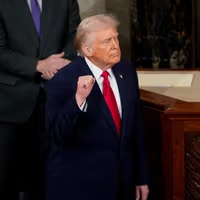
Trump received a hero’s welcome in Israel this week after helping to secure a truce that ended two years of war in Gaza and freed the last living Israeli hostages. During his visit, he signed a Gaza ceasefire deal at a summit in Sharm el-Sheikh and said US strikes on Iran’s nuclear facilities had “obliterated” the program.
“The bully of the Middle East has been taken down,” Trump said, adding that Iran “will not return to the nuclear world again.”
Iran has denied pursuing nuclear weapons and accused Israel of misleading the US president into authorizing the attacks. Foreign Minister Abbas Araghchi said on Tuesday that Trump had been “badly fed the fake line” that Iran was close to producing a bomb.
Araghchi wrote on X that Trump was “being misled by the same warmongers who derailed American diplomacy with Iran for many years.” He said the US could not call for peace while leading military action against Iran and reinstating sanctions.
“The real bully of the Middle East, Mr. President, is the same parasitic actor that has long been bullying and milking the United States,” he wrote, referring to Israel.