Iranian parliament targets Rouhani and Zarif amid row over Russia stance
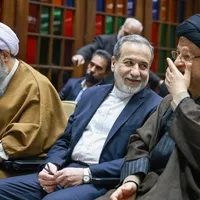
File photo of former President Hassan Rouhani (left) and former Foreign Minister Mohammad Javad Zarif
Iran’s political establishment has intensified its backlash against former president Hassan Rouhani and former foreign minister Mohammad Javad Zarif over their recent remarks on Russia, with parliament members and former officials accusing them of undermining national unity.
Abbas Goudarzi, spokesman for the parliament presidium, accused Rouhani of “disturbing public opinion and weakening national unity” and called on the judiciary to investigate what he described as Zarif’s “anti-Russia remarks.”
His comments, published on Saturday by Tasnim News Agency, came amid growing debate over Iran’s strategic partnership with Russia and China.
Rouhani has recently renewed calls for dialogue with the West and the United States, while Zarif said on October 17 that Moscow’s foreign policy toward Tehran rests on two red lines: “Iran must not normalize relations with the world and must not enter direct confrontation with it.”
“The judiciary must respond decisively,” Goudarzi said. “National security cannot be left in the hands of those who did nothing when in power and now seem upset to see a new global order forming.”
“Today Russia and China stand by the Islamic Republic and by truth itself, taking good positions against America’s unilateralism and condemning the wrongful actions of European countries. Unfortunately, some from within are sending negative signals."
"When they were in positions of responsibility, they leaned entirely toward the West, but now that we are witnessing a positive approach in foreign policy, the same people are pouring water into the enemy’s mill, creating obstacles and placing sticks in the wheels,” he added.
Lawmakers and former officials join criticism
Vahid Ahmadi, a member of the parliament’s National Security and Foreign Policy Committee, also rejected criticism of Iran’s alignment with Russia and China.
“Those who are sensitive about our friendship with the East are either hostile, uninformed, or influenced by certain propaganda,” he said on Saturday in remarks quoted by Fararu website.
“We have long-term 20- and 25-year agreements with Russia and China as partners, and we are acting based on the national interests of our country,” Ahmadi added.
Former foreign minister Manouchehr Mottaki, who served under President Mahmoud Ahmadinejad, also joined the criticism of Rouhani.
“During his government’s nuclear negotiations with the United States, Rouhani adopted the worst possible approach. By referring to America as ‘the village elder,’ he effectively disarmed himself and handed the upper hand to the other side,” he said.
Earlier, parliament speaker Mohammad Bagher Ghalibaf also accused Rouhani and Zarif of damaging Tehran-Moscow relations, which he described as progressing well.
Despite the 20-year strategic cooperation agreement signed earlier this year between Tehran and Moscow, the exchange has laid bare widening divisions within Iran’s political establishment over the country’s reliance on Russia, as critics warn that Moscow sees Iran largely as leverage in its standoff with the West.
Tehran seeks peace but will deliver a decisive response if attacked, Iran’s deputy foreign minister said in an interview with CTV Belarus on the sidelines of the Eurasian Security Conference in Minsk, according to Iranian media.
The recent confrontation in June had shattered long-standing assumptions about Israel’s military power, Saeed Khatibzadeh said.
“The myth of Israel’s invincibility collapsed after Iran’s response,” he added, describing Tehran’s military action as a turning point that proved Iran’s capacity to retaliate.
Earlier this year, the United States held five rounds of negotiations with Tehran over its disputed nuclear program under a 60-day deadline set by President Donald Trump.
When no agreement was reached by the 61st day, on June 13, Israel launched a surprise military offensive, followed by US strikes on June 22 targeting key nuclear facilities in Isfahan, Natanz, and Fordow.
“Iran has no choice but to secure a decisive victory against the aggressor,” Khatibzadeh said, arguing that any attack on Iran would be met with a response aimed at ensuring that “the aggressor will undoubtedly regret its decision.”
‘We are peace-seeking, but we fight well’
Iran does not seek confrontation but will not hesitate to defend itself, Khatibzadeh said. “We are a peace-seeking people, but if war is imposed on us, we fight well… We never sought confrontation, but they chose the path of confrontation.”
The deputy minister linked Iran’s stance to what he called the “geopolitical ambitions” of the United States and Israel, urging other countries to recognize Iran’s right to defend itself.
“We have never accepted the language of force,” he said. “Our message is clear: respect, justice, and balance must define international relations.”
The 12-day conflict ended on June 24 after a US-brokered ceasefire, but global alarm over Tehran’s nuclear program deepened as 400 kilograms of Iran’s highly enriched uranium remained unaccounted for.
Tehran says the material lies buried beneath debris from US and Israeli airstrikes, rendering it unreachable, yet it has so far refused to grant international inspectors access to the damaged sites.
Oman on Saturday called on Iran and the United States to resume suspended nuclear negotiations, as Tehran’s foreign minister ruled out halting uranium enrichment or curbing its missile program.
Omani Foreign Minister Badr Albusaidi said during the Manama Dialogue conference in Bahrain that Muscat wanted to see “a return to negotiations between Iran and the United States.” He said the talks, which Oman had hosted earlier this year, were derailed in June when Israel launched air and missile strikes on Iranian nuclear sites.
“Just three days before the sixth and possibly decisive round of talks, Israel unleashed its bombs and missiles in an illegal and deadly act of sabotage,” Albusaidi said, according to AFP.
Oman, a traditional mediator between Tehran and Washington, has helped facilitate indirect talks this year aimed at reaching a deal to limit Iran’s nuclear work in exchange for sanctions relief.
Iran’s Deputy Foreign Minister Majid Takht-Ravanchi visited Muscat earlier this week for a meeting of the Iran-Oman Political Strategic Committee, where he and Albusaidi discussed regional developments and plans to expand bilateral cooperation, according to Iranian media.
Tehran denies US message via Oman
The United States did not send a message to Iran through Oman, Iran’s IRGC-affiliated Tasnim News Agency reported on Saturday, citing an informed source. The outlet said the comment came after Iraq’s Baghdad Al-Youm alleged that Washington had used Muscat to convey a proposal to resume suspended nuclear talks.
Iranian Foreign Minister Abbas Araghchi told Al Jazeera on Saturday that Tehran would not stop uranium enrichment or negotiate on its missile program, warning that any new Israeli attack would have “bad consequences.”
Araghchi said Iran was open to indirect talks with Washington to reach what he called a fair agreement on its nuclear program but would not make concessions after being attacked. He added that Iran would not accept Western pressure or what he described as “dictates.”
Cairo urges Iran, IAEA to resume cooperation
His comments came a day after Egypt said it had urged both Iran and the International Atomic Energy Agency to end the standoff over inspections of damaged nuclear sites. Egyptian Foreign Minister Badr Abdelatty said he conveyed the appeal to Araghchi and IAEA chief Rafael Grossi in separate phone calls aimed at reviving cooperation between the two sides.
Iran suspended full cooperation with the UN nuclear watchdog after the June war with Israel and the United States. Under a post-war law, inspections now require approval by Iran’s Supreme National Security Council and exclude access to bombed facilities.
Albusaidi said regional states should seek dialogue rather than confrontation. “Over the years, the Gulf Cooperation Council has at best sat back and permitted the isolation of Iran,” he said. “I believe this needs to change.”
Iran’s foreign minister said Tehran will not halt uranium enrichment or negotiate over its missile program, warning that any new Israeli attack would have “bad consequences,” Al Jazeera reported on Saturday.
Foreign Minister Abbas Araghchi said Iran had managed the June war with Israel effectively and prevented it from spreading to the wider region, according to the Qatari network. He said Iran was fully prepared for any new confrontation and warned that Israel would face “another defeat” if fighting resumed.
Araghchi said Iranian nuclear sites were damaged in the war but its enrichment technology remained intact, with nuclear materials still at the bombed facilities.
He said Iran would not accept Western pressure and was ready for indirect talks with Washington to reach what he called a fair agreement on its nuclear program. Tehran was willing to address international concerns, he added, but would not make concessions after being attacked.
His remarks came a day after Egypt said it had urged both Iran and the International Atomic Energy Agency to end the standoff over inspections of damaged nuclear sites. Egyptian Foreign Minister Badr Abdelatty said he conveyed the appeal to Araghchi and IAEA chief Rafael Grossi in separate calls aimed at reviving cooperation.
Iran suspended full cooperation with the UN watchdog after the June war with Israel and the United States, which struck several nuclear facilities. Under a post-war law, inspections now require approval by Iran’s Supreme National Security Council and exclude access to the bombed sites.
Western powers accuse Tehran of hiding military dimensions to its program, while Iran insists its nuclear work is peaceful.
Tensions with Washington have sharpened after US President Donald Trump ordered the first American nuclear weapons tests in more than three decades. Araghchi called the move a regressive and irresponsible step and said it showed what he called US hypocrisy for condemning Iran’s nuclear work while restarting its own testing.
Iraq’s communications ministry said on Friday that its contract with a company tied to Iran-backed militias was legal and unrelated to the management of the country’s data network, after a recent US report raised security concerns.
“The contract was concluded according to proper procedures and has no connection with the management of Iraq’s communications network,” the ministry said. It added that operations and data systems remain under the authority of ministry staff.
The statement followed an article in The Atlantic that described the Muhandis General Company as an Iraqi version of Iran’s Revolutionary Guard Corps. The magazine said Prime Minister Mohammed Shia al-Sudani had created the firm and awarded it government contracts, including for fiber-optic maintenance, giving Iran-aligned militias new influence inside Iraq’s economy. The Atlantic also reported that Washington sanctioned the company in October, calling it a front for terrorist groups and corruption.
According to The Atlantic, the Popular Mobilization Forces—an umbrella for mostly Shi’ite militias formed in 2014 to help the army fight Islamic State—have gained wider power under al-Sudani, who has embraced and enriched them through public-works contracts. The report said recent deals with the Muhandis company give the militias something they have long sought: a foothold in Iraq’s data network.
The communications ministry rejected what it called “targeted attacks” against its work and said its projects were being carried out transparently and in line with Iraqi law.
A senior Iranian official has called for sweeping changes in the country’s system of governance, warning that without reform the Islamic Republic risks “war, collapse, or chaos,” according to remarks published on Thursday.
Even a breakthrough in talks with the United States or renewed oil exports would not resolve Iran’s deeper political and economic dysfunction, said Mohammad Sarafraz, a member of the Supreme Cyberspace Council and former head of state broadcaster IRIB, in an interview with Khabar-e Fori. “We will not reach a desirable outcome, nor will the results benefit the people,” he added.
Sarafraz urged what he described as a “revolution in governance,” saying the Islamic Republic’s current structures had reached a dead end. On the nuclear file, he warned that Iran’s ambiguity “is certainly not to our benefit and must change,” as United Nations sanctions have now been reinstated. Continuing the present course, he said, would isolate Iran further, since “this time it will not only be the United States we face – Europe and some regional countries will also stand with America.”
His comments came as US Treasury Undersecretary John Hurley began a tour of the Middle East and Europe aimed at tightening financial pressure on Tehran.
"President Trump has made clear that Iran's destabilizing and terrorist activities must be met with sustained and coordinated pressure," Hurley said in the statement.
"I look forward to meeting with our partners to coordinate our efforts to deny Tehran and its proxies the financial access they rely on to evade international sanctions, fund violence, and undermine stability in the region."
Sarafraz also dismissed the notion that pursuing nuclear weapons could deter foreign threats. The Western countries say Iran’s uranium enrichment exceeds civilian needs. Tehran insists its nuclear program is peaceful.
Turning to Iran’s regional allies, he said groups such as Hamas, Hezbollah, and Yemen’s Houthis were now weakened or sidelined and no longer capable of providing strategic depth. “They were powerful in the past, but failed to deliver,” he said.
Sarafraz called for a recalibration of foreign policy toward the United States, China, and Russia, warning that all three “seek a weak Iran compliant with their interests.” He urged a balanced approach – “neither dependent nor hostile” – and said Iran’s faltering economy had become “a hostage of foreign policy.”
At home, he demanded fundamental reform rather than a mere change of president, advocating genuine public participation in governance.