Russia says no rift with Iran as row over Moscow role heats up in Tehran
Russian President Vladimir Putin (left) meets Iran's Supreme Leader Ali Khamenei in Tehran on November 1, 2017
Russia’s Deputy Foreign Minister Sergey Ryabkov on Monday dismissed suggestions of mistrust between Moscow and Tehran, as tensions rise among Iranian political factions over the Islamic Republic’s partnership with Russia.
In an interview with Iran's official news agency IRNA, Ryabkov asserted that the two neighbours had to stand “even closer” in the face of Western pressures.
"I don't believe we have any mistrust in our countries. I hope people who understand very difficult, challenging period which both of our countries are moving through," Ryabkove said.
"Russia is very prepared to do so in all areas, be it economy, be it finance, be practical cooperation on transportation, be it pacific use of nuclear energy."
The interview was conducted in Moscow at a time when in Tehran rival factions battle over Russia’s role in Iran's foreign policy and its alliance with the Islamic Republic.
Rift in Tehran
A short video widely circulated in Iran recently, in which former president Rouhani criticized UN sanctions from 2010 onward, noting that even Russia and China had supported them.
Rouhani's foreign minister, Mohammad Javad Zarif, also told a conference in Tehran that Russia did not want Iran to have normal relations with the rest of the world, yet did not wish for Iran to enter direct confrontation with other states either.
“I find it necessary to express my explicit criticism of the former president and foreign minister who, precisely as our strategic partnership with Russia is progressing, have damaged this path through their statements," Iran’s parliament speaker said on Sunday.
Ryabkov said Russia and Iran remain strong partners in the nuclear field and accused the United States and the European Union of using Tehran’s nuclear activities as a pretext for military threats and sanctions.
“This is to the detriment of international security and the overall prosperity of humankind,” Ryabkov said. “We strongly condemn this, and we stand hand in hand, shoulder to shoulder with Iran.”
Mounting pressure
Last month, UN sanctions were reimposed on Iran after France, Germany, and the United Kingdom triggered the so-called snapback mechanism, accusing Tehran of spurning diplomacy and nuclear inspections.
Russian Foreign Minister Sergey Lavrov said the snapback provision — which allows for the rapid reimposition of UN sanctions if Iran breaches the agreement — was “largely Zarif’s creation” and a “legal trap” for Tehran.
Tehran maintains that UN Resolution 2231, which endorsed the 2015 nuclear deal, has expired, ending all restrictions against the country.
Iranian officials have repeatedly said the country’s nuclear rights remain intact, accusing the United States and Europe of breaching the accord, while asserting that Russia and China support its position against Western efforts to reimpose UN sanctions.
Iran and Russia signed a 20-year strategic cooperation agreement in January, endorsed by Presidents Vladimir Putin and Masoud Pezeshkian. The treaty covers cooperation in defense, energy, transportation, finance, and cultural exchange.
Despite the Gaza ceasefire, Iran is expected to maintain its regional strategy and support for its Palestinian ally Hamas, a think tank closely affiliated with the Israeli military said in a report on Monday.
In its latest assessment, the Meir Amit Intelligence and Terrorism Information Center (ITIC) said the end of hostilities in Gaza will not significantly alter Tehran’s policy.
Iran remains committed to expanding its influence in the Palestinian territories, particularly through logistical and financial support to Hamas and other factions operating in both Gaza and the West Bank, the think tank affiliated with the Israel Defense Forces (IDF) said.
“Tehran views Hamas’s continued presence in these areas as a potential avenue to rebuild its capabilities and preserve Iranian leverage, even amid mounting operational constraints,” the report said.
Since Hamas’s October 7, 2023 attack on Israel — in which about 1,200 Israelis were killed and more than 200 taken hostage and dragged into Gaza — Iran’s regional allies, including Hamas, Lebanon’s Hezbollah, and Yemen’s Houthis, have suffered major blows in fighting.
Still, the ITIC report says Iran is unlikely to alter its policy of supporting and sustaining proxy networks across the region, particularly the so-called “Axis of Resistance.”
“The Houthis are capitalizing on the Gaza ceasefire to enhance their weapons stockpile and offensive capabilities, further entrenching Iran’s influence in the Arabian Peninsula,” the report said.
Iranian officials have publicly supported the ceasefire but emphasized that the decision was made independently by Hamas.
Tehran declined to participate in the recent peace summit in Sharm al-Sheikh, Egypt, citing ongoing threats and sanctions against Iran.
Analysts believe Iran is far more comfortable operating in the shadows and through proxies, preferring to stay in the background and avoid direct conflict.
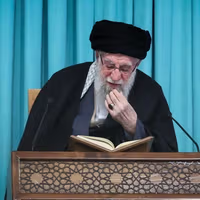
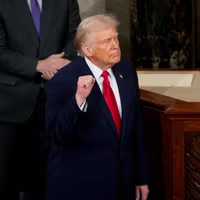
US President Donald Trump warned Iran's Supreme Leader Ali Khamenei in a letter in March that failure to reach a deal through talks would lead to war, an Iranian deputy foreign minister said on Monday.
Iran agreed to indirect negotiations, while Washington pushed for direct talks, Takht-Ravanchi said.
“The content of the letter and the attitude of US officials showed they believed with Trump’s return, the whole world needed him and he could dictate the terms,” he said, adding that Tehran decided to respond but only through indirect channels.
In June 2025, tensions between Israel and Iran erupted into open conflict when Israel launched coordinated airstrikes on Iran’s nuclear facilities, including Natanz and Isfahan, as well as several missile and command centers.
Several top Iranian military leaders, including IRGC commander-in-chief Hossein Salami and armed forces chief of staff Mohammad Bagheri, were killed in Israeli attacks
Citing an imminent threat from Tehran’s expanding nuclear program, Israel’s operation drew swift retaliation from Iran, which fired waves of missiles and drones at Israeli targets.
Within days, the United States joined the campaign, striking key Iranian nuclear and military sites in support of Israel. The fighting lasted nearly two weeks, leaving heavy damage.
Economic reform in the country is impossible without energy reform, Iran’s parliament speaker Mohammad Bagher Ghalibaf said on Monday, adding that his remarks should not be interpreted as an immediate plan to raise energy prices.
“Economic reforms and progress are meaningless without energy reform,” Ghalibaf said in a speech on Monday. “With the current energy situation, can we expect proper efficiency? Everything about it is completely wrong,” he said.
The government’s priority, he added, was not to raise prices but to restructure the energy sector. “This does not mean we want to increase energy prices – that has its own method. Raising prices is not the first step; there are several stages before that,” Ghalibaf said.
The comments come amid growing conjecture in Iranian media over a possible imminent increase in gasoline prices. Last week, President Masoud Pezeshkian said there was no doubt that fuel prices would eventually need to rise, though he acknowledged that such a move could worsen economic hardship for ordinary Iranians.
Iran's Parliament Speaker Mohammad Bagher Ghalibaf
“It’s not that simple,” Pezeshkian said. “Of course it must be done, that’s obvious, but it can’t be done overnight,” he added.
Call for fair energy use
Ghalibaf described the first step in energy reform as what he called popularization, suggesting that the country’s vast energy resources must benefit all citizens equally. “This is public wealth and must reach the people fairly. It’s not acceptable that 46 percent of the population fully benefits from part of this energy while 52 percent get nothing,” he said.
Changing consumption habits, he added, is essential to avoid waste. “If culture improves, energy consumption will improve. We cannot have the heater on while people sit at home in undershirts,” he said.
The parliament speaker did not elaborate on the mechanism of the proposed popularization plan. His remarks come as Iran, despite possessing the world’s second-largest natural gas reserves, faces chronic energy shortages that disrupt industries and daily life.
In recent months, widespread blackouts and gas shortages have forced temporary shutdowns across several provinces, exposing what officials themselves have described as deep structural and managerial failures in the energy sector.
Two senior members of President Masoud Pezeshkian’s administration urged officials and citizens to refrain from public criticism of the government, describing Iran’s current economic and political situation as “wartime conditions.”
First Vice President Mohammad Reza Aref said on Sunday that criticism of the government’s performance was serving the enemy. Speaking at a meeting of the Market Regulation Headquarters, Aref accused outside actors of spreading “malicious and misleading analyses” following the recent 12-day conflict, which he said were being echoed domestically.
Iran’s Chamber of Commerce in September projected a worst-case scenario of a 60% currency plunge, inflation at 75%, and unemployment at 14% in the coming months.
Responding to growing discontent over the government’s handling of poverty and rising living costs, Aref said supervisory and economic institutions must “avoid giving excuses to the enemy” and “not dishearten the public.” He warned officials against airing internal disagreements in public, adding that “there is no need for officials to discuss disputes at podiums; such issues should be resolved in meetings.”
Officials defend government amid rising hardship
President Pezeshkian last week acknowledged that his administration’s economic policies were contributing to inflation, saying, “We are creating inflation. We are sleeping on gold, yet the people are hungry.” His remarks drew criticism from Javan, a newspaper affiliated with the Islamic Revolutionary Guards Corps, which urged the president to address inequality instead of “repeating the word hunger.”
Mounting inflation, shrinking household purchasing power, and soaring living costs have deepened public frustration, exacerbated by the reactivation of the UN’s snapback sanctions mechanism against Iran.
Mohammad Jafar Ghaempanah, Pezeshkian’s executive deputy, also described the current situation as wartime on Sunday. Rising sanctions, he said, meant “the country must be evaluated in exceptional, not normal, circumstances.”
“Parliament members have the right to criticize the government,” Ghaempanah said. “But this is not the time to question how the country is being managed.”
Their remarks came amid intensifying domestic criticism over economic hardship, while Iranian officials continue to stress the need for “internal cohesion” against what they call a “hybrid war.”
A shortage of qualified nurses has left some hospital units unopened, Iran’s nursing chief said on Monday, warning that high living costs in Tehran have discouraged recruits from taking vacant posts in the capital.
The country faces a shortfall of at least 100,000 nurses, a deficit that has increased workloads, extended shifts, and contributed to staff burnout and lower patient satisfaction, Ahmad Nejatian, head of the Iranian Nursing Organization told Tasnim. Many nurses work compulsory overtime to compensate for missing staff, he said.
“Some hospitals in Tehran have wards ready to open, but they remain closed because there are not enough nurses,” Nejatian said. “Even when recruitment exams are held, a number of positions remain vacant because housing costs in Tehran make living in the capital unaffordable for nurses.”
Iran’s nurse-to-patient ratio, according to the Ministry of Health, remains far below international standards. The gap, Nejatian said, stems not only from limited funding but also from outdated staffing frameworks that do not reflect the actual number of active hospital beds.
Housing costs and retention challenges
Around 70 percent of nurses in Iran are women, most aged between 30 and 35, balancing work with family responsibilities, Nejatian said. Current regulations prevent hospitals from hiring temporary replacements for staff on maternity leave, placing added pressure on remaining personnel.
Offering incentives, he added, could help retain nurses in major cities. “Building dormitories or hostels alone won’t solve the problem,” he said. “We need a comprehensive plan that includes housing support and financial incentives similar to those used to attract staff to remote regions.”
Iran’s nurse-to-population ratio remains critically low – about 1.3 to 1.6 per 1,000 people – well below international standards. The shortage is worsened by excessive workloads, delayed or insufficient pay, insecure employment, short-term contracts, and the growing exodus of skilled nurses seeking better opportunities abroad. The impact is already visible, with some hospitals forced to shut down intensive care and emergency units due to a lack of qualified staff.