Russia says Iran erred by agreeing to nuclear deal sanctions 'trap'
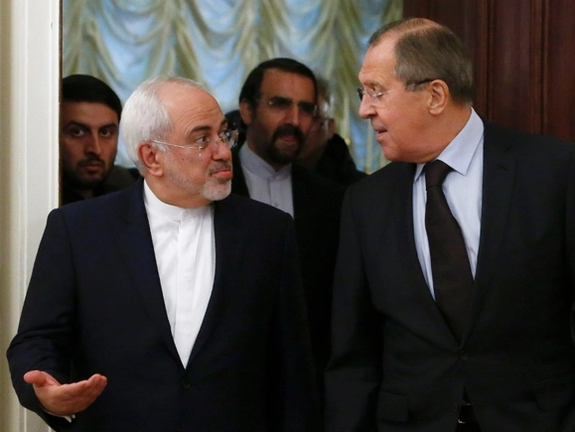
Russia Foreign Minister Sergei Lavrov (right) and Iran's former foreign minister Mohammad Javad Zarif
Moscow was surprised by Iran's agreement to the so-called UN snapback sanctions mechanism of a 2015 international nuclear deal, Russian Foreign Minister Sergei Lavrov said, describing it as a legal trap for Tehran.
“To be honest, we were surprised. But if our Iranian partners accepted this formulation - which, frankly, was a legal trap - we had no grounds to object,” Lavrov told reporters in Moscow.
Last month, UN sanctions were reimposed on Iran after France, Germany, and the United Kingdom triggered the so-called snapback mechanism, accusing Tehran of spurning diplomacy and nuclear inspections.
The snapback mechanism was part of the Iran nuclear deal, formally known as the Joint Comprehensive Plan of Action (JCPOA). It allows any participant, including the five permanent members of the UN Security Council plus Germany, to reimpose UN sanctions on Iran in the event of alleged violations, without the possibility of a veto.
Iran denies seeking a nuclear weapon and calls the new sanctions aggressive and illegal.
Hardliners in Iran have long criticized Zarif for accepting the JCPOA’s snapback mechanism, viewing it as a concession that ultimately enabled the reimposition of sanctions.
“That provision was, in fact, agreed upon during the final stage of the direct negotiations" between Iran's then top diplomat Mohammad Javad Zarif and his US counterpart John Kerry, Lavrov added.
“The other participants were essentially observers at that point, watching the US and Iran reach an agreement."
“What happened instead is that Iran did not breach the deal, yet the United States withdrew from it, and the Europeans failed to meet their commitments,” Lavrov said.
Fate of the deal
The United States withdrew from the Iran nuclear deal in 2018 during first President Donald Trump’s administration. In response, Iran gradually reduced its compliance with the JCPOA and in 2019 began enriching uranium at higher levels.
Zarif expressed frustration with Russia’s role in a leaked 2022 interview, saying, “When the JCPOA was signed, Russia made every possible effort in the final week to prevent the agreement from being concluded.”
Israel launched a surprise military offensive in June, striking Iran’s military and nuclear facilities and targeting top officials. Iran retaliated with waves of drone and ballistic missile attacks.
The United States entered the conflict on June 22 with strikes on key nuclear sites in Natanz, Fordow, and Isfahan, and later brokered a ceasefire between Iran and Israel after 12 days of fighting on June 24.
Following the attacks, Iran halted cooperation with the International Atomic Energy Agency (IAEA).
Human rights activist Reza Khandan has been denied visits with his wife, prominent human rights lawyer Nasrin Sotoudeh, for more than nine months because she refuses to wear the mandatory hijab during prison visits, political prisoners at Tehran’s Evin Prison said.
“We believe the decision by prison officials to deny him and his wife visitation on the pretext of hijab is a form of white torture against this prisoner and his family,” the inmates said in a joint letter signed by 12 detainees.
Khandan, who is serving a three-and-a-half-year sentence for opposing Iran’s compulsory hijab law, began a sit-in on September 30 to protest the visitation ban.
The inmates said prison officials continue to enforce hijab rules for visitors even as the government and other institutions have retreated from strict enforcement in public spaces.
They called the ban a violation of human rights and urged authorities to allow visits or grant Khandan temporary leave.
Last week, rights groups Robert F. Kennedy Human Rights, PEN America, and the Raoul Wallenberg Centre for Human Rights filed a petition and urgent action request with the UN Working Group on Arbitrary Detention, calling Khandan’s detention unlawful and “life-threatening.”
The groups said Khandan, 60, has been arbitrarily detained since December 2024 in reprisal for his peaceful activism against Iran’s hijab laws and warned of dire prison conditions following Israeli airstrikes that damaged Evin Prison in June.
“Reza Khandan is being punished simply for his peaceful advocacy and his unwavering commitment to women’s rights in Iran,” said Kerry Kennedy, president of Robert F. Kennedy Human Rights.
While Iranians continue to defy hijab rules, the Islamic Republic's judiciary said on Tuesday that the country’s hijab laws “remain in force” and that penalties will continue to be applied under the Islamic Penal Code.
A new military conflict will be inevitable unless Iran regains its national strength through reform, rearmament and realistic diplomacy, former president Hassan Rouhani warned.
“Diplomatically, we must reject the dichotomy of war or surrender,” Rouhani said in remarks published on Tuesday.
“We should pursue win-win negotiations, accepting 70–80% gains instead of zero-sum failures that previously resulted in UN resolutions," the former president said.
A key architect of the now mostly lapsed 2015 international nuclear deal, Rouhani is out of favor with Supreme Leader Ali Khamenei and has stepped up calls for reform.
He made the remarks in a meeting on Sunday with his former cabinet members, on the eve of the Middle East Peace Summit in Egypt where US President Donald Trump invited Tehran to join in a new regional order.
The US state department told Iran International on Sunday Washington remains ready for “serious and direct dialogue” with Tehran, hours after Iranian leaders declined invitations to attend the Trump-led summit.
“We are ready to talk directly,” a state department spokesperson said. “Should the Iranians want to negotiate, the ball is in their court."
'Iran attacked when deterrence was gone'
Rouhani called for the Islamic Republic to boost its military and intelligence power while engaging in negotiations in order to avert a war.
“If we strengthen our military, intelligence, political, and diplomatic power—and above all, our national power—there will be no war,” Rouhani said.
"If deterrence exists, there will be no war. War will only happen when deterrence is called into question; otherwise, Israel has always wanted to fight us—it’s not as if it just decided to do so now."
Israel launched a surprise military offensive in June, striking Iran’s military and nuclear facilities as well as targeting top officials. Iran retaliated with salvos of drones and ballistic missiles.
The United States entered the conflict on June 22 with attacks on key nuclear sites in Natanz, Fordow, and Isfahan, and later brokered a ceasefire between Iran and Israel after 12 days of fighting on June 24.
Iranian authorities intensified crackdowns following the conflict, claiming to have disrupted espionage networks and detained alleged spies.
“If you arrest ten top Mossad agents in the country, and the enemy realizes their key operatives are captured, their plans will be disrupted, forcing a redesign that could take months,” Rouhani said.
“More than three and a half months have passed since the 12-day war. We had - and we still have - an opportunity to act to achieve results that delay or even prevent another war."
Since late September when UN sanctions were reimposed on Iran, many observers and Iranian officials have warned of a potential new military conflict with Israel or its allies.
However, Russian President Vladimir Putin said earlier this month that Israel currently has no interest in going to war with Iran.
“We continue our trusted contacts with Israel and are receiving signals from the Israeli leadership asking us to convey to our Iranian friends that Israel is focused on achieving further stability and is not interested in any form of confrontation,” Putin said, according to the Tass news agency.
Backers of a petition to save an Iranian dissident and researcher in US immigration custody from deportation to Iran say he faces death if forced back to his homeland.
Erfan Qaneifard, a critic of Tehran's clerical establishment, has been in a US immigration and customs enforcement (ICE) detention center in Texas for over six months.
His strident rebukes of the Islamic Republic in books and editorials for Israel's Jerusalem Post newspaper may lead to a death sentence if US law enforcement carries through on plans to deport him, sponsors of a petition seeking his freedom told Iran International.
For them, Qaneifard’s case is a test of America’s moral commitment to protect those who speak out against tyranny.
Negar Karamati said Qaneifard told her in a phone call this week he is hopeful but exhausted.
“It’s not a pleasant place to be, especially when you haven’t done anything wrong,” she told Iran International. “He’s been there for over 200 days now — it’s an immigration issue, nothing more.”
Qaneifard has been held at the Prairieland Detention Center in Alvarado, Texas, since March 28, when he was detained after reporting to an ICE office in Dallas to update his address, according to his attorney, Masoud Peyma.
The center, which houses more than 700 detainees, has faced complaints of overcrowding and harsh conditions according to US media.
Peyma said Qaneifard, who was preparing to start a teaching position at a Dallas college, was instead detained and transferred to a facility for undocumented migrants.
"The risk is real. If he is sent back, his life will be in danger,” Peyma told Iran International. “There is no reason for him to remain in detention after six months.”
Karamati described Qaneifard as a demanding but deeply caring mentor who inspired her and other young Iranians to engage critically with politics and the media.
“He teaches in a way that you could sit for hours and learn,” she said. “Even in conversation, it feels like a lecture — he’s that informative and passionate.”
She said Qaneifard’s detention has devastated his friends and family. "Every voice counts in stopping this serious injustice,” she added.
Petition gains momentum
From California, grassroots activist Mojgan Mehdizadeh launched an online petition titled Free Erfan Qaneifard — Stop His Deportation to Danger that has gathered nearly 3,000 signatures, including Keramati's.
“I’ve followed his books and interviews for years,” Mehdizadeh said. “He’s an expert on Iran’s modern history and a critic of the regime. Sending him back would be a death sentence.”
The petition calls on the US President, Department of Homeland Security and State Department to release Qaneifard and halt any removal order.
It cites US and UN reports documenting torture, arbitrary detention and executions of political dissidents in Iran, urging Washington to uphold its obligations under the Convention Against Torture and the principle of non-refoulement.
'A test of America’s promise'
Qaneifard’s attorney, Masoud Peyma, told Iran International that ICE has contacted Iran’s Interests Section in Washington seeking travel documents, but Tehran has not responded.
He has filed motions in federal and immigration courts to secure his client’s release and reopen his asylum claim with new evidence of his political work.
Qaneifard’s earlier asylum request, filed in 2013, was rejected in 2018 for lack of evidence.
He reentered the United States in 2017 through the Mexico border, applied for asylum, and was previously detained at ICE facility in El Paso until 2020, during which time the US attempted to deport him through Azerbaijan, but he refused to board a Tehran-bound flight.
The case comes as the United States faces scrutiny for a series of deportations to Iran. A US-chartered flight recently carried dozens of Iranians to Tehran after stopping in Puerto Rico and Qatar, following months of talks between Washington and Tehran.
Immigration attorney Ali Herischi told Iran International that flight included political dissidents and Christian converts, some of whom were shackled and separated from their families before being handed over to Iranian authorities.
For Qaneifard’s supporters, that makes his situation even more urgent. “This man hasn’t done anything criminal,” one wrote in the petition. “If he is sent back to Iran, they will kill or torture him for speaking the truth.”
Between 2017 and 2024, Qaneifard wrote extensively about Iran’s security apparatus and regional militias, contributing commentary to Persian- and English-language outlets.
In one of his columns with the Jerusalem Post he wrote: “No one believes anymore that a bloodthirsty madman like Khamenei represents Allah or The Lord … The deceit of malicious and vile mullahs no longer finds buyers in Iranian society.”
For his friends, those words emblematize both his courage and the danger he faces. “America’s promise is to protect people who speak out against tyranny," Mehdizadeh's told Iran International. “Erfan’s case is a test of that promise.”
Iran’s judiciary spokesman on Tuesday confirmed that hijab laws remain in force, amid renewed debate over the enforcement of the Islamic Republic's compulsory veiling as public flouting of the policy appears more widespread.
Ali-Asghar Jahangir's remarks come after conservative politician Mohammad Reza Bahonar suggested there was no binding hijab law, a comment that sparked controversy among hardline figures, which he later retracted.
Jahangir said Bahonar had since “corrected his statement,” adding that enforcement of hijab-related penalties continues under existing laws.
Earlier this month, Bahonar said the Hijab and Chastity Law, which Iran’s Supreme National Security Council (SNSC) quietly suspended in May, was “no longer legally enforceable.”
He also said that while some in Iran insist hijab must be compulsory, he has “never believed in the mandatory hijab — not from the beginning, and not now.”
Following backlash from Tehran’s ultra-hardliners, Bahonar on Saturday retracted his remarks opposing the mandatory hijab, calling it a “social necessity” and urging punishment for those who defy it.
The issue remains a flashpoint since the 2022 death of Mahsa Amini, which sparked nationwide protests, with more women refusing to comply with compulsory hijab rules in public despite warnings, fines and surveillance.
Across major cities, women are increasingly seen without headscarves in public spaces, often posting videos online in acts of civil disobedience.
According to a 2022 survey by independent Netherlands-based research group GAMAAN, over 70 percent of men and women in Iran opposed mandatory hijab laws.
Israel prodded US President Donald Trump into attacking Iran by portraying Tehran as within reach of a nuclear weapon, Foreign Minister Abbas Araghchi said on Tuesday
The remarks appeared to pour cold water on dovish comments Trump had repeatedly made about seeking Iran's participation in Middle East peace the previous day while in Israel and Egypt to clinch a Gaza truce.
“It is more than clear by now that POTUS has been badly fed the fake line that Iran’s peaceful nuclear program was on the verge of weaponization this spring,” Araghchi wrote on X.
“That is simply a big lie and he should have been informed that there is zero proof of that, as confirmed by his own intelligence community.”
Araghchi’s post followed Tehran’s criticism of Trump’s remarks at the Sharm el-Sheikh summit in Egypt and in a speech to the Israeli parliament a day earlier, where he said, “It would be great if we made a peace deal with them, wouldn’t it be nice.”
Trump, Araghchi added, had promised to end “Israel’s serial deception of US presidents” but was now “being misled by the same warmongers who derailed American diplomacy with Iran for many years.”
Trump told reporters on Monday that Iran “has been battered and bruised” by sanctions but would “come along” to negotiations.
Iran’s Foreign Ministry said Trump’s statements were inconsistent with US actions, including the reinstatement of sanctions and joint US-Israeli strikes on Iranian nuclear facilities in June. “How can one speak of peace while attacking residential areas and peaceful nuclear facilities of a country and killing innocent people?” the ministry said on Tuesday.
Tehran calls Gaza summit illegitimate
Foreign Ministry spokesman Esmail Baghaei said Tehran had refused to attend the Sharm el-Sheikh meeting, describing it as “illegitimate” and lacking international credibility because it was not held under United Nations supervision. “Diplomacy will never be suspended,” he said, “but we did not take part in a summit chaired by a party that takes pride in an illegal attack against our country.”
The summit, attended by leaders from the United States, Egypt, Turkey, Qatar, France, Germany and the United Kingdom, followed the signing of a ceasefire agreement between Israel and Hamas that ended two years of war in Gaza and secured the release of 20 Israeli hostages.
Responding to Trump’s remark that Iran had been “the bully of the Middle East,” Araghchi wrote, “The real bully of the Middle East, Mr. President, is the same parasitic actor that has long been bullying and milking the United States,” referring to Israel.
Araghchi said Iran remained open to “respectful and mutually beneficial diplomatic engagement,” but questioned how Washington could extend an olive branch while supporting military action against Iran. “Mr. Trump can either be a President of Peace or a President of War, but he cannot be both at the same time,” he wrote.
He added that Iran agreed with Trump on one point — that Tehran should not be used as a pretext for Arab-Israeli normalization. “If someone wants to throw the Palestinians under the bus while embracing a genocidal entity, they should have the guts to take full responsibility for it,” Araghchi said.