Iran says committed to diplomacy despite absence from Gaza summit
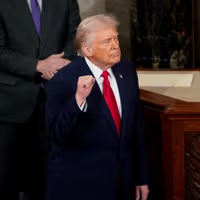
US President Donald Trump looks on from the lectern during remarks following the official signing of the first phase of the Gaza ceasefire agreement between Israel and Hamas, during a world leaders' summit on ending the Gaza war, in Sharm El-Sheikh, Egypt, October 13, 2025.
Iran did not attend the Sharm el-Sheikh conference on Gaza because it lacked legitimacy, though the country remains committed to diplomacy, Foreign Ministry spokesman Esmail Baghaei said in an interview on Tuesday.
“Diplomacy will never be suspended, but we did not take part in a summit chaired by a party that takes pride in an illegal attack against our country,” Baghaei said, referring to the Monday meeting in Egypt that was led by US President Donald Trump.
The Sharm el-Sheikh summit, attended by leaders from the United States, Egypt, Turkey, Qatar, France, Germany and the United Kingdom, followed the signing of a ceasefire agreement between Israel and Hamas that ended two years of war in Gaza. The deal included the release of 20 Israeli hostages in exchange for hundreds of Palestinian prisoners.
Baghaei said the meeting “had no international credibility” because it was not held under the supervision of the United Nations and several major countries, including China and Russia, were not invited. “A gathering of limited participants cannot claim to represent the global community,” he said, according to state radio.
He added that Iran viewed the conference as politically one-sided, given that it was chaired by “a party that not only supported but also celebrated illegal strikes against Iran earlier this year.”
In June, the United States joined Israel in a series of attacks on Iranian nuclear sites after indirect talks between Tehran and Washington stalled over enrichment and inspection terms. The strikes destroyed parts of Iran’s nuclear infrastructure and killed scientists and soldiers, according to Iranian officials.
World leaders pose for a family photo, at a world leaders' summit on ending the Gaza war, in Sharm el-Sheikh, Egypt, October 13, 2025.
Baghaei said Iran’s position on Gaza remained unchanged. “Our clear priority is ending the genocide in Gaza, ensuring the return of displaced residents and securing the withdrawal of the occupiers,” he said. “As long as the Palestinian right to self-determination is not recognized, no plan will lead to real peace.”
Iran rejects Trump’s remarks on peace
His remarks came after the Iranian Foreign Ministry rejected Trump’s comments about a possible peace deal with Tehran, calling them contradictory to US behavior. Trump said during the summit in Egypt that “it would be great if we made a peace deal with them,” and later told reporters that Iran “has been battered and bruised” by sanctions but would “come along” to negotiations.
Tehran said such comments could not be taken seriously in light of US sanctions and the June attacks. “How can one speak of peace while attacking residential areas and peaceful nuclear facilities and killing innocent people?” the ministry said on Monday.
Baghaei said Iran continued to rely on diplomacy “to safeguard national interests and promote peace,” emphasizing that participation in international affairs “is not limited to physical presence at summits.”
“The Islamic Republic has always used diplomacy as a tool to protect its sovereignty and to pursue peace and stability,” he said. “This approach will continue, but it will not come at the cost of our national dignity.”
Iran’s parliament on Tuesday voted down a bid to stop the government from seeking to join a United Nations convention against terror financing, Tasnim news agency reported.
Lawmakers rejected the motion with 150 votes in favor, 73 against and nine abstentions out of 238 members present, Tasnim said. The proposal was sent to parliament’s National Security and Foreign Policy Committee for further review.
The bill was introduced by conservative lawmakers seeking to block implementation of Iran’s conditional approval to join the UN Convention for the Suppression of the Financing of Terrorism, one of the Financial Action Task Force (FATF) standards that require countries to monitor and report financial transactions to curb money laundering and terror funding.
Earlier this month, Iran’s Expediency Council, which resolves disputes between parliament and the Guardian Council under Supreme Leader Ali Khamenei, gave conditional approval for joining the treaty after years of delay. The council said implementation would depend on guarantees that Iran’s economic and security interests would not be compromised.
Hardline lawmakers argue that joining the convention could expose Iran’s financial channels used to bypass US sanctions and support regional allies such as Hezbollah and armed groups in Iraq and Yemen. They say Iran should only join once all sanctions are lifted.
Supporters of the treaty, including some moderate lawmakers and economic officials, argue that compliance with FATF standards could help reconnect Iran’s banking system to global financial networks and attract foreign investment amid a severe economic downturn.
Iran’s Foreign Ministry on Tuesday criticized US President Donald Trump’s call for dialogue with Tehran, saying his remarks about peace were inconsistent with Washington’s record of sanctions, military strikes and support for Israel.
Trump told Israeli lawmakers on Monday that “it would be great if we made a peace deal with them,” adding later that Iran “has been battered and bruised” by US sanctions and “will come along” to talks. “I’d love to take the sanctions off when they’re ready to talk,” he said.
In June, the United States joined Israel in a series of strikes on Iranian nuclear sites after months of indirect talks stalled over enrichment and inspection terms. The attacks destroyed parts of Iran’s nuclear infrastructure and killed scientists and soldiers, according to Iranian officials.
Iran dismissed Trump’s remarks, saying they were “in complete contradiction” with US behavior. “How can one speak of peace while attacking residential areas and peaceful nuclear facilities of a country and killing innocent people?” the ministry said on Tuesday in a statement carried by Iranian media.
Tehran said US support for Israel and its obstruction of UN measures on Gaza showed that Washington’s talk of peace was insincere. It accused the United States of complicity in what it called Israel’s “war crimes” in the enclave.
The ministry said Iranians would never forgive the 2020 US drone strike that killed Quds Force commander Qassem Soleimani, describing him as a national hero who led the fight against Islamic State militants.
Trump said on Monday that Iran “cannot survive” under current sanctions but that he hoped Tehran would “want to get back into the world of good economies.” He said the US-led strikes in June had “obliterated” Iran’s nuclear program and that the country “won’t go back into the nuclear world again.”
Iran said its nuclear program was peaceful and that repeated US accusations were aimed at justifying aggression. It said Washington’s “admission of crimes” only deepened its responsibility for regional instability.
Trump reinstated sweeping sanctions on Iran in January, reviving his “maximum pressure” policy. Tehran says US sanctions violate international law and that Washington must first change its conduct before any negotiations can begin.
Toronto’s Iranian-Canadian community celebrated a milestone on Saturday with the official inauguration of “Little Iran,” a new cultural district in Willowdale within the city's North York district.
The event at Centre Park brought together Mayor Olivia Chow, city councilor Lily Cheng and MP Ali Ehsassi - both of Willdowdale - along with dozens of Iranian-Canadians to unveil the district’s new sign.
The designation recognizes the community’s cultural and economic contributions as part of Toronto’s growing multicultural landscape.
“On this Thanksgiving weekend, I want to show my gratitude to the Iranian community for coming together and celebrating,” Mayor Chow said in remarks cited by the local outlet Straight Outta Six on Instagram. “Today is really a historic day.”
Canada is home to one of the largest Iranian diasporas outside the Middle East, with more than 200,000 Iranian-Canadians nationwide, according to the 2021 census.
The majority live in the Greater Toronto Area - particularly in North York, Richmond Hill and Thornhill - where Iranian businesses, restaurants and cultural centers have flourished since large waves of immigration began after the 1979 Islamic Revolution.
The new district’s designation highlights both the community’s long-standing presence and its growing influence in shaping Toronto’s cultural identity.
Festivals such as Tirgan, which showcases Iranian music, art and dance, as well as the Persian New Year Nowruz celebrations and Persian cuisine, have become widely popular across Canada, reflecting the community’s vibrant cultural scene.
US President Donald Trump appeared to suggest in a passing remark during a speech before Israel's Knesset on Monday that his son-in-law Jared Kushner could lead US diplomacy with Tehran.
“We always bring Jared when we want to get that deal closed … Steve, you and Jared and the general and Pete and Marco — you’ll get that deal done,” Trump said moments after discussing Iran’s nuclear program and its role in the Middle East.
The line was brief but telling.
For analysts who have followed Trump’s unconventional diplomacy, it echoed the playbook that produced the Abraham Accords — a blend of personal trust, transactional bargaining and Kushner’s unique access to Persian Gulf capitals.
Kushner has already hinted at his own views on Iran in the past. In a post on X in September 2024, he called the day Hezbollah leader Hassan Nasrallah’s was assassinated by Israel “the most important day in the Middle East since the Abraham Accords.”
Kushner wrote on X that Iran was “now fully exposed” because its deterrent — Hezbollah’s arsenal — had been “a loaded gun pointed at Israel.”
The billionaire businessman argued that Israel “cannot afford now to not finish the job and completely dismantle the arsenal that has been aimed at them,” and praised Trump’s strategy of strength over negotiation.
The message underscored Kushner’s hawkish outlook on Iran and belief that its armed allies in the region must be dismantled before any lasting peace can emerge.
The Kushner Factor
Eric Mandel, director of the Middle East Political Information Network (MEPIN), told Iran International that Trump’s reliance on loyal envoys like Kushner reflects his governing style — but that Iran is a different arena entirely.
“He uses people who are loyal to him to do things way beyond what normal portfolios are,” Mandel said. “But you’re not going to change the spots of the Islamic Republic.”
Mandel warned that Kushner’s pragmatic, business-minded approach could misread Tehran’s ideological rigidity.
While Mandel sees value in verifiable understandings — such as access for inspectors, curbs on ballistic missile and limits on activity by armed allies — he doubts Tehran would treat such talks as anything more than a tactical pause.
Iran has expressly rejected curbs to its military activities as a non-starter for talks.
“If you can kick the can down the road five years, maybe ten, and get something binding, fine,” he said. “But don’t expect human-rights progress or regime transformation. They’ll stall until Trump is gone," said Mandel.
Trump’s renewed focus on Iran comes amid a regional recalibration. Following Israel’s 12-day war with Iran in June and a fragile Gaza truce, he may be testing whether Tehran’s leadership will engage diplomatically or double down on defiance.
‘The Carrot and the Stick’
Kushner’s re-emergence makes practical sense, as he retains credibility with Riyadh, Abu Dhabi and Doha, and may offer Tehran a face-saving interlocutor outside official channels, Middle East analyst, former Israeli intelligence official and author Avi Melamed told Iran International.
“It makes sense that he could be someone the Iranians would be willing to look at as a go-between,” Melamed said. “He’s a familiar figure in Gulf capitals, and his track record with the Abraham Accords gives him legitimacy others don’t have.”
Kushner has multi-billion dollar business ties with state-linked businesses in the region.
His Affinity Partners investment group partnered with Saudi Arabia's Public Investment Fund to help buy US videogame developer Electronic Arts last month for $55 billion, which if completed would be the largest leveraged buyout in history.
Carrot, stick
Trump’s mention of Kushner also signaled a dual strategy — diplomacy backed by implicit threat, Israeli-Iranian researcher Beni Sabti, who served as former spokesperson to Prime Minister Netanyahu, told Iran International.
“Jared is the carrot, and Israel is the stick,” he said. “Trump shows Iran that there’s a softer route if they behave, but the alternative is pressure and potential strikes.”
Yet others see opportunity rather than confrontation. With Iran under economic strain and its regional proxies weakened, some analysts believe Trump’s overture — and Kushner’s possible return — could open a narrow diplomatic window.
Melamed argued Tehran has reasons to listen. The June 12-day war severely weakened the so-called axis of resistance and exposed Iran’s regional vulnerabilities.
Coupled with new US sanctions and pressure on Iran-backed militias, “the toolkit Washington holds today is far stronger than before October 7,” he said. Melamed expects the clerical establishment to seek talks to ease economic strain while preserving its core power structure.
Sabti said Tehran’s refusal to attend last month’s Sharm el-Sheikh peace summit underscores both its isolation and its pride — a system that, he said, “would rather stay out and look strong than appear subordinate.”
Whether Kushner formally re-enters diplomacy on Iran remains unclear. But Trump’s words revived speculation first reported by Iran International podcast Eye for Iran in 2024, when Yale’s Jeffrey Sonnenfeld — who worked with Kushner on the Abraham Accords — predicted that “the only way there will be peace in the Middle East is through someone like Kushner.”
For now, Iran’s answer is silence.
The Islamic Republic declined an invitation to the Sharm el-Sheikh summit, calling recognition accords with Israel a “treacherous normalization project.”
Still, with sanctions tightening and proxies under strain, analysts agree Tehran may be preparing to reopen diplomatic channels — even if only to buy time.
Britain’s MI5 warned members of Parliament that spies from China, Russia and Iran are targeting UK politicians in an effort to influence policy, gather intelligence and undermine democracy, Reuters reported on Monday.
MI5 Director General Ken McCallum urged lawmakers to stay alert to blackmail attempts, phishing attacks,and approaches from individuals seeking to cultivate long-term relationships or make donations to sway decisions.
“When foreign states steal vital UK information or manipulate our democratic processes, they don’t just damage our security in the short term—they erode the foundations of our sovereignty,” McCallum said, mentioning the three countries.
Iran’s inclusion alongside Russia and China highlights growing concern over Tehran’s global network of influence operations, which British and European officials say increasingly target lawmakers, journalists and activists.
MI5’s warning follows reports linking Iranian cyber groups to intimidation and disinformation campaigns abroad, including against UK-based journalists critical of the Islamic Republic.
The advisory comes a week after prosecutors dropped a high-profile espionage case against two British men accused of spying for China, after the government declined to present classified evidence in court. The case has sparked debate over how to confront foreign interference while protecting intelligence sources.
McCallum concluded his message by urging vigilance among lawmakers: “Take action today to protect democracy—and yourself.”