Trump says Iran has asked about lifting US sanctions | Iran International
Trump says Iran has asked about lifting US sanctions
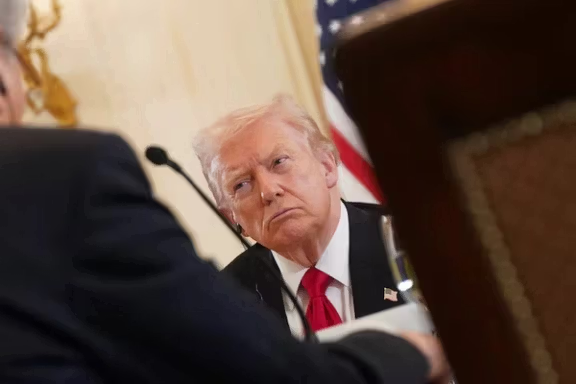
US President Donald Trump attends a dinner with the leaders of the C5+1 Central Asian countries of Kazakhstan, Kyrgyzstan, Tajikistan, Turkmenistan, and Uzbekistan, in the East Room of the White House in Washington, DC, US, November 6, 2025.
Iran has approached Washington to ask whether US sanctions could be lifted, US President Donald Trump told the leaders of the C5+1 Central Asian countries at the White House on Thursday.
“Iran has been asking if the sanctions could be lifted. Iran has got very heavy US sanctions, and it makes it really hard for them to do what they'd like to be able to do. And I'm open to hearing that, and we'll see what happens, but I would be open to it,” Trump said.
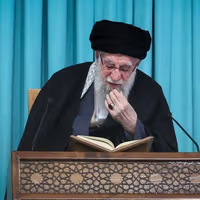
Earlier this week, Iran’s Supreme Leader Ali Khamenei said cooperation between the two countries was impossible as long as Washington continued to support Israel, maintain military bases, and interfere in the Middle East.
“As long as America supports the Zionist regime and interferes in the region, cooperation with it is neither rational nor possible,” Khamenei said on Monday.
Trump also said that the United States directed Israel’s first strike on Iran during the June conflict. “Israel attacked first. That attack was very, very powerful. I was very much in charge of that,” Trump told reporters late on Thursday.
“When Israel attacked Iran first, that was a great day for Israel because that attack did more damage than the rest of them put together.”
After taking office for his second term in January, Trump reimposed his maximum pressure campaign on Iran, a policy aimed at preventing Tehran from developing a nuclear weapon. In June, the United States bombed Iranian nuclear sites, further straining ties between the two countries.
The two sides held five rounds of nuclear talks before a 12-day war between Iran and Israel in June. Negotiations have since stalled over uranium enrichment, with Western powers insisting Iran end enrichment on its own soil, a demand Tehran has rejected.
Last month, Khamenei described negotiations with the United States as “useless and harmful” and declared any talks with Washington forbidden. Foreign Minister Abbas Araghchi also said no direct dialogue had taken place, adding that Tehran would discuss only nuclear matters and would never negotiate on regional issues.
A 20-year-old student set himself on fire in Ahvaz, in southwest Iran, after municipality workers demolished his family’s kiosk, Karun Human Rights Organization reported.
Ahmad Baledi was hospitalized with about 70 percent burns and remains in critical condition, the rights group said.
The report said municipality workers, accompanied by police officers, arrived at the kiosk on Sunday without notice and began demolishing it.
Baledi's wife and son Ahmad staged a sit-in inside the kiosk to try to stop the demolition, but officers continued, Karun said.
The group said the deputy for municipal services in the district “behaved violently” and threw Baledi's wife out of the kiosk.
In protest at what was described as unjust and violent treatment, Ahmad Baledi poured gasoline on himself and set himself on fire in front of the officers.
Witnesses cited by Karun said some of the officers made no effort to stop him and watched with indifference and mockery.
The incident comes amid deepening economic hardship in Iran, where soaring joblessness and inflation have pushed many households into street vending, peddling, and other informal work to survive.
The self-immolation also echoes, in unsettling ways, the act by Tunisian street vendor Mohamed Bouazizi that helped ignite the Arab Spring in 2011.
Zohran Mamdani’s stomping win in New York’s mayoral race drew starkly different reactions in Iran, with views on the first Muslim to run America’s largest city reflecting a bitterly divided political landscape.
For hardline supporters of the Shi'ite theocracy, his faith was a welcome slap to a US establishment seen as implacably hostile. To their critics, Mamdani's win highlights everything the Iranian system resists: youth, pluralism and the power of the vote.
The conservative daily Hamshahri, published by Tehran’s municipality, splashed "America Against America" on its front page, interpreting Mamdani's victory as a proof of the US enemy's internal divides.
Tehran lawmaker Abolghasem Jarareh declared in parliament: “Zohran Mamdani’s victory shows the strength of the slogan ‘Death to Israel!’”
Without elaborating, he then joined fellow lawmakers in chanting the slogan on the floor of parliament, a regular practice among arch-conservatives.
Abdolmotahhar Mohammadi, spokesperson for Tehran’s mayor, wrote on X: “The clear message of Zohran Mamdani’s election … is that the people of New York reject the influence of a genocidal regime in US governance,” adding that Iran “welcomes any strengthening of anti-racist and pro-Palestine discourse anywhere in the world.”
Gaza and Israel
Mamdani's platform emphasized affordable housing, police reform and Palestinian solidarity, earning him strong backing from progressives and Muslim organizations.
Early in his campaign he faced criticism for using the phrase "globalize the intifada" and has since distanced himself from the slogan. Mamdani has repeatedly called Israel's incursion into Gaza a genocide but has spoken out against anti-Semitism.
In an interview, he cited his Shi'ite Muslim faith as an important inspiration.
"To stand up for justice, to stand up for that which is right often means doing something difficult. Imam Hossein's, peace be upon him, conviction in spite of the odds is something that inspires me."
Mamdani has hit out at what he has called Islamophobia in the wake of the 9/11 attacks but has not cited Islam as a basis of his political outlook.
Still, Tehran University academic and idealogue Foad Izadi called Mamdani’s victory “the arrival of the message of 13 Aban in New York.”
He was referring to the Persian calendar commemoration of the 1979 storming of the US embassy by revolutionary students and the hostage-taking of staff there which permanently soured relations.
The date is now celebrated annually in Iran as a focal point of state-sponsored hostility toward Washington.
Free elections vs. clerical vetting
Middle East analyst Mostafa Najafi criticized the hardliners in a social media commentary titled “America’s self-healing system or the message of 13 Aban in New York?”
“Lacking a realistic understanding of the inner workings of power in the United States, some in Iran keep insisting that the country is on the verge of collapse or regime change,” he wrote.
Many critical voices drew sharp comparisons between America’s open elections and Iran’s heavily restricted political system, where supervisory bodies often whittle down lists of eligible candidates.
“Mamdani’s victory shows that despite 46 years of propaganda against America, it is democracy and the rule of law — not the will of the president who is the top official of the system — that prevail there,” prominent commentator Sadegh Zibakalam posted on X.
The veteran analyst was alluding to the limitless authority of Supreme Leader Ali Khamenei, Iran's ultimate decision-maker in all matters, including elections.
Conservative commentator Abdolreza Davari also wrote on X: “Mamdani’s rise in New York … is proof of people’s sovereignty and modern civilization. The roots of America’s global leadership lie in this very expression of the people’s will.”
“In our ‘religious democracy,’ the Guardian Council bars a Zoroastrian from city council because of his faith. But in ‘American liberal democracy,’ a socialist Muslim anti-Zionist can become mayor of New York,” Davari wrote in another post.
He was referring to Sepanta Niknam, a Zoroastrian elected to Yazd’s city council in 2013.
After winning re-election in 2017, a defeated candidate challenged his eligibility because of his religion. Although Zoroastrianism is a recognized religion under Iran’s constitution, Niknam was barred from taking his seat for over a year.
While he was eventually allowed to return, his candidacy for future elections was ultimately disqualified, making the case a symbol of theocratic discrimination.
'Masterclass in democracy'
Prominent jurist Mohsen Borhani called Mamdani’s win “a masterclass in democracy, rule of law and respect for citizens’ choices,” urging Iran’s Guardian Council, which oversees the approval of presidential candidates, to “learn from it.”
The rise of Mamdani, 34, also reignited Iran’s long-standing debate over youth exclusion from politics, even among conservatives.
Khamenei is 86, Guardian Council chairman Ali Jannati is 98 and President Masoud Pezeshkian is 71.
“If this young man from New York ran for office here, would the Guardian Council even approve his qualifications?” conservative activist Vahid Ashtari asked bluntly,
“In Iran, our elections are always between the same figures," he added. "Could any thirtysomething even imagine becoming mayor of the capital?”
An Iranian businessman sanctioned by the UK government for allegedly funding Iran’s Revolutionary Guards owns a £33.7 million ($44.3 million) mansion on an exclusive London street, according to a report by an investigative watchdog.
56-year-old Ali Ansari, also known as Aliakbar Ansari, is the registered owner of the property in an upscale North London neighborhood, the Organized Crime and Corruption Reporting Project (OCCRP) said citing land registry records.
A 2017 French company filing lists the mansion as his residence, the report added. The home includes three reception rooms, eight bedrooms, an indoor pool, a cinema, games rooms and library.
According to the report, the mansion was not among previously reported UK real estate linked to Ansari, which includes a dozen other houses on the same street registered to Birch Ventures Limited, an Isle of Man-based company he owns.
Private Eye reported last month that the 12 homes were bought in 2013 for £73 million ($96 million).
The United Kingdom sanctioned Ansari on October 30, alleging corruption and claiming he helped financially support the activities of the Revolutionary Guards.
OCCRP said that in a previous response to the nonprofit investigative journalism organization, company spokesperson Iman Mirzaie said the allegations are baseless, emphatically denied, and political in nature.
Ansari is subject to an asset freeze, disqualification from any UK company ownership and a travel ban. He holds multiple passports, including from Iran, St Kitts and Nevis, and Cyprus, according to UK foreign office.
Ansari held stakes in Ayandeh Bank, one of Iran’s largest private banks, created in 2012 through a merger of a private bank and two credit institutions.
The bank came under scrutiny last month after it was ordered to merge with state-owned Bank Melli following the disclosure of losses exceeding $4 billion.
In a public letter, Ansari said the bank’s operations were halted as a result of decisions made outside its will.
OCCRP said it contacted a law firm representing Ansari and the UK Office of Financial Sanctions Implementation for comment but had not received a response.
The United States Treasury on Thursday imposed sanctions on a network of alleged Hezbollah financiers it says channelled tens of millions of dollars from Iran into Lebanon this year.
The individuals helped move Iranian funds through both licensed and unlicensed exchange companies, the Treasury said, allowing Hezbollah to rebuild its military infrastructure and sustain its paramilitary units.
“Lebanon has an opportunity to be free, prosperous, and secure, but that can only happen if Hizballah is fully disarmed and cut off from Iran’s funding and control,” said John K. Hurley, the US undersecretary for terrorism and financial intelligence, in a statement.
Efforts to curb Hezbollah’s military power have intensified but borne little fruit since a ceasefire with Israel in June 2024.
The Lebanese group argues that its weapons are needed to defend the country’s from Israel, but rival factions in Lebanon’s fragmented political landscape say the group undermines the state and serves Tehran’s interests.
This message was delivered by Iran's President Joseph Aoun directly to Iran’s security chief, Ali Larijani, during his visit to Lebanon in late September.
Larijani rejected accusations of interference, saying those pushing for disarmament, not Tehran, were meddling in Lebanese affairs.
‘Cash network’
The latest measures target Hezbollah operatives who, according to US officials, oversee the influx of Iranian money generated through covert dealings which contravene US sanctions, including the sale of oil and other goods.
According to the Treasury, the Islamic Revolutionary Guards Corps–Quds Force has transferred more than $1bn to Hezbollah since January 2025.
Among those sanctioned is Ossama Jaber, a Hezbollah member accused of collecting and converting tens of millions of dollars between September 2024 and February 2025.
Washington also moved against figures linked to Hezbollah’s finance team, whose structure has been in flux since the death last year of its long-time chief, Muhammad Qasir, and the collapse of Bashar al-Assad’s regime in Syria — a key financial bridge to Iran for decades.
Qasir’s responsibilities were split among several relatives and associates, including his son Ja’far and nephew Ali, both of whom have already been sanctioned by the US.
Hezbollah has been listed by the US as a foreign terrorist organization since 1997.
US authorities have arrested the 19-year-old son of Iranian-American poet Roger Sedarat over an alleged Islamic State-inspired plot to bomb gay bars in Detroit, the New York Post reported citing police sources.
Milo Sedarat was detained at his father’s home in Montclair, New Jersey, on Wednesday in connection with a foiled attack that investigators said was planned for Halloween.
Roger Sedarat, Milo’s father, is an award-winning Iranian-American poet and professor at Queens College in New York City.
Another 19-year-old from Montclair, Tomas Kaan Guzel, was also arrested according to the report.
The arrests came after five other alleged co-conspirators, including one minor, were charged last week following an investigation by the FBI and the New York Police Department’s Intelligence Bureau.
Authorities said the suspects intended to replicate Islamic State's 2015 Paris attacks.
Police sources told the Post that Guzel moved his travel plans forward after learning of FBI raids on other suspects’ homes in Detroit.
Authorities said the raids uncovered multiple firearms, including three AR-15-style rifles, two shotguns, four pistols, and over 1,600 rounds of ammunition, along with tactical vests, GoPro cameras, and combat gear.
FBI Director Kash Patel said before Halloween weekend that the suspects were planning a “violent attack.”
Sedarat and Guzel are expected to face charges in federal court in New Jersey.
Roger Sedarat has authored four collections of poetry including Dear Regime: Letters to the Islamic Republic and most recently an academic work, Emerson in Iran: the American Appropriation of Persian Poetry.