IAEA wants full reengagement with Iran, chief says
International Atomic Energy Agency (IAEA) Director General Rafael Grossi
The International Atomic Energy Agency wants to fully reengage with Iran to restore access to its nuclear sites and verify the country’s enrichment activities, Director General Rafael Grossi said on Tuesday, after the UN watchdog’s board censured Tehran for restricting access.
Grossi told reporters in Manila that the agency’s aim was to “restore continuity of knowledge” and reestablish full verification inside Iran. His comments followed last week’s decision by the UN watchdog’s 35-member Board of Governors calling on Tehran to inform it “without delay” about the status of its enriched uranium stock and sites hit in June strikes.
The board’s resolution, backed by the United States, Britain, France and Germany, deepened tensions with Tehran, which condemned the vote as “illegal and unjustified.” Iran said the move nullified a September inspection accord reached in Cairo with Grossi through Egyptian mediation.
Foreign Minister Abbas Araghchi said at the time the Western powers had “killed” the Cairo accord and accused them of seeking escalation rather than diplomacy. Iran insists its cooperation with the IAEA remains within the limits of the Nuclear Non-Proliferation Treaty but says access to bombed facilities cannot resume until safety and legal issues are addressed.
Iran weighs NPT withdrawal
Iranian lawmakers have said Tehran is considering suspending or withdrawing from the NPT in response to the censure. Amir Hayat-Moghaddam, a member of parliament’s National Security and Foreign Policy Committee, said the option was “on the table” and under expert review.
He said a final decision would be coordinated between parliament and the Supreme National Security Council. Another lawmaker said a draft bill had been prepared to boost what he called Iran’s “nuclear and sanctions-related deterrence.”
Iran has appointed Brigadier General Kioumars Heydari as deputy commander of the Khatam al-Anbiya Central Headquarters, a top joint operational command that plans and coordinates the country’s armed forces, Iranian media reported on Monday.
Heydari had led Iran’s Army Ground Forces for more than seven years before being replaced on November 22 by Brigadier General Ali Jahanshahi, as part of a wider reshuffle across Iran’s military following the June war.
Iran’s Khatam al-Anbiya Central Headquarters is the unified combatant command under the Armed Forces General Staff, responsible for operational design and coordination across the army and the Revolutionary Guards.
The deputy post was previously held by Major General Hossein Hassani Sa'di, according to Iranian news agency ISNA, while Major General Ali Abdollahi Aliabadi currently commands the headquarters.
US President Donald Trump has asked Saudi Crown Prince Mohammed bin Salman to manage a channel aimed at opening dialogue between Washington and Tehran as the kingdom seeks to avert further regional escalation, the Lebanese newspaper al-Akhbar reported on Tuesday.
Citing what it described as Western sources, the Beirut-based daily said Trump authorized bin Salman to manage contacts aimed at brokering an agreement with Tehran covering the nuclear file and sanctions.
According to the report, bin Salman argued to Trump that a US-Iran understanding was necessary for stability across the Middle East and warned that Israel could try to derail any diplomatic track through renewed military action.
Sources told the outlet that bin Salman had asked Ali Larijani, secretary of Iran’s Supreme National Security Council, during their September meeting in Riyadh about Tehran’s stance on a Saudi initiative toward Washington on a possible agreement with Iran. They said Larijani later sent a positive reply, while stressing that Tehran was not ready to make concessions.
Al-Akhbar also reported that Saudi officials contacted Iran’s leadership after the crown prince’s November 18 visit to the White House and agreed to hold a senior Saudi-Iranian meeting in Paris within 24 hours, to be followed by Saudi shuttle contacts between the United States and Iran.
Iranian Foreign Minister Abbas Araghchi is due in Paris on Wednesday for talks with French Foreign Minister Jean-Noel Barrot focused on Iran’s nuclear program and the status of two French citizens who, though released from prison, remain under travel restrictions and are staying at the French embassy in Tehran, France’s foreign ministry said.
There has been no indication of any parallel Saudi-Iranian meeting in Paris. Iran International could not independently verify al-Akhbar’s account.
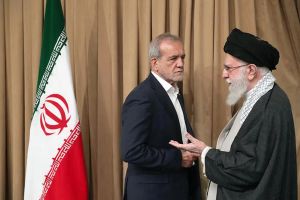
The report comes as Iranian officials push back against reports that President Masoud Pezeshkian asked the Saudi crown prince to help revive nuclear talks with the United States.
Iran says Pezeshkian’s letter to the crown prince was a routine message on Hajj coordination, while Reuters reported last week, citing two sources familiar with the exchange, that the letter urged bin Salman to use his influence with Trump to restart stalled nuclear diplomacy.
Foreign Ministry spokesman Esmail Baghaei said, “The president’s message to the Saudi crown prince had purely bilateral content,” and added that persistent “baseless speculation about it does nothing to advance national interests.”
Baghaei’s comments follow a rising domestic debate over whether Tehran is exploring indirect channels to Washington after a former lawmaker, Mostafa Kavakebian, said Pezeshkian had sent a message to Trump through bin Salman offering talks without preconditions with the permission of Supreme Leader Ali Khamenei.
‘Mediator talk is secondary to US approach'
The government’s news agency IRNA said on Tuesday that the flurry of talk about third-party mediation reflects a broader tendency to read every letter, trip or phone call as a signal of imminent Iran-US negotiations, but argued that mediation is not the core issue.
In its analysis, the state news agency said Iranian officials view the real obstacle as the absence of a shared understanding with Washington on what talks would look like, adding that Tehran wants “equal and fair” diplomacy rather than what it describes as US attempts to dictate terms.
IRNA added that, from Iran’s perspective, questions about mediators such as Saudi Arabia or Egypt are secondary to whether the United States changes its approach and shows seriousness about balanced negotiations.
A blaze which had devastated a unique forest ecosystem in northern Iran has been brought under control after weeks of firefighting efforts, an environmental official said on Tuesday.
But when pressed on state television about the extent of damage to the ancient Hyrcanian Forest, head of Iran’s Natural Resources and Watershed Management Organisation Reza Aflatouni on Monday declined to respond.
“State TV should not make the sweetness of such management bitter for people’s taste,” he said.
Aflatouni said that the main phase of the blaze, which reignited on 15 November is now extinguished, with only isolated smoldering spots left under close monitoring.
The Elit wildfire has burned through parts of Iran’s ancient Hyrcanian Forests, a UNESCO World Heritage site dating back 25–50 million years and home to over 3,200 plant species and endangered wildlife, including Persian leopards.
In a report on Sunday, the semi-official ISNA news agency wrote that the fire has been burning for about 20 days. However, the head of natural resources in Mazandaran province rejected this, insisting two separate fires occurred 10 to 15 days apart.
ISNA's said local residents insist the blaze has continued without interruption since November 1, with smoke showing it never fully went out.
“The fire in the Hyrcanian forests is not merely an environmental disaster; it is a symbol of managerial backwardness, social neglect and a weak environmental culture,” the news website Rouydad24 wrote.
“Without urgent action, the continuation of this trend could destroy large parts of Iran’s natural heritage and cause irreparable damage to the country’s society and economy,” the report added.
Mazandaran Governor Mahdi Younesi estimates around eight hectares have been destroyed so far.
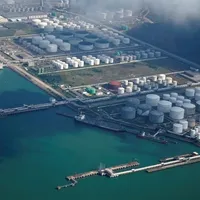
Indonesia announced it will auction the seized Iranian tanker MT Arman 114 and its 1.245 million barrels of crude oil starting December 2, with a reserve price of Rp 1.174 trillion ($70 million) through the government’s online auction platform.
The 1997-built supertanker (IMO 9116412), flagged to Iran and under US sanctions, was seized by Indonesia’s Maritime Security Agency in October 2023 in the North Natuna Sea.
The MT Arman 114 had conducted an illegal ship-to-ship transfer with the Cameroon-flagged MT S Tinos while both vessels had their AIS identification systems switched off.
Drone footage captured a pipeline between the ships and an oil spill entering the sea.
Following a district court ruling on July 10, 2024, the Egyptian captain, Mohammed Abdelaziz Mohamed Hatiba, was convicted of illegal waste dumping. He was sentenced to seven years in prison and fined Rp 5 billion (approximately $300,000).
The court ordered both the vessel and its cargo forfeited to the state, paving the way for the upcoming auction.
A security deposit of Rp 118 billion ($7 million) is required for the aucion. Only companies licensed to trade or process oil and gas, or those registered with the Energy and Mineral Resources Ministry, are eligible to bid. As of Monday, 19 firms have registered interest.
Several pro-government social media activists in Iran issued public apologies after a new transparency feature on X revealed that their accounts had been granted unrestricted internet access, a privilege reserved for only a select few by the authorities.
The accounts of several journalists and activists - on both reformist and conservative camps - were exposed by the feature, triggering widespread backlash from ordinary Iranian internet users who struggle daily to access the web. The controversy quickly spread under the hashtags #LocationGate and #Whitelisted_Line”.
“I swear on my honor that I will never again be active on any social network without a VPN,” right-wing social media activist Amir Tanha wrote on Monday. “To all friends who became upset or disappointed with me: I give my word of honor that, as always, I will stand with the people."
“I request the relevant authorities to immediately restore my line back to the same state as the rest of the people of Iran,” he posted on X. “Please forgive me.”
Right-leaning journalist Behnam Abdollahi issued a similar apology, relinquishing his privileged access.
“Without any further explanation, I sincerely apologize from the bottom of my heart to all my dear compatriots and ask for your forgiveness,” Abdollahi posted on X.
“I request the relevant authorities to return my line to normal status. I give my word of honor that as a journalist I will never use any special privileges and will remain with the people. May God grant us all a good end," he added.
The apologies sparked thousands of replies, many mocking them as insincere.
“The ‘whitelisted SIM card’ is not the issue,” wrote user Hatef Salehi. “What sparked public outrage was the double standards of those posing as standing by the people.”
Fayyaz Zahed who until recently was a member of President Masoud Pezeshkian’s Information Council, posted an apology in the same tone.
“Now that I’ve seen how upsetting this is for people, I’ve asked my friends – since I’m no longer in the government – to make my line normal. I hope filtering is lifted.”
‘Orwellian discrimination’
Tehran-based whistleblower and journalist Yashar Soltani compared the privileged access to behavior of some characters in George Orwell's Animals Farm.
“Seeing the ‘whitelisted internet’ of officials – especially the hardliners who oppose free internet – reminded me of the pigs in Animal Farm. They enter through the main gate while people must climb over the wall," Soltani posted on X.
Freedom, when rationed, is no longer freedom; it is structural discrimination. White internet for 90 million Iranians!" he added.
Iran’s “White Line” or “white SIM cards” provide privileged, unfiltered internet access to select elites, officials and government loyalists, bypassing national censorship, according to journalists who enjoyed the privilege.
X (formerly Twitter) has been officially blocked for ordinary users in Iran since 2009, though many senior officials, including Supreme Leader Ali Khamenei, maintain active accounts.
In July 2025, Iran’s Supreme Council of Cyberspace approved tiered internet regulations, officially to empower “digital businesses,” but critics denounce the system as “digital apartheid” that rewards loyalty and deepens inequality.