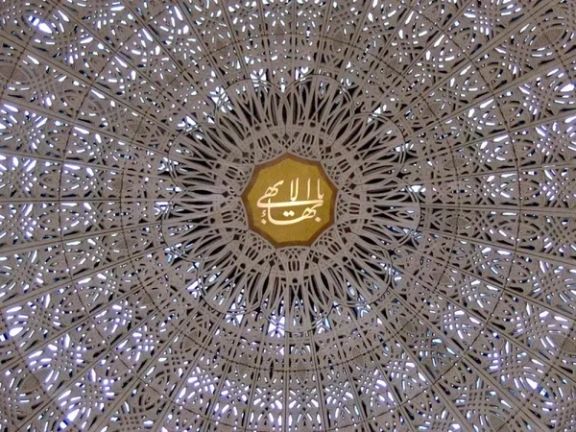
EU lawmakers urge sanctions over Iran’s persecution of Baha’is
The European Parliament adopted a resolution on Thursday condemning the systematic persecution of Iran’s Baha’i community and urging EU governments to impose sanctions on officials involved in rights abuses.
The resolution was approved with 549 votes in favor, 7 against and 31 abstentions.
Members of the European Parliament said the Baha’is face escalating repression, including harassment, arbitrary detention and property confiscation, and called for the immediate release of all those jailed for their religious beliefs.
"Member states must raise the issue of severe human rights violations in Iran and impose sanctions on Iranian officials contributing to the persecution of the Baha’is," MEPs said in a statement.
The adopted resolution also said Baha’i women face gender-based persecution and account for around two thirds of those detained.
MEPs called on Iran to compensate victims, return seized assets and allow the Baha’i community access to education, employment and services.
Lawmakers criticized the rise in executions in Iran and urged Tehran to halt the use of capital punishment as a tool of political and religious repression.
Fresh wave of hate speech and arrests
The European Parliament’s resolution comes amid a renewed crackdown on Baha’is inside Iran and rising anti-Baha’i rhetoric on state media.
Last month, a hardline commentator on Iranian state television, Ali Shirazi, alleged that the Baha’i minority holds “an unbreakable bond with Zionism,” claiming that “Baha’i and Israel are one and the same.” His remarks followed reports by the Baha’i International Community (BIC) that at least 22 members of the faith had their homes and businesses raided in coordinated operations across six provinces.
Iran does not recognize the Baha’i faith as an official religion, unlike Christianity, Judaism or Zoroastrianism.
Baha'is constitute the largest religious minority in Iran and have faced systematic harassment and persecution since the Islamic Revolution of 1979.
Iranian authorities have long accused the Baha’i community of links to Israel, partly because the faith’s spiritual center is located in Haifa, where its founder’s shrine stands. Rights groups say such claims have been used to justify arrests, confiscations, and lengthy prison sentences.
Nearly three quarters of documented violations against religious minorities in Iran over the past three years have involved Baha'is, according to the US-based Human Rights Activists News Agency (HRANA).
The Trump administration has responded to a message from Iran’s president, conveyed through the Saudi crown prince, by saying its three conditions for any negotiations with Tehran remain unchanged, sources told Iran International.
President Masoud Pezeshkian asked Saudi Crown Prince Mohammed bin Salman on the eve of his trip to Washington DC last week to act as an intermediary between Iran and the United States to help prepare the conditions for resuming talks, sources said.
In a confidential message delivered through Riyadh, Washington informed Tehran that it would return to the negotiating table only if Iran accepts the three demands previously outlined to Iranian negotiators by Steve Witkoff, President Donald Trump’s special envoy, the sources added.
The United States has long insisted that Iran must completely halt its uranium enrichment program, stop supporting its armed allies in the Middle East, and accept restrictions on its ballistic missile program.
Following Pezeshkian’s latest request for Saudi mediation, sources said, Washington reiterated that any negotiations with Iran remain conditional on Tehran agreeing to those demands.
Iran International on Thursday asked the State Department whether Saudi Arabia had conveyed any message from Tehran or served as an intermediary. The State Department neither confirmed nor denied the existence of such contacts.
“As President Trump has repeatedly said, including at the UN General Assembly, the United States has kept the door open for serious and direct dialogue, even as Iran has consistently rejected negotiations,” the spokesperson said in response to an email inquiry.
Supreme Leader Ali Khamenei on Thursday dismissed reports that Tehran had sought Riyadh’s help to facilitate talks with Washington, saying outreach to Trump would be beneath Iran’s dignity.
“They fabricate rumors claiming that Iran has sent a message to the United States through some country. It is pure lies. Nothing of the sort ever happened,” Khamenei said in a speech.
It is not clear whether Khamenei was not briefed on Pezeshkian’s outreach or whether the Islamic Republic chose to deny the entire exchange after receiving the US response.
The United States held five rounds of negotiations with Iran over its disputed nuclear program earlier this year, for which Trump set a 60-day deadline.
When no agreement was reached by the 61st day on June 13, Israel launched a surprise military offensive, followed by US strikes on June 22 targeting key nuclear facilities in Isfahan, Natanz, and Fordow.
Iran’s Foreign Minister Abbas Araghchi said last week that President Trump’s letter to Supreme Leader Ali Khamenei, sent shortly before the war, explicitly presented two options: continued war and bloodshed, or direct negotiations aimed at completely eliminating Iran’s nuclear enrichment and ballistic missile programs.
Iran has repeatedly turned down talks with the Trump administration while Washington keeps the door open for serious dialogue, a State Department spokesperson told Iran International on Thursday.
“As President Trump has repeatedly said, including at the UN General Assembly, the United States has kept the door open for serious and direct dialogue, even as Iran has consistently rejected negotiations,” the spokesperson said in response to an email inquiry.
Iran International asked if the State Department had any confirmation, clarification, or response regarding an alleged Iranian message sent to the US via the Saudi crown prince or any indirect diplomatic outreach from Tehran.
Last week, Reuters reported citing two sources familiar with the exchange that Iran's President Masoud Pezeshkian had urged Saudi Crown Prince Mohammed bin Salman to help persuade US President Donald Trump to revive nuclear talks.
Supreme Leader Ali Khamenei on Thursday denied reports that Tehran had sought to enlist Riyadh as an intermediary in talks with Washington, saying outreach to President Donald Trump was beneath Iran's dignity.
“They fabricate rumors claiming that Iran has sent a message to the United States through some country. It is pure lies. Nothing of the sort ever happened," Khamenei said in a speech.
"The Americans betray even their own friends ... A government of this kind certainly does not deserve for a state such as the Islamic Republic to seek relations or cooperation with it."
‘No peaceful purpose’
The United States held five rounds of negotiations with Tehran over its disputed nuclear program earlier this year, for which President Donald Trump set a 60-day ultimatum.
When no agreement was reached by the 61st day on June 13, Israel launched a surprise military offensive, followed by US strikes on June 22 targeting key nuclear facilities in Isfahan, Natanz and Fordow.
The State Department said Iran’s pre-strike uranium enrichment served no credible peaceful purpose.
“Prior to the United States’ successful military operation, Iran was amassing a growing stockpile of highly enriched uranium for which there was no credible peaceful purpose,” the spokesperson said. “Iran was the only state producing highly enriched uranium to this level that does not have nuclear weapons.”
Tehran denies seeking a nuclear weapon, but Western powers and Israel doubt its intentions.
Canada told Iran International on Thursday it does not automatically reject Iranian men’s permanent residency applications solely for compulsory IRGC service, after a conscript said he was ruled inadmissible for his involuntary service.
In a written response via email, Immigration, Refugees and Citizenship Canada (IRCC) said that “conscription, in itself does not necessarily result in a person being deemed inadmissible to Canada, adding every application is examined case-by-case after thorough security screening.
"Officers consider whether service was voluntary, any involvement in violence or terrorism, rank and role within the IRGC, support for the organization’s goals, and current ties to its members," the statement said. "Senior regime officials who served after June 23, 2003, remain fully inadmissible."
The clarification follows Monday’s Federal Court dismissal of Mohammadreza Vadiati’s appeal. The 40-year-old Iranian asylum seeker had his permanent residency refused despite completing only mandatory IRGC service from 2006 to 2008 and insisting it was non-combatant.
Ottawa formally listed the IRGC as a terrorist entity under the Criminal Code last year.
Under Canada’s anti-terrorism laws, membership in or support for a listed terrorist entity can result in inadmissibility, asset freezes, and criminal penalties.
The listing of the IRGC – which Canada blames for human rights abuses and the 2020 downing of flight PS752 – has broad implications for thousands of Iranian nationals who performed compulsory service.
Canadian politicians, including MP Kevin Vuong and Public Safety Minister Dominic LeBlanc, have said the listing aims to curb Tehran’s influence in Canada and prevent IRGC-linked individuals from operating on Canadian soil.
The court also confirmed that humanitarian or family reunification arguments cannot override terrorism-related inadmissibility findings under the IRPA.
The United Arab Emirates (UAE) remains a central conduit for Iranian funds reaching Hezbollah despite international sanctions, the Wall Street Journal reported on Thursday.
The newspaper cited Arab officials as saying that Iran routes money through UAE-based shell companies and hawala networks, or traditional means of transferring money that mostly skirt easy tracing. Hawala brokers in the UAE convert and move cash without creating bank records.
Hawala is a centuries-old informal money transfer system rooted in trust, operating outside traditional banking. No funds physically cross borders, brokers later settle balances through trade, reverse transfers or cash.
Hezbollah remains one of the most important armed allies of Iran in the region even after it took punishing blows from Israel in a war which was paused late last year.
To evade stricter airport controls, Iran now dispatches more travelers carrying smaller, undeclared amounts of cash and jewelry, the Journal cited the officials as saying.
“One billion used to be their entire annual budget, but after the war they need a lot more,” Hanin Ghaddar of the hawkish US-based thinktank the Washington Institute told the WSJ.
Iran supports an array of armed groups via the Islamic Revolutionary Guards Corps (IRGC), providing funding, training and weapons to advance its regional influence and confront rivals like Israel and the US.
Abu Dhabi has opened investigations and promised cooperation with Western allies, but enforcement has been inconsistent because of deep economic links with Iran, the report said.
Hamas and Hezbollah are quietly rebuilding their military capabilities amid a tense ceasefire with Israel, the Jerusalem Post reported last week. Both groups accuse Israel of violating ceasefires aimed at ending the region's two-year-old conflict.
Israel maintains military outposts on Lebanese territory and has carried out sporadic attacks targeting Hezbollah officials, including the assassination of its military chief of staff on Sunday.
Meanwhile Israeli strikes on what its forces call militant targets in Gaza have killed nearly 350 people in the impoverished enclave since a US-brokered truce last month.
‘Disarmament challenge’
Hezbollah and Iran are also active another front, since the government in Lebanon vowed to disarm the group and give the
Lebanon's government is pushing for Hezbollah to surrender its weapons nationwide by year's end, but the chances of its success appear remote.
Hezbollah insists it will only relinquish arms south of the Litani River in a southern sector adjoining Israel once its enemy fully withdraws from the country and stops its ceasefire violations.
Tehran views the surrender of Hezbollah’s weapons as capitulation to the United States and Israel and has dismissed efforts to seize its arms as fruitless.
Iran is steadily rebuilding its nuclear program and stalled talks with the United States have increased the likelihood of another direct confrontation with Israel, HuffPost Italy reported citing a former senior Mossad official.
“Iran is continually working to rebuild its nuclear program," the former official said, speaking anonymously due to what the outlet described as pressure from Iran.
"The dialogue with the IAEA (International Atomic Energy Agency) has been interrupted, and the one with the United States is stalled and making no progress. Given this situation, there is reason to believe that we could soon find ourselves facing another round of direct war between Iran and Israel,” he added.
Israel launched a surprise military campaign in June which was capped with US attacks on the three key nuclear sites in Esfahan, Natanz and Fordow.
US President Donald Trump said the attacks had "obliterated" Iran's nuclear program but a diplomatic standoff over its fate continues to fester.
The ex-Mossad official said strikes on Iranian nuclear facilities during the twelve-day war in June caused “serious damage” but did not destroy Iran’s nuclear material, adding that Tehran is strengthening defenses around key sites.
Iran’s leadership, the former official assessed, is divided over talks with the United States, with President Masoud Pezeshkian favoring compromise while Supreme Leader Ali Khamenei and the Revolutionary Guards oppose concessions.
"I do not believe the Supreme Leader will allow Pezeshkian to reach an agreement and prevent a war. The situation could deteriorate,” he said.
Iran signals military readiness
His assessment came as Iran’s defense minister issued a fresh warning about the country’s military posture towards any hostile action from its adversaries.
Defense Minister Aziz Nasirzadeh said Iran is “monitoring threats accurately and continuously” and is prepared to respond “more decisively and more harshly than in the past."
"In the twelve-day war, we displayed part of our capabilities, and of course we did not reveal all our defensive power," he said.
"Today, with full strength and complete intelligence oversight, we are ready to respond to any threat ... If our enemies make a miscalculation and any movement or hostile action ... they will undoubtedly face an immediate and regret-inducing reaction," he added.
Mossad operates 'inside' Iran
The former Mossad official's comments followed separate disclosures about Israeli intelligence activity in Iran.
In a separate report on Thursday, Israeli newspaper Haaretz said former Mossad director Yossi Cohen told a private conference that the agency operates “inside Iran itself” and recruits sources directly, according to recordings obtained by the paper.
“(Iran) is not a place where we operate by proxy,” Cohen was quoted as saying.
“We go in to recruit and to bring intelligence,” he added.
Israeli assassinations of Iranian nuclear scientists and hundreds of military personnel and civilians during the June war exposed deep intelligence lapses in the Islamic Republic.
In the aftermath of the 12-day war which culminated in US airstrikes on three Iranian nuclear facilities, Tehran's intelligence forces arrested more than 700 Iranians accused of acting as agents for Israel.
The arrests targeted what authorities described as an “active espionage and sabotage network” that intensified operations after Israeli attacks.