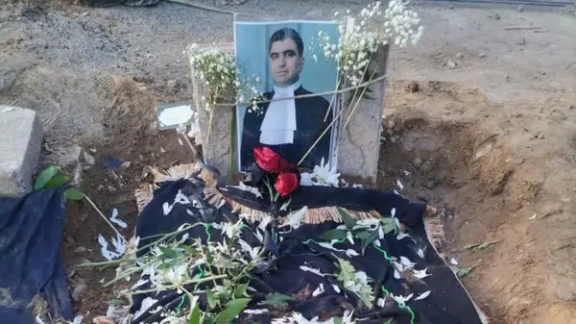
The US State Department on Tuesday denounced what it called the suspicious death of Iranian human rights lawyer Khosrow Alikordi, saying his case highlights the severe risks faced by those defending basic freedoms in the Islamic theocracy.
Alikordi, a 46-year-old prominent lawyer for jailed protesters and a former political prisoner, was found dead under unclear circumstances on Friday night, prompting some attorneys and activists to suggest possible Islamic Republic involvement.
"He devoted his life to defending Iranians who were fighting for freedom — including imprisoned protesters and the families of those killed by the Islamic Republic — even though he knew it meant putting his own life at risk," the State Department said in a post on its Persian-language X account.
"Years ago, he wrote: 'If I am killed, I am just one person — it is nothing. Do not let my homeland fall into the hands of the vile.' He never fought for himself alone; his struggle was for the people of Iran and for his country."
His death, the State Department said, "is a stark reminder of the dangers faced by those who fight for their rights in Iran."
"The United States continues to stand with the people of Iran in their pursuit of freedom and justice."
Alikordi died of cardiac arrest in his office in Mashhad, northeastern Iran, according to a report on Saturday by Iranian lawyers news agency (Vokala Press).
His body was transferred to the forensic institute for determination of “the main cause of cardiac arrest,” while police restricted entry to and from the office, according to media reports.
However, fellow lawyer Marzieh Mohebbi wrote on X that Alikordi died from “a blow to the head”, according to what she called "trusted contacts". Security officers, she said, removed cameras from the area and that access to his family had become impossible.
Alikordi, originally from Sabzevar and living in Mashhad, had represented political detainee Fatemeh Sepehri, several people arrested during the 2022 Woman, Life, Freedom protests, and bereaved families including that of Abolfazl Adinezadeh, a teenager killed during protests.
“We find his death highly suspicious and do not believe he died of a heart attack," Adinezadeh's sister Marziyeh said in an Instagram post about their lawyer's death.
A 25-year-old Iranian woman and child marriage survivor who had been sentenced to death for killing her abusive husband has been spared execution after the victim’s family agreed to forgive her, the judiciary's news agency reported.
Goli Kouhkan hails from Iran's Baluch minority in the country's southeast, where poverty and traditional social practices present special challenges for women's rights in the Islamic theocracy.
Mizan News Agency, the outlet affiliated with Iran’s judiciary, published a video on Tuesday showing the late husband's relatives formally recording their forgiveness in the presence of judicial officials and signing the necessary documents.
In the video, a local judiciary official says all the legal formalities for carrying out the execution had been completed, but mediation efforts led to a settlement and the victim’s family ultimately chose to pardon her.
The victim’s father also appears in the footage, saying they decided to forgive her after repeated requests from mediators and discussions with his wife.
“The family of the murder victim, with extensive cooperation from the provincial prosecutor’s office and the Dispute Resolution Council, and with both financial and moral support from philanthropists, has taken a magnanimous step and relinquished its legal and religious right,” the official said.
He did not clarify how much money — if any — was ultimately paid to the husband’s family. However, according to UN experts, the family had previously agreed to forgo the execution only if she paid 100 billion rials (about $80,000) in blood money, “an amount considerably higher than the recommended rate and far beyond her reach, especially as an undocumented woman who has been rejected by her family.”
Last week, UN human rights experts urged Iran to halt her execution, saying Iranian courts "failed to consider the sustained pattern of abuse or assess specific circumstances surrounding her actions."
Kouhkan was forced into marriage at the age of 12 to her cousin and endured years of physical and psychological abuse while working as a farm laborer, they said.
According to the experts, which include Special Rapporteur on human rights in Iran Mai Sato, Kouhkan gave birth at home at 13 without medical care. Attempts to escape the marriage failed because of her lack of legal identification documents and societal pressure.
In May 2018, her husband beat both her and their five-year-old son. After a relative was called to help, a confrontation ensued that resulted in her husband’s death, according to the experts.
The experts said at least 241 women were executed between 2010 and 2024, including 114 sentenced to death for homicide, many of whom had allegedly killed a husband or intimate partner after years of domestic violence or child marriage.
In Iran, the legal marriage age for girls is 13, and even younger with a guardian’s and judge’s approval. Rights groups say girls and women have little protection from domestic violence, and women face major obstacles when trying to divorce.
A prominent Iranian tech CEO has been sentenced to 74 lashes and had his company’s business license revoked after authorities accused the firm of hosting a mixed-gender party where women appeared without hijabs.
Nima Ashrafzadeh is CEO of Iranian e-commerce platform Pindo, a subsidiary of Iran's top online retailer Digikala.
The internal celebration at Pindo last December was reportedly deemed by authorities to have violated public morality codes because men and women attended together and some women appeared unveiled, according to Tehran-based tech outlet Digiato.
Yalda Night, an ancient Persian festival marking the year’s longest night, is traditionally celebrated in Iran with gatherings of family and friends, poetry readings, and fruit such as pomegranates and watermelon.
Digikala co-founder Hamid Mohammadi confirmed the sentence on the social platform X, saying the verdict had become final. He called it “unbelievable” and said it sends a “discouraging message” to those working in Iran’s digital economy.
“A few weeks ago, leaders of the digital economy were invited to meetings with the president and the heads of all three branches of government, where we heard promises of support,” Mohammadi wrote on Tuesday. “Today, the CEO of Pindo has been sentenced to 74 lashes, and the company’s license has been revoked.”
Mohammadi described the punishment as evidence of “a deep gap between official words and action,” saying it reflects growing uncertainty for Iran’s private sector and tech entrepreneurs.
Part of broader hijab crackdown
The case comes amid a renewed campaign by Iranian authorities to enforce mandatory hijab laws in both public and private settings. Earlier this month, judiciary chief Gholamhossein Mohseni Ejei said “the current situation cannot continue,” announcing new coordination between police, prosecutors, and regulators to address what he called “social disorders” linked to hijab violations.
Ejei said intelligence agencies had been ordered to identify “organized promoters of improper hijab,” and warned that restaurants, cafés, and companies could face permanent closure if violations occurred on their premises. Government institutions, he added, would also be held responsible for “unlawful behavior” at official events.
The judiciary statement followed a letter from 155 lawmakers urging tougher enforcement, accusing the courts of passivity toward noncompliance and demanding “consistent application of existing regulations.”
Despite these pressures, many women in major Iranian cities continue to appear unveiled in public spaces, and videos circulating online show mixed gatherings, music, and casual dress — a sign of ongoing defiance amid an intensifying state crackdown.
Iran was among the world’s top jailers of journalists this year, Reporters Without Borders (RSF) said in its annual report published on Tuesday, behind China, Russia and Myanmar.
Following the top three, RSF listed the next biggest jailers in order as Belarus, Vietnam, Azerbaijan, Iran, Egypt, Israel and Saudi Arabia. 21 journalists are currently imprisoned in Iran, it added, and one remains missing.
“This is where impunity for these crimes leads us,” RSF Director General Thibaut Bruttin said in a statement.
“The failure of international organizations that are no longer able to ensure journalists’ right to protection in armed conflicts is the consequence of a global decline in the courage of governments, which should be implementing protective public policies,” it added.
The report dedicates separate sections to journalists working in war zones, including Russia, Ukraine, Sudan and Syria, warning that these environments have become increasingly deadly.
“About 43% of the journalists slain in the past 12 months were killed in Gaza by Israeli armed forces. In Ukraine, the Russian army continues to target foreign and Ukrainian reporters. Sudan has also emerged as an exceptionally deadly war zone for news professionals,” the report said.
Exiled journalists
RSF also places Iran among the top 10 countries whose journalists receive its assistance while in exile. The list includes Afghanistan, Russia, Sudan, Iran, Belarus, Myanmar, El Salvador and Kyrgyzstan.
“Out of over 40 media outlets supported by the RSF Assistance Office over the last 12 months, 19 were Afghanistan, Russia, Sudan, Iran, Belarus, Myanmar, El Salvador and Kyrgyzstan newsrooms that continued to produce journalism in exile,” the report noted.
More than half of the journalists who applied for RSF emergency assistance in 2025 had been forced into exile, coming from 44 countries.
“2025 will be remembered as the year press freedom died in plain sight,” the report concludes, urging targeted sanctions on officials and entities responsible for the surveillance and detention of journalists.
Following widespread protests that began in September 2022 in Iran, repression of the press intensified and shows no sign of easing.
The crackdown coincides with increased pressure after the outbreak of war between Iran and Israel in June, which over 700 people have been arrested on allegations of collaboration with Israel.
United Nations experts have urged Iran to end the post-ceasefire repression, warning that “post-conflict situations must not be used as an opportunity to suppress dissent and increase repression.”
Iran’s judiciary opened proceedings against an unnamed Iranian dual national charged with spying for Israel, local media reported on Monday.
Mizan, the judiciary’s outlet quoted the chief justice of Alborz province, Hossein Fazeli Herikandi as saying that the defendant, who is a European country resident, allegedly held “multiple meetings with Mossad officers during a visit to Israel.”
Harikandi provided no evidence supporting the accusation and did not disclose the suspect’s identity – a pattern seen in past espionage cases brought by the Islamic Republic, many of which have later been discredited.
Rights groups note that Iran has repeatedly detained, prosecuted and even executed individuals on espionage charges without presenting verifiable proof.
One of the most prominent examples is the case of Mazyar Ebrahimi, arrested in 2012 and tortured into confessing to assassinating nuclear scientists – a claim he later exposed as fabricated.
Arrest during the 12-day war
Intelligence agents of the Islamic Revolutionary Guard Corps, Mizan said, arrested the dual national on the fourth day of the 12-day war between Iran and Israel.
“Complex espionage and intelligence equipment” was found at his residence, the report said, but did not specify what those items were or whether the defendant has had access to independent legal counsel.
Following the war, Iran’s judiciary has accelerated arrests and prosecutions on charges of “espionage” or “collaboration with Israel.” In October, political prisoner Javad Naeimi was executed in Qom on such charges.
Pattern of politically driven arrests
Over recent years, the Islamic Republic has detained dozens of foreign and dual nationals, often accusing them of spying or security offenses. Human-rights groups describe the practice as “state hostage-taking,” arguing Tehran uses detainees to pressure Western governments and extract concessions.
International monitors have repeatedly cited Iran’s judiciary for due-process violations, noting that many political defendants are denied independent lawyers and face opaque trials.
Iran’s judiciary says it has filed a case against a veteran ecologist and former adviser to the Department of Environment, after he said the government could fix Iran’s high-pollution mazut fuel with the cost of developing ten missiles.
Iranian media on Monday described the charges against Esmail Kahrom as relating to making “false statements” and actions “against national security.”
Prosecutors also opened a case against the editor-in-chief of the Jamaran news site, which published Kahrom’s interview.
In the November 30 conversation, Kahrom said that each missile costs roughly two million dollars and argued that if public health mattered to officials, they could redirect the equivalent of 10 missiles to upgrade fuel standards. He said authorities refused because “their priorities lie elsewhere.”
Iran, one of the largest oil and gas producers in the world, is facing a severe natural gas shortage. That shortage has prompted refineries to bulk out the fuel's volume with other substances, like mazut which environmentalists believe has played a major role in Iran's worsening air pollution.
Kahrom warned that the mazut used in Iran contains sulfur levels “seven times the global standard,” and that domestic fuel quality is also inadequate. His comments triggered sharp pushback from state-affiliated outlets.
Veteran ecologist and former adviser to the Department of Environment, Esmail Kahrom
Mazut, the non-standard gasoline contains harmful additives and has significantly contributed to the air pollution crisis in the country.
The use of the low-grade fuel mazut by power plants in Iran has been linked to severe harm to public health and even fatalities, with Iranians frequently expressing frustration over the worsening air quality and pollution in many cities.
State media dismiss environmental concerns
Young Journalists Club, tied to state broadcaster IRIB, wrote that “certain groups believe defense budgets should be spent on the environment,” calling national security a nonnegotiable necessity and portraying environmental debates as a distraction.
Farhikhtegan, a newspaper affiliated with the state-run Islamic Azad University, similarly argued – referencing the 12-day war with Israel – that critics forget “without deterrence, the cost of war would far outweigh any air pollution.”
Environmental warnings have frequently been downplayed or mocked by officials and pro-government media. Past concerns over water scarcity, energy crises, deforestation and land subsidence have met similar resistance.
A prominent example was the campaign against hydrologist Kaveh Madani, who faced accusations of espionage after warning of impending water collapse and ultimately left the country.
Iran has faced worsening air pollution in recent years alongside severe water and energy shortages, with experts tracing the crisis to aging infrastructure, poor fuel quality and policy inaction.