Top US General Warns Israeli War on Hezbollah Could Involve Iran
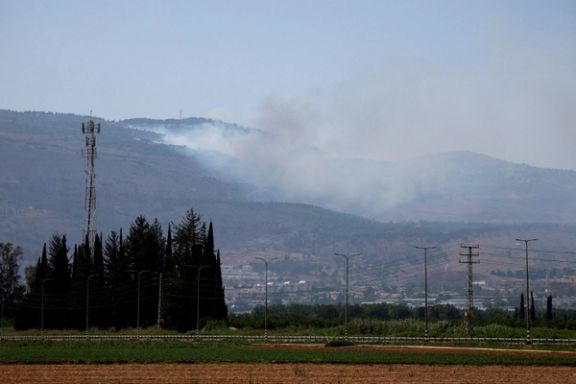
Smoke rises, amid ongoing cross-border hostilities between Hezbollah and Israeli forces, in Kiryat Shmona, northern Israel, June 14, 2024.
Any Israeli offensive in Lebanon would risk a broader conflict that draws in Iran and Iran-aligned militants, particularly if Hezbollah's existence is threatened, the top US general said on Sunday.
Air Force General C.Q. Brown, the chairman of the Joint Chiefs of Staff acknowledged Israel's right to defend itself, but indicated that given the location of the conflict, it would be more difficult for US forces to help Israel against massive drone and missile attacks.
"From our perspective, based on where our forces are, the short range between Lebanon and Israel, it's harder for us to be able to support them in the same way we did back in April," Brown said. He was referring to a massive Iranian missile and drone attack against Israel from Iranian territory on April 13 that failed to inflict any serious damage as Israeli and allied forces downed almost all projectiles. Last week, Washington voiced concernabout Hezbollah’s large arsenal of rockets overwhelming Israel’s air defenses.
Brown did not predict Israel's next steps and acknowledged Israel's right to defend itself, but he cautioned that a Lebanon offensive “can drive up the potential for a broader conflict."
As Hezbollah’s missile and drone attacks and Israel’s targeted strikes in southern Lebanon have increased, the Biden administration has been trying to prevent an all-out Israeli incursion into Lebanon. This has increased diplomatic tensions with Prime Minister Benjamin Netanyahu whose government has signaled its intention to launch a major land attack against Hezbollah.
"Hezbollah is more capable than Hamas as far as overall capability, number rockets and the like. And I would just say I would see Iran be more inclined to provide greater support to Hezbollah," Brown told reporters before stopping in Cape Verde on his way to regional defense talks in Botswana.
"Again, all this could help to broaden the conflict in the region and really have Israel not only be worried about what's happening on their southern part of the country, but also now what's happening in the north."
Iran's mission to the UN in New York warned Israel on Friday about the consequences of waging a full-blown war on Hezbollah. A statement posted on the Iranian mission's X account said Hezbollah "has the capability to defend itself and Lebanon."
"Perhaps the time for the self-annihilation of this illegitimate regime has come," it said.
"Any imprudent decision by the occupying Israeli regime to save itself could plunge the region into a new war, the consequence of which would be the destruction of Lebanon's infrastructure as well as that of the 1948 occupied territories," the Iranian mission warned.
It also called Israel the "ultimate loser" of the possible war.
Brown's comments came as Israeli Prime Minister Benjamin Netanyahu said on Sunday that a coming end to the intense phase of fighting in Gaza would allow Israel to deploy more forces along the northern border with Lebanon.
Iran-backed Hezbollah began attacking Israel shortly after Hamas' Oct. 7 assault sparked the war in Gaza, and the sides have been trading blows in the months since then. Hezbollah has said it would stop until there is a ceasefire in Gaza.
Earlier in June, Hezbollah targeted Israeli towns and military sites with the largest volleys of rockets and drones in the hostilities so far, after an Israeli strike killed the most senior Hezbollah commander yet.
Brown's remarks came as Israeli Defense Minister Yoav Gallant headed to Washington on Sunday to discuss the next phase of the Gaza war and escalating hostilities on the border with Lebanon.
Brown noted that the United States could be more limited in its ability to defend Israel from attacks by Hezbollah than it was helping intercept Iran's April missile and drone attack on Israel, which was largely thwarted.
Shahram Irani, the commander of Iran’s Navy, announced that it is a “permanent plan” of Iran's army to maintain a presence on all high seas of the world.
“Currently, the Islamic Republic's naval fleet is present in the Gulf of Aden to support the security of shipping," Irani said Sunday, without referring to the fact that Tehran-backed Houthis have been attacking commercial vessels in the Red Sea and the Gulf of Aden since November.
Irani said that the Iranian Navy also assists ships from other countries in distress.
However, a recent incident highlighted a contradiction in Iran’s stated mission of aiding ships in distress. The United States Central Command (CENTCOM) reported on June 16 that the Iranian frigate IRIN Jamaran ignored distress calls from the Palauan-flagged, Ukrainian-owned bulk cargo carrier M/V Verbena after it was hit by two separate missile attacks by the Houthis.
“The Iranian frigate IRIN Jamaran was eight nautical miles from M/V Verbena and did not respond to the distress call.”
CENTCOM condemned the inaction of the Iranian vessel while referring to a pattern of "malign and reckless behavior" by the Iranian-backed Houthis, asserting that such actions "threaten regional stability and endanger mariners' lives across the Red Sea and Gulf of Aden."
In his Sunday remarks, Irani also referred to the presence of "enemy ships" in the area, saying it "does not advance their cause, and the damage inflicted on gigantic ships by the small group of Yemeni Houthis proves this point."
The statement comes amid an ongoing US-led multinational coalition military operation, initiated in December 2023, responding to Houthi aggression.
As proxies of Iran, the Houthis started targeting maritime commercial traffic in mid-November, following a call from Iran’s Supreme Leader Ali Khamenei for Muslim countries to blockade Israel. Initially confined to the Red Sea, these attacks subsequently extended into the Indian Ocean.
Lebanon's Hezbollah is amassing a large cache of Iranian weapons at Beirut’s main civilian airport, Rafic Hariri International Airport, whistleblowers say.
There are also reports of the presence of AT-14 Kornet anti-tank guided missiles, Burkan short-range ballistic missiles, and RDX explosives.
The situation at the airport, located just four miles from Beirut's city center, has escalated concerns that it could become a military target for Israel amid rising tensions between the two sides.
One airport worker revealed the arrival of "mysterious large boxes from Iran," marking a concerning uptick in arms storage that coincides with heightened regional tensions. The worker expressed fears reminiscent of the devastating Beirut port explosion in 2020, suggesting that a similar incident could occur at the airport due to such activities.
Insiders report that Hezbollah's influence over airport operations has visibly increased, with the group's key figures, like its second-in-command Wafiq Safa, being regularly spotted managing affairs directly, intensifying the threat of retaliation by Israeli forces.
Later on Sunday, Lebanon’s Hezbollah-affiliated Transport Minister Ali Hamieh held a press conference at the Beirut–Rafic Hariri International Airport to dismiss what he called "ridiculous" allegations by whistleblowers that the airport is used by Hezbollah to store Iranian weapons.
He invited journalists and ambassadors to take a tour of the airport's facilities on Monday morning to prove "there's nothing to hide".
He also said that his office is in the process of filing a lawsuit against Telegraph.
Hezbollah, Iran's most formidable proxy, funded, trained, and armed by Tehran, continues its daily skirmishes with Israeli forces amid the ongoing Gaza conflict. The northern border conflict marks the most severe since the Second Lebanon War.
Since the October 7 invasion, Hezbollah, along with Iran's proxies in Syria, Yemen, Iraq, and Gaza, has supported Hamas by launching missiles towards all of Israel's borders.
Tehran's judiciary chief Ali Alghasi-Mehr announced that the Criminal Court of Tehran has sentenced the US government and officials to pay a total of $9 billion over the targeted killing of Ghasem Soleimani and sanctions against the Islamic Republic.
Alghasi-Mehr alsos aid that 73 US officials were notified to announce legal representation for the court proceedings concerning the case of IRGC Quds Force commander Qassem Soleimani.
On January 3, 2020, President Donald Trump ordered a drone strike near Baghdad International Airport that resulted in the death of Soleimani. The US justified the action by claiming Soleimani was actively planning attacks against American diplomats and military personnel in Iraq and the broader region.
Last year, Iran's judiciary said it has identified 97 suspects in the killing of Soleimani, including former US President, Donald Trump.Mohammad Mosaddegh, Deputy Chief of Iran's Judiciary, announced on Wednesday that "legal measures have been initiated against 73 Americans" including Trump and former secretary of state, Mike Pompeo.
Soleimani, who held a prominent role in Iran's military and intelligence operations abroad, oversaw the support and coordination of various militant proxy groups, including Lebanon's Hezbollah and Shiite militias in Iraq, which frequently targeted US forces.
Starting in January 2021, Tehran openly indicated its readiness to carry out deadly missions within the United States to seek revenge for the killing. It consistently singled out Trump, Pompeo, and former CENTCOM Commander General Kenneth McKenzie as top-priority targets for potential retaliation.
In 2022, late President Ebrahim Raisi told the UN that Donald Trump should face trial for his role in the Soleimani killing, and this year, continues to call for "vengeance" to the military man's killers.
The Canadian government's designation of the Revolutionary Guard (IRGC) as a terrorist entity provoked diverse reactions from Iranians: the authorities expressed profound outrage, while many citizens welcomed the decision.
Shortly after the announcement, the Canadian Foreign Minister advised against travel to Iran, citing increased risks of arbitrary detention for Canadians.
The Iranian Foreign Ministry Spokesman, Nasser Kanaani, did not mince his words, denouncing the move as 'disgusting' and an irresponsible and "provocative continuation of Canada's longstanding policies." Similarly, Kazem Gharibabadi, Deputy for International Affairs of Iran's hardliner Judiciary, did not hold back, labeling Canada’s decision as 'hostile' and emphasizing the IRGC's importance for Iran's national security and regional anti-terrorism efforts.
Iran's Foreign Ministry summoned the Italian ambassador, who represents Canadian interests in Tehran, to protest Ottawa's decision, condemning the move as "unlawful and internationally illegal."
Meanwhile, the Iranian community in Canada rejoiced, having played a pivotal role in pressuring the Canadian government to designate the IRGC, driven notably by families of the victims of flight PS752, which was shot down shortly after departing Tehran's international airport in January 2020.
Hamed Esmaeilion, a Canada-based activist who lost his family aboard flight PS752, told Iran International that designating the Guards sends a supportive message to Iranians worldwide and provides a sense of justice to families of IRGC victims.
Ardeshir Zarezadeh, director of the International Center for Human Rights in Canada, remarked that this is a significant step because "the IRGC, rather than the government, is the principal power" in Iran.
“This move is likely to prompt more countries to add the IRGC to their terror lists, further restricting trade and diminishing IRGC's influence,” Zarezadeh told Iran International.
Numerous Iranians worldwide also voiced their jubilation through voice and video messages to Iran International, urging more countries to follow suit.
The psychological impact on people close to IRGC members was noted by one individual, who pointed out that "even within their own families, the IRGC elements are not respected", and even more so now if they lose the prestige of money and a Canadian visa.
Another described Canada's move as a "turning point," eliciting joy among more Iranians worldwide.
According to another individual, this step “may be the catalyst for European nations to classify the IRGC as a terrorist organization and impose sanctions on them.”
Despite this, some individuals were content with the move but more pessimistic in their outlook.
A citizen remarked on the "formidable influence of the IRGC", questioning whether the designation as a terrorist organization, despite being a positive step, would bring about substantial change, pointing to Hamid Nouri's release from prison in Sweden, the individual underscored that the IRGC operates akin to a “global mafia, interacting extensively with security institutions worldwide.”
Hamid Nouri, a former Iranian official convicted of war crimes, was exchanged in a prisoner swap between Sweden and the Islamic Republic earlier this month.
Critics denounced the Swedish government's actions as "dangerous". They warned of "far-reaching consequences," asserting that such measures bolster Iran's strategy of diplomatic hostage-taking, resulting in numerous dual nationals being incarcerated in Iran without clarity or resolution.
The designation also sparked international calls for action, especially from Australian senators who have criticized their government for its reluctance to consider listing the IRGC.
Yet, governmental decisions on this matter have been shaped by endeavors to mollify Iran amid its nuclear program, as exemplified in the EU and the UK. Still, they have imposed targeted sanctions against Iran for its destabilizing activities and proliferation of weapons.
Senior US officials assured top Israeli diplomats that the Biden administration stands ready to support Israel if a full-scale war erupts on its northern border with Iran-backed Hezbollah, according to a CNN report Friday.
This comes amid escalating cross-border attacks that have heightened fears of another major conflict in the Middle East.
In a series of high-stakes meetings in Washington this week, the delegation of Israeli officials, which included Minister of Strategic Affairs Ron Dermer and National Security Adviser Tzachi Hanegbi, engaged in discussions with key figures in the Biden administration such as National Security Adviser Jake Sullivan, Secretary of State Antony Blinken, and White House Middle East Affairs Coordinator Brett McGurk.
Sources cited by CNN saidthat the discussions included “the situation on Israel’s northern border, Iran, and the ceasefire and hostage negotiations.”
A senior administration official told CNN that the US reiterated its commitment to providing the necessary security assistance to Israel, though it clarified that American troops would not be deployed on the ground.
Lebanon's Iran-backed Hezbollah has launched rockets into Israel in solidarity with Hamas, leading to the displacement of tens of thousands of people in northern Israel.
In response, US officials have repeatedly called for diplomatic efforts to prevent a full-scale war on Israel's northern front. This week, US envoy Amos Hochstein was dispatched to the region to assist in de-escalation efforts.
US officials expect the Netanyahu government to respond with full force if Hezbollah significantly expands the scope of its attacks on Israel that result in Israeli casualties.
The reassurances also come amidst a public dispute between Israeli Prime Minister Benjamin Netanyahu and the U.S., with Netanyahu accusing the U.S. of withholding military supplies. The face-to-face meetings in Washington aimed to address these tensions and reaffirm the strong U.S.-Israel alliance.