Iran-Backed Iraqi Militias Vow to Target US Interests If Israel Attacks Lebanon
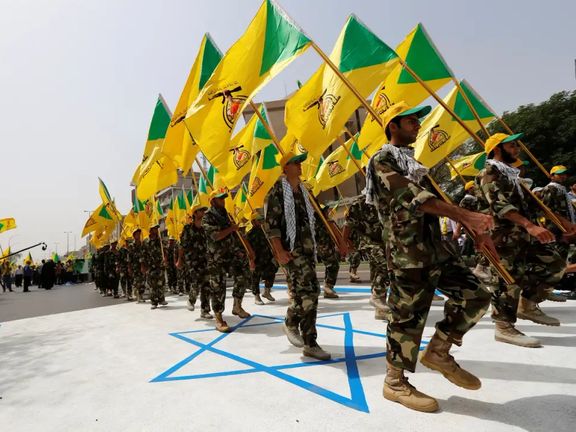
Iraqi Kataib al- Hezbollah during the early years of its formation
The Iran-backed Iraqi Resistance Coordination Committee (IRCC) has threatened to target the US interests in Iraq and the broader region should Israel launch an attack on fellow Iranian proxy Hezbollah in Lebanon.
The declaration follows a meeting of the coalition, reported by Al-Manar, a Hezbollah-affiliated network funded by Iran.
The IRCC is a coalition of Iranian-backed Iraqi militias, part of Tehran’s broader strategy to exert influence in the Middle East and counter US and allied presence.
Key groups within the IRCC include Harakat al-Nujaba (HaN), Kata'ib Hezbollah (KH), and Kata'ib Sayyid al-Shuhada (KSS).
The committee’s statement comes in response to escalating tensions along the Israel-Lebanon border. The border has seen daily exchanges of fire between Israeli forces and Hezbollah since the outbreak of the Gaza conflict on October 7.
Fears of a full-scale war intensified after Israeli Prime Minister Benjamin Netanyahu announced preparations for "a very tense operation" on the Lebanon border.
Iran's UN mission has warned Israel against “full-scale military offensive” in Lebanon, saying it would lead to an “obliterating war”.
“All options, [including] the full involvement of all Resistance Fronts, are on the table,” the Iranian mission said in a post on its X account on Friday.
Over the weekend, Israeli forces conducted a series of attacks on Hezbollah targets in southern Lebanon. "Hezbollah understands very well that we can inflict massive damage in Lebanon if a war is launched," said Israeli Defense Minister Yoav Gallant during a visit to Washington DC.
Hezbollah's leader, Hassan Nasrallah, has promised a war with "no restraint and no rules and no ceilings" if Israel initiates a major offensive against Lebanon.
The Lebanese group is believed to have amassed over 100,000 missiles, with Nasrallah frequently boasting about advanced weaponry yet to be deployed in its ongoing skirmishes with Israel.
Israeli Foreign Minister Yisrael Katz has responded to Iran's warning against the Jewish state's possible offensive in Lebanon, saying the Islamic Republic deserves to be "destroyed".
"Iran threatens today to destroy Israel if Israel fully responds to Hezbollah attacks from Lebanon," Katz said in a post on his X account on Saturday. “My response to Iran is clear: A regime that threatens destruction deserves to be destroyed."
Katz's comments came in response to Iran's mission to the United Nations which warned that any “full-scale military aggression” by Israel in Lebanon against Hezbollah would trigger an "obliterating war."
The Israeli top diplomat also made it clear that if Hezbollah does not cease its attacks from Lebanon, Israel will retaliate with full force.
"If Hezbollah does not cease its fire and withdraw from southern Lebanon, we will act against it with full force until security is restored and residents can return to their homes,” Katz said.
The situation has been tense along the Lebanese border following a series of attacks by Hezbollah, the Iran-backed militia. The Israel Defense Force (IDF) retaliated by targeting several Hezbollah positions after the group launched attacks on northern Israel.
The confrontation is part of a broader conflict involving Iran’s “Axis of Resistance," which includes not only Hezbollah but also Hamas, Yemen’s Houthis, and other groups in Syria and Iraq.
The axis has actively targeted Israel since October 7, when Hamas-led fighters stormed southern Israel, killing 1,200 people and taking 251 hostages, sparking the ongoing war in Gaza.
Iran itself launched missile and drone strikes on Israel on April 13, following an alleged Israeli airstrike in Damascus that killed several senior officers of the Islamic Revolutionary Guard Corps.
Although Iran’s strike was largely repelled with the help of the United States and other allies, it marked a new level of escalation in the region.
IRGC Chief Commander Hossein Salami claims Iran's 'Resistance' ideology has infiltrated universities across the United States and Europe, referring to pro-Palestinian protests in Recent months.
"The resistance is so grand, beautiful, and captivating that its attractions have penetrated even into the universities of the US and into the cities of France, England, Germany, Spain, Australia, and everywhere," Hossein Salami said during a conference on "Resistance" in Mashhad on Saturday.
The "Resistance" generally refers to the Islamic Republic's ideology of fighting Israel and also the US through a coalition of Tehran-backed armed militant groups such as Hezbollah, Hamas, the Palestinian Islamic Jihad, the Houthis in Yemen, and various Iraqi Shiite militias.
Salami's remarks specifically point to the recent campus protests in the US and Europe by thousands of students who established encampments on campuses to decry Israel's military actions against the Iran-supported Hamas in Gaza.
Enraged by the Israeli military campaign in Gaza, students across the US have been organizing pro-Palestinian rallies and sit-ins to pressure their institutions to disclose and divest from funds and corporations that do business with Israel.
Triggered by a Hamas attack on October 7, which resulted in the deaths of 1,200 individuals, mostly civilians, Israel's subsequent military response reportedly led to the deaths of over 35,000 Palestinians, according to Hamas figures.
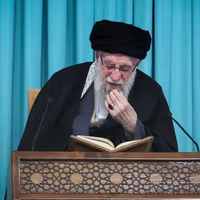
The protests in Western universities have been praised and politically leveraged by Iranian leaders, including Supreme Leader Ali Khamenei, who has repeatedly lauded the students' efforts as aligning with Iran's resistance against American and Israeli policies.
In a recent speech, Khamenei branded the campus protesters part of Iran's 'resistance front' against the US and Israel.
The campus protests across the US featured on the cover pages of many Iranian dailies, triggering a considerable backlash from ordinary Iranians who view the stunt as ‘glaringly hypocritical’ from a ruling system that suspends, beats and imprisons students for much less than what students have been doing in the US in the past ten days.
The Islamic Republic has always presented itself as the only true champion of Palestinians and their cause. This sentiment has become much stronger and prevalent since October 7 when Hamas, backed by Iran, rampaged border areas inside Israel.
The irony, as ordinary Iranians have been pointing out on social media, is hard to miss. It is a case of 'astounding hypocrisy', many say, of a regime who cheers on American students exercising their freedom of expression, while its prisons are humorously called ‘universities’ for hosting sheer numbers of students, graduates, and educators who have dared to speak their mind.
The US Department of State's latest International Religious Freedom report has revealed Iran's continued violations against religious freedoms.
Secretary of State, Antony Blinken, during the unveiling ceremony of the annual report, said that "government restrictions on religion had reached their highest global level since tracking began back in 2007".
The report, which annually assesses 200 countries, highlighted the repression of multiple minorities in Iran including the Baha'is. Only Islam, Christianity and Judaism are legal in Iran, though even Sunni Muslims face repression, along with restrictions on Jews and Christians.
Unofficial estimates suggest that more than 300,000 Baha'is live in Iran, making them the largest non-Muslim religious minority in the country and the most persecuted.
The Baha'is, in particular, suffer from systemic oppression, including arbitrary arrests, business closures, and frequent raids on their homes based on unfounded charges.
"The [Iranian] penal code provides for hudud punishments (those mandated by sharia), including amputation, flogging, and stoning. It specifies the death penalty for moharebeh ('enmity against God') and sabb al-nabi ('insulting the Prophet')," the report details, illustrating the harsh legal environment for those accused of religious crimes.
One of the most alarming aspects highlighted in the report is the variable application of the death penalty, depending on the religion of both the perpetrator and the victim, which disproportionately affects religious minorities. The report clarifies that "prevailing fatwas prescribe the death penalty for apostasy," showcasing the risks faced by individuals who deviate from the state-sanctioned religion or seek to renounce Islam.
Last year, rights group Rudaw claimed executions of the Kurdish minority had tripled, the majority of whom are Sunni muslims.
The repression extends beyond physical punishments, affecting various aspects of life for religious minorities. "The law, as typically interpreted, prohibits Muslim citizens from changing or renouncing their religious beliefs," the report states.
The 2023 report, like previous years, is compiled based on information gathered by US embassies from government officials, religious groups, NGOs, journalists, human rights observers, and other sources.
The US Commission for Religious Freedom's recommendations for 2024, list Iran as among the countries "of particular concern". "Religious freedom conditions in Iran are egregiously poor as the government continues to respond to calls for reform by systematically cracking down on religious minorities," its experts said.
"The government uses its official religious interpretation of Islam as an ongoing basis for denying freedom of religion and belief to citizens who express dissent through peaceful protest, including women and LGBTQI+ people."
The UK’s Labour Party intends to proscribe Iran’s Revolutionary Guard as a terrorist entity, if it wins the general election next month, according to a report by the British newspaper The Telegraph.
The report comes in the wake of the IRGC designation in Canada, which was welcomed by the Iranian-Canadian community who have been pushing for this measure for a few years.
The current UK government, led by the Conservative prime minister Rishi Sunak, has considered a similar move but decided against it on a number of occasions.
Based on the Telegraph report, the leading figures in the Labor Party do not share the hesitation and would be willing to back a change in the law that would allow for the IRGC’s proscription.
Yvette Cooper and David Lammy, picked to be the next Home and Foreign secretaries if Labor wins, are said to support the measure.
The Labor Party’s 2024 manifesto includes an explicit reference to Iran’s IRGC, while criticizing the UK’s approach.
“From the Skripal poisonings to assassination plots by the Iranian Islamic Revolutionary Guard Corps, threats from hostile states or state-sponsored groups are on the rise, but Britain lacks a comprehensive framework to protect us,” the manifesto reads. “Labor will take the approach used for dealing with non-state terrorism and adapt it to deal with state-based domestic security threats.”
It is unclear when and how the Labor would attempt such change –if it gets to form the next UK government after the July 4 election. The proscription will be a lengthy process, since it is a legal process and would require a legal case by the government.
Supporters of the move in the Labor Party may point to the October 7 attack by Iran-backed Hamas and the concerted efforts of non-state armed forces across the Middle East, almost all of which are backed by Iran’s IRGC.
Former US State Department spokesperson Morgan Ortagus took aim at the Biden administration's strategy on Iran, urging for more robust and assertive US policy to prevent Iran from having nuclear weapons.
In an exclusive interview with Iran International, Ortagus warned that if stronger action isn't taken, Iran will get a nuclear weapon.
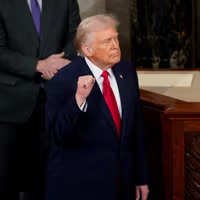
"Under the current trajectory, the Iranian regime will get a nuclear weapon in the next administration unless we have a president with the fortitude to stop it," said Ortagus.
She told Iran International's Arash Alaei that no matter who gets elected president in November, will have to make "some very serious and very hard decisions about the regime and their nuclear weapons proliferation."
That means Iran's estimated stockpile of enriched uranium had reached more than 30 times the limit set out in the 2015 nuclear agreement between Tehran and world powers. Iran insists that its nuclear program is for peaceful purposes.
Ortagus also took the opportunity to criticize some Western perspectives that she feels underestimate the resolve and capacity of the Iranian government to advance its nuclear program.
Responding to a question about the enrichment rates of uranium under different US administrations, she provided figures to illustrate her point:
“What was the enrichment rate in the Trump administration? You know the answer to this, 5%. What's the most recent enrichment rate in the Biden administration? 84%," highlighting a significant escalation that has occurred under the current US policy framework.
Ortagus served as a spokesperson for the United States Department of State from 2019 to 2021 during the Trump administration.
She said under Biden's administration, the Islamic Republic has been emboldened
Ortagus said attacks on US forces, the atrocities of October 7, and Iran's support and funding of its proxies known as the 'Axis of Resistance', is further destabilizing the region and the world.
"We just saw the British merchant Marine ship that was sunk. I mean, it's insane to me that we have the Houthis fully funded and armed and backed by Iran, sinking British merchant ships... It is wild to me that we have a terrorist group shooting ballistic missiles at US Navy ships after 911," she said.
“It was Iranian-made drones that killed 3 American service members in Jordan in January... It’s Iranian-made hardware, military hardware... the Houthis [use] ballistic missiles to attack American ships on a weekly basis,” she stated, pointing out the direct consequences of a less assertive US policy on regional security.
Ortagus advocated for Trump's 'maximum pressure' policy to contain Iran.
She argued that Trump's policies had effectively brought Iran "to its knees" by significantly curtailing its oil exports and crippling its economy. She credited these measures with hindering Iran's ability to fund terrorism and pursue its ballistic missile and nuclear weapons programs.
“We took Iran’s ability to export oil off the market, right? I mean, they pursued some black-market endeavours, but because we simultaneously sanctioned Iranian oil and also unleashed American energy exports, we had a situation where we kept the price of oil down,” Ortagus explained.
Ortagus lamented what she views as a relaxation of the strict measures under President Joe Biden, suggesting that the current administration has failed to enforce sanctions with the same vigor, thereby allowing Iran to mitigate some economic pressures.
“The Biden administration will say, well, the sanctions are still in place, sure, but they’re not being enforced as effectively as they were in the Trump administration,” she noted, adding that this lax enforcement has enabled Iran to continue funding and equipping its proxies throughout the Middle East.
Looking to the future, Ortagus discussed the potential for policy changes in a possible second Trump administration, emphasizing that a return to a stance of maximum economic pressure could be expected.
She argued that such measures would be necessary to prevent Iran from achieving its nuclear ambitions: “President Trump has said unequivocally that Iran will not get a nuclear weapon on his watch, and that means every option is on the table.”
Ortagus told Iran International that the Iranian government remains a significant threat not only to its own people but also to regional peace and global stability.
She said Donald Trump would not say "no to a negotiation" with Iran under a second Trump administration but would enter it "from a position of strength," but maintained that "every option is on the table."