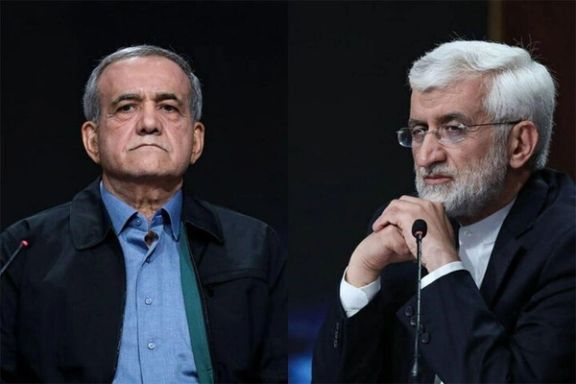
Iran's presidential candidates Masoud Pezeshkian (L) and Saeed Jalili
In the second and final debate on Tuesday between Masoud Pezeshkian and Saeed Jalili, the two candidates competing in Iran’s runoff presidential election, discussed Iran’s nuclear issue and the economic crisis.
The ultraconservative Jalili and the relatively moderate Pezeshkian frequently accused each other of lacking expertise, basic knowledge, and plans, and of making false promises.
At the start of the debate, Pezeshkian said, "Last night it seemed as though I disrespected the national hero Haj Qasem Soleimani. I consider him a symbol of national pride and a thorn in the side of our enemies, and if our youth follow his path, many of the country's problems can be solved."
During the debate on Monday night, Pezeshkian used a Persian expression to highlight Soleimani’s role in creating trouble for the United States in the region. However, this expression could easily be interpreted as belittling the IRGC operative.
Although the debate was supposed to focus on the economy, much of the discussion revolved around nuclear negotiations, the failure of the JCPOA, the foreign policy of the Islamic Republic, and negotiations with the West, with both candidates reiterating their previous positions.
In response to a question about why he opposed the Strategic Action Plan passed by the parliament in December 2020 to authorize more uranium enrichment, Pezeshkian said, "It's not true to say we don't accept the law. We said from the beginning we would follow the framework of the law and the policies of the Supreme Leader. So, there's no way we wouldn't implement the law."
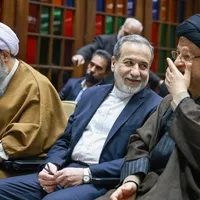
Candidates showing friendly gesture at the end of the debate on July 2
Previously, key figures in Pezeshkian's campaign, including Mohammad Javad Zarif, had criticized the Strategic Action Plan and called Jalili "a source of sanctions." The law, enacted as President Joe Biden won the White House, was meant to harden Iran’s negotiating position before expected talks to revive the 2015 JCPOA nuclear agreement, which was abandoned by the Trump administration.
Pezeshkian added, "One of the issues with this law is that the US must fulfill all its commitments before we return to the JCPOA. We need to discuss with the parliament, the Supreme National Security Council, and other relevant bodies to find a common language to address this challenge."
Jalili responded, "The parliament passed a law, and it must be followed."
Ali Khamenei praised the law and warned that no one should deviate from it.
Jalili continued, "We fulfilled our obligations under the JCPOA. You should be demanding compliance from the other side, not pressuring the nation to make concessions. When the other side hasn't fulfilled their commitments, what concessions are you going to make? Tell the people."
Without mentioning Mahmoud Ahmadinejad's government or his own role, Jalili said, "You talk about honesty. The governments of Hashemi, Khatami, and Rouhani, which included your friends, have been in power, and you're still demanding more. You've been in power for 40 years."
The fundamentalist Jalili is the main figure in an ultraconservative political faction that believes most other politicians loyal to the Islamic Republic and Supreme Leader Ali Khamenei are weak in their religious zeal and commitment to a more extremist version of the Islamist vision. Jalili and his allies were staunch supporters of former President Ebrahim Raisi and his “revolutionary” administration.
Pezeshkian replied, "You claim to have achieved results, so where are they? Didn't you promise to double employment and build a million homes a year? In these three years, you've only issued permits for 900,000 homes."
He added, "You say you have plans; why didn't you give them to Mr. Raisi to implement? Weren't you part of his team?"
Pezeshkian pointed to Jalili and said, "This person's entire experience is being the head of the National Security Council and reviewing some papers. Someone who hasn't managed anything now claims to have a plan for the country."
Referring to the significant boycott of the first round of elections, Pezeshkian said, "Despite all our campaigning, only 40% of the people participated. 60% did not, rejecting all of us. If this mindset prevails, turnout will drop to 20%. Can you govern the majority with just 20%?"
He concluded, "The 60% boycott in the first round sends a message to the government. I've heard and continue to hear this voice of doubt, dissatisfaction, and disillusionment."
During the debate, Saeed Jalili accused Pezeshkian of lacking basic knowledge, even in healthcare, despite being a physician. "It's good that Mr. Pezeshkian recites Quranic verses and hadiths, blessing our session. But these hadiths should be put into practice."
He added, "Mr. Pezeshkian, you lack knowledge on many topics and even basic information on some. Yet you want to become president."
Jalili concluded, "Already, they're shouting against me because they know I'll address their corruption in state-owned companies. I need the people's support to tackle these issues. Those who belittle Iran's capabilities continue to undermine our potential."
Iran’s former president Mohammad Khatami has highlighted the "unprecedented" absence of 60% of the electorate in Friday’s presidential election, stressing that dissatisfaction extends beyond just the non-voters.
“This act is a clear sign of the public's dissatisfaction with the current state of affairs and indicates the majority's discontent with the ruling system,” said Khatami. “The dissatisfaction is not limited to those who abstained from voting; many of those who did participate are also dissatisfied and voted in the hope of change."
Khatami stressed the importance of everyone participating in the second stage of the elections on July 5 to “complete the unfinished task.” He warned that abstaining could lead to the victory of an "approach harmful to the nation.”
The formerly popular reformist president announced his intention to vote for Masoud Pezeshkian, the sole reform-leaning candidate, and urged others to do the same.
The June 28 presidential election witnessed a historically low voter turnout in the Islamic Republic's history, with only a 39.92 percent participation. This broke the previous record set during the last election, when the late President Ebrahim Raisi won with a 48 percent turnout, providing a clear indication of the current political climate.
A runoff election will be held on Friday, with hardliner Saeed Jalili competing against Masoud Pezeshkian.
Khatami's call for participation in the election comes after he, for the first time in his political career, refrained from voting in the March parliamentary election, despite Supreme Leader Ali Khamenei's repeated assertions that voting is a religious duty. Previously, Khatami acknowledged that "people had the right to be disillusioned with reformists just as they are with the ruling system." This time, however, he is urging people to vote.
There is a notable difference in the current election compared to the parliamentary elections. Reformist parties and groups, such as the Etehad-e Mellat (Nation’s Unity) party, who were previously denied the opportunity to field any candidates, have now endorsed Pezeshkian. They engaged in an intensive campaign to convince voters to take part and elect Pezeshkian. Nevertheless, despite their campaign and repeated calls by Khamenei, at least 60% refused to vote according to official figures. Many Iranian on social media express doubt even about the 40% turnout, insisting that the government boosted the numbers to push the final tally to 24.5 million votes out of 61.5 million eligible.
The results showed that reformists and even the once popular Khatami have lost the trust of the majority.
The erosion of trust in reformists is evident in the public's perception of the ruling establishment, now viewed as a consolidated power structure led by Supreme Leader Ali Khamenei and the Islamic Revolutionary Guard Corps (IRGC), effectively marginalizing the president's authority.
This perspective is mirrored by the reform-leaning candidate, who has consistently acknowledged during debates that Khamenei is the ultimate decision-maker and pledged his adherence to the Leader's directives.
In the latest debate on Monday, Pezeshkian critiqued Jalili for attributing decisions to himself that were, in reality, Khamenei’s. “The final decision is made by the Leader. Don't say that something was done because I was in charge—no. If Mr. Khamenei doesn't like it and doesn't see it as appropriate, he won't allow it to happen,” Pezeshkian asserted, a stance that in theory, appears even more hardline than Jalili's.
It is worth noting that not all reformists continue to believe in “improving” the system. Key marginalized figures within the reform faction have also boycotted the election. Mirhossein Mousavi and Zahra Rahnavard, both under house arrest since 2011, abstained from voting in the presidential elections. Some imprisoned reformists such as Mostafa Tajzadeh also called for a boycott.
As Iran’s presidential runoff on Friday approaches and the initial US election debates are underway, the potential implications of a Donald Trump victory for Tehran have become a focal point in Iranian media.
The prevailing consensus among Iranian outlets is that there is little chance of Joe Biden's re-election and that a Trump presidency would be detrimental to the Islamic Republic. While some emphasize potential "disasters" in Iran's foreign relations, others propose solutions to mitigate these challenges.
Furthermore, analyses delve into the potential outcomes should either of the Iranian handpicked presidential candidates, Masoud Pezeshkian or Saeed Jalili, be elected.
Mohammad Ali Sobhani, a former Iranian ambassador in Lebanon, explained the best and worst scenarios for Iran's relations with the US in an article published on the “reformist” news outlet Etemaad on Tuesday.
In the best case, if "moderate governments" are in power in both countries—such as "reformists in Iran" and Biden in the US—it would be easier to reduce problems and reach agreements, creating a smoother path for diplomacy and cooperation, according to Sobhani.
In the worst case, if Jalili and Trump are in power, reaching an agreement would be much harder. Sobhani noted that Jalili's' past shows he would be reluctant to use his authority to revive the Joint Comprehensive Plan of Action (JCPOA), even when allowed by the Supreme Leader. He warned that “Jalili's extreme views” could pose significant risks to Iran's foreign relations, making the situation more challenging.
The only reform-leaning candidate, Pezeshkian, supports the JCPOA and advocates for expanding Iran's international ties, emphasizing the economic benefits of the 2015 nuclear deal. In contrast, Jalili criticizes the JCPOA and the moderate factions' focus on relations with just "three world powers," arguing that Iran should engage with over 200 countries to explore diverse opportunities.
The JCPOA involved Iran and major world powers, including the five permanent United Nations Security Council members. Under this agreement, Iran agreed to reduce its nuclear capabilities in exchange for relief from economic sanctions.
However, the US withdrawal from the agreement in 2018 under then-President Trump, followed by the re-imposition of sanctions, strained relations and severely impacted Iran’s economy.
Former Iranian diplomat Abdolreza Farajirad warned that Trump's return could lead to broader sanctions and significantly impact Iran's oil exports. He told Fararu that even a short-term deal with the current US administration would be advantageous, arguing that securing agreements before the US elections would help Iran "be in a stronger postion against Trump."
Farajirad also claimed that such agreements would benefit the Biden administration by “providing a notable achievement before the elections.”
While Farajirad sought solutions, others, like the state-affiliated outlet Iran Online, advocated for a more aggressive stance against a future Trump administration. It emphasized "completing the cycle of nuclear deterrence" as Iran's best strategy against Trump, according to an article titled "What should we do with Trump? A must-read for Jalili and Pezeshkian."
Iran Online stated that when Trump left office, Iran had a "limited nuclear program," with uranium enrichment capped at 3.67% under the JCPOA. Now, with the potential return of Trump to the White House, Iran has enriched uranium to "60% with IR-6 advanced centrifuges" and could achieve nuclear weapons "within a few weeks," framing this as "Iran's biggest trump card against Trump."
Iran's nuclear program has expanded rapidly in recent years, with limited access and many UN inspectors being barred. In June, France, Germany, and Britain, original signatories of the 2015 nuclear deal with Iran, condemned Tehran's plan to expand its uranium enrichment further. The US has also threatened to respond if Iran continues to accelerate its uranium enrichment.
Iran Online also cautioned the upcoming Iranian government, emphasizing that during Trump's first presidency, Iran faced consequences where it showed "indecisiveness" and brought the "proud American to his knees" when exerting authority. The outlet asserted that Trump withdrew from the JCPOA because he saw it as the "endpoint, the only way out, and the only irreplaceable solution for Iran." It further argued that Trump's decision to "commit the crime of Baghdad," that is, killing IRGC Commander Qasem Soleimani by US drones, was a sign of "Iran's perceived vulnerability" following the protests of November 2019.
In 2019, Iran witnessed a series of nationwide protests, referred to as Bloody November, that rapidly evolved into demands for the overthrow of the government and Supreme Leader Ali Khamenei.
Iran Online asserted that should Donald Trump be re-elected, he would confront Iran with “limited available options."
The semi-official Mehr News Agency also echoed a similar sentiment, stating that "if Donald Trump wins in the upcoming US presidential elections, there is almost nothing left to impose sanctions on our country." Adding that "However, our country's efforts to neutralize sanctions are expanding day by day."
Although other outlets did not share this optimism.
Amirali Abolfath, an international relations expert, told Etemaad newspaper in Tehran that US sanctions will persist regardless of who is in the White House, noting they will "continue" and potentially "increase in numbers".
He asserted that any incoming president in Iran would be unable to effect significant changes in Iran-US relations or the nuclear issue, emphasizing the "continuity in Iran's foreign policy" due to the structure of the Iranian constitution, implying that Supreme Leader Ali Khamenei remains the ultimate decision-maker.
Abolfath also highlighted the possibility of the "snapback mechanism" being activated, irrespective of whether Jalili or Pezeshkian becomes president, mainly as the JCPOA expires in October 2025. Without a relative agreement by then, Abolfath warned that "UN sanctions will return," potentially escalating tensions between Iran and the US.
The snapback mechanism, part of JCPOA, allows any participant to restore all UN sanctions on Tehran if it deems Iran violating the agreement.
During their first televised debate on Thursday night, US President Joe Biden and former President Donald Trump clashed over their respective records on Iran, each accusing the other of weakness while failing to provide any clear insight into their future policy towards the Islamic Republic.
President Biden's Iran policy has faced widespread criticism for being too lenient. Critics say that the Biden administration has not enforced the oil export sanctions by reversing Trump's maximum-pressure approach to pursue a nuclear agreement. Additionally, prisoner swaps and waivers have freed $16 billion in previously frozen Iranian funds, funneling tens of billions of dollars into the regime's coffers.
Nevertheless, despite differences in outlook and style, both candidates seemed intent on appearing tough on Iran during their Thursday debate, particularly in the wake of the October 7 attack on Israel, which many believe would not have occurred without Tehran's support for Hamas.
In an attempt to engage the 60 percent of voters who abstained from the first round of Iran's presidential election, Masoud Pezeshkian, a candidate in the race, made additional pledges to merchants and shopkeepers on Tuesday.
"I promise that I will never lie and will never make a promise that I cannot keep. I will make every effort to solve the problems of poverty, unemployment, discrimination, and injustice," said Pezeshkian.
The June 28 election, now proceeding to a runoff between two candidates, recorded the lowest presidential voter turnout in the Islamic Republic's history. Over 60 percent of the electorate abstained, a 9 percent drop from the 2021 election won by the late President Ebrahim Raisi, who died in a helicopter crash in May.
Despite Supreme Leader Ali Khamenei's June 25 call for "maximum" turnout to legitimize the system, many Iranians remain apathetic. The Guardian Council, a 12-member body with the power to disqualify candidates, maintains stringent control over the electoral process.
Pezeshkian emphasized the need for economic reforms and international engagement, but he did not address how he plans to achieve these under the eyes of Supreme Leader Ali Khamenei, who holds the ultimate power over Iran's foreign policy.
Iran's trade is hampered by international sanctions, particularly from the United States, aimed at curbing its nuclear program and addressing its support for terror activities and its human rights abuses. The sanctions restrict Iran's access to global markets, technology, and foreign investment, further isolating its economy.
Pezeshkian further stated, "We will ensure that those who cannot afford to pay taxes are not burdened," but he again failed to provide concrete plans or resources to support his promises.
A few days before the runoff election that will decide whether the relatively moderate Massoud Pezeshkian or the ultraconservative Saeed Jalili becomes President of Iran, a fierce smear campaign is raging between the two.
A specific article links Jalili to hardline cleric Mohammad Mehdi Mirbagheri, who was reportedly behind the chemical attacks on girls' schools in 2022 and 2023. It also claims that the ideology Jalili subscribes to is detrimental to the country's development.
Those opposed to the government-controlled election doctor and merge the pictures of the two candidates alleging that the two men are part and parcel of the same system, calling them "the two halves of the same apple."
Supreme Leader Ali Khamenei has warned the candidates against engaging in smear campaigns more than once. While groups close to their campaigns are clearly involved in these tactics, a larger political force appears to be at play. Election boycotters and foreign-based opposition forces are trying to persuade voters to stay away from the polls on Friday. According to official numbers, at least 60 percent of voters stayed home during the first round on June 28, and the opposition is aiming for an even more extensive boycott this time.
Meanwhile, a report on moderate conservative Khabar Onlinewebsite also highlighted the link between Jalili and Mirbagheri, dubbing Mirbagheri as the new Mesbah Yazdi, the founding father of the ultraconservative Paydari Party. Mirbagheri, who has endorsed Jalili, is known for his belief in conspiracy theories and the clash of civilizations theory.
Their ideology, the article charged, that the fundamentalist group believes it is the mission of the Islamic Republic to to change the nature of the world and to take it back to the "Islamic civilization." They call moderate Islam the "American Islam."
In another development, former President Hassan Rouhani warned "officials," presumably including Khamenei and his aides that "the coming to power of a radical government in Iran will drag the country to the brink of war, more sanctions, poverty and misery. The forming of such a government will be a loss for everyone, whether they vote or not."
Rouhani also warned the boycotters that they would bear full responsibility for the consequences of their actions. He further cautioned those who are passively observing the situation that this is a matter of war and peace, life and death, and that inaction will not protect anyone.
He described the runoff election as a choice between Pezeshkian and Jalili, framing it as a decision between realistic progress and a "wishful U-turn" that could impact the fate of the Iranian nation for at least a decade.
The thorny issue of a possible fuel prices hike has taken the centerstage in the debates between supporters of the pro-reform Masoud Pezeshkian and ultra-hardliner Saeed Jalili, and among eligible voters.
The duel began Sunday with Jalili supporters claiming on social media that fuel prices would increase several-fold if Pezeshkian wins the runoff elections on July 5, and reach as high as 250,000 rials per liter (around 40 cents).
Currently rationed gasoline is sold at 15,000 rials per liter (2.5 cents). The cost of anything used over the rationed amount (From 25 liters per month for motorcycles and 60 liters for personal cars to 500 liters for ambulances) is 5 US cents per liter.
This heavily subsidized price, coming to less than 10 cents a gallon, is the second cheapest in the world and costs the government tens of billions of dollars per year. Average gasoline prices in the region is closer to $1 per liter.
Jalili’s campaign officials and supporters’ intensive attacks on Pezeshkian’s campaign were followed by a Jalili tweet on Monday. The image posted by Jalili with no comment looked like the map of an Internet Taxi application with Pezeshkian as the taxi’s passenger going to the presidential office. The caption read “Will increase transportation costs” to suggest that Pezeshkian’s government intends to increase fuel prices to 250,000 rials (around 40 cents) per liter.
“Mr. Jalili, I haven’t proposed any plans for increasing gasoline prices but you must say if the price of gasoline will be less than 600,000 rials (nearly $1) after your government implements your ‘The One Plan’,” Pezeshkian’s official X account respondedto Jalili shortly after.
Jalili has proposed "The One Plan" to distribute energy subsidies equally to all Iranians, regardless of income, instead of the current income-based cash subsidies in 2021 by allocations of “One” units which could be used like cash to buy fuel or electricity instead of money. Fuel should be sold at international rates after the introduction of the plan.
The plan, he argued, would allow individuals with less energy consumption to sell saved units at any price through a mobile application or treat them as investments for the future. According to information on Jalili’s website, One units can also be used to pay water bills.
Neither Jalili, nor his campaign had made any reference to the plan during the campaign before Friday’s low turnout elections in which he came second after Pezeshkian but his campaign aides and supporters are now extensively promoting the plan as one of Jalili's measures to improve the lives of low-income Iranians.
Jalili formed a shadow government during the presidency of moderate Hassan Rouhani and maintained it during Ebrahim Raisi’s administration to which he appears to have proposed his plan.
Raisi’s government did not implement The One Plan and the price of gasoline remained the same as in 2019. A mini model, however, was introduced in the Persian Gulf free economic zone Island of Kish as a pilot in March 2022 for four months.
Not only economists, but even hardliners media including the Revolutionary Guards (IRGC) linked Javan newspaper criticized the pilot plan in Kish Island and said it had increased fuel usage instead of decreasing it.
Fuel gasoline has always been highly subsidized by the government. Smuggling of gasoline and other fuel in huge quantities to neighboring countries including Iraq, Afghanistan, Turkey, and Pakistan where it is much more expensive is a serious problem for all Iranian governments. Some economic experts say as much of 20 million liters of fuel is smuggled out of Iran every day.
The quadrupling of fuel prices by Mahmoud Ahmadinejad’s government in 2007 sparked riots, particularly in Tehran where petrol stations were torched by angry protesters. Hassan Rouhani’s government increased fuel prices three times. The last increase in November 2019 the tripling of the prices led to extensive protests across the country that lasted a week. Hundreds were killed and security forces seriously injured thousands during the crackdown on protesters.