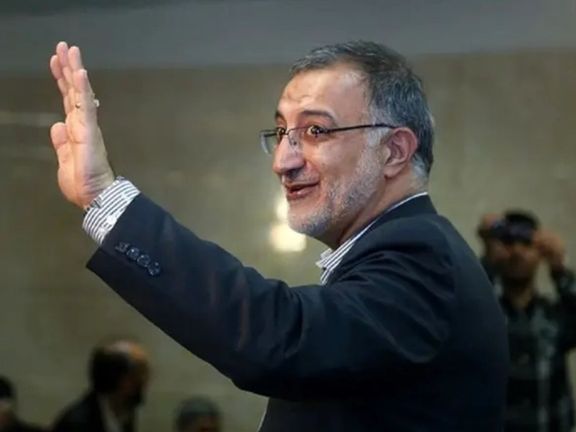
Popular campaign to unseat Tehran's hardline mayor gains momentum
Tehran Mayor Alireza Zakani
A popular campaign to unseat Tehran's mayor, Alireza Zakani, is gaining momentum, with reports on Sunday indicating that over 71,000 people have signed a petition against the hardliner.
The ongoing campaign, addressed to the Tehran City Council, calls for Zakani’s dismissal, arguing that the mayor's actions, including repurposing green spaces for building mosques and commercial projects, show his inability to handle the responsibilities of his office.
Back in April, over 147,000 people signed a petition to prevent the destruction of Qeytarieh Park, where Zakani's administration planned to construct a mosque, leading to the cutting down of many trees.
However, Mehdi Chamran, the chairman of Tehran City Council, has downplayed the popular campaigns to dismiss Zakani, saying similar efforts against US President Joe Biden also failed to unseat him.
"Now he is sitting in his place, hale and hearty," Chamran said, emphasizing that even the large number of signatures does not justify changing the mayor.
Zakani's tenure as mayor has been marked by significant controversy and criticism. His involvement in the 14th presidential election, where he withdrew in favor of other conservative candidates, left many issues, such as the construction in parks, unresolved.
During the 2022 “Woman, Life, Freedom” protests, the United Kingdom sanctioned several officials of the Islamic Republic, including Zakani, highlighting his contentious past as the former head of the Student Basij Organization, a group notorious for its human rights violations.
Last year, Zakani’s trip to Brussels for the “World Association of Major Metropolises” assembly stirred further controversy. Darya Safai, a Belgian MP of Iranian descent, criticized his presence, stating that Zakani is the former head of the Student Basij, an organization sanctioned by the European Union for human rights violations. She said it is outrageous that the “regime’s terrorists” can freely walk in the heart of Europe.
Tehran is grappling with numerous challenges, including severe air pollution, heavy traffic, land subsidence, water shortages, high housing costs, and an aging and insufficient public transportation system. Many residents believe these issues have worsened under Zakani's leadership.
Zakani's political career has been fraught with aggressive tactics and controversies, particularly against reformists. Financial and familial scandals have also plagued his tenure, with allegations of nepotism involving his son-in-law and questionable financial dealings by his daughter.
Zakani's recent candidacy in Iran's presidential election also drew criticism, as he took a leave from his municipal duties to participate in a race that almost everyone anticipated he would eventually withdraw from to support other hardline candidates.
In a meeting with the outgoing government, Iran’s Supreme Leader, Ali Khamenei, lavished praise on the late president Ebrahim Raisi, stating that "he was an exemplary model of management," for all officials.
Khamenei’s remarks came just one day after he told the newly elected Masoud Pezeshkian to follow in Raisi’s footsteps. Although the president-elect has vowed not to propose any major plans and execute Khamenei’s vision, he has also criticized certain policies and actions pursued in the past three years by the Raisi administration.
In this meeting, which was the final gathering of the members of the Raisi government, Khamenei described the administration as the "government of work, hope, and progress." He said, "Martyr Raisi was truly hopeful and rightfully optimistic about the future, and he was determined to achieve the outlined goals."
Ebrahim Raisi, a cleric backed by hardliners and elected in June 2021 in a highly stage-managed election, was killed in a helicopter crash in May. So far, no clear cause for the incident has been provided.
Khamenei’s praise for the former president contradicts his administration’s poor record in managing the economy and its conduct during anti-government protests in 2022-2023, when security forces killed around 550 civilians, injured hundreds more and arrested 22,000 people.
The Iranian currency doubled its losses in less than three years during Raisi, sinking to more than 600,000 rials per US dollar. This worsened inflation, especially for food and consumer necessities while the government was unable to meaningfully boost salaries. Monthly wages for ordinary workers has remained below $200, impoverishing tens of millions of people.
When Raisi was elected, there was some hope for a nuclear agreement with the United States and European powers that could have lifted crippling US sanctions. Negotiations had been underway in Vienna since April 2021, but the talks paused for nearly six months. When they resumed in November of that year, they ultimately failed in 2022.
This left Iran struggling with a deepening economic crisis. While it is widely known that Khamenei determines Iran's foreign policy and the president has little say in strategic issues, Raisi praised the Leader’s wisdom and continued to preach self-reliance and closer relations with Russia and China.
This was perhaps what Khamenei valued most as he praised Raisi's deep belief in domestic capabilities on Sunday. "We have talked about this with officials at various times, and no one disagreed with this appraisal; however, one could see that Raisi genuinely believed in the domestic capacities and capabilities to solve the country's problems."
However, the fact was that even many conservative politicians began criticizing Raisiearly in his term for mismanagement and a lack of ability to make changes necessary to alleviate economic pressures.
While suspicions linger among many Iranians about the helicopter crash that killed Raisi, Khamenei and his ideological establishment do their utmost to present him as a hero and a martyr.
Khamenei in his speech even tried to credit Raisi with a project to transport sea water to Iran’s arid interior, a lofty plan that preceded the late president and will probably remain on paper for years to come.
In the concluding part of his speech, Khamenei delivered remarks that many will interpret as a message to the new president: These characteristics were highlighted to establish a model and to be recorded in history, demonstrating that the head of the executive branch can possess a collection of intellectual, heartfelt, and practical virtues and can pursue them in both governance and personal conduct.
UN Special Rapporteur Javaid Rehman says due to systemic issues within Iran's judicial system, a change in presidency is unlikely to improve the country's human rights situation.
"There are certain systemic issues in Iran starting from 1979 (Revolution). The system is very repressive, intolerant, and non-accepting of democratic values," Rehman said in an interview with Iran International's Mahsa Mortazavi in Toronto, Canada.
He pointed out that the constitutional framework concentrates all powers with the Supreme Leader, creating an absence of an independent judiciary where people's rights can be respected. "There is a need for reform in the constitutional framework," he said, emphasizing that the people need to be recognized with the right to democratic governance, which has been absent for the last 45 years.
Rehman, who will leave his post in July, discussed his findings publicly for the first time outside the UN in Toronto, Canada, after being unable to travel to Iran to investigate human rights in Iran during his six-year tenure. The Iranian government, which dismisses all accusations regarding human rights violations, has not permitted UN special rapporteurs to visit the country and conduct investigations.
In response to Iran International’s question about how he could investigate Iran’s human rights issues without traveling to Iran, Rehman explained that he had held many meetings with the Iranian diaspora and individuals who had first-hand experiences of human rights violations, allowing him to collect substantial evidence.
"We certainly work on the basis of dialogue and human rights discourse and the improvement of the human rights situation," Rehman said.
Rehman also noted that the regime has not allowed any space for civil society to grow, repressing even non-governmental organizations like the Imam Ali organization. "The system needs substantial changes for it to accept democracy, rule of law, and the rights of the people," he asserted.
Previously, Rehman had labeled Iran's mass executions of political prisoners in 1988 as "genocide" and "crimes against humanity." In June, during a UN Human Rights Council session in Geneva, he unveiled a detailed report showing systemic state-sponsored atrocities during a brutal crackdown on dissent. His investigation revealed that thousands of political prisoners, including Baha'is, Kurds, and members of groups like the MEK, were executed in the 1980s, particularly in the summer of 1988, following a fatwa issued by Iran's then-leader, Ruhollah Khomeini, and approved by a four-member death committee.
Rehman said he chose Toronto as his destination due to its significant Iranian diaspora community. He said he wanted to meet people closely connected to Iranian communities within Iran. "It is important for them to understand the perspective of the Special Rapporteur and the challenges I face in my work, including the lack of access to the country, which Iran has unfairly denied me for the past six years," he explained. "Toronto offers a great opportunity to learn more from a community closely following developments in Iran," he added.
Rehman’s comprehensive reports, along with a detailed 400-page report from the Fact-Finding Mission on Iran, have paved the way for international tribunals and greater use of existing international jurisdiction to prosecute those responsible. The focus remains on collecting evidence that can withstand scrutiny in court. Rehman's latest report will be published on his website later this month.
During both the presidential election and the runoff, diaspora Iranians gathered outside polling stations abroad to voice their disapproval, arguing that voting would lend legitimacy to the Islamic Republic.
Protests erupted in numerous global cities, including Bern, Amsterdam, Melbourne, Oslo, The Hague, Vienna, Stockholm, Manchester, Auckland, Sydney, Washington, and Hamburg, as demonstrators called to boycott the polls.
Meanwhile, clashes were reported between voters and protesters, with some arrests reported in London and at least four recorded on camera. The Metropolitan Police did not respond to Iran International’s request for comment.
The confrontations highlighted the divide even within the diaspora where voters and boycotters came face to face.
In London, outside the Iranian consulate where voting for Iran's presidential election was underway on Friday, protesters confronted voters, questioning their decision to participate after the government's bloody repression of the 2022 nationwide protests in Iran.
"How can you vote after all these people were killed? You legitimize the regime by doing so," one protester was heard shouting in a video shared on social media.
In another video, one voter is seen making a death gesture at protesters.
A notable incident, capturing even the attention of Iranian media, involved a female protester filming herself as she pulled off the hijab of one of the voters, igniting considerable controversy.
Two videos surfaced showing voters being arrested by the Metropolitan Police, along with one protester being detained for swearing as confrontations became physical.
But, this incident is not isolated. In May, during the commemoration of Ebrahim Raisi's death in a freak helicopter crash, clashes erupted between Islamic Republic loyalists and dissidents in both London and Maryland.
In the United States, a court issued a temporary restraining order against an employee of Iran's Interests Section in Washington, DC, who was seen threatening Iranian protesters with death.
Meanwhile, in London, images of an Iranian woman being beaten to the ground by a man seemingly loyal to the Islamic government went viral on social media. Additionally, an Iranian protester sustained injuries following an attack during the clashes.
"Any form of physical abuse or violation of someone's personal space is entirely unacceptable. Freedom of religion is a fundamental right, and violence in any context cannot be justified," remarked Arash Joudaki, a researcher and holder of a doctorate in Philosophy, in an interview with Iran International.
Explaining the venting of frustrations of the protesters, Joudaki said, “Swearing is a convenient outlet for expressing anger. Some argue that if certain people gain power, they will commit atrocities, equating their swearing to murderous intent. However, this comparison is flawed. Hitler did not swear; he orchestrated mass murder. Verbal abuse and killing are not directly related.
“Supporting an authoritarian regime through your vote means accepting the consequences, including receiving verbal backlash. Swearing pales in comparison to the regime's atrocities, such as the shooting of protesters during nationwide demonstrations."
Sociologist Hossein Ghazian saw the recent incident as a sign of Iranian society's anger. “Our anger manifests in two ways: Through words, which becomes ‘verbal aggression,’ meaning angry verbal behavior, and through actions, which becomes ‘violence,’ meaning angry physical behavior.”
“People swear to hurt and harm the recipient of the curse,” Ghazian said. He believes opponents of the Islamic Republic use such language against their adversaries because they have taken on its characteristics and are influenced by it during their fight, whether in mindset, language, or behavior.
Ghazian views swearing as a "political act" with both advantages and drawbacks.
“It has its benefits, for instance, when it is directed at the Supreme Leader and his inner circle” because it breaks the sacredness or untouchability of the Supreme Leader, but in contrast, if it’s aimed at security forces or the supporters of the Islamic Republic it ultimately proves counterproductive.
“Imagine a Revolutionary Guard involved in oppression all day returning home to a family upset by his actions, possibly scolding or advising him to stop. However, if the family, especially the mother, has heard the protesters' curses targeting them, she is less likely to be upset about his involvement in repressing those who insulted them. She might not encourage further repression, but she will be less upset,” Ghazian wrote.
Moral and tactical considerations
This is precisely the issue that social scientist Erfan Sabeti cautions against, arguing that swearing is both tactically and morally detrimental.
Sabeti, an editorial board member of Nashr Aasoo, told Iran International that swearing and vitriolic language, even when directed solely at the Supreme Leader, is morally problematic because it transforms us into the very thing we strive to oppose. This behavior does not merely remain an isolated act of defiance against an oppressive figure; instead, it insidiously embeds itself into our conduct and psyche. By adopting the methods and temperament of our adversaries, we risk becoming reflections of them, perpetuating a cycle of hatred and aggression.
Sabeti thinks that when we resort to swearing, we engage in a form of verbal violence that mirrors the moral degradation we condemn in our opponents. Though this kind of rhetoric may seem like a harmless venting of frustration, it fundamentally undermines the ethical high ground we seek to maintain.
“The Islamic Revolution was founded on violence, and its results reflect that foundation. Violence is destructive, not constructive. While one might overcome an opponent through violence, it leaves behind ruin. If we aim to eliminate oppression and repression, we must not let hatred accumulate within us, despite the government's extensive violence making it very difficult,” Sabeti told Iran International.
Striving for ethical integrity
According to Sabeti, actual change, both political and social, requires that we uphold the values of respect, empathy, and ethical integrity, resisting the temptation to mirror the malice of our adversaries. Only by doing so can we hope to create a future that transcends the cycles of violence and retribution that have marred our past.
Another danger of this behavior is that the Islamic Republic propaganda machine exploits this by suggesting that if these people come to power, they will destroy everything and be even worse than us.
This assertion has been substantiated as Iran’s Interior Minister last week denounced the Iranian diaspora protesting outside consulate buildings and polling stations on presidential election day, branding them as "terrorists" residing in the West.
Also, another is that it is not just to curse Khamenei; we become accustomed to it, it normalizes, and its disgrace fades, according to Sabeti.
Internal opposition disputes mirror this behavior, spreading rudeness within. This can be seen on social media, as opposition supporters sometimes engage in that behavior.
The complex dynamics of the diaspora
Ghazian posits that the dynamics between the diaspora and the people inside Iran are complex, with the actions of dissidents abroad having both positive and negative effects. He believes that the sizable Iranian diaspora now holds significant electoral weight, which can influence local politicians. However, their actions are heavily scrutinized and depicted in the media.
This scrutiny can reinforce the belief among Iranians within the country that the diaspora wields more power than it actually does. While this perception might provide some comfort to dissidents inside Iran, it also poses a danger. Ghazian argues that many Iranians hold the belief that Western powers, being responsible for the Islamic Revolution, can remove it. This can lead to an overestimation of the diaspora's power. Consequently, when it becomes apparent that the diaspora alone cannot bring about change, people may become disillusioned and lose hope.
There have been two significant occasions when the diaspora engaged in substantial protests in recent years. On October 22, 2022, over 80,000 people gathered in Berlin, according to German police reports. Protesters demanded the closure of Iranian embassies worldwide. Despite the Berlin demonstration revealing an intellectual imbalance within the Iranian diaspora, as evidenced by the disproportionate nature and diversity of the participants compared to the organizing group and the speeches delivered, it garnered significant international attention.
On January 16, 2023, a gathering of 12,000 people took place in Strasbourg, France, in front of the European Parliament. Iranian protesters aimed to have the European Union declare the Iranian Revolutionary Guard Corps (IRGC) a terrorist organization.
Sabeti contends that the Iranian diaspora wields considerable influence. However, there has been a historically strained relationship between dissidents inside and outside the country, which is not solely an issue confined to Iranians.
Those within Iran often argue that, having escaped the "cage," the diaspora is not in a position to dictate their methods of resistance. Conversely, those abroad frequently believe they possess a superior understanding of the situation from their vantage point. Sabeti believes that, in reality, each group perceives only a portion of the broader picture, and effective collaboration between them is essential.
Two misguided reactions to the Islamic Republic
Sabeti believes there are two misguided reactions to the Islamic Republic. “One approach is to resort to dissimulation, a practice that has persisted among us for centuries. This involves playing a role and becoming two-faced, thinking one can deceive the ruling regime.”
“However, the regime is aware of this pretense and is content with it, as the entire totalitarian system is based on appearances and lies. This is also true for participating in elections, which are merely for show and not genuine,” Sabeti added.
The other path is violence—harboring thoughts of revenge and adopting the rulers' behaviors. “Following their actions means believing that the ends justify the means, but this changes one's very nature.”
Strategies for effective support
Sabeti believes that these strategies could enable the diaspora to support the people within the country from abroad effectively:
Building Organizations: Establish enduring institutions that focus on education, research, and various methods of resistance.
Organizing Protests: Arrange protests in strategic locations, such as in front of embassies, while avoiding swearing and maintaining a respectful tone.
Raising Awareness: Inform and engage with the civil society in their host countries to raise awareness about the issues. Educate Western voters on these matters since politicians tend to respond to the concerns of their electorate.
Supporting Workers' Strikes: Provide financial support for nationwide workers' strikes by creating and contributing to support funds. These funds can help sustain striking workers, ensuring they can continue their protests without facing immediate financial hardship. This form of support not only bolsters the morale and resilience of workers but also amplifies their collective bargaining power against the ruling establishment.
Saeed Laylaz, a supporter of president-elect, Masoud Pezeshkian, said it would not be in his interest to act without the lead of the Supreme Leader on foreign policy.
In an interview with KhabarOnline, he stressed the critical role of Khamenei in shaping Iran's foreign policy, saying, "I don't see it at all in the interest of Pezeshkian to make even the smallest move in the field of foreign policy without Khamenei's permission and approval."
The comments follow fears amid the presidential campaign that he may veer away from previous president’s approach.
Laylaz stressed the complexity of the Joint Comprehensive Plan of Action (JCPOA) nuclear discussions which now face the new president.
Iran’s ongoing nuclear program has seen the country slammed with global sanctions thrusting the Iranian population into a dire economic crisis.
He noted, "The era of election slogans is over. We must take into account Iran's national and geopolitical interests.”
He said the JCPOA issue is “more complex than what was raised in the debates” calling for discussions with the country’s security, military, economic, and political experts, “in 100% interaction with the Supreme Leader."
Iran’s Supreme Leader holds ultimate control over the country’s economic, political, social and military workings.
Iran's Former Science Minister, Mostafa Moeen, revealed that students at Tehran University during the protests of July 1999 were “attacked at night” and had their “arms and legs broken” after being “thrown off from the roof".
Speaking candidly for the first time about the tragedy on the eve of its 25th anniversary, he told the KhabarOnline news website, “It happened even to a foreign student… I visited a Pakistani PhD student in the hospital who had a broken arm and leg. The student was a victim without having committed any sin".
The protests begun by Tehran University students, also known as the Kuye Daneshgah Disaster, were sparked by the closure of the reformist newspaper, Salam.
Iranian police and plainclothes security forces attacked protesters and set fire to their dormitories in echoes of the 2022 uprising. The protests quickly spread from the capital to other cities in Iran.
At the time, Amnesty International said that despite the students’ peaceful protest, “police fired tear gas at the students, and they were attacked by members of a state-sanctioned militia group, Ansar-e Hezbollah, who, along with the police, forced their way into student dormitories in Amir Abad, Tehran, beating and ill-treating students and destroying their property.”
The rights group also found students had been tortured including being "whipped on the feet with metal cables, suspended by their limbs, and in at least one case, forcing a detainee’s head into a toilet full of excrement, causing partial drowning".
The protests occurred during the presidency of Mohammad Khatami who refused to support the students. Despite over a thousand arrests and the brutal crackdowns, Iran's judiciary only tried a few low-ranking soldiers, sentencing one to three months in prison and a fine for theft during the raid. All other attackers were acquitted.