Germany bans Iran-linked association for pursuing radical Islam
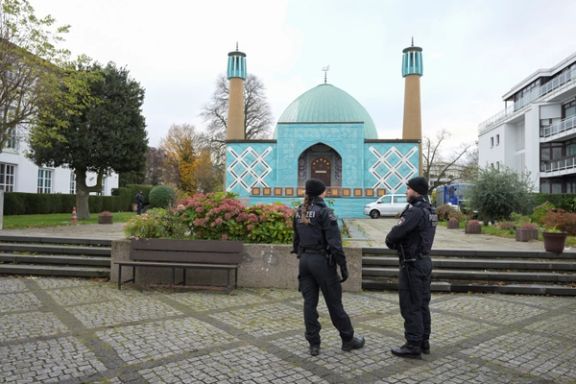
German police officers walk towards the Islamic Center Hamburg, during a raid, due to suspicion of members acting against a constitutional order and supporting the militant group Hezbollah in Hamburg, Germany.
Germany's interior ministry said on Wednesday it has banned the Islamic Centre Hamburg (IZH) association and its subsidiary organizations, saying it pursues radical Islamist goals. The entity is controlled by Tehran.
The ministry said in a statement that 53 of the organization’s premises had been searched by authorities in eight German states early on Wednesday, acting on a court order.
Germany's federal police had raided the Islamic Center on suspicions of support for the Lebanese militant group Hezbollah, accused of terrorism, in November 2023. Germany banned Hezbollah activities in 2020.
The interior ministry said at the time that the Khamenei-controlled IZH activities are “aimed at spreading the revolutionary concept of the Supreme (Iranian) leaders,” and that the center allegedly undermines Germany’s “constitutional order.”
In addition to the Hamburg-based IZH, which includes one of the oldest mosques in Germany known for its turquoise exterior, its subgroups in Frankfurt, Munich and Berlin were also banned.
As a result, four Shiite mosques will be closed, said the ministry. Some German politicians issued statements expressing satisfaction that the government finally acted against IZH.
The IZH was not available for comment by phone on Wednesday morning, Reuters said, and its website was not accessible to the public.
The IZH has been a hotbed of pro-Hezbollah activism and support for Qasem Soleimani, the former commander of IRGC's Quds Force. In January 2020, after the US killed Soleimani in a drone strike in Iraq, a group of 600 pro-Iran regime Islamists attended a memorial service at the Hamburg center to mourn his death. The Islamists praised him as a “heroic martyr.”
In early 2023, the German Federal Administrative Court ruled that the IZH (and its affiliated Blue Mosque are an "extremist Islamic organization."
Evidence from the earlier search of 55 properties conducted in November provided the basis for Wednesday's ban of the IZH, known in German as Islamisches Zentrum Hamburg, said the ministry.
"Today, we banned the Islamisches Zentrum Hamburg, which promotes an Islamist-extremist, totalitarian ideology in Germany," said Interior Minister Nancy Faeser.
"This Islamist ideology is opposed to human dignity, women's rights, an independent judiciary and our democratic government."
She said she wanted to make clear that "this ban absolutely does not apply to the peaceful practice of the Shiite religion."
The ministry said the IZH acted as a direct representative of Iran's Supreme Leader and sought to bring about an Islamic revolution in Germany that would create theocratic rule.
In addition, IZH promotes anti-Semitism and the Iran-backed militant group Hezbollah, which is also banned, it said.
In the final days of Ebrahim Raisi's administration, an announcement was made that promised to revolutionize the Iranian car market when the cabinet approved a plan to lift the ban on the import of used foreign cars.
The government spokesperson declared last week that Iranian citizens could now import used foreign cars without any restrictions, sparking initial excitement among the media and the public. However, as the details of the plan unfolded, the enthusiasm quickly dissipated.
Stringent restrictions undermine the policy
The regulations accompanying the plan revealed a series of restrictions that cast doubt on the feasibility of the new policy. Among them were stipulations that the cars must be between 3 to 5 years old, have an engine capacity limited to 2500 cc, and must not be imported from the United States. Additionally, imported cars could not be sold for five years. Most critically, the foreign currency used for the purchases had to come from "profits from exports or foreign investment."
Economic realities and ‘hypocrisy’
Currently, the cheapest domestic car costs between $7,500 to $10,000, while the majority of imported cars are low-quality Chinese models priced as high as European or Japanese cars. For instance, a Cherry Tiggo 8 Pro Max SUV costs $50,000. Other Chinese cars, like the Lamari EAMA produced by Dongfeng Liuzhou Motor, assembled in Iran, sell for $31,000. Brands like Great Wall Motors, Baic, FAW, and JAC also import parts for assembly, with prices ranging from $20,000 to $40,000.
An ad for Chinese vehicle Cherry Tiggo 8 for almost 52000 USD in Iran on July 20. 2024
Farhad, a Tehran resident, speaking to Iran International, said the move would not benefit Iranians. We cannot reveal his full name due to security reasons. "We cannot say this move benefits the people. Due to sanctions, they [government] can't access oil money from China, forcing them to import Chinese cars. This new policy will not benefit individuals and is hypocritical.”
Impractical requirements for foreign currency
Ahmad Aghaei, the Deputy Minister of Transportation, clarified that the currency needed for purchasing the cars must originate from abroad and be approved by the Central Bank, limiting those with access to benefit from the new policy.
"The importer must have a foreign currency account or currency outside the country to buy the car. Those who have their currency within the country will face restrictions from the Central Bank for sending the currency out of the country," he added. This requirement further limits the average Iranian's ability to benefit from the policy highlighting the plan's impracticality.
A car sales showroom in Iran
Public outcry and media criticism
In conversations with Iran International, many Iranians dismissed the plan as deceptive. “It is a lie. If you want to import a car, you have to export goods. How many people have the ability to export in order to afford a car?” said Mahmoud from Karaj.
The Iranian news agency Tabnak also pointed out the “deceptive” nature of the plan, stating that the regulations only benefit a small group of exporters, reinforcing the monopolistic market of state-owned car manufacturers.
Financial struggles of domestic manufacturers
In February, the Minister of Industry, Mine, and Trade, Abbas Aliabadi, called for more funds for the country’s two main government-controlled automakers: Iran Khodro and SAIPA. These companies face financial difficulties due to high inflation, and despite government claims, car prices have risen in the market over the past year.
A production line in Saipa car factory
Iranian auto industry experts report that state-owned carmakers are incurring daily losses of $3.7 million, totaling over one billion dollars annually, a direct result of government interventions in the auto industry. The quality of domestically produced cars is also a significant concern, with majority of road deaths in Iran involving drivers of these low-quality vehicles.
According to economic journalist Arash Hassan-Nia, Iran Khodro and Saipa are nearly bankrupt, with around $2.5 billion in accumulated losses. “Due to their managerial and ownership structures, they are unable to improve the quality of their current products,” he earlier told Iran International.
The car mafia and election politics
Ali Khosravani, vice president of the Tehran Automobile Dealers Union, previously highlighted the role of the "car mafia" in Iran, which he described as the main obstacle to new entrants in the car market. This shadowy group maintains a tight grip on the market, further complicating any genuine reform efforts.
During the presidential election debates, president-elect Masoud Pezeshkian questioned why Iranians should be forced to drive substandard cars under the guise of supporting national production.
His rival, Saeed Jalili, made a controversial claim in response saying that “People in Russia wait six months in queues for the Iranian-made Samand vehicle,” a claim ridiculed on social media.
Many now say that the recent decision to import second-hand cars is another “propaganda efforts in the final days of the Raisi government, adding one more item to their list of achievements.”
A slogan with no substance
The new car import regulations in Iran, while initially promising, reveal a complex web of restrictions and inconsistencies that ultimately leave the monopolistic market of state-owned car manufacturers intact. The majority of Iranian citizens remain unable to benefit from the changes, highlighting the gap between government promises and the harsh economic realities on the ground.
Observers believe that the promotion of "one car import for every single Iranian" is clearly a “populist” slogan, as few people have the financial means to import a car, leaving the public disillusioned once again.
The Islamic Republic is prepared for nuclear negotiations with world powers to have sanctions lifted, Iran's president-elect said, a couple of weeks after the White House made it clear that there is no diplomatic path ahead to curb Iran's move toward acquiring a nuclear weapon.
White House National Security spokesman John Kirby told Iran International on July 11 the Biden administration is committed to making sure Tehran would never develop nuclear weapons. "We'd love to be able to do that through diplomacy. But right now, there's not a path, a diplomatic path ahead of us."
Still, Iran's president-elect Masoud Pezeshkian said on Monday, "The Islamic Republic of Iran has always been and remains ready for any kind of dialogue" on the removal of sanctions imposed against the country, even though "it was the US that first withdrew from the JCPOA and then imposed the harshest sanctions on the Iranian nation."
Former US President Donald Trump in 2018 imposed crippling sanctions against the Islamic Republic after withdrawing from the Obama-era Joint Comprehensive Plan of Action (JCPOA), a nuclear deal that had curbed Tehran's nuclear program in return for some sanctions relief.
Various sanctions have since been enforced against Iran because of its nuclear weapons program and support for terrorist groups, but Supreme Leader Ali Khamenei and his loyalists have been reluctant to acknowledge the strain caused to the economy. Instead, they claim the sanctions are opportunities for growth and development and could foster national unity.
Now Iran is apparently hopeful that with the election of Pezeshkian, presented as a “reformist,” nuclear talks would resume leading to some reduction in US sanctions that have crippled the economy.
Pezeshkian made the comments in a phone conversation with Japanese Prime Minister Fumio Kishida, whose country tried to mediate between Tehran and Washington in 2019 during former prime minister Shinzo Abe's trip to Iran.
The Monday phone call may suggest a renewed interest on Tokyo's side to act as a mediator.
The Japanese foreign ministry's readout of Kishida's phone call with Pezeshkian confirms the two leaders have exchanged views on Iran's nuclear program, but only says, "The two leaders discussed the situation regarding the Iran nuclear issue and agreed to maintain communication."
However, Iranian state-run media claim that the Japanese prime minister "expressed his country’s readiness to mediate between Iran and the US in the talks on the revival of the 2015 nuclear deal."
Iran's acting foreign minister Ali Bagheri-Kani in a visit to New York earlier this month lauded the purported new foreign policy direction under President-elect Pezeshkian.
"We believe that now it is the turn and time of the other side to prove this honesty for interaction and, of course, to open a new chapter," Bagheri Kani said in an interview with Newsweek, fueling speculations that Pezeshkian's election victory might be part of the Islamic Republic's plan to restore the 2015 nuclear deal and end the crippling sanctions that have plagued the country for years.
In his interview with Newsweek, Bagheri Kani said that Tehran remained open to resuming negotiations with Washington toward restoring mutual participation in a nuclear deal.
He made the comments one week after claiming that nuclear talks with the US are ongoing through indirect negotiations mediated by Oman. The claim was categorically rejected by the White House national security spokesman.
"I won't speak or can't speak to channels of communication with Iran one way or the other, but there are no active negotiations going on to restore the nuclear deal. The reason for that is because Iran was killing its own people in protests activity. Iran was continuing to spin centrifuges. Iran was continuing to support terrorist groups. And in the early stages of the negotiations, Iran was making unnecessary demands that made it impossible for us to do that. They weren't negotiating in good faith," Kirby told Iran International.
Last month, the International Atomic Energy Agency (IAEA) warned about Iran’s nuclear activities, raising concerns about the program's peacefulness. The IAEA reported that Iran has stockpiled large amounts of highly enriched uranium, with Raphael Grossi saying that Iran is "weeks not months" from a nuclear weapon.
A new report has highlighted an alarming trend of increasing femicide cases amid an ongoing pattern of violence against women and girls in Iran.
According to the report by Etemad Daily, in the first three months of the Iranian calendar in 2024 alone (March 20 to June 21), at least 35 women and girls were murdered by their close male relatives, particularly their husbands.
The number is a 25 percent increase from the 28 recorded during the same period in 2023 and a 59% rise from the 22 deaths in 2022.
A massive 85 percent of the murders were committed by the victims' husbands and cases were spread across the country. In 2022, 16 women were killed by their husbands, followed by 15 in 2023, with a sharp increase to 27 in 2024 amid the climate of state crackdowns on women and girls.
Rights activists point to Iran’s laws and patriarchal society based on Islamic law as the primary cause of femicide which has worsened since 2022.
Conditions for women have become so bad that the United Nations branded Iran's policy as "gender apartheid" as state policy legitimizes violence against women.
Honor killings can be carried out for as little as not wearing the mandatory hijab, bringing shame on the family.
UN Women says these gender-related killings are the “most brutal and extreme manifestation of violence against women and girls. According to the latest UN Women report, globally on average, more than 133 women or girls are killed every day by someone in their own family.
Speaking to Iran International, Iranian feminist and human rights activist, Mina Khani, highlighted the lack of accurate statistics in Iran amid heavy censorship and corruption, and the state's own involvement in committing femicide.
Official figures suggest numbers even lower than Germany, she said, with massive discrepancies in both the reporting and recording of such crimes.
"In this context, human rights statistics are crucial," she said. "Organizations like Hengaw report femicide statistics in Iran based on the cases they document, as there is no official statistical reference for human rights organizations to rely on,” Khani stated.
Norway-based rights organization, Hengaw, identified that "at least 50 cases of femicide have been recorded in various cities of Iran since the beginning of 2024.
Khani noted "the state's failure to take legal measures to protect women from domestic violence".
She said, "Instead, the regime has legalized violence attributed to honor and gender-based violence against women, and it also engages in state-sponsored femicides".
High profile cases such as Mahsa Amini and Armita Geravand, who both died in morality police custody, exemplify the role of the state, she said, which "has never been held accountable".
Soraya Fallah, an Iranian researcher and women’s rights activist touched on the surge and prevalence of femicide in Iran adding that the situation highlights an “urgent need for serious measures to change laws and address cultural issues in Iran.”
Fallah echoed Khani’s statements, blaming Iran's discriminatory laws for fueling the femicide crisis.
“The Islamic government of Iran has institutionalized unequal laws and their implementation, enabling crimes like honor killings. These laws, such as Article 630, provide legal grounds for such acts, fueling patriarchal violence," she said.
Article 630 of the Islamic Penal Code allows a man to kill his wife and her partner if he catches them in the act of consensual adultery, without facing any punishment. This law exclusively targets women. Additionally, a father or paternal grandfather who kills their child is exempt from the retribution sentence, known as Qesas.
"The Islamic Republic uses these laws to maintain power and perpetuate these issues within society. Comprehensive legal and cultural changes are crucial to address these deep-rooted problems and protect women's rights in Iran," she added.
Amnesty International last year said, "The Iranian authorities’ oppressive methods of policing women and girls and punishes those who dare to stand up for their rights".
"To this day, not a single Iranian official has been held accountable for ordering, planning and committing widespread and systematic human rights violations against women and girls through the implementation of compulsory veiling," it added.
Iran’s president-elect’s praising voters for delivering a "resounding punch to the mouth" of those calling to boycott the polls, has ignited a firestorm of reactions from the public.
"I pray that God spares us from being shamed before these esteemed citizens, who, despite the widespread propaganda discouraging them from voting, turned out in force and delivered a resounding punch to the mouths of those, both domestic and foreign, who campaigned against participation," Masoud Pezeshkian said in parliament on Sunday.
Critics assert that during his campaign, Pezeshkian, presenting himself as a pro-reform politician, used softer language, acknowledging non-voters' grievances and speaking of forgiveness and national unity.
In stark contrast, his current rhetoric in the face of mass abstention, mirrors the hardline stance of the Islamic Republic, further alienating a populace already frustrated by economic hardships and political repression.
Iran’s Independent Filmmakers Association is the latest to join the critics, issuing a statement condemning Pezeshkian's "blatant insult" to Iranians who did not participate in the government elections.
Just 40 percent of Iranians came to the first round of the polls, the lowest trunout in a presidential election in the 45-year history of the Islamic Republic. In the runoff around almost 50 percent participates, according to unverifiable government numbers.
Former MP Bahram Parsaei tweeted addressing Pezeshkian, "If you believe those who voted delivered a resounding punch to non-voters, to whom did the majority who abstained deliver their blow?"
Political prisoner Hossein Razzagh took to X to voice his criticism, stating, "Pezeshkian and Zarif are the epitome of today's reformists! They eagerly seek a moment of favor from the Supreme Leader, becoming willing pawns in his disgraceful puppet shows and justifications of oppression."
Razzagh, who is currently on medical leave, added, "So enamored with the autocrat's bait, they rush to insult the majority who boycotted the elections!"
The new statesman's shift in rhetoric after the election has aggrieved the public who saw him as at least, a less hardline option for president. Before winning the runoff, Pezeshkian notably said, "I have heard, and continue to hear this doubt, dissatisfaction, and disengagement. I urge you to come forward again on Friday, for Iran, and make your choice. To me, both those who voted and those who did not are worthy of respect."
Former political prisoner Mehdi Mahmoudian also joined the chorus of critics, noting the fact that the new president has formed "the most minority-based government of the last five decades".
Slamming the change of tone, he accused Pezeshkian and the government of "deceptive promises, engineered intimidation, and government doping."
Pezeshkian has already courted controversy by dedicating his time to attending religious ceremonies, which critics argue underscores his lack of substantive political planning ahead of assuming office.
“To demonstrate solidarity with the 20% of the establishment’s supporters, he tirelessly moves from one gathering to another each night. Meanwhile, he wields an iron fist against the 60% who chose not to vote,” Mahmoudian added.
Meanwhile, Pezeshkian supporters condemned the controversial language but argued that one sentence should not define him. Pro-reform daily Shargh stood by the incoming statesman, maintaining that his remarks targeted not the non-voters but those actively campaigning to dissuade participation.
On Monday, Pezeshkian took to Twitter with a message that likely fell short of his supporters' expectations. By labeling non-voters and those advocating for a boycott as "enemies" and calling those who voted "honorable citizens", he reverted to the harsh and divisive rhetoric characteristic of the Islamic Republic. He reduced the complex political landscape to a simplistic "us vs. them" narrative, underscoring a tendency to vilify dissent and ignore the nuanced grievances of a significant portion of the populace.
Ehsan Bodaghi, a journalist and a prominent media supporter of Pezeshkian, also took to X to highlight the reasoning behind the mass abstention and called for Pezeshkian "to recognize this segment of society's rights and demands and listen to their voices".
Having voted himself, he said, "Not only was I not looking to punch those who didn't vote by casting my ballot, but I found many of their arguments logical and valid.
Journalist Hormoz Sharifian, has characterized the president-elect's remarks as an "insult" to figures like Sedigheh Vasmaghi, a former political prisoner and Islamic scholar, and Abolfazl Ghadiani, a political activist who had advocated for an election boycott.
On X, Sharifian wrote, "While journalists may not have the right to urge the public against voting, seasoned political activists like the esteemed individuals mentioned certainly do. Exercising their civic rights should not subject them to threats of being 'punched in the mouth' by the president of a minimalist government."
In the face of pressure from the authorities, multiple political prisoners abstained. High profile figures such as Nobel Peace Prize laureate Narges Mohammadi was among those who publicly declared her refusal to participate, joining many political prisoners who boycotted the elections.
Azadeh Mokhtari, a journalist at Tehran’s Rokna Press, pointed out that the mass abstention is the result of years of suffering. "For years, a significant portion of those who abstained from voting have seen one hollow promise after another burst under the relentless pressure of inflation, leaving them disillusioned and distrustful of any further assurances," referring to Iran's economic crisis amid global sanctions.
But, Pezeshkian's use of incendiary language is not out of character, even throughout his campaign. He once told his ultraconservative rival, Saeed Jalili, that if Jalili were elected and failed to keep his promises, he should be hanged.
During a televised debate on Iranian state TV in July, Pezeshkian challenged Jalili's economic promises: "I will withdraw from the election if Mr. Jalili commits to being executed if he fails to achieve eight percent growth in his government."
Supporters of Pezeshkian seem to overlook his conservative track record, including his years in parliament supporting the IRGC, harsh rules of hijab, and other contentious strategies in the Middle East.
Some supporters insist he is merely posturing to align with the Supreme Leader, hoping this will enable him to implement reforms. They are now anxiously waiting to see the composition of his cabinet, with optimists hoping for a progressive lineup. However, this appears unlikely given the power struggles, as Pezeshkian, even if inclined to appoint moderate figures, would need to persuade the predominantly conservative parliament.
Violence between Iranians and the country's Afghan community is spiralling with two deaths of Iranians in a week fueling calls for the expulsion of possibly millions of illegal immigrants.
Since the incident, Afghans in eastern Tehran have reported an increase in attacks from local residents. In interviews with Afghanistan International, several expressed their fear and described feeling under siege.
"Because I am Afghan, they broke my nose in Bisim Park," one Afghan immigrant said in a video sent to Afghanistan International.
The clash last week was sparked by unpaid building fees owed by the victim's brother, with migrants sent to collect the debt.
It has since spiralled into a wave of violence. One Afghan migrant detailed how he and his family now feel trapped in their home, afraid to venture out for work or even basic necessities like groceries.
Another individual from District 15 of Tehran, the area where the fight occurred, shared a photograph of a notice warning Afghan migrants to leave the neighborhood immediately.
While it is not known who wrote the notice, it explicitly warns Afghan migrants that failure to leave District 15 will result in their forcible expulsion from Iran, exacerbating fears among Iran's largest migrant community who feel increasingly unsafe.
Afghanistan International has also received videos purportedly showing street clashes, although these videos have not been independently verified.
Iranian media report that Afghans have now outnumbered Iranians in some impoverished areas in and around the capital, as well as in major cities and smaller towns.
Afghans initially came to Iran as refugees in the early 1980s and later as economic migrants. Their numbers rarely exceeded two million until the Taliban takeover of Afghanistan in 2021. Currently, around 780,000 Afghans have official refugee status and are not considered illegal.
The 2016 census recorded over 1.5 million Afghans in Iran. Officials acknowledge that this number has significantly increased since then, with unsubstantiated claims suggesting there may now be as many as 10 million Afghans in the country, thousands coming across the border each day.
In recent months, there has been an increase in criticism regarding the presence of Afghan migrants in the country, contributing to a growing atmosphere of hostility.
Two days ago, following the killing of another Iranian man, allegedly by his Afghan restaurant worker, residents of the city of Khor in Fars Province attacked the homes of migrants, setting several houses on fire.
Simultaneously, domestic media quoted Tehran police as saying that ten Afghan citizens had been arrested on charges of "street knife fights."
The current tensions are also being influenced by political rhetoric. During campaigning for snap presidential elections in Iran, Parliament Speaker Mohammad Bagher Ghalibaf and a candidate approved by the Guardian Council, made one of his main campaign promises to prevent Afghan refugees from entering Iran and to deport illegal migrants.
On April 9, the Ministry of Interior explicitly announced that Afghan refugees without residence permits would not be allowed to stay in Iran and would be expelled.
In March, the IRGC-affiliated Tasnim News Agency reported that a police plan had been initiated to round up and repatriate unauthorized immigrants from Tehran Province.
In May, it was also announced that a "special patrol" had been established in Shahr-e Rey, south of Tehran, to identify and round up illegal foreign nationals.
The government has largely turned a blind eye to the influx, sparking accusations that Iran may be planning to use Persian-speaking Afghans for political or military purposes.
Last year, Iran International exclusively reported that Unit 400 of the Quds Force of Iran's Islamic Revolutionary Guard Corps (IRGC) recruits Afghans for suicide attacks and collaborates with Al Qaeda to target Israelis.
Just last month, Al-Akhbar, a newspaper affiliated with Hezbollah in Lebanon, reported that Taliban leaders have promised Iranian officials to send fighters to Lebanon in support of Hezbollah currently fighting Israel on its northern border.
And last year, an Afghan national was arrested in connection to a Tehran-backed plot to attack the Israeli embassy in Baku as the country's poor remain vulnerable to recruitment by Iran in its global proxy war.