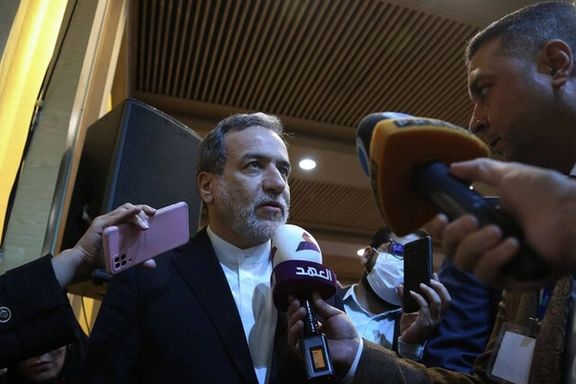
Iran's FM seeks regional backing against Israel in Mideast tour
Iranian Foreign Minister Abbas Araghchi has departed for Jordan, advancing his Middle East tour to rally support among regional countries as Tehran braces for a promised Israeli retaliatory strike.
The overarching message from his previous meetings, Araghchi has reaffirmed Iran’s position that it "does not want war" but is "fully prepared for a war situation."
Following visits to Lebanon, Syria, Saudi Arabia, Qatar, Iraq, and Oman, Iran’s top diplomat will continue to Jordan, Egypt, and Turkey.
While Iran has actively tried to engage in regional diplomacy to counter Israel's actions and mitigate US influence, one former Iranian diplomat says the state’s strategy is bound to fail.
In an interview with the Iranian news site Khabar Online, Iran’s former ambassador to Jordan, Nosratollah Tajik, argued that the Islamic Republic cannot realistically expect neighboring countries to fully align with its stance against Israel.
Tajik says that Tehran lacks a comprehensive approach that aligns with the priorities of neighboring states, stating that many – particularly Saudi Arabia – are focused on economic stability and are unlikely to adopt an anti-Israel stance just to support Iran's position.
On October 1, Tehran launched more than 180 ballistic missiles at Israel, declaring the strike a response to the recent killings of Hezbollah leader Hasan Nasrallah and Islamic Revolutionary Guards (IRGC) General Abbas Nilforoushan in Lebanon.
Since Israel's vow to retaliate, Prime Minister Benjamin Netanyahu has reportedly assured the Biden administration that any potential strike would target military assets rather than Iran’s oil or nuclear facilities. Prior to that, a top US State Department official told CNNthat Israel has given no assurances it won’t target Iran’s nuclear facilities.
"Some think the US has turned a blind eye to Israel's actions! Not at all. The US, with full awareness, has allowed Israel a free hand to undermine Iran’s position in the region, enabling any crimes in Gaza and Lebanon," Tajik further argued in the interview. Currently residing in the UK, Tajik's diplomatic career faced complications following his 2006 arrest there on alleged arms trafficking charges—a case that garnered substantial media attention.
Amid his continuing Middle East tour, Iran’s foreign minister also announced that indirect talks with the United States would not continue, citing the worsening Middle East crisis as a barrier to further negotiations.
"We do not see a basis for these talks until the current crisis is resolved. Afterward, we will decide whether to resume negotiations and in what form they should continue," Araghchi said in Oman, which had previously facilitated indirect talks with the US.
Araghchi also held talks with a senior official from Yemen’s Iran-backed Houthi movement.
The specifics of his discussions with the Houthi official were not disclosed. However, Yemen’s Houthis, along with Hamas in Gaza and Hezbollah in Lebanon, form part of Iran’s so-called “axis of resistance,” a coalition of militant groups aligned against Israel.
Iran's FM seeks regional backing against Israel in Mideast tour | Iran International
Israeli security services have arrested a Russian-Israeli citizen for being part of an Iran-backed assassination plot targeting a senior scientist for $100,000, the second in just three days.
It is the third such arrest in a matter of weeks. Vladimir Varehovskim 35, from Petah Tikva in central Israel, is alleged to have agreed to carry out the assassination and now faces a court hearing on Wednesday, October 16.
In a joint operation, Shin Bet and Israel Police uncovered "an Iranian intelligence network working to recruit and activate citizens in Israel," according to a police statement.
“Some of the tasks performed were documented by Vladimir and payment was received for their performance,” a statement from Israel Police said. “The contact between him and the Iranian officials took place in the English language and as part of it he was asked to purchase a dedicated phone.”
After having done a series of smaller operations for Iran such as gathering information about an Israeli entity, hanging banners and spraying graffiti, “Vladimir later agreed to carry out a mission to eliminate an Israeli scientist for the sum of $100,000”, Israel Police said.
Ronen Solomon, an Israeli intelligence and defense expert, told Iran International: “The Iranians are learning from Western intelligence methods which had been taken from Israeli operations in order to target Israeli officials. Iran is also learning from the Russians.”
He said recruitment is being done by a cyber program, the latest suspect being recruited by Facebook. Recent recruits have also been recruited through Telegram.
“The Iranians see Russians as the weak link in Israeli society,” he said, hundreds of thousands having used Israel’s right of return laws for Jews since the fall of the Soviet Union.
“This is the second case in a row, so it could be the same handler in Iran,” he added.
Many of the roughly 1.5 million Russians in Israel are atheist and do not integrate as well into Israeli society as others, preferring to live in areas with large numbers of fellow Russian speakers.
Since the war with Ukraine making travel for Russians increasingly hard, Israel absorbed many more seeking a second passport.
It follows the arrest on Monday of Vladislav Victorson, 30, on charges of orchestrating an assassination plot on behalf of Iran. The Russian, living in the Tel Aviv suburb of Ramat Gan, had been in contact through social networks with a person named "Mari Hossi”, speaking in Hebrew.
Victorson was also accused of agreeing to assassinate an Israeli citizen and throw a grenade at his home, the statement from Israel Police saying he had worked to obtain weapons, including a sniper rifle, pistols and grenades.
He was also accused of having carried out tasks including burying money and burning vehicles in Yarkon Park in Tel Aviv. In addition, he was asked to sabotage communication infrastructure and ATMs as well as set fire to forests.
He is alleged to have recruited two other citizens, including his partner, Anna Bernstein, just 18 years old, who took part in several tasks in the operation.
Israel Police said he was also accused of locating street gangs in order to recruit them to perform additional tasks and photograph demonstrators during protests.
Asher Ben Artzi, the former head of Israel's Interpol, warned: "The Iranian intelligence is quite sophisticated. They are very active."
A closed community, he said Israel's Russians are vulnerable to recruitment. "We can assume that as many of them have a tough life here, they could be more angry at the state of Israel. If you offer such people a lot of money, they don't resist such a temptation," he told Iran International.
"The bottom line is that Iranian intelligence is very dangerous for us," he added as cases of this kind become ever more frequent.
Iran-backed plots recruiting date back more than a decade and have seen Iran hiring a wide spectrum of society, including an orthodox Jew from the religious suburb of Jerusalem, Beit Shemesh, arrested in July. In 2022, a network of Israeli women was uncovered as having been recruited by Iran.
Last month, Israel revealed they foiled an Iranian plot to assassinate top leaders including Prime Minister Benjamin Netanyahu, the head of Shin Bet and the country’s defence minister.
Moti Maman, a 73-year-old Israeli businessman from the city of Ashkelon, was accused of twice smuggling himself into Iran via Turkey to meet with intelligence officials directing the plots from Tehran.
Kayhan daily says Iran must close the Strait of Hormuz in the Persian Gulf to European vessels in retaliation for the European Union’s sanctions on Iran Air, the country’s flagship carrier.
“Europe chose the path of confrontation instead of interaction with Iran by starting a new round of sanctions under the false pretext that Iran has sent missiles to Russia. Now Europe must wait to pay the cost of its decision,” Kayhan arguedon Wednesday inan article titled “Europe Shut the Sky to Iranian Flights, Block the Sea to European Ships."
“Iran definitely has more capabilities to put pressure on Europe today in the gambit that they started,” the ultra-hardline daily whose managing editor, Hossein Shariatmadari, is an appointee of Supreme Leader Ali Khamenei, wrote, arguing that preventing European vessels from reaching their destinations in the Persian Gulf will be more costly to Europe than the ban on Iranian flights.
Iran Air, the only Iranian airline operating flights to European Union countries, suspended all its services to Europedue to new sanctions imposed by the European Union that targeted Iran Air, Mahan Air which is partly owned by a Revolutionary Guards (IRGC) linked company, and Saha Airlines, a civil operator owned by the Islamic Republic of Iran Air Force.
The Persian Gulf and the Strait of Hormuz.
The United States and its Western allies accuse Iran of using its civilian flights to send weapons including missiles to Russia for its war in Ukraine. The Islamic Republic denies any missile transfer to Russia.
There have always been allegations that the Islamic Republic uses its civilian fleet for military transfers.
Iran International acquired the audio file of an interview with former foreign minister Mohammad-Javad Zarif in April 2021. In the interview that was never published in Iran, Zarif criticized Qasem Soleimani, the slain commander of the extra-territorial arm of the Revolutionary Guards (IRGC), the Qods Force, of using Iran Air flights for shipments, presumably fighters and weapons, to Syria rather than the allegedly IRGC-linked Mahan Air which he said was less safe.
Mahan Air was designated by the US Treasury in 2011 for "providing financial, material and technological support” to the IRGC. These were followed by bans by several European countries including Denmark and Germany in the following years until the airline lost all its flights to European destinations by Spain joining the embargo in 2020.
Iranian officials and hardliners have periodically called for the closure of Hormuz as retaliation for various Western actions. Around 21 percent of the world's crude oil passes through the straits, heavily patrolled by both Iran and Western navies. This means that a closure of Hormuz will also stop all of Iran's oil shipments and a significant portion of China's oil inports. From January to September, China imported 4.2 mb/d of crude via the Strait of Hormuz, accounting for 43% of its seaborne crude.
Iranians have taken to social media since the announcement of the Iran Air sanctions and the country’s suspension of its flights to European destinations to voice their frustration.
Iran Air sanctions mean that no Iranian can fly directly to destinations in the Western Hemisphere without using a connecting flight from other regional airports such as those in Turkey, the United Arab Emirates, or Qatar.
Some netizens contend that the suspension of direct flights to Europe will highly affect expatriate Iranians including students and their families, including the elderly and the sick who will find it very difficult to find their way through non-European airports to board connecting flights.
Masoud Pezeshkian’s strategic deputy and former foreign minister, Mohammad-Javad Zarif, has said that Supreme Leader Ali Khamenei opposes nuclear weapons not only for religious reasons but also for strategic considerations.
“My understanding is that the Supreme leader has held the same view from the strategic point of view, in addition to the Sharia perspective, since he issued his religious edict [to ban weapons of mass destruction], and even before that,” Zarif told the Iranian Labour News Agency (ILNA)Tuesday.
The comment was made in response to a question about ultra-hardliner lawmakers’ demandfor a change in Iran's ‘defense doctrine’ and considering nuclear weapons to allow a strategy of ‘nuclear deterrence’ to be drawn.
The step that these lawmakers urged the Supreme National Security Council (SNSC) to take requires Khamenei’s clear and definite approval, both as Supreme Leader and as commander-in-chief of the armed forces.
Iran's government has always maintained that it will not pursue nuclear arms because Khamenei’s fatwa (religious edict) has banned all weapons of mass destruction including nuclear bombs. Khamenei’s ruling was presented by Iranian officials at the International Conference on Nuclear Disarmament in April 2010.
“We consider the use of such weapons as haram [religiously forbidden] and believe that it is everyone’s duty to make efforts to secure humanity against this great disaster,” Khamenei’s statement read.
Skeptics argue that what Iranian authorities refer to as a fatwa was only an advisory opinion, not a legal document that cannot be revoked and was meant to mislead the international community about the real intentions behind a nuclear program that Iran has always maintained is peaceful.
Fatwas by Shia Marja (a source of emulation) are not set in stone, as skeptics say. They could be altered or overturned given the ‘requirement of time and place’ as many historical instances prove.
“What has been declared as haram by Khamenei, whatever the intentions behind it may have been at the time, requires a clear public statement to make it halal, that is, permissible,” a commentator in Tehran told Iran International, adding that the change that ultra-hardliners demand requires leaving the Non-Proliferation Treaty (NPT), also a decision that only Khamenei can make.
“By publicly demanding that he endorses a move towards building and testing a nuclear bomb, these lawmakers are actually challenging the Leader to make a drastic decision in these circumstances,” he added.
Masoud Pezeshkian’s government has used the same argument as Hassan Rouhani’s government which used the fatwa to convince the international community that Iran's nuclear program was peaceful.
“The government's stance on building atomic bombs is the same as [declared by] the Supreme Leader, which he has emphasized many times … Matters such as nuclear energy are regulated under the leadership of the Supreme Leader,” Fatemeh Mohajerani, spokesperson of Masoud Pezeshkian’s government, stressed last week in reaction to the lawmakers’ demand.
“[The Leader] has stated many times that the Islamic Republic has the ability to build a nuclear bomb, but this is forbidden from the point of view of Sharia. This is the official position of the Islamic Republic of Iran,” she added.
In an article Sunday entitled “Adventurism or Deterrence”, the reformist Ham-Mihan newspaper criticized ultra-hardliners’ move. The article argued that rationality can have a greater deterrence power than a nuclear bomb when what they demand could provide Israel and the West with “an excuse for a military confrontation with Iran."
“An invitation for an invasion of the country? The tune that some circles are singing about the need for ‘changing Iran's nuclear doctrine’ is rooted in their deep ignorance of the power relations in the Middle East and at the international level,” reformist activist and journalist Ahmad Zeidabadi wrote last week in response to the lawmakers’ letter to the Supreme National Security Council (SNSC).
Speaking of a change in the nuclear doctrine will not only fail to secure the least level of deterrence but could also be construed as a “some kind of invitation to a military attack on the country by a well-equipped and powerful military alliance,” Zeidabadi who was widely quoted by Iranian media argued. “Is that what they want?” he asked.
He argued that if Iran could “build, safely maintain, and use” a nuclear bomb there could be nothing other than trouble for the country. Such a move would lead to the formation of a united international alliance against a “strategically alone” Iran, he said while pointing out that even Iran's powerful allies, China and Russia, do not want it to become a nuclear power.
Ultra-hardliners’ move will only boost the work of the “enemy's propaganda machine against Iran," conservative commentator Hassan Beheshtipour told the reformist Ham-Mihan newspaper in an interview published Monday.
“This is a miscalculation. [Such] people don’t pay attention to the fact that our nuclear program is conducted under the supervision of IAEA inspectors and bringing up such matters will achieve nothing except creating media and propaganda trouble for Iran and provide its enemies with something to maneuver on,” he added.
Beheshtipour argued that those who demand a change in Iran's ‘nuclear doctrine’ could not achieve anything even if they meant to boost Iran's power of deterrence.
Israel appears closer to showing its hand on how and when it will strike back at Iran as as a critical US election looms, Jewish holidays wrap up and US-Israeli diplomacy accelerates.
Israeli Prime Minister Benjamin Netanyahu has decided on the response to this month’s aerial bombardment from Iran, according to Israel’s Kan 11 News on Tuesday, and the strategy will now be referred to Israel’s cabinet.
Netanyahu's government is made up of a right-wing coalition mostly calling for a tough response to the 181 ballistic missiles launched towards Israel.
It comes as the United States has sent 100 troops and deployed the Terminal High-Altitude Area Defense (Thaad) antimissile battery, ahead of an expected retaliatory strike from Israel on Iran that may provoke yet another attack from Iran.
Prime Minister Benjamin Netanyahu assured US President Joe Biden in a phone call last week that Israel will refrain from attacking Iran's nuclear or energy facilities, US newspapers reported citing officials.
It is not the first time that the Israeli premier is said to have made a plan of action, but as the psychological war between the two sides continues, timing may be key.
Israel is currently in the middle of a month of religious holidays, and after last year’s October 7 attack caught troops off guard amid the final one of the month, many believe that the government is giving the country time to breathe.
Last year's October 7 attack happened in the middle of the Simchat Torah festival, and Israel may be reluctant to invite an escalation to the war one year later.
Also crucial is the US presidential election, which is less than three weeks away.
“The US will want to get this done soon so it’s faded out of the news story before the election. Generally speaking incumbents don’t like wars around elections," said Michael Knights, an Iran expert at the Washington Institute for Near East Policy.
"It’s a distraction and looks like things aren’t under control. So once the holidays are over Israel and the US will want to get this over in a matter of weeks so the US can draw a line under it,” he added.
On Monday, a massive bombardment from Hezbollah saw swathes of central Israel sent to shelters as sirens sounded across most of the region.
Israeli intelligence and defense analyst, Ronen Solomon, predicts Israel will in fact carry out a multi-dimensional attack which may already have begun.
“Maybe one of the responses was the explosion we saw this week at the iron market in Tehran,” he explained, referring to a mysterious fire that broke out in a market housing companies manufacturing parts for Iran’s nuclear development.
“Those facilities supporting the nuclear project could well have been part of this multi-dimensional attack,” he added. “It means that Isfahan can also be a target, with Ministry of Defense facilities for developing a nuclear bomb. It could be hit without being considered a nuclear facility like Natanz.
Other options are the UAV manufacturing facilities in Isfahan, Solomon said, and the missile launching sites in Tabriz which gives Iran a unique position to attack Israel from north to south.
Psychological warfare
An Israeli official, speaking on condition of anonymity, told Iran International that the delay could as easily be a part of the psychological war as the ongoing discussions with the US. Biden has said sending the THAAD system to Israel is to defend Israel, but said he will not support a direct hit on Iran’s nuclear facilities.
“Israel will keep its cards close to its chest and strike when it’s ready. Bibi knows that timing is key and is the master of psychological warfare with Iran."
It took Iran over two months to avenge the killing of Hamas's political leader, Ismail Haniyeh, in an IRGC compound in Tehran, and Iran's retaliation came only after an airstrike killed Hezbollah leader Hassan Nasrallah in Beirut.
A year's worth of bombardments on Israel from rockets, missiles and drones launched by Iran itself and its regional allies Hamas in Gaza and Hezbollah in Lebanon has left Israel facing a looming shortage of interceptor missiles, the FT reported.
Since the Hamas invasion now known as the Black Sabbath, over 20,000 rockets and missiles have been fired from Gaza and Lebanon alone.
So far, the Iron Dome has shot down the short-range rockets and drones from Hamas in Gaza, but it is the system known as David’s Sling which has intercepted the heavier rockets from Hezbollah’s huge arsenal in Lebanon.
In the multi-layered system, the Arrow defence has been used to block the ballistic missiles from Iran, but several of these in the recent attack struck, more than 30 of them hitting Nevatim air base alone, as shown in open source analysis.
Another missile exploded less than a kilometer from Israel’s foreign intelligence agency, Mossad.
Drone attacks
Attacks have also come from Yemen, Syria and Iraq, with low-quality drones also penetrating the country’s air defences. On Sunday, a drone from Hezbollah killed four soldiers and injured dozens more when a precise hit on a military base caught soldiers in the mess eating dinner.
Solomon, who spent 10 years as an advisor to one of the military's intelligence units and is writing a book on Iran’s nuclear program, said bolstering Israel’s defences is key as tensions between the two archenemies escalate.
“Israel is using hundreds of their interceptors by the day against Hezbollah, but the problem is not the rockets, but the missiles. What we really need the THAAD for is against Iran. We would expect double the kind of attack from before.”
However, Dana Stroul, a former senior US defence official with responsibility for the Middle East, told the FT, “Israel’s munitions issue is serious”.
She said: “If Iran responds to an Israel attack [with a massive air strike campaign], and Hezbollah joins in too, Israel air defences will be stretched,” she said, adding that US stockpiles were not limitless.
“The US can’t continue supplying Ukraine and Israel at the same pace. We are reaching a tipping point.”
Boaz Levy, chief executive of Israel Aerospace Industries, a state-owned company which makes the Arrow interceptors used to shoot down ballistic missiles, admitted in an interview with the FT that operations were running triple shifts to keep production lines running.
“Some of our lines are working 24 hours, seven days a week. Our goal is to meet all our obligations,” Levy said, adding that the time required to produce interceptor missiles was “not a matter of days”. While Israel does not disclose the size of its stockpiles, he added: “It is no secret that we need to replenish stocks.”
Iran Air, the only Iranian airline operating flights to European Union countries, has suspended its services to Europe due to new sanctions imposed by the bloc, Iranian authorities announced on Tuesday.
"Iran Air was the only airline in our country flying to Europe, and considering the new sanctions of the European Union against Iran Air, not a single Iranian airplane will fly to Europe now," said Maqsood Asadi Samani, Director of the Association of Iranian Airlines.
On Monday, the European Union introduced sanctions targeting Iran Air, Mahan Air, and Saha Airlines. The sanctions also covered various industrial and transport companies as well as related officials, businessmen and military personnel.
The United States and Western allies accuse Iran of using its civilian air fleet to transfer missiles to Russia for its war in Ukraine - charges Tehran denies.
Asadi Samani said there had been significant demand for flights from Iran to European destinations which will now likely now be met by foreign airlines.
"Flights to Europe in this situation will probably be made through connecting flights in intermediate countries, such as Turkey and the UAE," he said, adding that passengers from Iran will now have to rely on such routes to reach Europe.
Jafar Yazerloo, the spokesperson for the Iranian Civil Aviation Organization, said Iran Air proactively suspended the flights to avoid the consequences of not being allowed to land at European airports and to prevent passengers from being stranded both inside and outside of Iran.
Yazerloo also noted that efforts are underway through diplomatic channels and other relevant organizations to find alternatives for passengers affected by the sanctions.
The European sanctions against Iran’s civil aviation industry are particularly significant, as Iran Air reportedly operates an average of 24 weekly flights each way to at least nine European cities, including Paris, London, Frankfurt, and Rome, according to information obtained by Aviacionline via Cirium.
Last month, the United States sanctioned Iran Air after accusing Tehran of supplying Russia with short-range ballistic missiles. The US Treasury accused Iran Air of having transported goods "on behalf of Iran’s Islamic Revolutionary Guard Corps (IRGC) and Ministry of Defense and Armed Forces Logistics (MODAFL)."
Iran has been deeply involved in Russia’s war effort in Ukraine since mid-2022, providing drones, spare parts and training. However, the provision of missiles is viewed by Western powers as a significant escalation warranting a strong response.