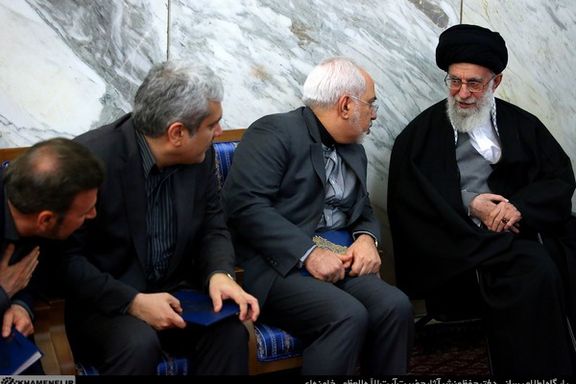
Mohammad-Javad Zarif speaking with Supreme Leader Ali Khamenei. Undated photo
Ultra-hardliners in Iran continue to attack Pezeshkian’s government, despite indications that Supreme Leader Ali Khamenei does not oppose the inclusion of former foreign minister Mohammad Javad Zarif in the cabinet.
Majid Ansari, President Masoud Pezeshkian’s legal deputy, along with other government supporters such as lawmaker Ahmad Fatemi, argue that Supreme Leader Ali Khamenei approved a recent government bill to amend the 2022 legislation that ultra-hardliners claim disqualifies Mohammad Javad Zarif from serving as Pezeshkian’s deputy for strategic affairs.
The 2022 law prohibits appointing dual nationals or individuals whose spouses or children hold dual nationality to "sensitive positions" in the government, a restriction hardliners insist applies to Zarif.
This applies to Zarif whose son was born on US soil and is an American citizen as well as many other government officials, particularly diplomats, whose children may have dual citizenship by birth.
Ultra-hardliners accuse Ansari of lying, but on Friday, Mehdi Fazaeli, a member of Khamenei’s office, tweeted that he had informed Pezeshkian two months ago that Khamenei’s office approved amending the legislation.
This, too, has failed to convince ultra-hardliners, who now say they will not accept anything attributed to Khamenei unless they hear it from his mouth.
Zarif who played a major role in Masoud Pezeshkian’s campaign was appointed as his strategic deputy but ultra-hardliners who have never forgiven the former foreign minister for the 2015 nuclear deal with world powers have been trying since day one to push him out of the government.
This led to Zarif’s announcement of his resignation in a pointy Instagram post, only a few days after his appointment in early August. Not before long he used X to announce that he had re-joined the government. The announcement was made after he was seen in Khamenei’s meeting with Pezeshkian’s cabinet on August 27 which implied he was not out of favor.
Khamenei, according to Fazaeli, has specified that dual citizenship of family members should not become an obstacle to an official’s service in the government if the citizenship is bestowed automatically for being born on foreign soil.
Referring to the bill and ultra-hardliners’ opposition to it due to their hostility toward Zarif, the government spokeswoman, Fatemeh Mohajerani told the official news agency (IRNA) Wednesday that “prominent political, cultural and social figures do not have to be assassinated with bullets. Eliminating them [from government] is a kind of assassination, too.”
She also insisted that Zarif and others in government should never be held responsible for “decisions on important and sensitive matters which are never made without coordination with the Leader of the Revolution and his approval.”
Whether Zarif remains in the role of strategic deputy—a non-executive position—is not particularly significant, according to a commentary published Saturday by the Rouydad24 news website. The piece argued that the position is beneath Zarif, suggesting he could have, or should have, been appointed as first vice president.
The commentary criticized ultra-hardliners for diverting domestic policy focus to the question of whether Zarif retains a non-executive position, while the country grapples with pressing crises, including the "new resolution from the International Atomic Energy Agency against Iran, [Donald] Trump's return to power, and the European Union’s hostility."
The commentary also criticized Pezeshkian for optimistically announcing that his government is planning to employ top international experts in the development of the Persian Gulf, Sea of Oman, and Caspian ports because ultra-hardliners will obviously oppose such plans even more strongly.
Iran's health ministry has come under fire for denial of a crisis requiring general vaccination against the Human Papillomavirus (HPV) to please the religious and political hardliners.
Experts, the media, and social media activists have been warning about the alarming spread of sexually transmitted HPV. However, the ministry has so far resisted adding the HPV vaccine to its general vaccination program.
There are no official figures on the spread of HPV, however, and the ministry insists that there is no need to start a vaccination program. Currently, the HPV vaccine can only be procured privately at a very high cost.
Around a dozen variations of the Human Papillomavirus can cause genital warts and different types of cancer in both sexes. HPV16 and HPV18 both of which are transmitted through sexual activity are believed to be responsible for around 70 percent of cervical cancer cases in women. The lesions and warts caused by the virus may be removed with topical preparation or various surgical methods but there is no permanent cure for HPV.
The Islamic Republic’s influential religious establishment and political hardliners oppose general vaccination against HPV on moral grounds, arguing that general vaccination will encourage immorality and promiscuity.
Religious hardliners on social media, particularly domestically developed social media platforms such as Eitaa, have been campaigning against the health system’s adoption of the HPV vaccine in its general vaccination program, calling it “the prostitution vaccine”.
“Sexually transmitted diseases will exist as long as there is prostitution and promiscuity. You can’t escape punishment for these with any vaccines or medication. The lasting solution is chastity,” a recent X post against vaccination exhorted.
“The propaganda over [the necessity] of vaccination against HPV on social media is a kind of fraud and the ministry does not approve of it,” Deputy Health Minister Alireza Raisi told the semi-official Mehr News Agency earlier this month, adding that the introduction of a vaccination program required further studies on its effectivity against cervical cancer.
Two types of HPV vaccine are currently available in Iran including Gardasil, developed by Merck & Co., an American multinational pharmaceutical company. Gardasil is imported through intermediary companies and sold in some pharmacies, but it must often be procured from the underground networks that smuggle pharmaceutical products from neighboring countries.
The American vaccine which offers protection against nine types of the HPV virus is completely unaffordable to most Iranians whose monthly income is around $200. According to Iranian media, three doses currently cost around 350 million rials (roughly around $500).
An Iranian version named Papilloguard, developed by Nivad Pharmed Salamat, is more readily available and costs less, around 40 million rials (roughly $60). It only offers protection against the two most high-risk types of the HPV virus.
In a tweet Wednesday, Alireza Vahabzadeh, a health ministry adviser under Hassan Rouhani, warned those opposed to general HPV vaccination and public education that the crisis was going to hit them in the face, like the HIV crisis that broke out in Iranian prisons in the 1990s, if they refused to acknowledge it.
During the second term of the reformist Mohammad Khatami’s presidency (2001-2005), authorities had to introduce a comprehensive harm reduction program which included methadone maintenance treatment and offering free needles and condoms at prisons and harm reduction centers) to contain the epidemic.
The program, authorities said, was very successful in controlling the spread of HIV/AIDS. Distribution of condoms, however, stopped during hardliner Mahmoud Ahmadinejad’s presidency, and the whole harm reduction program was abandoned a few years ago.
In 2021, vaccination against non-sexually transmitted Covid-19 also became a huge political issue when hardliners spread various conspiracy theories and opposed vaccination with Western-made vaccines, the only ones available at the time.
Supreme Leader Ali Khamenei eventually banned importing American and British-developed vaccines and insisted that Iran had to develop its own vaccines or procure them from more reliable sources. The ban allegedly led to tens of thousands of extra deaths when a severe wave of infections hit the country from June to August 2021.
In the US and UK, vaccination against HPV is recommended around the age of 12 as a preventive treatment against the likes of cervical cancer. Research from the National Institutes of Health found that in the US, 40 percent of the population aged 15 to 59 had contracted HPV.
Iranian perspectives on the conflicts in the Middle East are mostly dominated by the prevailing resentment toward their own rulers.
“The enemy of my enemy is my friend” is a prevailing logic vis-a-vis the Israeli-Palestinian conflict, overshadowing political, even humanitarian, sentiments.
Across Tehran, banners urging support for Palestinian and Lebanese war victims have become a common sight. One banner calls on citizens to sponsor displaced Lebanese families. On state TV, women are featured donating their gold and jewelry for Gaza and Lebanon. But this is not the whole story—far from it, in fact.
“These campaigns to support Gaza and Lebanon are sickening. They target people who can’t even afford bread. Money that could help Iranians escape poverty is funneled into Gaza and Lebanon.” This is my friend Safoora, a 38-year-old graphic designer. She jumps in when I ask our rideshare driver what he thinks about the pro-Palestinian billboards. The driver nods in agreement, half-glancing at Safoora in the rear-mirror.
“I agree with every word,” he joins in. “The government pours oil revenues into Gaza and Lebanon while our own people suffer. They wanted a Shiite crescent in the region, but look at what happened to the IRGC commanders and the leaders of Hamas and Hezbollah. They spent our money for nothing.”
No reliable data exists on Iranians’ view of regional politics. But anecdotal evidence suggests the views shared by Safoora and Kamran the driver are typical.
Iran’s strategy of backing armed groups against Israel and the United States has not sat well with much of the Iranian population. The discontent is evident in everyday conversations. And it’s cried out in almost every collective act of protest in recent years: “No to Gaza, no to Lebanon, (I give) my life for Iran”.
The laws of the Islamic Republic criminalize travel to Israel or expressing support for it. Iranian athletes are barred from competing against Israelis in international events.
Until recently, even using the word “Israel” in publications (instead of the “Zionist regime”) could mean serious trouble. Then there's the annual, state-sponsored Quds Day rally in solidarity with the Palestinian cause.
This one-sided approach has alienated many Iranians, who increasingly link the country’s economic woes to its regional policies.
Apathy and resentment are prevalent. Those feeling differently—those sympathetic to Palestinians and critical of Israel— often keep quiet to avoid “pro-regime” and “apologist” labels.
“The regime has monopolized and corrupted the Palestinian issue,” says Roya, a 34-year old activist from Iran’s Kurdish region. “It’s almost impossible to express support for Palestinians when the public is so hostile or indifferent at best."
"People who oppose Israel’s killing of civilians feel trapped. We want to protest these atrocities, but we don’t want to be associated with the regime and its propaganda,” she added.
Last month, more than 400 Iranian academics, writers, and activists inside and outside Iran signed a letter condemning Israel’s actions in Gaza.
The letter sparked backlash on social media. The signatories were called hypocrites for not criticizing the Islamic Republic equally. They responded that Iran’s stance was irrelevant to their concern about what they called genocide.
“Why do they condemn Israel but not Hamas? Why are they not so vocal when the regime executes protesters?” said Alireza, 29, works in a tech-support company. He believes it’s “stupid at best” to be concerned about Palestinians. “We have enough injustice to deal with at home,” he added.
His coworker, Babak, snaps at him. “So I’m stupid if I’m mad about kids being killed by Israel?” He turns to me, “I often think we’re blinded by our hatred for the Islamic Republic. We happily ignore or condone any crime if we think it’s somehow against our government.”
The debate surrounding Israel and Palestine is a microcosm of Iran’s internal struggles. For many Iranians, animus toward the Islamic Republic overshadows everything, including humanitarian sentiments. Life is tough here—too tough, often, for empathy to get the better of cynicism.
Iranian President Masoud Pezeshkian reiterated his campaign pledge this week to invite foreign experts to help address the country’s economic crisis, as his administration struggles with soaring inflation, severe shortages, and a collapsing currency.
Justifying his statement, Pezeshkian said, "With the leadership of Khamenei and the economic potential of our country, Iran does not deserve to lag behind its neighboring countries."
However, Iran has a bitter history of inviting foreign experts and economists to solve Iran's problems since the early 1910s.
Five years after Iran's 1905 Constitutional Revolution, the country's first parliament, determined to establish a Western-oriented democratic civil society in what was then known internationally as Persia, persuaded Mohammad Ali Shah—a ruler heavily influenced by Russia—to invite an economic adviser from the United States. Unlike Russia and Great Britain, the US had no political ambitions in Iran and showed no interest in exploiting its resources.
The 1905 revolutionaries had forced the Qajar Dynasty monarch Mozaffar ad-Din Shah to agree to the election of a parliament (Majles) and the opening up of a relatively free press as well as bringing about other reforms. But the king died within a few months and was replaced by Mohammad Ali Shah.
At the time, the United States was so uninvolved in regional ambitions that it initially declined Iran's request. However, under persistent pressure from the Iranians, the US government recommended William Morgan Shuster—a lawyer, civil servant, and publisher—who was ultimately appointed by the Iranian parliament as the Treasurer-General of Persia. Shuster served in this role from May to December 1911.
William Morgan Shuster 1877-1960
Shuster made every effort to stabilize Iran's chaotic and fragile economy, which had been severely impacted by the Qajar Shahs' debts to Imperial Russia and Great Britain. These two powers had effectively divided Iran into spheres of influence under the 1907 Anglo-Russian Convention. However, Shuster’s reforms, which sought to restore financial independence, challenged the authority of both Russia and Britain. In response, their agents in Iran created obstacles for him, and Russian forces subsequently occupied parts of northern Iran. They later accused Shuster of deploying Iranian gendarmes to collect taxes from people within the Russian-occupied territories.
Under mounting pressure from Russia and Britain, Shuster was ultimately forced to resign. He returned to the United States, where he wrote The Strangling of Persia, a book detailing the extensive influence and interference of Britain and Russia in Iran.
The Iranian government also appointed US-educated British lawyer and economist Arthur Millspaugh as its financial adviser, first from 1922 to 1927 and again from 1942 to 1945, to reform the country’s financial system. While his first tenure was relatively successful, his second was deemed a complete failure. The Iranian government attributed this failure to Millspaugh's "arrogance," though many observers pointed to factional infighting, political instability, and obstruction by opposition groups as key factors.
The factors mentioned—factional disputes, economic and political instability, obstructions by political rivals, and a deep-rooted xenophobia exacerbated under the Islamic Republic’s anti-West ideology—persist in modern Iran. Although 80 percent of the economy is controlled by the state or entities affiliated with the Islamic Republic’s establishment, factions thrive among these privileged groups ranging from clerics to the IRGC and influential families. Reforming the economy is hard to imagine in this non-competitive, non-transparent system.
Starting in the 1950s and continuing until the 1979 revolution, American and other international experts, advisors, and engineering specialists flocked to Iran to support the ambitious economic and industrial development spearheaded by Mohammad Reza Shah Pahlavi. By the 1970s, Iran was emerging as a regional industrial power and a major oil exporter.
In the unlikely event that Pezeshkian secures approval to hire international advisers, the challenges inherent in the Islamic Republic's economic and political system are likely to hinder their work.
The UN nuclear watchdog has censured Iran over its perceived non-cooperation with international inspections, setting the stage for a new phase in the dispute over Iran's activities which could lead toward more sanctions.
Q: What is the IAEA resolution against Iran about?
The International Atomic Energy Agency (IAEA) says it is not convinced that Iran’s nuclear program is peaceful. It has been asking questions and seeking clarification on several issues for years. But many remain unresolved.
On November 21, 2024, the IAEA Board of Governors passed a resolution calling on Iran to urgently improve its cooperation with the agency and provide a comprehensive report on its nuclear activities.
The resolution was proposed by the US, UK, France, and Germany. It passed by 19 votes in favor (of 34). China, Russia, and Burkina Faso voted against and 12 countries abstained.
Q: Is the resolution binding?
No. IAEA resolutions are not legally binding in the way that treaties or UN Security Council resolutions are. However, they are significant politically, signalling a shift in international attitudes and an intent to take further action.
The resolution against Iran may prove a crucial step in building a case for more binding measures. It provides a basis for the parties to the 2015 nuclear deal - Joint Comprehensive Plan of Action, or JCPOA - to claim Iran is violating its commitments and potentially initiate what is known as the Trigger Mechanism.
Q: What is the Trigger Mechanism?
Trigger Mechanism is an informal term for a provision under the 2015 deal that allows signatories to reimpose Iran sanctions that were lifted under the agreement.
Any party can report alleged non-compliance to the Joint Commission, consisting of all current parties to the deal - which oversees the agreement. If the issue isn’t resolved within 35 days, the complaining party can notify the UN Security Council, effectively triggering a process that could result in snapback sanctions
Q: What is snapback?
Snapback refers to the concept that UN sanctions on Iran can be restored automatically.
The Security Council does not have to vote on reimposing sanctions. Once Iran’s case is referred to there, the sanctions that were lifted under the JCPOA will snap back into place in 30 days unless the council votes to continue lifting sanctions.
Q: Who can start this process?
Any party to the 2015 deal can allege that Iran is non-compliant and take their case to the Joint Commission.
The countries that can do so are France, Germany, UK, Russia and China. The United States was also a signatory to the JCPOA, but unilaterally withdrew in 2018 during President Donald Trump's first term.
Q: Who decides if Iran is compliant or not?
The IAEA is tasked with monitoring Iran’s nuclear activities and ensuring compliance with safeguards agreements under the Nuclear Non-Proliferation Treaty (NPT) and the JCPOA. Reports from the IAEA are critical in assessing whether Iran is fulfilling its obligations.
The JCPOA signatories assess Iran’s activities based on IAEA findings and their own intelligence inputs.
In short, the IAEA provides the technical foundation for judgments, but political decisions depend on consensus, or lack thereof, among JCPOA signatories.
Q: Has the Trigger Mechanism been used before?
Yes and no. In January 2020, France, and Germany and the UK (E3) initiated the Dispute Resolution Mechanism, the process that can lead to the Trigger Mechanism, after Iran moved away from some of its JCPoA commitments in response to the Trump administration withdrawing from the deal.
The E3 did not notify the UN Security Council, however, saying that their aim was to convince Iran to respect its obligations, not to impose snapback sanctions.
The Iranian prison system continues to expose political prisoners to significant risks by failing to adhere to the principle of separating inmates based on the nature of their crimes, according to an investigation by Iran International.
This neglect, despite being mandated in the Islamic Republic’s own regulations, has led to threats, violence, and deteriorating conditions for political detainees.
Human rights organizations have repeatedly warned that mixing political prisoners with those accused of violent offenses endangers their safety. Yet, officials from the judiciary and Prison Organization remain indifferent to these violations.
One notable case is Mehdi Meskinnavaz, a political prisoner serving a 13-year sentence in Bandar Anzali prison, north of Iran. After returning to incarceration on September 3 following a temporary suspension of his sentence, Meskinnavaz has faced repeated threats and physical abuse from an inmate accused of murder. His suffering highlights the dangers of housing political detainees with violent offenders.
Maryam Akbari Monfared, among Iran’s longest-serving female political prisoners, was transferred from Semnan prison to Gharchak women’s prison on October 22. Currently held in section six of Gharchak alongside approximately 120 other inmates, she faces dire conditions.
Gharchak Prison is a prison for women located in in Gharchak County, previously part of Varamin County, Tehran Province, (30 km SSE of the capital).
Jila Baniyaghoob, a journalist and activist, wrote on the Focus on Iranian Women website about the inhumane circumstances in Gharchak. She reported that section six has only one bathroom and one toilet for all inmates, forcing prisoners into long waits and frequent conflicts over access.
Baniyaghoob also noted that at least 20 inmates in the section are on death row, primarily for murder. These prisoners require both healthcare and psychological support, but such services are lacking in the overcrowded and unsanitary environment.
The systematic failure to separate prisoners is not limited to individual cases. The death of Alireza Shir Mohammad Ali in June 2019 is a reminder of the consequences. Shir Mohammad Ali, detained after the 2018 protests, was killed by two violent inmates in Tehran’s Grand Prison, where he was held without proper separation.
In another example, political prisoner Saeed Gharibi at Adelabad prison in Shiraz attempted self-immolation on November 16 to protest his conditions and the lack of adherence to the separation principle.
According to the Islamic Republic’s prison regulations, security detainees, including political prisoners, should be held in special facilities. These rules explicitly require the segregation of inmates by the nature of their crimes to prevent ideological, political, or personal conflicts. However, these regulations remain largely unenforced.