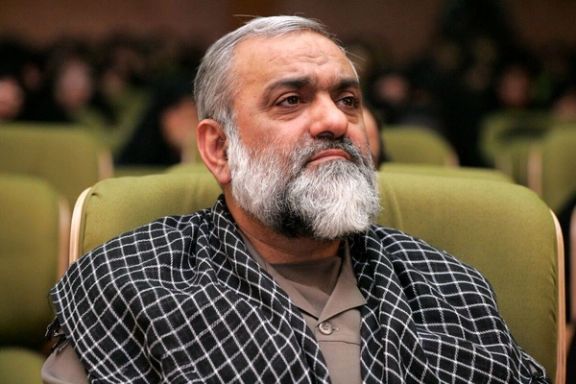
The deputy coordinator of Iran’s Revolutionary Guards on Friday announced a pivot to proxy warfare against Israel as Tehran finds itself in the spotlight following crippling setbacks suffered by Hezbollah and Hamas.
“Many inquire about the fate of Operation True Promise 3. That is not my concern,” Mohammad-Reza Naghdi said. “We, as Basij forces, are focused on pursuing Al-Aqsa Storm 2 to bring an end to Israel, and that day is fast approaching.”
Tehran refers to its direct strikes on Israel as Operation True Promise, with the first taking place in April and the second in October. Additionally, Tehran has referred to Hamas's attack on Israel last year as Al-Aqsa Storm.
Naghdi’s comments come after the IRGC’s leadership took a stronger tone last month. IRGC commander Hossein Salami hinted at the possibility of more direct involvement in actions against Israel, reflecting intense Israeli attacks in the region.
Meanwhile, the United States is preparing to renew strict measures against Iran under President-elect Donald Trump. According to The Wall Street Journal, Trump’s administration plans to revive the “maximum pressure” campaign aimed at reducing Iran’s economic capacity to fund armed groups and other adversarial activities.
On Tuesday, Mike Waltz, Trump’s soon-to-be national security adviser, also said, “The change you’re going to see is more focus on Iran.” During his previous term, Trump’s administration implemented extensive sanctions targeting Iran’s oil industry, aimed at curbing its nuclear program and weakening its regional influence.
Iran’s proxies have faced notable losses over the past year. In September, a precision Israeli strike in Beirut killed Hezbollah leader Hassan Nasrallah and several senior commanders. Israeli military sources estimate that around 3,000 Hezbollah operatives have been killed since October 2023, while Reuters reports the figure could be as high as 4,000.
Meanwhile, Hamas has also faced significant challenges in Gaza. Over a year of Israeli bombardment has caused severe damage to the group’s infrastructure, reportedly killing more than 17,000 operatives since last year’s offensive began, according to Israeli military sources.
On Wednesday, a 60-day ceasefire brokered by the United States and France between Israel and Hezbollah took effect. This agreement aims to pause 14 months of fighting that began following Hamas’s October 2023 invasion of Israel. During this period, Hezbollah fired more than 17,000 projectiles at Israel in support of Hamas.
Armed opposition factions in Syria including the Islamist group Hay’at Tahrir al-Sham (HTS) killed a top Iranian military commander and pierced the outskirts of Aleppo in recent days, jolting the stalemated fight against President Bashar al-Assad’s forces.
These movements have highlighted an unexpected strength within the opposition, placing pressure on the Iranian-backed Syrian authorities amid an already complex political and military landscape.
These developments come at a critical time for the Syrian government, which is grappling with deep internal pressures due to a deteriorating economy and growing public discontent. Externally, Assad faces diminishing Russian support as Moscow remains preoccupied with the conflict in Ukraine, alongside mounting battlefield losses among Iranian-backed allies.
These shifts on the ground appear to signal a change in the rules of engagement in Syria, raising questions about the ability of both local and international actors to adapt to these changes and what they might mean for the country’s political future.
Unexpected military tactics
The operations were launched with meticulous coordination among different factions of Islamist groups and the Syrian National Army (SNA), focusing on strategic targets. Although the timing of the attacks was unexpected, evidence suggests that preparations had been underway for months, bolstered by advanced weaponry.
Armed drones and other sophisticated tools played a pivotal role, enabling the opposition to effectively manage the conflict and secure rapid territorial gains into Aleppo, Syria’s second-largest city.
Within hours, opposition forces seized key strategic locations, including stretches of the M5 highway and major military bases such as Brigade 46 and Regiment 46. These swift gains highlighted the opposition’s ability to challenge Assad’s forces—and even Russian troops—when sufficiently supported. Notably, the operations set aside internal factional disputes, presenting a rare display of unified military coordination.
The opposition’s treatment of prisoners added a notable dimension to their strategy, as humane practices are rarely observed in the Syrian conflict. Even HTS, an internationally designated terrorist organization, appeared to adopt a more calculated approach in handling detainees. This shift may reflect an effort to send a positive signal to the international community and position themselves for potential political transformation and broader acceptance on the global stage.
International stakeholders
The Syrian government finds itself in a precarious position, suffering heavy losses among its troops and allied militias. Iranian-backed militias, a critical pillar of support for Assad, have faced significant setbacks, including the death of a senior Iranian advisor and members of Hezbollah. These developments underscore Iran’s continued direct military involvement in Syria, despite mounting losses that reflect the depth of its entanglement in the conflict.
Meanwhile, Russia, a steadfast supporter of Assad, appears increasingly constrained in its ability to intervene decisively to restore balance, largely due to its focus on its invasion of Ukraine and growing international pressures. This could prompt Moscow to scale back its direct military support for Assad, opening the door to unpredictable military and political changes.
On the other hand, Turkey’s role in these operations cannot be overlooked. Analysts suggest that Ankara aims to achieve strategic objectives, including facilitating the return of thousands of Syrian refugees to safe zones in northern Syria and pressuring Assad to accept a political settlement on new terms.
Despite their field successes, extending the conflict to other regions, such as Deir ez-Zor, appears unlikely. The Syrian Democratic Forces (SDF), backed by the international coalition, control territories east of the Euphrates, while areas west of the river remain dominated by Iranian militias and Assad government forces. Any military advance into these regions would require significantly greater logistical support and troop numbers.
Shifting balance of power
These developments indicate that the Syrian conflict may be entering a new phase of escalation, potentially compelling Assad and his allies to reconsider their military and political strategies. As domestic and international pressures on the government intensify, the urgency for political solutions has grown, likely requiring terms that differ significantly from those previously proposed.
Iran: Official reactions and battlefield losses
On the official level, Iran has expressed deep concern over what it describes as the resurgence of “terrorist takfiri groups” in Syria. Iranian Foreign Ministry spokesman Esmail Baghaei warned that these developments pose a serious threat to regional stability, accusing the United States of orchestrating a “malicious plot” to destabilize the region. Iran called on regional countries to enhance cooperation to thwart these threats, framing them as part of a broader strategy to undermine Syria’s and the region’s stability.
Tehran blamed the armed factions for violating de-escalation agreements established under the Astana process, in which Iran, Turkey, and Russia serve as guarantor states. It described recent attacks near Aleppo and Idlib as blatant breaches of these accords, warning that continued operations could jeopardize the progress made in reducing violence over recent years.
Iran reaffirmed its unwavering support for the Assad against what it considers “takfiri terrorism” and praised the sacrifices of its “resistance martyrs.” The killing of senior military advisor General Kioumars Pourhashemi during recent clashes in rural Aleppo was framed as evidence of Iran’s commitment to safeguarding regional security. Iranian officials stressed that such losses would not deter Tehran from continuing its support for the Syrian government until full security and stability are restored.
A New Chapter in the Syrian crisis
Amid these rapid and complex developments, Syria’s landscape appears set for a significant shift in military and political power dynamics. The recent changes underscore evolving strategies by both local and international players, reigniting the Syrian crisis on new fronts.
As the Assad government and its allies face growing pressures, the opposition is striving to consolidate its gains, bolstered by limited but strategic support. The central question looms: will these developments open the door to a political resolution that could end the suffering of the Syrian people, or is the country destined for prolonged escalation, further entrenching the tragedies of the conflict?
Iranian negotiators held talks with the deputy head of the EU’s External Action Service on Thursday, setting the stage for Friday’s negotiations between the Islamic Republic and the three European nations collectively known as the E3.
A meeting is scheduled for Friday between the three European signatories of the 2015 JCPOA nuclear accord—the United Kingdom, France, and Germany (E3)—and the Islamic Republic, with the participation of EU representative Enrique Mora, who met with the Iranian envoys.
Both sides issued posts on X briefly describing the discussions, with widely different accounts, except calling the exchange as frank.
The EU official, Mora, enumerated the issues he brought to the attention of Majid Takht-Ravanchi and Kazem Gharibabadi, both Iran’s deputy foreign ministers.
“Frank exchange with Iran Deputy FM @TakhtRavanchi and @Gharibabadi on Iran’s military support to Russia that has to stop, the nuclear issue that needs a diplomatic solution, regional tensions (important to avoid further escalation from all sides) and human rights,” Mora tweeted.
Gharibabadi, tweeting on behalf of the Iranian side, detailed a lengthy list of alleged mistakes and missteps by the European Union and European powers.
“It was reaffirmed to him [Mora] that EU should abandon its self-centered and irresponsible behaviour towards issues and challenges of this continent and international matters,” he said.
The Iranian diplomat accused the European side of deflecting its own problems and mistakes onto others, particularly regarding the war in Ukraine. European nations have strongly condemned Iran’s role as a weapons supplier to Russia and have imposed sanctions on numerous companies and individuals linked to Tehran’s government.
Gharibabadi also strongly criticized Europe’s stance on Iran’s nuclear program, as Paris, London and Berlin have adopted a tougher position, backing a recent censure against Tehran at a meeting of UN’s nuclear watchdog, the International Atomic Energy Agency.
“Similarly, with regard to the nuclear issue of Iran, Europe has failed to be a serious player due to lack of self-confidence and responsibility. Europe is in need of self-recovery,” the Iranian diplomat said.
Iran’s government-controlled media has projected a positive tone regarding the talks with the Europeans, as US sanctions pose increasingly difficult challenges for Tehran. However, Gharibabadi’s tweet does not reflect a more flexible Iranian position.
The European Parliament on Thursday approved a resolution denouncing human rights violations in Iran, particularly the growing and systematic repression of women, with 562 votes in favor, 2 against, and 30 abstentions.
The EU resolution called on the Islamic Republic to end systematic discrimination against women and girls, including mandatory hijab laws, and to repeal the Hijab and Chastity Law and other gender-discriminatory legislation.
The resolution also highlighted rights violations, including “the murders of Mahsa Amini, Armita Geravand,” and over 811 executions in the past year, many targeting political prisoners.
It urged member states to extend sanctions under the EU Global Human Rights Sanctions Regime to include Iranian officials responsible for these violations. It also calls for the designation of the Iran’s Revolutionary Guards (IRGC) as a terrorist organization, citing the group’s role in suppressing dissent and its involvement in international acts of violence.
German MEP Hannah Neumann, in a plenary debate at the European Parliament, highlighted the case of Iranian student Ahoo Daryaie, who removed her clothing in protest after security forces allegedly assaulted her at Tehran's Islamic Azad University over her hijab. Authorities later labeled Daryaie as mentally ill, sparking outrage amongst activists and human rights advocates.
"The only one who is sick here is the Islamic regime. Sick with paranoia, terrified of women who dare to show their hair or sing a song. And the only thing that Iranian women are suffering from is being sick of this regime. Ahoo Daryaie is not a patient. She's a remedy. A symbol of courage and resistance against repression, like so many others, whose names we don't even know," Neumann said.
Neumann criticized these actions, describing them as "repression disguised as care," and drew parallels to historical misogyny.
The EU resolution comes a day after Mohammad Bagher Ghalibaf, speaker of Iran’s parliament announced that the Hijab and Chastity law would be officially enacted next month.
Iran's foreign ministry called on Singapore not to proceed with the execution of an Iranian convict, hours after twelve Iranians were hanged in prisons across Iran.
Iran's Foreign Minister Abbas Araghchi in a phone call with his Singaporean counterpart Vivian Balakrishnan urged the southeast Asian country to reconsider the execution of Masoud Rahimi Mehrzad for "humanitarian considerations".
Rahimi, a Singaporean-Iranian citizen who is expected to be executed on Friday, was arrested 14 years ago in Singapore on charges of drug trafficking. He was 20 when arrested for possessing 31 grams of diamorphine in Singapore and sentenced to death, the Norway-based Iran Human Rights (IHR) organization said.
"Executions have never prevented drug-related crimes, and we hope that Mr. Tharman Shanmugaratnam, the President of Singapore, will issue a pardon to save Masoud's life," Mahmood Amiry-Moghaddam, the IHR director, said on Thursday in an effort to save Masoud.
Born in Singapore to a Singaporean mother and an Iranian father, he was taken to Iran as a child following his parents’ divorce. He returned to Singapore at the age of 17 to complete his mandatory military service, three years before his arrest.
Preaching what not practiced at home
The Iranian foreign minister's call for the reconsideration of Rahimi's execution came hours after Iran executed at least 12 people on illicit drug and murder charges.
Four prisoners were executed in Qazvin Central Prison, four in the prisons of Yazd, Qom and Shahre Kord, three in Shiraz, and one in Nahavand, according to reports by human rights organizations. The 12 prisoners were hanged on Thursday morning for illicit drug and murder charges.
HRANA’s reports indicate an average of 811 executions occurred between October 2023 and October 2024, encompassing both political detainees and ordinary prisoners.
A senior commander of Iran's Revolutionary Guards (IRGC) was killed in Syria's Aleppo province during an overnight attack by Islamist forces opposed to the Syrian government, Iranian media reported Thursday.
Brigadier General Kioumars Pourhashemi, also known as Haji Hashem, was a senior military advisor in Syria, the IRGC-affiliated Tasnim News reported, adding that he was killed by “Takfiri terrorists,” a term widely used in Shiite-majority Iran to refer to jihadists or supporters of radical Sunni Islam.
Islamist militants from US-designated Hayat Tahrir al-Sham (HTS) and allied rebel groups launched an offensive on Wednesday, seizing control of several towns and villages in northwest Aleppo province, a region under the control of Iran-backed supporters of the Bashar al-Assad government.
The attack marks the most significant operation since March 2020, when a ceasefire negotiated by Russia, a key ally of Assad, and Turkey, a supporter of the rebels, brought an end to years of fighting that had uprooted millions of Syrians opposed to Assad's rule.
The Syrian army reported heavy losses among the attackers, whom it described as "terrorists" operating across a broad front. The army also said it was working with Russia and unnamed "friendly forces" to regain territory and reestablish previous lines of control.
The UK-based Syrian Observatory for Human Rights reported that at least 130 people have been killed in the fighting, including 65 members of the HTS, 18 allied fighters, and 49 Syrian government soldiers.
Referring to the Wednesday attack, Iran's Foreign Minister Abbas Araghchi said the unrest in Syria was part of a US-Israeli design aimed at destabilizing the region’s security, during a phone call with his Lebanese counterpart Abdullah Bou Habib, Iran's Foreign Ministry quoted him as saying.
Russian warplanes, alongside Syrian fighter jets, have bombarded opposition positions near the Turkish border as part of efforts to repel the attack, Reuters reported on Thursday.
Syrian opposition forces are said to be operating near Aleppo within the boundaries of the Idlib de-escalation zone established in a 2019 agreement between Russia, Iran, and Turkey, the Reuters report added citing Turkish security sources.