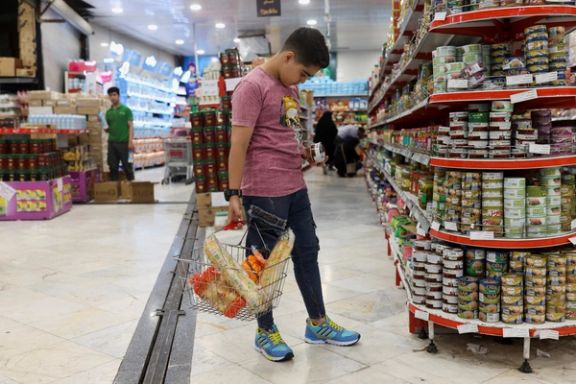
A shopper in Tehran looking at prices that climb higher.
As Iran's fiscal year draws to an end in March, the government and parliament grapple with the challenge of raising wages in line with an inflation rate of 40% that has pushed millions of workers to poverty.
Raising wages would be fraught with challenges. The heavily dominant government sector lacks the funds to pay higher wages, while quasi-governmental and private enterprises could face bankruptcy if they attempt to double workers’ pay.
But why is doubling wages even being considered? Ordinary workers currently earn less than $150 a month, while official estimates indicate that a family of three needs at least $450 a month to cover basic necessities.
This disparity stems from persistent inflation, averaging 40% annually over the past five years. Since early 2018, Iran's current has plummeted twentyfold, while wages have increased less than eightfold.
Economists warn, however, that doubling wages is not a viable solution. The government cannot afford the increases, and if it resorts to printing money to meet the demand, inflation will only worsen.
Morteza Afqah, an economics professor, told the conservative Nameh News website in Tehran that Iran’s economic crisis cannot be solved through purely economic measures because the root cause lies in its foreign policy. He argued that the only path forward is to reach agreements with the United States and Europe on nuclear and other contentious issues. According to Afqah, sanctions relief is essential before Iran can even consider sustainable economic solutions.
Top decision-makers have acknowledged the severity of the economic crisis in public, emboldening some media outlets and commentators to be increasingly vocal about the urgent need to strike deals with the West.
Ahmad Zeidabadi, a prominent writer and commentator in Tehran, expressed the frustration of many in a tweet on Thursday. Referring to insiders who suggest they are willing to “negotiate with the devil” to save the Islamic Republic but remain opposed to talks aimed at rescuing the economy, Zeidabadi warned that this mindset could further anger a public already bearing the brunt of inflation and hardship.
Similarly, Sadeq Zibakalam, another well-known commentator, reminded his followers in a post on X that over a decade ago, the head of Iran’s nuclear program had promised to build five nuclear reactors for energy production. “
Where are the reactors?” he asked, noting that nothing materialized while Iran has lost hundreds of billions of dollars to sanctions imposed for its nuclear activities. “It’s time to negotiate,” he urged the government.
Despite these calls for action, Iran’s Supreme Leader has yet to signal any willingness to allow direct talks with the United States or to compromise on key issues. Meanwhile, US President Donald Trump has not officially outlined his policy toward Tehran, though his aides have indicated a tough stance on enforcing sanctions.
With the economy in crisis and public discontent rising, Iran’s leadership faces mounting pressure to make difficult decisions that could reshape the country’s trajectory. Whether they choose to engage with the West or continue their current path remains to be seen, but the stakes could not be higher for the Iranian people.
President Donald Trump said on Thursday that he hoped a deal over Iran's nuclear program would make it so that the United States did not have to support an Israeli attack on Iran.
Asked by a reporter in the Oval Office whether he would support Israel striking Iran's nuclear facilities, Trump said: "Obviously, I'm not going to answer that question."
"It would really be nice if that could be worked out without having to go that further step ... Iran hopefully will make a deal, and if they don't make a deal, I guess that's okay too."
Without elaborating, Trump said he would be meeting various "very high-level people" in the coming days to discuss the Iran dossier.
Trump has long opposed foreign wars but has adopted a hard line on Iran, beefing up sanctions on its oil exports in his first term and pulling out of an international deal on Tehran's disputed nuclear program.
Iran has denied seeking a nuclear weapon but Israel has long contended that a bomb in the hands of its arch-enemy poses an existential threat.
Trump has previously said that Iran cannot be allowed to have a nuclear weapon but has also maintained Washington should not pursue regime change.
A correspondent from Israel's Channel 12 quoted a Trump administration official as saying Trump is opposed to the idea of an Israeli strike and believes in a deal.
The President is alarmed at the idea of an attack on Iran, Yaron Avraham cited the official as saying. "He will want to reach a very restrictive deal that would stop Iran from obtaining a nuclear weapon, and he believes he can reach an understanding with Iran."
"Moreover, he believes the Iranians will run to the negotiating table under his leadership.”
A senior Iranian official has demanded the immediate arrest of Mohammad Javad Zarif, strategic deputy to President Masoud Pezeshkian, over his remarks on the Islamic headscarf hijab made at the Davos Economic Forum.
“Anti-coup forces must arrest Zarif upon his return to the country and subject him to interrogation," the secretary of Tehran’s Promotion of Virtue and Prevention of Vice Council, Momeni-Nasab, wrote on X Thursday. "Otherwise, the country will soon face more complex and highly dangerous crises.”
The criticism arose after Zarif signaled a softer line on hijab enforcement in a CNN interview on the sidelines of the Davos Forum in Switzerland.
“The Islamic Republic has decided not to pressure women regarding the hijab,” Zarif said. “If you walk on the streets of Tehran, you will see some women without hijab. Although this is illegal, the government has chosen not to put women under pressure.”
Tehran’s Promotion of Virtue and Prevention of Vice Council is a governmental body tasked with enforcing Islamic behavioral codes, including mandatory hijab laws. It plays a significant role in shaping and implementing the Islamic Republic’s social policies.
In November 2024, the council announced plans to establish a "hijab clinic" aimed at providing "scientific and psychological treatment" for women who defy compulsory hijab regulations.
In addition to Momeni-Nasab, Zarif’s remarks on the hijab issue sparked backlash on social media, with critics accusing him of misrepresenting the Islamic Republic's stance.
Many argue that the enforcement of the new and more restrictive hijab law has merely been suspended temporarily and it could be revived at any time.
Ultra-hardliners have doubled down on their criticism of Zarif’s remarks. They emphasize Supreme Leader Khamenei’s clear stance on the hijab, citing an April 2023 speech in which he declared that flouting the hijab was both "religiously and politically haram (forbidden)."
The chairman of the US Senate Foreign Relations Committee warned Tehran over its uranium enrichment on Thursday, adding that any acceleration would result in further sanctions and heightened international pressure to dismantle its nuclear program.
"Tehran's threats of uranium enrichment are only meant to distract from the fact that Iran is at its weakest point in decades," Jim Risch said in a post on X.
"If Iran accelerates in this direction, it will only bring down further sanctions and encourage the international community to take Iran’s nuclear program off the table," the Idaho Republican added.
His comments follow remarks by Rafael Grossi, head of the UN nuclear watchdog, who said on Wednesday at the World Economic Forum in Davos that Iran is "pressing the gas pedal" on enriching uranium to near weapons-grade levels.
Grossi also called on Iran to reach an understanding with the Trump administration, expressing concerns about Tehran’s growing stockpile of highly-enriched uranium.
Iran's Foreign Ministry spokesman called US President Donald Trump's decision to re-add Cuba to the list of state sponsors of terrorism 'baseless and arbitrary', standing alongside Tehran's long-time ally.
"The US has a long history of using such baseless, arbitrary listings and defaming independent countries as a tool to advance its foreign policy," Esmaeil Baghaei was quoted as saying by IRNA, Iran's state news agency, on Thursday.
On Monday, newly sworn-in President Donald Trump reversed the Biden administration's last-minute decision to remove Cuba from the US list of state sponsors of terrorism, the White House said.
The Cuban president responded late on Monday by calling Trump's decision to revoke Biden's measures an "act of mockery and abuse."
"Trump's goal is to continue to escalate the cruel economic war against Cuba with the aim of domination," Miguel Diaz-Canel said.
Cuba announced it would release 553 prisoners in a deal brokered by the Catholic Church after Biden's administration removed Cuba from the list.
Both Iran and Cuba are currently experiencing significant economic crises. Cuba is in its most severe economic crisis since the Soviet era, facing critical shortages of essential goods such as food, medicine and fuel.
Meanwhile, Iran continues to battle severe currency depreciation and hyperinflation in the worst depression since the founding of the Islamic Republic.
Iran has cultivated alliances with Latin American nations like Bolivia, Nicaragua, and Venezuela, strategically positioning itself to challenge Western influence in the region through diplomatic and ideological channels.
President Masoud Pezeshkian’s strategic deputy, Mohammad-Javad Zarif, has come under heavy criticism by Iranians following his remarks at the Davos Summit, where he said the government has relaxed hijab enforcement in Iran.
Zarif's interview with CNN host Fareed Zakaria on Wednesday failed to satisfy both the public and the government’s hardliner opposition, according to the Rouydad24 news website in Tehran.
"In addressing the hijab situation, he angered the public, especially women, while his comments about radical factions’ confrontations with him provoked the ire of the government’s critics,” the outlet reported.
During his conversation with Zakaria on the sidelines of the World Economic Forum's annual meeting, Zarif stated: "If you go to the streets of Tehran, you will find women not covering their hair. It's against the law, but the government has decided not to put women under pressure … We are moving in the right direction … It’s not enough, but it is a step in the right direction.”
He also told Zakaria that the decision not to enforce a new strict hijab law was adopted by the “leadership” of the country, that is, the heads of the three government powers and the Supreme National Security Council (SNSC), because Pezeshkian had promised it to voters. He added that Supreme Leader Ali Khamenei was not involved in the alleged decision.
Addressing Zakaria's assertion that ultra-hardliners dominate Iran’s security policies, Zarif denied the claim and argued that he would not have been able to walk freely in Tehran if they had such influence.
However, he admitted that ultra-hardliners have been attempting to remove him from office by invoking a law that prohibits individuals with family members holding foreign citizenship from serving in senior government positions.
Criticism on social media
Zarif’s remarks on the hijab issue sparked backlash on social media, with critics accusing him of misrepresenting the Islamic Republic's stance. Many argue that the enforcement of the new and more restrictive hijab law has merely been suspended temporarily, leaving the possibility of its reimplementation at any time.
Hossein Selahvarzi, the former head of Iran's Chamber of Commerce, criticized Zarif on social media, writing: “As the most recognized Iranian figure in international circles, Mr. Zarif, in addition to all his merits and capabilities, possesses two other remarkable talents: the ability to say things in Davos while fully knowing they are untrue, and the ability to return to Iran and look his compatriots in the eye [without feeling ashamed].”
The hijab law enforces extensive surveillance of public spaces to identify women who violate its regulations, with penalties ranging from fines to imprisonment. Businesses are required to deny service to unveiled women or report them to authorities to avoid facing sanctions themselves. Additionally, daily reports from Iran highlight that hijab police and clerics continue to harass women in streets and shopping centers for failing to cover their heads.
Ultra-hardliners react
Ultra-hardliners have doubled down on their criticism of Zarif’s remarks. They emphasize Supreme Leader Khamenei’s clear stance on the hijab, citing an April 2023 speech in which he declared that flouting the hijab was both "religiously and politically haram (forbidden)."
In the same speech, Khamenei accused "the enemy" of orchestrating plans to undermine the hijab and urged authorities to formulate a counter-strategy.
Notably, Khamenei has refrained from mentioning the hijab issue in recent speeches, sparking speculation that he might be concerned about the possibility of a strong backlash from the public.
Ultra-hardline publications also criticized Zarif’s comments on other topics, including his complaint about pressure from radicals.
In an editorial published Thursday titled “From whitewashing Trump to attacking domestic rivals,” Kayhan newspaper accused Zarif of making “out-of-norm remarks” and giving foreign adversaries ammunition to criticize the Islamic Republic.
The Revolutionary Guards-linked Javan newspaper similarly condemned Zarif for taking “his quarrels and grudges against domestic rivals to Davos” and singing “the ugly song of factional disputes,” for the enemies.
“These remarks undermine Iran's national security and authority,” Javan declared.