Iran summons My Favorite Cake film directors to revolutionary court
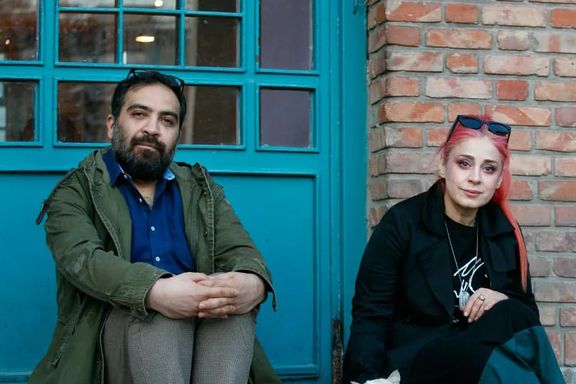
Behtash Sanaeiha (left) and Maryam Moghadam
The Iranian makers of My Favorite Cake, a critically-acclaimed film about a widow's search for companionship, have been summoned to a revolutionary court in Tehran over multiple charges including violation of public morality and ethics.
The film tells the story of a woman striving to live out her desires, including for intimacy, in a country where women's rights are heavily restricted.
Maryam Moghaddam and Behtash Sanaeeha have been summoned to Branch 26 of the Tehran Revolutionary Court, according to separate summonses they shared on Instagram, and are set to stand trial on March 1.
Moghaddam and Sanaeeha have been charged with propaganda against the Islamic Republic, producing, distributing and screening a film with obscene content, violating public morality and ethics and screening a film without a proper exhibition license.
The indictment cites their roles as producers, writers and directors of My Favorite Cake, accusing them of attempting to screen, distribute, and reproduce the film, which authorities say constitutes grounds for legal action.
The couple had previously been barred from attending their film's premiere at the Berlin Film Festival last February. They were set to attend the Swedish premiere in September when they found out that they cannot leave.
British newspaper The Guardian's named My Favorite Cake 2024's second-best film.
At Berlin Film Festival, the film won the Prize of the Ecumenical Jury Competition and the FIPRESCI Prize. It also won the Chicago Film Festival's Silver Hugo for in the New Directors Competition.
The film is just one of an increasing number of new Iranian films being produced without the Culture Ministry's permission in defiance of the country's strict ideological censorship and hijab regulations for actresses.
Many filmmakers are bypassing regulations requiring them to obtain approval at various stages of production, from screenplay inception to final screening and entry into international film festivals.
These new independent films challenge compulsory hijab rules, depicting Iranian women without the mandated head covering. This defiance has grown, especially following the 2022 Woman, Life, Freedom protest movement.
US sanctions on Iran and Russia are warding off buyers and stranding vessels laden with their oil at sea, Reuters reported on Wednesday citing trade sources and analysts.
A series of stepped-up US sanctions beginning in October on Russian and Iranian tankers, companies and entities facilitating their oil trade is increasingly hampering oil exports which are the main source of revenue for both countries.
US President Donald Trump this month reinstated the so-called "maximum pressure" campaign on Iran from his first term, aiming to drive its oil sales to zero.
Since the sanctions were ramped up in the fourth quarter of last year, OPEC member Iran has faced a challenge chartering tankers to move its supplies, Reuters cited Xu Muyu, a senior analyst at energy consultancy Kpler, as saying.
Kpler figures indicated that Iranian oil in so-called floating storage stood at an over one-year high exceeding 25 million barrels, with around 80% of the volume at sea off Malaysia and Singapore.
The total amount of Iranian oil at sea rose by as much as 20 million barrels already just since the start of 2025, three analysts cited by Reuters said.
A ban last month by the Shandong Port Group on US-sanctioned tankers has deprived Iran access to the operator of top crude importer China's largest oil terminals receiving Iranian, Russian and Venezuelan oil.
China accounts for 95% of Iran's oil exports, but it does not purchase the oil directly.
Instead, small independent refineries typically Iranian oil after it is blended with crude from other countries, ensuring it is not labeled as Iranian by Chinese customs in order to comply with sanctions against Iran.
Iran has slipped to its lowest corruption ranking yet since global watchdog Transparency International began tracking, sinking to 151 out of 180 countries.
According to Transparency International’s 2024 Corruption Perceptions Index (CPI) released Tuesday, Iran fell by one spot from the previous year, scoring 23 out of 100, where zero means most corrupt and 100, least.
The CPI, the most widely used global corruption ranking in the world, assesses countries and territories annually on how corrupt their public sector is perceived to be by experts.
It covers various markers of public sector corruption, including the misuse of public power for private benefit without facing consequences, bribery, diversion of public funds, nepotistic appointments and access to information on public affairs or government activities.
Each country’s score is drawn from 13 different corruption surveys and assessments by a variety of institutions including the World Bank and the World Economic Forum.
Transparency International reported that 47 countries recorded their lowest scores since the current ranking system was introduced in 2012.
Iran's score was lower than Iraq's at 26 but higher than Lebanon's at 22.
South Sudan, Somalia and Venezuela held the lowest scores in 2024.
Transparency International said the "state of anti-corruption efforts in the Middle East and North Africa region remains bleak," attributing the stagnation to the near-absolute control of political leaders.
The global watchdog added that countries experiencing conflict, severe restrictions on freedoms, and weak democratic institutions, rank lowest on the index.
The watchdog said that leaders in the region benefit from wealth directed toward themselves while suppressing dissent to maintain power.
Their authority, it added, has also stalled progress on global issues such as combating climate change and advancing gender equity.
In October 2023, a report by the World Bank has put Iran among the worst countries in the world in terms of Worldwide Governance Indicators, with a Voice and Accountability Index score of -1.45, placing it among the lowest for political participation, free expression, and media freedom.
Syria’s Foreign Minister said Wednesday that the country's new government is seeking reassurances from Russia and Iran to rebuild trust after years of conflict and their alignment with ousted President Bashar al-Assad.
Speaking at the World Government Summit in Dubai, Asaad Hassan al-Shibani emphasized the need for a clear policy shift: “There are positive messages, but we want these positive messages to turn into a clear policy that makes the Syrian people feel reassured.”
The Syrian conflict, which erupted in 2011, saw Iran and Russia back Assad militarily, enabling him to hold power until a rebel offensive forced his exile to Moscow late last year.
The transitional government that replaced him faces the challenge of navigating relations with former allies. “There are wounds among the Syrian people and there is pain that the Syrian people have suffered at the hands of these two countries,” Shibani added.
Russia aims to maintain its naval and air bases in Syria, with Deputy Foreign Minister Mikhail Bogdanov meeting Syria’s interim President Ahmed al-Sharaa in Damascus last month.
Meanwhile, Iran, which once supported Assad and had a formidable military presence the country, has begun communicating directly with Syria’s new leadership.
A senior Iranian official told Reuters in December that Tehran had opened a direct line of communication with Syria's new leadership.
However, Tehran’s Supreme Leader Ali Khamenei’s December call for Syrian youth to resist their new rulers has raised tensions. Shibani warned, “Iran must respect the will of the Syrian people and the country’s sovereignty and security.”
Syria’s war devastated the nation, claiming hundreds of thousands of lives. Iran withdrew in December after the rebel victory, marking a significant setback for Tehran’s regional influence.
Prices of roughly 400 medications covered under Iran’s national healthcare system have increased from 10-20% or even several times higher, the country’s social Security Organization said.
Shahram Ghaffari, Deputy Director of Treatment at the Social Security Organization, said on Wednesday that insurance organizations were slow to implement the new prices, further complicating the country's healthcare crisis for both patients and healthcare providers.
Ghaffari emphasized that with no change in drug subsidies, the financial burden on both insurance companies and individuals has intensified. “As in the past, 30% of the price of outpatient drugs is paid by the insured and 70% by the insurer, and in the inpatient sector, 10% is paid by the insured and 90% by the insurer.”
Iran is grappling with a broader drug crisis. Shortages of over 100 medications, including vital treatments for cancer and rare diseases, have become increasingly common. Concerns about counterfeit drugs, which pose a serious risk to patients' health, are also on the rise.
The Iranian Pharmacists Association recently issued a warning about the non-payment of pharmacies' claims by insurance organizations, saying that the Social Security Organization has only paid a fraction of what is owed.
The fluctuating value of Iran's currency is also a major contributing factor. As the rial's value plummets against the backdrop of fading US talk prospects, the price of everyday goods, including medications, has climbed beyond reach for many, one third of the country living below the poverty line.
Iranian lawmakers have warned that removing subsidy for essential medicines could lead to even more drastic price hikes, potentially making life-saving treatments unaffordable for many Iranians.
Health officials have echoed these concerns, predicting potential price increases of seven to ten times the current levels if the cheap dollar is eliminated.
Russia's envoy in Tehran said that Western countries are trying to marginalize Russia and China in discussions regarding Iran's nuclear program.
“The Russian Federation has been in this format (P5+1) from the very beginning. And, naturally, we expect that the relevant negotiations will continue in this format, since we have information that, unfortunately, Western countries are trying to wean Russia and China from this process.
"Without Russia and China, such negotiations will never achieve their goal and will not be productive," Alexey Dedov said in an interview with RIA Novosti on Tuesday.
Dedov's comments come amid a period of diplomatic impasse concerning the Joint Comprehensive Plan of Action (JCPOA), a pact that fell apart after the United States withdrew from it in 2018 under President Donald Trump.
Attempts to revive the agreement have stalled following Russia's invasion of Ukraine, which has intensified geopolitical tensions.
Iranian Supreme Leader Ali Khamenei rejected the chance of holding negotiations with the US this week as President Donald Trump reinstated his maximum pressure policy.
Russia remains a critical partner in Iran’s nuclear infrastructure, spearheading projects such as the expansion of the Bushehr Nuclear Power Plant.
Dedov said that Moscow and Tehran are working to complete the plant's second and third units, an initiative he described as vital to addressing Iran’s energy challenges.
The ambassador also spoke about the relationships between the two countries, referencing a recently signed strategic partnership treaty designed to enhance collaboration in various areas.
Tehran and Moscow first established a long-term agreement in March 2001, known as the Treaty on the Foundation of Mutual Relations and the Principles of Cooperation between the Islamic Republic of Iran and the Russian Federation Act. The initial treaty was valid for a decade and was later renewed twice, each for an additional five years.
Even though there have been talks of a new agreement since 2020, no updated treaty has been completed.
Iran and Russia have faced criticism, with Iranian analysts expressing doubts about Moscow's dependability.
Ataollah Mohajerani, a former government official, previously cautioned in Etemad newspaper that Russia could forsake Iran if it served its own interests.
Despite external pressures and internal doubts, both countries are advancing their joint initiatives, such as the North-South International Transport Corridor, which aims to improve trade routes linking Russia to the Persian Gulf.