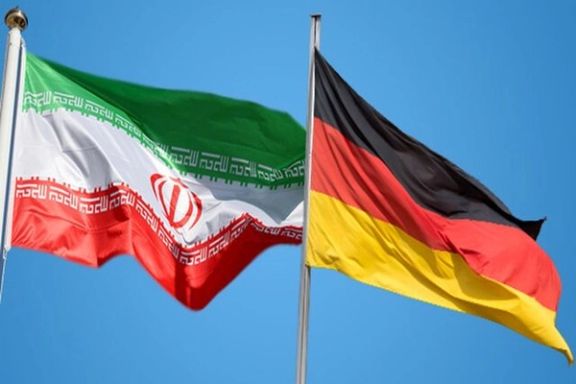
Berlin confronts Tehran over reports of German national’s detention
The German embassy in Tehran is investigating reports of the detention of a German national and has raised the matter with Iranian authorities, a source from the German Federal Foreign Office told Iran International on Sunday.
“The Foreign Office takes reports about detentions of German nationals very seriously. Our embassy in Tehran is investigating the report intensely and has confronted the Iranian side at a high level with the reports,” the source said.
No further details were immediately available on the identity of the detainee or the circumstances of their arrest.
On Saturday, Iranian Finland-based journalist Kambiz Ghafouri reported the alleged arrest of a male German citizen in Iran, saying he is currently in quarantine at Tehran's notorious Evin Prison.
In January, the European Parliament adopted a motion for a resolution condemning Iran’s detention of European Union citizens, labelling the practice as “hostage diplomacy.”
The resolution called for the immediate release of detained EU nationals and for a stronger coordinated diplomatic efforts by EU member states.
In its resolution, the European Parliament “strongly condemns Iran’s use of hostage diplomacy” and calls for the immediate and safe release of all EU citizens held in the country, including Olivier Grondeau, Cécile Kohler, Jacques Paris, and Ahmadreza Djalali.
Last month, the body of German-Iranian national Jamshid Sharmahd was returned to Germany after his death in an Iranian prison while awaiting execution.
Sharmahd was abducted by Iranian agents during a visit to the United Arab Emirates in 2020 and forcibly taken to Iran. In February 2023, the Iranian judiciary sentenced him to death on charges of endangering national security, but he died of a stroke before his scheduled execution, according to Iran's judiciary.
Sharmahd was convicted of heading a pro-monarchist group named Tondar accused of a deadly bombing incident that occurred in 2008 at a religious center in Shiraz, killing 14 and injuring 215 more. The accusation, which Sharmahd repeatedly denied, was never substantiated by documented evidence.
A sudden and unexplained reduction in Iranian electricity supply plunged Iraq's eastern province of Diyala into a partial blackout on Saturday, highlighting Iraq's ongoing dependence on Iranian power.
The cut, which slashed about half of the electricity Iran provides to Diyala, severely disrupted power in the province's eastern, northern, and northeastern regions, according to Aws al-Mahdawi, a Diyala Provincial Council member.
"It could be a technical issue or related to re-programming codes," al-Mahdawi told Rudaw, a media outlet in the Iraq’s Kurdistan region.
This latest incident follows a history of disruptions to the Mirsad power line, alongside Iran's own energy shortages which have seen extensive blackouts, most recently forcing working weeks down to two or three days in large swathes of the country.
During Iraqi Prime Minister Mohammed Shia' al-Sudani's visit to Tehran in January, officials announced plans to restore 625 megawatts through the Mirsad, Karkha, and Siril lines.
Iraq depends on Iranian electricity and gas imports to bolster its own power generation. To mitigate the impact of US sanctions on Iranian exports, Washington has repeatedly granted Iraq four-month waivers, allowing continued energy purchases.
These waivers, recently extended in the summer for 120 days and nearing expiration, are intended as a temporary measure until Iraq can achieve energy independence.
In early February, US President Donald Trump issued a directive to reinstate the 'maximum pressure' policy on Tehran. The directive signaled a potential end to sanctions waivers, saying, “The Secretary of State will also modify or rescind existing sanctions waivers.”
The Central Bank of Iran (CBI) has demanded new measures to force transparency from banks and financial institutions, citing widespread failure to comply with existing freedom of information laws.
The directive, reported by Tasnim News Agency on Sunday, mandates dedicated online portals for immediate publication of non-confidential financial data including information on financial policies, loan facilities, and regulatory directives.
It also ordered banks and non-bank credit institutions to establish units to handle public inquiries within a strict 10-day deadline.
Aimed at bolstering public trust and accountability, the move comes in response to repeated violations of the Law on Publication and Free Access to Information, according to the CBI.
The CBI said that inspections reveal banks are consistently failing to comply with transparency laws, adding that this undermines public trust and hinders access to crucial financial information.
The measure comes as Iran slides to 151st out of 180 countries in Transparency International's 2024 Corruption Perceptions Index (CPI).
The CPI, which assesses perceived public sector corruption, shows Iran's continued decline, with a score of just 23 out of 100. The index highlights concerns over bribery, misuse of public funds, and limited access to information.
In October 2023, a report by the World Bank placed Iran among the worst countries in the world in terms of Worldwide Governance Indicators, with a Voice and Accountability Index score of -1.45, placing it among the lowest for political participation, free expression, and media freedom."
Iran’s parliament impeached Economy Minister Abdolnaser Hemmati, bringing his tenure to an end after lawmakers blamed him for the country’s worsening economic crisis.
The vote followed a heated session in which Hemmati defended his record while critics pointed to the surging exchange rate and rising inflation.
Parliament voted 182 to 89 in favor of impeachment, with one abstention and one void ballot out of 273 total votes. Under Article 135 of Iran’s Constitution, ministers remain in office unless dismissed by the president or voted out by parliament.
The impeachment was initiated by 119 members of parliament, citing currency instability, the devaluation of the rial, and increasing food prices. Following speeches from both supporters and opponents of Hemmati, lawmakers cast their votes in favor of removing him from office.
“The country is in a state of war. Even Qatar, Turkey, and Iraq are not returning our dollars,” he said. Hemmati, for his part, sought to reassure lawmakers by arguing that “the exchange rate will decrease.”
The value of the Iranian rial has sharply declined, with the US dollar now trading at 940,000 rials, further straining households and businesses. Inflation has remained persistently high, with the price of essential goods continuing to rise.
Hemmati acknowledged the hardship, saying: “We understand the devastation that seven consecutive years of over 40% inflation have inflicted on the people. We know that people are suffering under the economic situation.”
During his defense, Hemmati highlighted efforts to increase government revenue through taxation since coming to office last year under Pezeshkian.
“Seventy percent of the government’s expenses are covered through tax revenues. The tax organization generated 1700 trillion rials ($1.8 billion) in revenue over the past month. If the tax organization neglects its duties even for a single day, we won’t be able to pay salaries,” he said.
Some lawmakers accused the government of deliberately allowing the exchange rate to climb. Hemmati rejected the statement, adding: “The dollar rate is not real, and we will certainly bring it down.” He also linked Iran’s economic struggles to US policies, warning that “Trump has officially declared economic war against us.”
Some commentators in Iran have argued that without a deal with the US and the removal of sanctions, the economy cannot improve. Others contend that removing Hemmati alone will do little to address the country’s deeper economic challenges.
The president can appoint an interim minister for up to three months in the absence of a permanent replacement.
Banners featuring the heated Oval Office exchange between US president and his Ukrainian counterpart have appeared across Tehran, echoing Iran's Supreme Leader’s criticism of Ukraine’s reliance on the United States.
The banners display phrases such as "End of the mirage" and "Leaning on the wind," referencing Ukraine’s ties with Washington.
The campaign underscore Iran's hardliners’ argument that the Trump-Zelensky clash validates Supreme Leader Ali Khamenei’s ban on negotiations with the United States.
Donald Trump and Volodymyr Zelensky's confrontation occurred during their meeting on Friday which intended to finalize a minerals agreement granting the US access to Ukraine's rare earth elements—a deal seen as a step toward a potential ceasefire with Russia - a long time Tehran ally.
The discussion escalated when Trump accused Zelensky of risking global conflict by refusing to make concessions to Russia, leading to an abrupt end to the meeting and the cancellation of the agreement.
Shortly after the Oval Office clash, Khamenei’s office reposted his 2022 remarks warning that Ukraine’s trust in the US was a mistake, saying that Washington cannot be trusted.
The Israeli ambassador to the US, Yechiel Leiter, warned that Iran is rapidly advancing its nuclear program while refusing to cooperate with the nuclear watchdog, arguing that diplomatic efforts to contain Tehran have failed.
“Right now we’re at a pivotal moment because Iran is racing forward in the nuclear program,” Leiter said in an interview with Fox News, pointing to the upcoming March 3 meeting of the International Atomic Energy Agency (IAEA).
“They’re supposed to produce a report on Iranian progress, but they won’t be able to because Iran doesn’t really cooperate with the IAEA.”
In 2023, Iran banned around one third of the IAEA's inspectors and the IAEA's chief, Rafael Grossi, said last month, “Iran is not still cooperating as we would like them to do.”
Leiter accused Iran’s leadership of lying about its nuclear ambitions and dismissed diplomatic efforts. “These people are liars. They’re charming liars. But they lie,” he said.
He added that Iran has openly declared its intention to destroy Israel and warned that its missile attacks on Israeli cities were part of a broader campaign against the West.
“They call us the little Satan. The United States is the big Satan. And they’re coming for Western civilization as a whole," he said.
He dismissed efforts to negotiate with Iran, saying, “You can’t talk Iran out of this.” He contrasted the Trump administration’s approach with prior US policies, praising former President Donald Trump for withdrawing from the 2015 nuclear deal.
“There’s real clarity on the Iranian situation within the Trump administration,” he said, emphasizing strong coordination between Trump and Israeli Prime Minister Benjamin Netanyahu.
Leiter's remarks come amid growing concerns over Iran’s uranium enrichment program.
Last Wednesday, the IAEA found that Iran's stock of near-bomb-grade uranium has risen to levels which in principle could be refined further into the equivalent of six nuclear bombs, according to a Reuters report citing confidential IAEA files.