Russia and US to discuss Iran nuclear issue, Moscow says
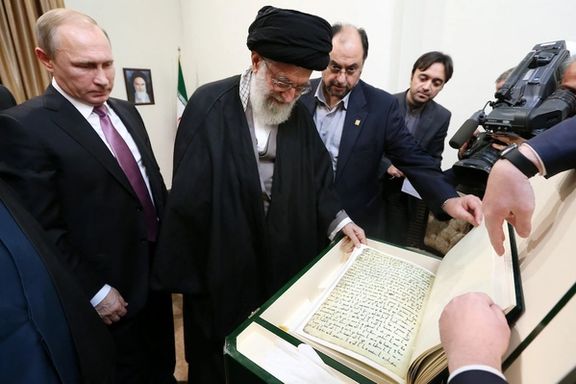
Vladimir Putin gifts a Quran manuscript to Supreme Leader Ali Khamenei on the sidelines of a meeting in Tehran on Nov. 23, 2015
Russia suggested to the United States that the two powers should hold talks focused on Iran's nuclear program, the Kremlin confirmed on Wednesday, in yet another sign of converging outlooks on global affairs by Washington and Moscow.
"The topic of Iran was on agenda, it was touched upon but not in detail," Kremlin spokesman Dmitry Peskov said in a call with reporters on Wednesday, referring to talks between Russia and the US in Riyadh last month.
"We suggested making it a separate subject of our dialogue and our consultations in the future," Peskov added. "Russia's position is that the issue of Iran’s nuclear dossier needs to be solved only through political and diplomatic means ... Russia is ready to do everything possible for it."
Moscow and Tehran signed a strategic cooperation treaty in January which both said would further strengthen ties that have been growing in the last few years.
Russia has relied on Iranian-made drones in its war in Ukraine, while Iran has sought deeper economic and military ties with Moscow to counter US-led sanctions.
President Donald Trump's efforts to end the war in Ukraine may pave the way for further cooperation with Russian president Vladimir Putin, who has offered to leverage his unique standing in Tehran to mediate between Iran and the US.
Bloomberg reported on Tuesday that Russia has agreed to assist Washington in communicating with Iran on various issues, including its support for regional groups hostile to the US.
The report has not been confirmed by Russian officials.
Iran has accelerated its nuclear program since 2022, enriching uranium to near weapons-grade levels while restricting access to international inspectors.
President Trump has said that his administration will not allow Tehran to acquire nuclear weapons but would seek a deal to that end before turning to other options.
Iran asserts that its nuclear program is solely for peaceful purposes, a position doubted by the UN nuclear watchdog, which says no non-nuclear armed country has ever enriched uranium to the purity that Tehran has.
Russia on Tuesday defended Iran’s actions in recent years, arguing that Tehran’s steps were a response to the US withdrawal from the JCPOA, a decision made in 2018 during the first Trump administration.
Israeli Minister of Defense Israel Katz warned about the ongoing danger that Iran's nuclear program poses to Israel on Wednesday, during a ceremony for the exchange of military chiefs.
"We must lead the IDF in a reality where the Iranian threat is ever-present and the enemy is striving with all its might to obtain nuclear weapons and establish them within our borders," he said as outgoing Chief of Staff, Lt. Gen. Herzi Halevi handed over to the new Chief of Staff, Lt. Gen. Eyal Zamir.
On Tuesday, the interim US envoy to international organizations in Vienna, Howard Solomon, called Iran's nuclear program an "existential threat" to the international community.
Prime Minister Benjamin Netanyahu, who also spoke at the event, said that Israel is “determined to achieve decision and victory” over Iran and its allied groups.
Katz spoke of Halevi's tenure, highlighting the challenges facing Israel in the wake of the October 7, 2023 Hamas invasion.
The shock attack saw more than 3,000 militants storm the country, killing around 1,200 mostly civilians in Israel. Over 250 more were taken hostage in the deadliest single day for Jews since the Holocaust.
"From the failure to protect our citizens on the Black Sabbath of October 7, you knew how to rise, recover, and lead an army that achieved a series of impressive military successes - in Gaza, Lebanon, Syria, Judea and Samaria, Yemen - and Iran," Katz said, referring to the onslaught of attacks from Iran-backed groups around the region sparked by the Gaza war.
Additionally, last year saw two direct aerial barrages from Iran as the shadow war between the two archenemies came into light, with Israeli retaliation taking out large swathes of Iran's air defences.
Since then, Iran has put even heavier focus on its allies in the occupied West Bank and stepped up spy operations in the country, Iran-backed plots rising by 400% last year, according to Israeli security.
Israel significantly weakened Iran's biggest military ally, Hezbollah in Lebanon, in addition to massively weakening Hamas in Gaza.
Large numbers of Hezbollah's leadership, including decades-long leader Hassan Nasrallah, were taken out in targeted strikes amid a conflict which sent Israel and the group to the verge of war.
As US-brokered ceasefires have seen calm with Hamas and Hezbollah, Israel's campaign against Iran continues while Tehran's allies keep threatening the Jewish state.
Earlier this week, senior Houthi leader Nasser al-Din Amer threatened on his X account that the Iran-backed group in Yemen was ready to resume its attacks against Israel.
"The eye is watching Gaza, the hand is on the trigger, the missiles and UAVs and all military units are on alert. The decision of the leader, Abdul-Malik al-Houthi, is clear," he said.
A group of 77 retired US generals and admirals have called on President Donald Trump to support possible Israeli military action against Iran, warning that Tehran is nearing nuclear weapons capability.
In an open letter organized by the Jewish Institute for National Security of America (JINSA), the former commanders said that “it is time to let Israel finish the job against the Iranian axis and stop Iran from crossing the nuclear threshold” and urged Washington to provide military assistance.
"A nuclear Iran would be a threat to US national security," the letter reads. "What Israel seeks from the United States is support to ensure the maximum effectiveness of its actions and manage the risk of Iranian retaliation. We should provide it expeditiously."
Referring to Iran's rising enrichment and obstruction of IAEA inspectors, it said more must be done to defend the Jewish state.
“With Iran capable of producing weapons-grade uranium in just days, working toward a nuclear weapon, and building ever-deeper underground facilities, time is running out to stop its march to the bomb,” the former generals added.
While acknowledging that diplomacy is preferable, the signatories said they doubt Iran would negotiate in good faith. "Repeated negotiations with Iran over two decades have led to one dangerous result: The world’s leading state sponsor of terrorism now stands on the cusp of developing the world’s most dangerous weapons," they wrote.
In early-February, Trump declared the return of the so-called maximum pressure on Tehran, vowing to block its paths to a nuclear weapon.
"Iran remains the world’s leading state sponsor of terror," the memo read, blaming Tehran for supporting militant groups such as Hezbollah, Hamas, and the Houthis.
Secretary of State Marco Rubio, visiting Israel last week, called Iran the single greatest source of instability in the Middle East. "There can never be a nuclear Iran," Rubio said. "That can never happen."
Israeli Prime Minister Benjamin Netanyahu said during the same press conference that "Israel and America are shoulder-to-shoulder in countering the threat of Iran."
Iran’s military security is fundamentally different from nations that depend on foreign powers, Foreign Minister Abbas Araghchi wrote in Ettela’at daily on Wednesday, pointing to the Trump-Zelensky flare-up this week.
“Iran does not purchase its security; it builds it,” he said, arguing that its independence comes at a cost Tehran has long been willing to pay. "Iran has demonstrated that dependence on others is not only a risk but also a strategic mistake."
He said the country has chosen a path of self-reliance, avoiding the risks that come with dependence on shifting geopolitical alliances, highlighted last week in the very public spat at the Oval Office between Ukrainian President Volodymyr Zelensky and US President Donald Trump over Russia's invasion of Ukraine.
"Maintaining independence comes at a cost, and Iran has always paid that price. Since the early days of the Islamic Revolution, economic pressures, sanctions, military threats, and proxy wars have all been designed to turn Iran into a submissive player in the international system," he wrote.
"The recent dispute at the White House between Donald Trump, J.D. Vance, and Volodymyr Zelensky was not just an ordinary disagreement; it revealed deepening fractures at the core of the international system."
Following the heated exchange, Supreme Leader Ali Khamenei’s office reposted his 2022 remarks warning against reliance on the West.
Banners reflecting this message have also appeared across Tehran, featuring phrases such as “End of the mirage” and “Leaning on the wind.”
The column pointed to shifting dynamics in Ukraine, where Zelensky—once reliant on Western aid—now challenges US leadership directly.
“Even small allies are realizing that their dignity comes at a cost,” he added.
Although Iran produces many types of weapons, its arsenal is technologically inferior to Western and many Russian weapons. Iran does not have an effective air force, and despite Araghchi's claim of independence buys many weapons systems from others, such as Russia.
Since Friday's clash, many Iranian hardliners have said that the Trump-Zelensky blowout validates Khamenei’s opposition to negotiations with the United States.
Citing Khamenei’s early February speech, in which he declared negotiations with the Trump administration would not be “wise, expedient, or dignified,” they argue that Trump's confrontational exchange with Ukrainian President Volodymyr Zelensky in the Oval Office should serve as a warning to those who question Khamenei’s stance.
Araghchi’s comments about self-reliance contrast with the reality that the general population in Iran is experiencing.
With over 40 percent inflation, skyrocketing prices, and the devaluation of the national currency, one-third of the population has fallen below the poverty line—something that, according to many, the officials of the Islamic Republic never experience in their own lives.
The United States on Tuesday said Iran's accelerating nuclear program is imperiling world peace and either aims to get Tehran closer to a bomb or extort the world to extract concessions.
The remarks to the United Nations nuclear watchdog underscore a harder new line by the administration of US President Donald Trump, which has vowed to bar Iran from acquiring nuclear weapons.
They came in the form of a statement responding to International Atomic Energy Agency (IAEA) Director General Rafael Grossi's report to the IAEA board the previous day documenting a sharp rise in Iran's stockpile of highly enriched uranium.
"It underscores the existential threat that Iran’s nuclear program poses to the international community," interim US envoy to international organizations in Vienna Howard Solomon said in a statement.
"It appears Iran is attempting either to extort the international community or hedge closer toward nuclear weapons. I will be plain and simple: this is a very dangerous strategy for Iran. We will not be extorted."
Tehran denies seeking a nuclear weapon and has branded suspicions over its intentions as a way for outside powers to meddle in internal affairs.
Grossi reported that Iran's uranium stock refined to up to 60% purity grew by 92.5 kilograms (kg) in the past quarter to 274.8 kg. According to an IAEA yardstick, the amount is enough in principle for six nuclear bombs if enriched further.
“Iran is the only non-nuclear weapon State enriching to this level, causing me serious concern,” he said.
The European Union on Tuesday also urged Iran to immediately halt and reverse its accelerating nuclear program.
“In light of these multiple and grave concerns, we strongly urge Iran to reverse its alarming nuclear trajectory and return to its nuclear non-proliferation commitments without further delay,” the EU said in a statement.
It represented one of the bloc's strongest statements yet on Iran's nuclear program.
Beyond uranium enrichment, Iran’s refusal to allow key verification and monitoring activities under a now defunct 2015 nuclear deal has deepened unease over Iran's intentions.
Trump has mooted a deal over the program but Iranian Supreme Leader Ali Khamenei has ruled out talks, setting the two sides up for further confrontation.
“If Iran wants a deal, the path starts with ceasing its escalatory nuclear activities, fulfilling its safeguards obligations, building international confidence, and allowing the Agency to provide assurance that its nuclear program is exclusively peaceful," Solomon added.
Iran will not tolerate statements from Turkish officials that threaten historical and regional ties, Ali Akbar Velayati, senior advisor to Supreme Leader Ali Khamenei, warned.
“Iran will never remain silent in the face of baseless remarks,” he told Jam-e Jam daily, responding to Turkish Foreign Minister Hakan Fidan’s recent comments to Al Jazeera in which he accused Iran of risking regional disorder.
Iran was a key backer of Syrian President Bashar al-Assad, who was ousted in December by a Turkish-supported Islamist-led rebel alliance. “If this policy continues, I don’t think it will be good,” Fidan said.
Iran has also backed groups including Lebanese Hezbollah, Hamas in Gaza and the Houthis in Yemen for decades with financial aid and weapons.
"If you are trying to cause anxiety in a third country, other countries can also disturb you by supporting groups in your own country," Turkey's foreign minister added.
Velayati rejected that Iran was destabilizing the Middle East, saying, “Iran is a powerful country with an ancient civilization that has always worked for regional security and cooperation.”
He cautioned Turkish officials against repeating “unrealistic and interventionist claims” and stressed that engagement and dialogue define Iran’s approach, but added that Tehran will respond to any criticism.
Iran's foreign ministry summoned Turkey's ambassador, state TV reported on Tuesday, following Fidan’s comments.
Without using the term ‘summoning’, the Iranian foreign ministry confirmed that Ambassador Hicabi Kırlangıç met with Mahmoud Heydari, the ministry's Director General for the Mediterranean and Eastern Europe, on Monday.
"The common interests of the two countries and the sensitivity of regional conditions require avoiding wrongful comments and unreal analyses that could lead to differences and tensions in our bilateral relations," Heydari said.
Elsewhere in his remarks, Velayati warned against Israel for what he alleged as attempts to divide Syria, saying that “the groundwork for disintegration has already been laid,” citing rival factions including Kurdish groups, Alawites, and militant groups.
Iran's Shiite clerical government became deeply involved in Syria's civil war early in the conflict, sending regular and proxy forces to defend Bashar al-Assad's rule.
Iran, which invested heavily in Assad’s survival—spending at least $30-$50 billion—now faces the challenge of recalibrating its strategy. Supreme Leader Ali Khamenei has vowed on multiple occasions to reclaim Iran’s influence in Syria, adding further tension to an already complex situation.
Turning to Europe, Velayati predicted the European Union’s eventual collapse, citing deepening divisions over Ukraine.
“This is one of the worst periods for Europe since NATO’s founding,” he said. He argued that Europe’s dependence on the US had left it politically vulnerable, saying that “in the end, Europe will submit to America.”
On Trump’s stance in the Ukraine war, Velayati said Washington was pursuing an “empire in the Western Hemisphere” while seeking cooperation with Russia to avoid disruption to its plans.
“However, in the Eastern Hemisphere, countries like China, Iran, and even Saudi Arabia will not easily bow to such dominance,” he added.