After leak furor, Trump says attacks sent Iran-backed Houthis reeling
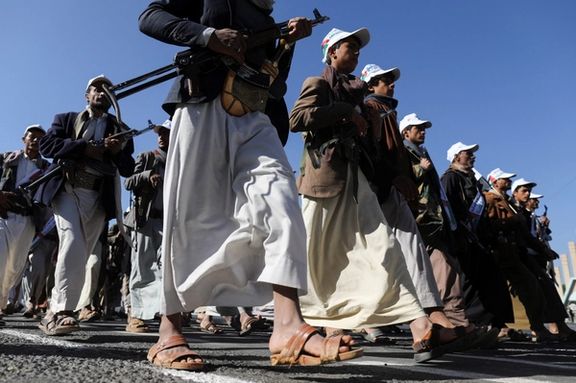
Newly recruited fighters who joined a Houthi military force intended to be sent to fight in support of the Palestinians in the Gaza Strip, march during a parade in Sanaa, Yemen December 2, 2023
As controversy over leaked attack plans gripped Washington, US President Donald Trump said the strikes had successfully battered the Houthis in Yemen and that their Iranian patrons must soon negotiate a nuclear deal or else.
"The Houthis are absolutely on the run, the worst of them have been killed," Trump told reporters at the White House. "This is not an incompetent group of people. They make their own missiles. They get their missiles also from Iran. It's an offshoot of Iran, another offshoot."
"You have Hamas, you have Hezbollah, you have the Houthis. You've got a lot of stuff going on with Iran, and we sent a letter to Iran. You're going to have to be speaking to us one way or the other pretty soon, because we can't let this happen."
The remarks come after consternation in Washington among Trump's opponents about the inclusion of a prominent journalist in a chat conversation among senior officials about plans for a military campaign against the group.
Following an attack by Iran-backed Hamas militants on Israel on October 7, 2023 and Israel's incursion into Gaza, the Houthis began attacking commercial and military vessels in the waterways astride Yemen in what they called solidarity with Palestine.
The group, which controls much of the war-torn country, has been provided advanced drone and missile technology by Iran.
His ultimatum over the nuclear standoff was delivered in the form of a letter to Iran's Supreme Leader Ali Khamenei, who has rejected previous overtures and said Trump and the United States cannot be trusted.
Iran denies seeking a nuclear weapon and the US director of national intelligence on Tuesday said Washington continues to assess that Tehran has not yet resolved to build one but that decision-makers there are increasingly promoting the idea.
Two top Trump officials have appeared to vary in recent days on the administration's precise demands on Iran.
White House National Security Advisor Michael Waltz said on Sunday that Washington seeks the full dismantling of Iran's nuclear program: "This is the full program. Give it up, or there will be consequences."
A softer line appeared to be mooted by Trump’s Middle East envoy, Steve Witkoff on Friday: “We should talk. We should clear up the misconceptions. We should create a verification program so that nobody worries about weaponization of your nuclear material."
Asked by Iran International if there was a discrepancy between the two sets of statements, a state department spokesperson said the president's line was unequivocal.
"President Trump has been clear: the United States cannot allow Iran to acquire a nuclear weapon," the spokesperson said.
"The President expressed his willingness to discuss a deal with Iran. If the Iranian regime does not want a deal, the President is clear, he will pursue other options, which will be very bad for Iran."
The UN nuclear watchdog warned that any new agreement with Iran is impossible before Tehran resolves outstanding questions about uranium traces found at undeclared sites.
"Common sense dictates you cannot build on a shaky basis," the head of the International Atomic Energy Agency (IAEA) said in an interview with Bloomberg, stressing that unresolved issues concerning uranium traces discovered at undeclared locations must be addressed.
"We discovered traces of uranium at places that were not supposed to have hosted any nuclear activity," he said, adding that satisfactory answers from Iran are still lacking. "We haven't had, I must say, answers or satisfying answers, to these questions."
The IAEA chief indicated that the current state of discussions with Iran regarding the unresolved uranium traces is not meeting the agency's expectations. "Well, we are not I must admit, we are not where we would like to be."
He acknowledged US President Donald Trump's outreach to Iran's Supreme Leader and his own recent and planned visits to Tehran, but underscored the necessity of addressing these past issues to establish a solid foundation for future negotiations.
"These things come together because you have, on one hand, these unresolved questions from the past. And then, yeah, at the same time the possibility of having some viable agreement form for the future."
The IAEA chief also highlighted the catastrophic potential of a nuclear-armed Iran in the volatile Middle East.
"The addition of that to the pot of nuclear weapons would be catastrophic," he said.
He called for continued efforts by the United States, European allies, and Iran to find a viable path forward as a matter of necessity, but only after the past discrepancies are resolved.
Iran's uranium stock refined to up to 60% grew by 92.5 kilograms (kg) in the past quarter to 274.8 kg, one of the IAEA reports said. According to an IAEA yardstick, the amount is enough in principle for six nuclear bombs if enriched further.
While Tehran has reduced IAEA inspections since 2021 and in 2023 barred a third of the inspectors, it continues to argue that its nuclear activities are peaceful.
Iran’s currency hit a record low of 1,039,000 rials to the US dollar on Tuesday, as the absence of nuclear talks with the US continues to fuel economic uncertainty.
The rial has halved in value since President Masoud Pezeshkian took office in August, deepening concerns over Iran’s worsening economic outlook, amid continuing US economic sanctions and negative regional developments for Iran.
The steep decline began after Israel launched devastating attacks on Iran’s proxy, Hezbollah, in Lebanon in September, undermining Tehran’s regional influence. The election of Donald Trump, who takes a harder line on the Islamic Republic, has added to the uncertainty.
Last week, the currency dropped to one million per US dollar in Tehran, a day after Trump warned Iran of retaliation if its Houthi allies in Yemen retaliated against US airstrikes designed to weaken them.
The rial, which was valued at around 40,000 per dollar in early 2018, began to plummet after Trump withdrew from the JCPOA nuclear deal in May of that year and imposed tough economic sanctions, pushing inflation above 40%.
Prices for food and other essential goods have recently surged, with inflation in these categories estimated at 100%. As the rial continues to lose value, even higher inflation is expected in the coming months.
The United Nations Human Rights Council is set to vote on extending the mandates of both its fact-finding mission on Iran and its human rights rapporteur, citing ongoing and systemic human rights violations, according to a draft resolution seen by Iran International.
The resolution, expected to be voted on within 10 days, condemns systematic human rights violations in Iran and calls on the Islamic Republic to end its structural impunity for perpetrators of crimes and to fully cooperate with the UN's Special Rapporteur and the Independent International Fact-Finding Mission.
"The structural impunity that the Islamic Republic has granted to officials and agents of suppression and perpetrators of crimes against the people strengthens the chain of violence and violates the victims' right to justice," the draft resolution read.
In April 2024, the Council voted to extend the Fact-Finding Mission’s mandate for an additional year.
As per the resolution, the mandate of the UN Special Rapporteur on the situation of human rights in Iran is also expected to be extended for another year, with a focus on monitoring, documenting, and assessing Iran's progress in implementing the council’s recommendations.
The resolution, drafted by Iceland, Germany, North Macedonia, Moldova, the United Kingdom, and Northern Ireland, highlights concerns over the suppression of women, ethnic and religious minorities, and the increasing use of the death penalty.
The resolution calls on Iran to amend discriminatory laws, ensure fair trials, lift restrictions on civil society, and allow access to the country for UN human rights investigators.
The council condemns the use of capital punishment to create public fear and suppress political dissent, warning that Iran's punitive approach, including death sentences for crimes not meeting the "most serious crimes" threshold, violates international law.
The resolution also cites the suppression of freedom of expression and assembly, harassment of journalists and media workers, restrictions on human rights defenders and civil activists, and widespread discrimination against minorities as key human rights violations.
The Independent International Fact-Finding Mission, established following widespread protests in 2022, will continue to gather evidence of human rights violations related to the suppression of protests, including gender and ethnicity-based discrimination and excessive use of force.
The mission's mandate includes preparing evidence for potential future legal proceedings to hold perpetrators accountable.
The UN Human Rights Council's decision follows reports by the fact-finding mission documenting widespread human rights violations, including torture and sexual violence in prisons, which they say constitute crimes against humanity.
In a letter to UN member states earlier in March, 42 Iranian and international human rights organizations called for the renewal of the Special Rapporteur's mandate and the continuation of an independent investigative mechanism with a broad mandate to build on the fact-finding mission's work.
UN Special Rapporteur Mai Sato warned of Iran's increasing use of executions to suppress dissent, with at least 169 executions recorded in January and February alone.
"Countries should make an informed decision considering the human rights situation in the Islamic Republic," Sato said earlier in the month, expressing hope that her mandate would be extended. "There are many human rights issues in Iran that need to be monitored and addressed, and ideally, prevented."
Iran has summoned the German ambassador and British charge d'affaires over their countries' role in drafting the resolution, describing the move as provocative and irresponsible.
Iran's allies, including Venezuela, North Korea, and China, have dismissed the UN fact-finding mission as politically motivated.
Iran's foreign minister revealed the contents of a letter from US President Trump to Supreme Leader Ali Khamenei during a call with his Iraqi counterpart, according to Iraq's foreign ministry.
Foreign Minister Abbas Araghchi “informed Mr. Fuad Hussein of the contents of a letter from US President Donald Trump addressed to the Iranian leadership, represented by the Supreme Leader Seyyed Ali Khamenei,” Iraq's foreign ministry said in a statement.
“He confirmed that the Iranian government will respond to the letter.”
Last week, an Emirati official brought a letter from Trump proposing nuclear talks with Tehran, which Supreme Leader Ali Khamenei rejected, saying such a proposal was deception from Washington amid crippling sanctions on Iran.
According to Iraq's foreign ministry, Hussein appreciated being briefed on the contents of President Trump’s letter and said he hoped that the exchange of messages would help open channels for dialogue between the two sides.
Iran's Foreign Minister Abbas Araghchi (left) and his Iraqi counterpart Fuad Hussein at Iraq’s Foreign Ministry’s headquarters in Baghdad, October 13, 2024
The two diplomats also discussed bilateral ties and agreed to continue communication, particularly during the sensitive phase ahead, the ministry added.
According to Axios, Trump’s letter to Khamenei included a two-month deadline for reaching a new nuclear agreement and warned of consequences if Iran expanded its nuclear program.
Iran's foreign ministry also released a readout of the call but made no mention of Trump’s letter. Instead, it focused on the escalation in Gaza and Lebanon following what it called brutal attacks by Israel, and the US military offensive in Yemen.
In part of the readout, the Iranian foreign ministry said Araghchi addressed US sanctions on Iran’s oil industry, saying the American claims and accusations aimed at pressuring Tehran were baseless.
The readout did not make any mention of Iraqi Oil Minister Hayan Abdel-Ghani who on Monday said Iranian oil tankers stopped by US forces in the Persian Gulf were using forged Iraqi documents, as Washington ramps up sanctions on Iran's oil exports as part of US President Donald Trump renewed "maximum pressure" campaign.
Iran’s health system faces an uphill battle filling vacancies, the country's medical regulatory body warned on Monday, citing shortages of doctors and nurses as the most pressing challenge in the year ahead.
“The three main challenges in the new year will be staffing, financing, and supplies,” the spokesman for the Iranian Medical Council Reza Laripous said, according to state-affiliated news agency ILNA .
Healthcare cannot function without trained workforce, Laripour warned, no matter how many new hospitals are built or expensive equipment brought in.
“Personnel—especially physicians and nurses—are the core users of medical resources and thebackbone of effective care,” he said.
The Iranian government strictly regulates medical fees and annually announces chargeable rates for private general practitioners, specialists, and dentists.
In early April, for instance, doctor's fees for general practitioners and specialists were set at 1.26 million rials ($20) and 1.89 million rials ($30), respectively, for the next twelve months. The medical community argues that these tariffs for medical services do not align with inflation and has strongly objected to them.
Since August, nurses in dozens of cities across Iran have been staging ongoing protests againstharsh working conditions and the government’s failure to pay wages consistently.
Laripour cited unfair tariffs, heavy workloads, and unequal resource distribution as key drivers behind dissatisfaction, leading many to leave their profession.
These pressures, he added, could push skilled staff to leave Iran or shift away from clinical work altogether.
He called for urgent government intervention, including better funding and attention to both thenumber and variety of healthcare professionals.
Without meaningful action, he said, rising inflation and poor economic planning will make it “irrational to expect effective care under current tariff structures,” leaving both providers and patients to bear the costs.
Iranian medical have repeatedly warned in the past few years about the inevitable deterioration of the healthcare system and its possible collapse if the same trends continue.
Government officials have never offered concrete figures on the number of doctors, midwives, and nurses who have left the country for better jobs in neighboring countries including the United Arab Emirates and Oman, as well as elsewhere in the world.