Trump warns Iran will bear brunt of any Houthi attack | Iran International
Trump warns Iran will bear brunt of any Houthi attack
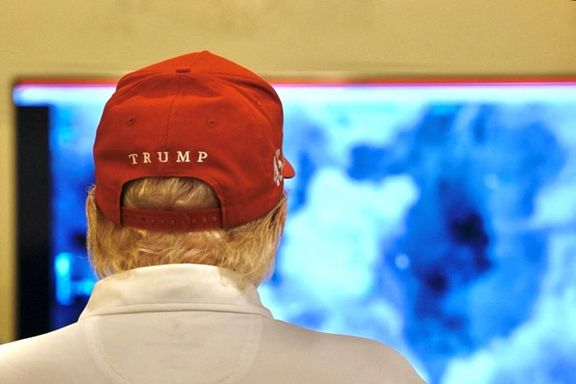
U.S. President Donald Trump looks on as military strikes are launched against Yemen's Iran-aligned Houthis over the group's attacks against Red Sea shipping, at an unspecified location in this handout image released March 15, 2025.
US President Donald Trump warned Iran on Monday that it will be punished if its Yemeni allies the Houthis retaliate against a US air assault over the weekend, escalating his rhetoric against Tehran.
"Every shot fired by the Houthis will be looked upon, from this point forward, as being a shot fired from the weapons and leadership of IRAN, and IRAN will be held responsible, and suffer the consequences, and those consequences will be dire!" Trump wrote on his Truth Social platform.
Trump on Saturday ordered large-scale military strikes against dozens of targets in Yemen controlled by Tehran-backed Houthi armed group, saying the attacks aimed at ensuring freedom of navigation through shipping lanes the militants have targeted.
Fresh US air strikes hit Yemen on Monday, the Houthis' Al Masirah TV reported. The Houthi-run health ministry said on Sunday that at least 53 people were killed in the attacks.
At a Pentagon press conference on Monday, lieutenant general Alexus Grynkewich told reporters that military casualties among the Houthis were in the dozens but there were no indications of civilian casualties.
Shortly after Israel's incursion into Gaza triggered by a Hamas attack on Oct. 7, 2023, the Shi'ite militant group which seized control of much of Yemen started missile and drone strikes against commercial and military vessels in the Red and Arabian Seas.
They described the effort as a blockade in solidarity with the Palestinian people.
Iran and the Houthis have denied close military coordination but weapons experts have linked the Yemeni fighters' advanced arsenal of anti-ship and ballistic missiles to Iranian technology.
US forces have been locked in their most intense naval combat since World War II with the Houthis but have yet to constrain the maritime attacks.
"Let nobody be fooled! The hundreds of attacks being made by Houthi, the sinister mobsters and thugs based in Yemen, who are hated by the Yemeni people, all emanate from, and are created by, IRAN," Trump added.
"Any further attack or retaliation by the 'Houthis' will be met with great force, and there is no guarantee that that force will stop there."
As ceasefires have taken hold pausing combat between Israel and its badly bludgeoned Hamas and Hezbollah militant adversaries, the Houthis have become the vanguard of Tehran's network of armed affiliates in the Middle East.
The Trump administration views their continued harassment of commercial shipping as an obstacle to his fight to bring down prices for US consumers and continued but largely ineffectual targeting of US forces as a nuisance.
"Iran has played “the innocent victim” of rogue terrorists from which they’ve lost control, but they haven’t lost control," Trump said.
"They’re dictating every move, giving them the weapons, supplying them with money and highly sophisticated Military equipment, and even, so-called, “Intelligence.”
Trump this month demanded Iran agree new deal over its nuclear program or face military attack - an overture rejected by Iran's Supreme Leader as bullying.
Ayatollah Ali Khamenei warned Washington would come off worst in any confrontation, insisting that Iran had not been weakened by over a year of direct and proxy conflict with Israel.
Iranian President Masoud Pezeshkian announced that government offices and executive bodies will be required to install solar panels as part of efforts to address the country's energy shortages, state media reported Monday.
Speaking at a meeting on energy distribution and consumption, Pezeshkian stressed the need for equitable energy policies and flexible solutions adapted to regional conditions.
“Addressing energy imbalances should not be confined to a single approach,” he said, advocating for a mix of strategies to optimize distribution and ensure fairness across different provinces.
Iranian officials refer to the shortages in the energy sector as an imbalance.
The president also emphasized public engagement in energy-saving initiatives, suggesting that mosques, health centers, and prominent cultural figures could help promote consumption reforms.
“If we involve people in implementing these decisions, we will overcome many challenges, including energy distribution and consumption management,” he added.
Among other measures, Pezeshkian highlighted the need to modernize heating equipment, ban outdated and inefficient appliances, and expand the use of smart meters in residential areas.
The energy crisis, marked by widespread electricity shortages and gas deficits, has disrupted industries across the country since the past months. Aging infrastructure, international sanctions, and poor management have compounded the problem, leading to the shutdown of approximately 80 power plants.
During the winter, Iran faces a daily shortfall of at least 260 million cubic meters of gas, further straining the electricity supply.
Iran has vast oil and gas reserves, much of which it cannot tap due to US-led sanctions which stall investment and maintenance.
The threat of war looming over Iran by President Trump’s ultimatum to make a nuclear deal or face attack may be a blessing in disguise for rulers in Tehran as they seek to manage growing popular discontent.
Iranian officials have repeatedly rejected negotiations with the United States under terms set by Donald Trump, doubling down on Supreme Leader Ali Khamenei's hardline stance.
Questioning the point of talks with a "deal-breaking" US president, Khamenei on Monday nonchalantly dismissed the consequences of shunning Washington.
"The United States is threatening militarization,” Khamenei said on the day his foreign ministry finally confirmed receiving a personal letter from Trump to Khamenei. “War is not a one-sided blow. Iran is capable of retaliating and will certainly do so,” he added.
War, once a distant threat, now looks a distinct possibility. It should concern those in power Tehran—and it perhaps does. But it may serve them as an instrument to deter adversaries and to enforce control at home.
War as a mechanism for control
Looking at Iran’s official outlets, the refrain of war is omnipresent. Military figures dominate state media and security-focused language overshadows other narratives.
This change of tone and substance—transmitted mainly inside Iran—appears to be not just a response to foreign threats, but a calculated strategy to unify and subdue the populace, forcing societal alignment by amplifying fears of conflict.
And this approach is driven by insecurity as much as intent.
Behzad Nabavi, a former minister and veteran lawmaker of the Reform camp, said recently that a wartime atmosphere could foster national solidarity, suggesting that even moderates long-shunned from power circles see fear as a unifying force.
Meanwhile, those in power have intensified the crackdown on the internet, branding the free flow of information a “cognitive war.” The sentiment was best summed up recently by Iran’s national police chief Ahmadreza Radan.
“Back then, we were encircled in the Komeil trench,” he said, invoking memories of the eight-year war with Iraq in the 1980s. “Today, we are surrounded in virtual trenches. If we’re not fighters now, we’ll surely retreat and surrender the homeland."
War as a gambit for survival
The Islamic Republic faces multiple challenges of significant severity: an ailing economy, environmental collapse, budget shortfalls, and entrenched corruption. Public trust has eroded, with sporadic protests signaling discontent.
Fearing another “sedition”—a term used to label past protests and justify their brutal suppression—officials now see war’s shadow as a lifeline.
The theocracy has a proven record of internet blackouts, arbitrary arrests and harsher suppression of dissent in general. It can be expected to do more in a state of inflated external threats, dishing out labels of “subversion” and “enemy collaboration.”
This isn’t mere opportunism—it’s a high-stakes gamble.
Iranians did rally during the war with Iraq, especially the early years. But that was forty-odd years ago. And Khamenei is no Khomeini, the first supreme leader who had all but universal following when he called for Iran’s monarchy to be replaced by an Islamic Republic.
Today, the system, as Khamenei likes to call it, is all but universally loathed. While he clings to power by keeping loyal forces primed and its critics silenced, millions of ordinary Iranians face an unrelenting battle of survival.
Stoking war fears and siege mentality to stifle unrest may work for the supreme leader. Or it could backfire spectacularly and save Trump a war he clearly does not want.
War as a lever for defense and deterrence
The Islamic Republic frames conflict as both a defensive necessity and a means to intimidate foes. Israel and Arab states astride the Persian Gulf have often borne the brunt of this rhetoric.
A senior commander of the Revolutionary Guards (IRGC) warned recently that an attack on Iran’s nuclear facilities would spark “a fire in the region that cannot be contained.” Another senior IRGC figure made it clearer: "True Promise 3 will take place at the right moment, destroying Israel and leveling Tel Aviv and Haifa.”
These threats are backed by action. Iran has nearly doubled its military exercises since October 2024, according to the Financial Times, with drills concentrated near the Natanz nuclear facility and the Strait of Hormuz.
This posturing may not be as effective in deterring the US or Israel but does help shape domestic perceptions amid worsening economic and social crises.
Mehdi Karroubi, a presidential candidate at the center of deadly 2009 protests, is set to be released from house arrest after 14 years, his son said on Monday.
"Security officers met my father and said his arrest would be lifted today on orders of the head of the judiciary," Karroubi's son Hossein Karroubi told Jamaran, a semi-official newspaper linked to Iran's Reformist political faction.
Karroubi's political ally, former Prime Minister Mirhossein Mousavi, would also be released from house arrest in the coming months, he added.
In the 2009 presidential election, which resulted in the controversial re-election of Mahmoud Ahmadinejad, Karroubi, now 87, and Mousavi, 83, ran on a reformist platform. The outcome sparked mass protests, known as the Green Movement, with demonstrators alleging widespread electoral fraud."
Both were detained in 2011 after taking a leading role in the protests, though they were not put on trial or publicly charged.
Karroubi’s son, however, added that his father had been told that security officers would be present at his home until April 8 to ensure his protection.
Iran's official news agency IRNA also reported on Karroubi's release, but did not refer to Mousavi's case.
Last year, Hossein Karroubi told Ensaf News that his father would refuse release from house arrest while Mousavi remained detained.
Iran's current president, Masoud Pezeshkian, promised during his election campaign to release both politicians.
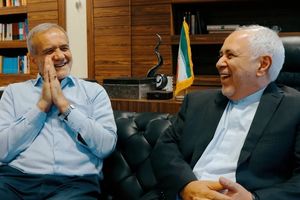
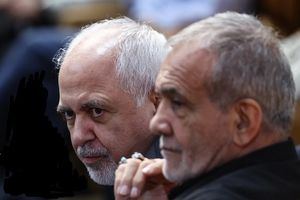
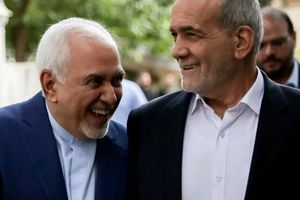
Veteran nuclear negotiator and top reformist Javad Zarif remains at his senior post despite resigning, a spokesperson said, signaling that the beleaguered president is loath to lose him.
Government Spokeswoman Fatemeh Mohajerani said on Sunday that Zarif's resignation, announced amid controversy over his children's US citizenship, has not been officially accepted, emphasizing that his appointment has not been revoked, nor has a replacement been named.
"From the government's perspective, Zarif remains the Strategic Affairs Vice-President," Mohajerani said. "Dr. Zarif's vice presidency remains valid, though he is absent from government meetings."
Zarif announced his resignation earlier this month, citing pressure from the Judiciary and a desire to "prevent further pressure on the government" after criticism from hardliners who cited a 2022 law banning officials with dual citizenship or close relatives with dual citizenship from holding sensitive positions.
Mohajerani also addressed concerns about other officials with dual citizenship. "If the law is to be enforced, it must apply uniformly across all branches of government," she added.
Mohajerani revealed that Zarif had met with President Masoud Pezeshkian after submitting his resignation, where she said they discussed "Zarif's capabilities, impact, and unique experiences".
Though she said "the text he released indicated a kind of resignation", she went on to say: “The Vice-President for Strategic Affairs resigned from his position to prevent harm to the President, the government, and the country."
Zarif's resignation sparked sharp political reactions in Iran, with hardliners celebrating his exit and reformists warning of its broader implications.
His departure came less than four weeks after Supreme Leader Ali Khamenei reaffirmed his opposition to negotiations with the United States, a stance that undermined Zarif’s role in the government.
It was widely perceived that Zarif joined the Pezeshkian administration to help negotiate another nuclear deal with world powers similar to the Joint Comprehensive Plan of Action (JCPOA), which was scrapped by Donald Trump during his first term in office.
However, Khamenei, the country's ultimate decision-maker, rejected the idea of talks with Trump last month.
Reformist commentators have warned that Zarif’s resignation, coming shortly after the impeachment of Economy Minister Abdolnaser Hemmati, signals growing instability within Pezeshkian’s administration.
Tehran will respond privately to US President Donald Trump's letter and will not make public its contents, according to Iran's foreign ministry.
"We currently do not intend to release the contents of Trump's message to the media," said Spokesperson Esmail Baghaei during a press conference on Monday.
Last week, an Emirati official brought a letter from the US president proposing nuclear talks with Tehran, which Supreme Leader Ali Khamenei rejected, saying such a proposal was deception from Washington amid crippling sanctions on Iran.
"Our response to this correspondence will be provided through appropriate channels after the completion of the reviews. What has been published in the media is mostly speculation and lacks a precise basis."
Baghaei noted that the letter's content "is not significantly different from Trump's speeches and is structured based on those elements."
The spokesman described US messages as contradictory signals, noting that while expressing readiness for talks, the US continues to impose sanctions.
He specifically criticized the US for sanctioning Iran's oil minister, whose "only crime is performing his official, legal, and national duties."
"Diplomatic negotiations have etiquette in that each side must recognize the other's interests and, more importantly, believe in fulfilling their commitments," he added during the televised press conference.
"The US does not respect that and uses the possibility of negotiations as a propaganda and political tool."
During his first term, President Trump withdrew the US from the 2015 Joint Comprehensive Plan of Action (JCPOA), an agreement between Iran and major powers that limited Iran's nuclear activities in exchange for sanctions relief. Following the 2018 US withdrawal and reimposition of sanctions, Iran exceeded the JCPOA's nuclear activity limits.
Western powers express concern that Iran's uranium enrichment, reaching up to 60% purity, indicates a potential pursuit of nuclear weapons, an allegation Iran denies, asserting its program is for peaceful purposes and compliant with international law.
Baghaei also highlighted recent diplomatic activities, including a trip by Foreign Minister Abbas Araghchi to Oman on Sunday, a trilateral meeting in Beijing with Russia and China, and a visit by the Deputy for Legal and International Affairs to Vienna for talks with the International Atomic Energy Agency (IAEA).
He stressed that Araghchi's Oman trip was unrelated to Trump's letter and had been scheduled beforehand.
In response to questions about US military strikes against the Iran-backed Houthis in Yemen, Baghaei condemned the attacks as a crime and a violation of international law.
"The US has unfortunately mistaken the victim for the criminal," he said, calling on the international community to take urgent action.
He also rejected US claims that Iran was behind the Houthi's blockade of commercial shipping in the Red Sea, saying the Yemeni people make their own decisions.
The denials came on the back of claims made on Sunday by Revolutionary Guard Corps (IRGC) Commander Hossein Salami who categorically denied US accusations of Iranian control over the Houthis', in spite of the blockade being ordered by Iran's Supreme Leader in allegiance with Iran-backed Hamas amid the Gaza war, back in 2023.
"We have always declared, and we declare today, that the Yemenis are an independent and free nation in their own land and have an independent national policy," Salami said.
"Ansarullah, as the representative of the Yemenis, makes its own strategic decisions, and the Islamic Republic of Iran has no role in setting the national or operational policies of any movement in the resistance front, including Ansarullah in Yemen."