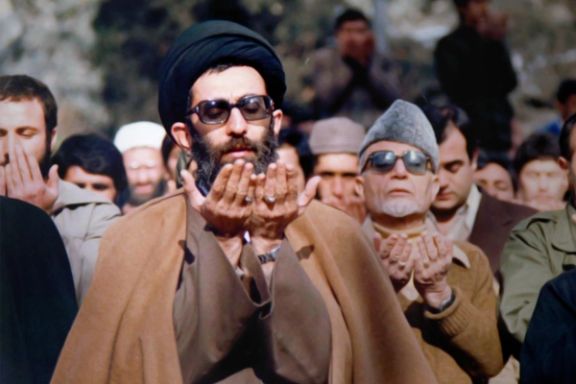
Iran's Supreme Leader Ali Khamenei leading a Tehran Firday prayers, January 18, 1980
Many middle-aged and older Iranians associate Friday prayers with the iconic image of a cleric delivering a sermon four decades ago while holding a 1970s G3 assault rifle—once a symbol of revolutionary power and defiance.
In the 1980s, following Ayatollah Khomeini’s Islamic revolution and during the Iran-Iraq war, Friday prayers drew large crowds and held significant public appeal. Over time, however, attendance declined as the lineup of Friday prayer imams changed, and growing dissatisfaction with the Islamic Republic’s social restrictions and worsening economic conditions further eroded their popularity.
Today, Friday prayers resemble weekly political briefings, often attended by local military and civilian officials. Policy directives are routinely sent from Tehran to guide the content of the sermons, turning them into orchestrated political messaging platforms.
Since assuming power, Supreme Leader Ali Khamenei has restructured the Friday prayer apparatus, moving its coordinating headquarters from the religious center of Qom to Tehran. He also systematically removed the imams appointed by his predecessor, Ruhollah Khomeini, replacing them with younger clerics more aligned with his vision.
Facts and figures According to an investigation by the Iran International website:
- There are currently 850 Friday prayer imams across Iran.
- Around 85% of them were appointed after 2017.
- Most cities have two Friday prayer imams.
- The seven-member Friday Prayer Headquarters under Khamenei’s control appoints imams even in small towns with populations as low as 500.
- About 70% of the imams appointed since 2017 have served with Iran’s military forces or were embedded with military units in Syria.
- Only one imam appointed by Khomeini remains in his position today.
Leading the Friday prayers is only one of the responsibilities of the Imams. They also lead the local councils in charge of imposing Islamic social and cultural control. They also supervise Islamic tax organizations, they are jury members at the Press Courts, they are member of the trustees of the Islamic Azad University, member of the Educational Council and local security councils among many other responsibilities. Some have their own bureaucratic empire.
Khamenei introduces changes
When Ali Khamenei became Supreme Leader, he replaced four of the seven members of the headquarters overseeing Friday prayer imams. Ten months later, he renamed the body the Policy-Making Headquarters for Friday Prayers. Significant changes followed the 2018 nationwide protests, when Khamenei appointed a younger cleric, Mohammad Haji Ali Akbari, as its head. Haji Ali Akbari also serves as one of Tehran’s Friday prayer imams.
Unlike most cities, Tehran does not have a permanent Friday prayer leader. In each of Iran’s 31 provinces, the Friday prayer imam also serves as Khamenei’s official representative.
Kazem Nour Mofidi, the Friday prayer imam of Golestan province, is currently the only one still in office from Khamenei’s earlier appointments. Historically, many provincial imams were members of the Assembly of Experts—the body responsible for selecting the Supreme Leader’s successor. Of those appointed after 2017, however, only six hold seats in the Assembly. Most of the older imams were replaced due to political misalignment with Khamenei’s views.
The province of Isfahan has the largest number of Friday prayers imams (86) while two provinces, Qom and Kordestan have 8 imams each.
The imams, who enjoy Khamenei’s backing, in many cases wield a lot of political power in their city, adjudicating differences among officials, overseeing local government decisions and in times of civil unrest rally government forces and supporters against protesters.
What is Friday Prayer?
Muslims face Mecca five times a day every day to say their prayers. Muslims may do their mid-day prayers in congregations of at least five individuals as "Friday prayers." The imams deliver two speeches called sermons before the prayers. Friday prayers are compulsory in Sunni populated areas which the Shiites may or may not turn up for the congregation.
Khomeini never led Friday prayers while Khamenei used to lead the prayers regularly in his early years as Supreme Leader. However, he has been only occasionally taking part in Friday prayers in recent years.
Senior officers in Iran’s Revolutionary Guard's intelligence organization stole around $21 million in cryptocurrency while pretending to investigate a corruption case, Iran International has found.
The case centers on Cryptoland, a digital exchange shut down after the May 2021 arrest of its CEO, Sina Estavi.
At the time of his arrest, Estavi had no formal accusers, but once the news spread thousands of investors lodged complaints. Mizan news website, controlled by Iran's notorious Judiciary department, later reported over 51,000 plaintiffs.
The BRG token, which Estavi had developed, collapsed in value following his arrest. Blockchain records show that just a day after his detention, six billion BRG tokens were moved from his crypto wallet. This was before the general public was aware of a potential scandal.
These were then sold off by IRGC officers, generating tens of millions of dollars for the interrogators themselves.
A court-appointed expert identified two of the key figures: Mehdi Hajipour and Mehdi Badi, both senior interrogators in the IRGC’s economic branch. The expert’s report confirms that wallets controlled by Hajipour sold over $21 million in BRG tokens.
In March 2022, IRGC counterintelligence agents arrested Hajipour in a sting operation. He was caught accepting a $10,000 payment from Estavi, who had been led to believe he was buying back the stolen tokens from a third party — a fake identity Hajipour had created.
Cryptoland CEO Sina Estavi
Court documents show that before the token theft, Hajipour’s assets were worth about 10 billion rials ($40,000 at the time). Four months later, his fortune had surged to 600 billion rials — spent on real estate, gold, and luxury vehicles. He was later held in Ward 66, a prison used for detained IRGC personnel.
The court document also reveals that Hajipour had a network of senior interrogators from the IRGC Intelligence Organization working alongside him.
The second suspect in this case is Mehdi Badi, a senior interrogator who operated under the alias Dr. Ebadi, whose name has appeared in many major cases labeled as IRGC economic corruption investigations.
He is the nephew of Ali Akbar Hosseini Mehrab, the former Deputy for Economic Anti-Corruption Affairs at the IRGC intelligence organization, who also served for a time as the Director General of Intelligence in Khuzestan and was later appointed as the governor of Khuzestan under the President Ebrahim Raisi administration.
According to the court document, two other interrogators from the IRGC intelligence organization, Majid Jahan Parto and Majid Tabatabaei, are also members of the corruption network, along with four others who assisted the group by forging documents.
There is no available information about the fate of the defendants in this case or the sentences they received, except that Hajipour’s appeal was rejected in September 2022.
However, Sina Estavi was sentenced to 15 years in prison and ordered to return the embezzled funds. He fled the country under pressure from the senior interrogators—who had in fact stolen the victims' money themselves.
Three months after Hajipour’s arrest, Hossein Taeb was dismissed from his position as head of the IRGC intelligence organization and replaced by Mohammad Kazemi.
Half of the victims in this case—whose money amounted to $14 million—were repaid from Estavi’s account while he was in prison, but around 25,000 others are still owed money. They are creditors of funds that were obtained and never returned by Hajipour, Badi, and the other members of the network.
Calls are growing for the Iranian president to fulfill promises made during his campaign or step down, as the administration faces accusations of inaction amid mounting public dissatisfaction.
“If he promised to remove internet restrictions and says he can, then he should. If he can’t, he should walk away,” political analyst Abbas Abdi said in comments published by Khabar Online on Saturday.
“There was no need for more meetings. He could have issued the order in the summer and the platforms would have been unblocked immediately.”
The sharp remarks come amid waning confidence in the president, elected on a platform that included commitments to ease Islamic restrictions on society, give more freedom to the media, and restore access to global platforms like Telegram, Instagram, and YouTube.
Voters also hoped Pezeshkian would help achieve a diplomatic breakthrough with the United States and ease the burden of crippling US sanctions. However, foreign policy is under the firm control of Supreme Leader Ali Khamenei and it is clear he is not willing to make sufficient concessions.
Nearly eight months into his presidency, critics say none of these objectives have been meaningfully pursued—and the economic situation has deteriorated further, with the national currency plunging to an all-time low.
Abdi argued that Pezeshkian’s declining popularity reflected the administration’s inaction. “His approval should have gone up since taking office. Instead, it’s halved,” he said.
The critique reflects broader disillusionment among segments of the Iranian public. Protests over economic hardship and social constraints have surged in recent months, and Abdi warned that the next wave could be more expansive. “Right now, each sector has had its own protests. Economic protests have come from the lower classes, while cultural and social protests have been led by women... Now, they’ve all come together. In my opinion, the next wave of protests will be very widespread—unless the political system decides to address and resolve some of these issues.”
Although Pezeshkian promised reforms, he also said he had no plans of his own and would follow Khamenei's policies.
Esmail Gerami-Moghaddam, another political figure aligned with the Reformist camp, echoed similar frustrations, urging Pezeshkian to “stand firmly against hardliners” and fulfill the mandate given to him by voters. “The public voted not for the endurance of hardline power, but for its curtailment,” he said.
Gerami-Moghaddam criticized Pezeshkian’s decision to retain conservative ministers and warned that ongoing economic woes, compounded by sanctions, will persist unless there is a shift in foreign and domestic policy. “No one can stabilize the economy without addressing the sanctions,” he said.
Both figures cited structural dysfunction as a key impediment.
Pezeshkian appears to lack clear solutions on pressing issues. Addressing Iran’s soaring prices, he recently admitted, "I have no idea whom to blame for the uncontrolled rising prices." His remark drew sharp criticism on social media, where many reminded him that, as president, he is ultimately responsible for the government's handling of the crisis.
An unprecedented police crackdown on pro-hijab protesters in Iran suggests a shift in priorities, signaling that defiance of higher authorities even by supporters will no longer be tolerated.
On Friday evening, hundreds of male and female police officers raided a makeshift vigilante camp outside the Iranian parliament, dispersing around two dozen protesters—mostly women—who had been stationed there for over 45 days. They were protesting the delay in enforcing a controversial hijab law.
While no arrests were reported, religious vigilante groups claim that police used excessive force. They called on their supporters to rally outside the parliament on Saturday afternoon. A spokesman, Hossein Allahkaram, announced later that the rally would be postponed until after the Nowruz holidays.
In the past, security forces have even protected radical supporters during high-profile actions, such as the storming of the British embassy in 2011 and the Saudi embassy in 2016—both of which triggered major diplomatic crises.
A defiance of the Supreme Leader and his policy shift?
In mid-September, Iran's Supreme National Security Council (SNSC) suspended the implementation of the hijab legislation, which imposes harsh penalties—including heavy fines and prison sentences—on women who violate strict dress codes and businesses that fail to enforce them. The decision was reportedly driven by concerns over public backlash and the risk of triggering anti-government protests.
Since the decision could not have been made without the approval of Supreme Leader Ali Khamenei, who has avoided discussing the issue in his speeches for months, criticism of the delay could be viewed as defiance of what appears to be a strategic shift in Khamenei’s approach.
Vigilantes continue to refer to Khamenei’s April 2023 speech, in which he took a firm stance. Khamenei declared in the speech that disregarding hijab was “religiously and politically haram (forbidden).” In the same speech, he accused foreign intelligence agencies of encouraging Iranian women to defy the mandatory hijab. However, he has conspicuously avoided addressing the hijab issue in recent months, including during his December 17 address to an all-female audience.
Rather than blaming Khamenei, vigilantes hold Mohammad-Bagher Ghalibaf responsible for the delay in enforcing the legislation and argue that he should be accountable for Friday’s crackdown. Hours before the crackdown, they chanted against Ghalibaf during his speech at Friday prayers in Tehran.
The Friday crackdown could also be seen as a warning to ultra-hardliners that opposition to Khamenei’s potential policy shifts— possibly including allowing engagement in direct talks with the Trump administration—will not be tolerated.
“Consider the recent actions against [pro-] hijab protesters as marking a shift in Iran’s political landscape,” a former aide to ex-President Mahmoud Ahmadinejad, Abdolreza Davari, posted on X, suggesting that authorities are now seeking to mend their relationship with the hugely disillusioned middle classes.
Debate over freedom of assembly
The police action has sparked debate over the right to assembly in Iran. Some opposition figures have criticized the crackdown.
Ali-Asghar Shafeian, chief editor of the reformist Ensaf News, argued in a tweet that the police response was unnecessary and contradicted President Masoud Pezeshkian’s stance on freedom of expression.
Others, including prominent Islamic law expert Mohsen Borhani, pointed out that the vigilantes—who had no permit for their sit-in—have consistently rejected the right of other political groups to protest, despite Article 27 of the Iranian Constitution protecting peaceful assembly.
Mahmoud Nabavian, a senior Paydari member who played a key role in drafting the hijab law, recently argued that the preservation of the Islamic Republic must take precedence over enforcing the law, given the multiple domestic and international crises that it is facing—implicitly acknowledging the risk of unrest.
While Iran’s Foreign Minister Abbas Araghchi has repeatedly emphasized that Tehran is committed to holding indirect talks with Washington, a prominent politician in Tehran argues that President Donald Trump is unlikely to accept such negotiations.
Araghchi, widely seen as representing Supreme Leader Ali Khamenei’s position, has stated in multiple interviews and statements that Iran’s current strategy is to engage with the US through intermediaries.
However, Heshmatollah Falahatpisheh, former head of the Iranian parliament’s Foreign Relations and National Security Committee, told the conservative Nameh News website: “Trump will not accept negotiations through intermediaries.”
He also criticized President Massoud Pezeshkian for “lacking a clear foreign policy strategy,” arguing that while Trump appears to have a plan for every possible scenario, Iran’s president has yet to outline a vision for Tehran’s future relations with Washington.
Since Pezeshkian is widely known to have limited authority over foreign policy, the criticism may have been aimed at Khamenei, though the politician would not have dared to address him directly.
“Currently, Trump's plan is to force Iran to the negotiating table through maximum pressure,” Falahatpisheh said, adding that “diplomacy will have a chance if Trump moderates his stance.” He also made it clear that Trump seeks direct talks with Iran.
Falahatpisheh further noted that apart from some Persian Gulf states, most international players are focused on their own interests rather than easing tensions between Iran and the US. He pointed to the recent trilateral meeting between Iran, China, and Russia in Beijing, saying that both China and Russia were primarily advancing their own agendas rather than working to resolve Iran’s standoff with Washington.
Earlier this week, Khamenei's senior adviser Ali Larijani, as well as prominent economists in Tehran said that Iran needs to address its problems with the United States urgently in a bid to lift or reduce US sanctions and give the ailing economy a chance to grow after many years of crises and stagnation.
Iranian economist Mehdi Pazouki, an academic in Tehran told the press that Iran's economy is hostage to the country's failing foreign policy and Iran's inability to have amicable relations with the world.
Ali Ghanbari, another Iranian economist, told Iranian media that the country’s economy is under strain due to its foreign policy, which is not controlled by the Pezeshkian administration. Without explicitly stating that Khamenei, rather than Pezeshkian, oversees Iran’s foreign policy—particularly Tehran’s relations with Washington—Ghanbari described it as “a structural problem beyond the control of Pezeshkian’s government.”
Given this reality, Falahatpisheh outlined two possible scenarios for the future of Iran-US dynamics: “Either a war breaks out between Iran and Israel, with the United States carrying out precision strikes on targets in Iran—an escalation that would not stop there but spread across the region—or there will be no war, but additional countries will join the United States in its maximum pressure campaign against Iran.”
He noted that even China and Russia will cautiously support the United States in this case if Washington guarantees their interests.
Falahatpisheh noted that “Iran has not identified its opportunities in this situation or considered the consequences of what might unfold.” He blamed Pezeshkian’s passivity and inaction for the current state of affairs, suggesting that the president should begin the new year with concrete operational plans. Meanwhile, Pezeshkian’s stated approach has been to push forward Khamenei’s impractical vision of domestic investment as a path to economic recovery—without explaining how it would be implemented.
As inaction continues and unrealistic economic projections persist, the exchange rate for the US dollar in Tehran’s markets has surpassed one million rials. According to former Central Bank governor Mohammad Hossein Adeli, every Iranian household is effectively paying 180 million rials ($180) per month as a hidden cost of US sanctions. He warned that with each Iranian losing money to the sanctions’ impact on non-oil trade, the situation could become a serious security issue for the country before 2029.
The deputy governor of Tehran has defended the police action against a sit-in by supporters of mandatory hijab outside Iran’s parliament on Friday, saying the gathering was unauthorized.
Hossein Khosh-Eghbal said on Saturday that outdoor protests or sit-ins must have official permission. “We thank the security and police forces for enforcing the law and maintaining public order,” he said, adding that gatherings without a permit would face a legal response.
His comments came after some Iranian domestic media reported that police dispersed the sit-in on Friday, which coincided with Quds Day. Protesters had been camped outside parliament for several weeks, calling for the enforcement of Iran’s new and more restrictive hijab law.
The law, which increases penalties for violations of the country’s dress code, was passed by parliament in September but has not been implemented. Authorities delayed its enforcement in December following domestic opposition and international pressure.
Drafted in May 2023, less than a year after the Woman, Life, Freedom uprising sparked by the death in custody of Mahsa Amini in September 2022, the law was introduced in response to widespread defiance of compulsory veiling by women and young girls.
Videos shared online appeared to show the protest site being cleared. In the footage, individuals identifying themselves as participants said they were removed by police, taken away and later abandoned near Behesht-e Zahra cemetery and the burial site of Ayatollah Ruhollah Khomeini, south of Tehran.
The crackdown has drawn mixed reactions. Some conservative figures criticized the move, while others aligned with the government welcomed the end of what they described as an illegal protest.
Khosh-Eghbal called on all political groups loyal to the Islamic Republic to avoid “divisive and unlawful behavior,” especially during sensitive times. He said demands should be expressed “wisely and within the legal framework,” and warned that unrest could be exploited by hostile groups.