Russian tells Iranians: Alliance with Moscow can counter the West
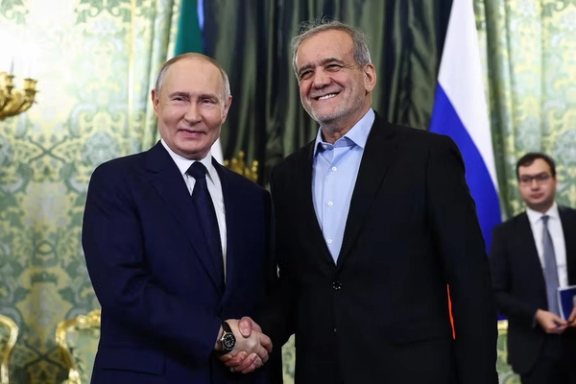
Russian President Vladimir Putin and Iranian President Masoud Pezeshkian shake hands as they meet in Moscow, Russia January 17, 2025.
Russia views Iran as a strategic ally and is ready to mediate between Tehran and Washington, a senior Russian academic said, arguing that the West cannot isolate the two countries if they remain aligned.
Nikolay Plotnikov, director of the Center for Scientific and Analytical Information at the Russian Academy of Sciences told Iran's state news agency IRNA, “We are ready to serve as a mediator between Iran and the United States if that helps solve problems through dialogue."
As Iran's Supreme Leader, Ali Khamenei, has until now rejected direct talks, the option of mediation is now essential as US President Donald Trump threatens Iran with military action if it does not reach a nuclear deal within two months.
Trump and Russia's President Vladimir Putin have had better relations than most US presidents with Moscow, though the relationship is still complex, making Moscow an unlikely choice of mediator.
A recent letter from Trump to Iran's Supreme Leader was delivered by the United Arab Emirates.
But the academic, from an institution closely associated with the Putin administration, said diplomacy is the only viable path to revive the 2015 nuclear deal.
“There is no evidence Iran is seeking to produce nuclear weapons,” he said, adding that Tehran is under “closer inspection by the IAEA than many other countries.”
“With cooperation between Russia and Iran, neither Washington nor Brussels can bring us to our knees,” said the academic known to move among Russia's political and business elite.
Moscow and Tehran have increased their military cooperation in recent years, particularly in Syria, where both backed former President Bashar al-Assad.
Additionally, Russia has deployed Iranian-made drones and and possibly missiles in Ukraine, despite Tehran’s official denials.
The strengthening of ties between Russia and Iran has accelerated in recent years, driven by mutual isolation stemming from Western sanctions – imposed on Russia for its invasion of Ukraine and on Iran for its nuclear program, support for regional armed groups, and human rights abuses – as well as a shared strategic interest in countering US influence in the region.
However, some media outlets and commentators in Iran, who are in favor of resolving differences with the West, have warned about Russia's true intentions in recent months.
Both countries are also seeking ways to circumvent the sanctions, with recent discussions exploring the expansion of trade using national currencies and alternative financial mechanisms.
Plotnikov also pushed back against Western concerns about Iran’s nuclear intentions in spite of UN reports saying Iran has enough uranium for six nuclear weapons.
Asked whether Moscow could distance itself from Tehran under Western pressure, Plotnikov said that Russia’s foreign policy doctrine in fact prioritizes its relationship with Iran.
“I recommend that you carefully study doctrinal documents such as the concept of Russia’s foreign policy and its priorities. Iran is one of the countries whose relations with Russia are being developed as a priority,” he said.
An Iranian cargo aircraft belonging to Iran's Revolutionary Guards transported weapons to Sudan's armed forces last month amid that country's ongoing civil war, two informed sources told Iran International.
A European intelligence source said the Boeing 747 with registration EP-FAB operated by Fars Air Qeshm, an airline owned by the powerful military organization, departed Tehran and landed in Port Sudan under flight number W5998 on March 17.
A second source with knowledge of the activities of the Islamic Revolutionary Guard Corps (IRGC) confirmed the shipment contained military equipment, including various types of drones.
The source added that the cargo was delivered to the Sudanese army.
A transnational paramilitary force, the IRGC spearheads Tehran's influence in the Middle East, including training and arming affiliates including Hamas, Hezbollah, the Houthis and Iraqi militias.
Iran previously used this same aircraft—bearing the same registration number—to fly a similar shipment from Bandar Abbas to Sudan in June/July 2024.
In recent months, multiple open-source investigations have pointed to an increased Iranian military role in Sudan. Satellite imagery published by BBC World Service showed Iranian drones stationed at a military site near Khartoum.
The BBC reported that Tehran had sent Ababil-3 and Mohajer-6 drones, models known for reconnaissance and strike capabilities. Iran has also supplied these drones to armed groups in Iraq, Venezuela, and Russia.
Images have emerged on social media that appear to show Iran-made anian-oduced eh-2 anti-armor missile Saeqeh-2 army positions.
The Sudanese military has been engaged in a two-year-long war against the Rapid Support Forces, a paramilitary group.
Iran’s ties with Sudan have fluctuated in recent years. In 2016 following the storming of Saudi diplomatic sites in Iran by protesters, Sudan severed diplomatic relations with Tehran along with other Saudi allies including the United Arab Emirates.
However, the two countries resumed ties in late 2023, amid the war between Israel and Hamas. In December, Sudan’s foreign minister visited Tehran, and the two governments announced the re-establishment of formal relations.
In February, Sudanese Foreign Minister Ali Youssef returned to Iran for further talks.
Last year, the Wall Street Journal reported that Iran had proposed an agreement to Sudan offering a warship in exchange for a permanent base. According to the report, the Sudanese government rejected the offer.
Even so, arms deliveries from Tehran appear to have continued. Bloomberg reported in December that Iran is backing the Sudanese army forces with weapons and drones as Tehran and its ally, Moscow, seek military bases in the Red Sea.
The report said Iran has delivered arms to Sudanese army forces and provided them with dozens of drones, helping tip the conflict against militia opponents but also giving Tehran a foothold in the region.
Israeli Prime Minister Benjamin Netanyahu accused Iran of leading what he called an “assault on civilization” during joint remarks with Hungarian Prime Minister Viktor Orban in Budapest on Thursday.
Netanyahu's visit followed Hungary’s formal decision to withdraw from the International Criminal Court earlier in the day. The Israeli leader is sought under an ICC arrest warrant for alleged war crimes in Gaza.
“This is important for all of civilization as we fight this battle against barbarism,” Netanyahu said. “We are fighting a similar fight for the future of our common civilization.”
He said that civilization itself is “under assault from radical Islam” spearheaded by Iran.
Iran-backed Hamas militants launched an attack on Israel on Oct. 7 2023, killing some 1,200 people and taking around 250 hostages to Gaza.
Israel's ongoing incursion into Gaza has killed more than 50,000 people, according to Palestinian health authorities, with nearly a third of the dead under 18.
Tehran and its allies were dealt significant setbacks last year, including Israeli attacks that severely weakened Iran's ally in Lebanon Hezbollah and helped dislodge the Assad dynasty in Syria, Tehran's oldest Arab ally.
On Oct. 26, Israel launched air strikes on Iran which it said knocked out Iran’s Russian-supplied air defense system.
Since Donald Trump took office in the United States for his second term as president, Tehran has issued repeated warnings against further attacks.
It has also conducted continuous military drills since early January. After reviving the "maximum pressure" campaign of sanctions from his first term, Trump on Sunday mooted bombing Iran if it does not agree to a new nuclear deal.
Iran's newly published budget law reveals the Islamic Revolutionary Guard Corps’ (IRGC) major share of oil revenues and public funds—and opens the door for the IRGC and Supreme Leader–linked institutions to take control of state assets.
In the past Iranian year, which ended on March 20, a portion of the country’s oil exports was allocated to the armed forces—particularly the IRGC—under the pretext of “strengthening national defense.” This year not only has the military’s share of oil export revenues grown significantly, but direct government budget allocations to the armed forces have also sharply increased. Additionally, the law expands the authorization for crude oil transfers to other entities, including those involved in nuclear programs.
Meanwhile, the budget law allows IRGC-affiliated entities—such as Khatam al-Anbiya Construction Headquarters—as well as institutions linked to Supreme Leader Ali Khamenei’s office, like the Execution of Imam Khomeini’s Order (EIKO), to acquire state assets as a means of settling government debt owed to them.
Military's share of oil
President Masoud Pezeshkian’s government has projected daily oil exports of 1.85 million barrels for the current fiscal year, which began on March 21. Of this, one-third—valued at $12.4 billion—will be directly allocated to the armed forces and their specialized military projects, a figure that has tripled compared to the previous year. The remaining oil revenues, along with total gas export earnings, estimated at $33.5 billion, will be divided among the government budget, the National Development Fund, and the National Iranian Oil Company.
Another key point is that the government has set the exchange rate for oil allocated to the armed forces at roughly 600,000 rials per euro—while the euro trades at around 1.14 million rials on the open market. This disparity creates a major financial windfall for the military, enabling them to sell the oil and convert the proceeds at market rates, effectively pocketing the difference.
Moreover, the military has priority in oil sales, meaning any decline in national exports will primarily impact the government’s share. If the armed forces are unable to export their allocated share, the government is obligated to compensate them with equivalent cash payments.
Despite the government’s target of exporting 1.85 million barrels of oil per day this fiscal year, data from commodities intelligence firm Kpler—obtained by Iran International—shows that the average daily delivery of Iranian crude to Chinese ports, Iran’s sole oil customer, stood at approximately 1.34 million barrels in the first quarter of 2025. That’s down from a daily average of 1.5 million barrels in 2024.
Additionally, the Trump administration has launched a campaign to reduce Iran’s oil exports to “zero”, and several tanker tracking and energy consulting firms previously told Iran International that Iranian oil exports could drop by about half a million barrels per day in the coming months.
Kpler also reported this week that Chinese independent refineries, known as "teapots," appear to be pausing new orders of Iranian crude oil following Washington's first imposition of sanctions on a Chinese refinery, Shandong-based Shouguang Luqing Petrochemicals.
In addition to the armed forces, the Iranian government has authorized five other entities—including those involved in “nuclear energy projects”—to sell oil directly.
At least part of these funds will likely be directed toward nuclear activities unrelated to electricity production, like sensitive and controversial uranium enrichment that the US and its allies object to.
Moreover, beyond revenues from direct oil sales under the so-called “strengthening national defense” initiative, the military and security forces are also set to receive 10% of the government’s general budget for personnel salaries.
Transfer of state assets to the military and supreme leader's office
Amid a lack of transparency surrounding the economic activities of the IRGC and institutions under the Supreme Leader’s control, unofficial reports suggest these entities dominate roughly half of Iran’s informal or “shadow” economy. Over the past two decades, much of the government’s privatization program has veered off course—rather than transferring assets to the true private sector, state-owned properties have been handed over at heavily discounted rates to the IRGC and Supreme Leader–affiliated institutions.
These entities also play a major role in Iran’s infrastructure development. Yet the exact amount the government owes them for state-assigned construction projects remains unclear. What is clear, however, is that the 2025 budget law specifically authorizes the IRGC-linked Khatam al-Anbiya Construction Headquarters and the Supreme Leader–controlled Execution of Imam Khomeini’s Order (EIKO) to receive up to two quadrillion rials (approximately $2 billion) worth of state assets as repayment for outstanding government debts.
This year, the government plans to sell 15.8 quadrillion rials in state-owned assets, of which 13% is earmarked for transfer to the military and institutions tied to the Supreme Leader—if budget targets are met. Given the weakness of Iran’s private sector, it is widely expected that, once again, entities under the IRGC and Supreme Leader’s control will acquire the lion’s share of these assets.
A new bipartisan bill in the US is pushing for measures to empower Iranians to help overthrow the government in favour of a democratic alternative including facilitating greater internet access and funding for dissidents.
The Maximum Support Act, introduced by Reps. Joe Wilson (R-SC) and Jimmy Panetta (D-CA), would require the administration to develop an aggressive interagency strategy aimed at backing Iranian dissidents who would be pivotal in the process.
The legislation outlines a broad suite of initiatives including facilitating secure communications for activists, appointing a special representative for coordinating support efforts, and forming multi-agency teams to counter online censorship and regime surveillance.
It also calls for offering safe channels for defection by Iranian officials and utilizing information shared by defectors.
“The Iranian regime will fall sooner rather than later,” Wilson said.
“As the fall of Assad in 12 days illustrated, these regimes are a lot weaker than they think they are. I’m grateful to introduce this bipartisan bill which will provide maximum support to the Iranian people in their struggle for democracy and human rights.”
Rep. Joe Wilson (R-SC)
Panetta highlighted the importance of focusing on broader Internet access to empower the Iranian public as the government uses crackdowns and censorship as a form of suppression.
Rep. Jimmy Panetta (D-CA)
“The Maximum Support Act counters these abuses by bolstering internet freedom, seizing regime assets to aid pro-democracy efforts, and supporting those resisting oppression," he said.
One element involves redirecting seized Iranian assets under US jurisdiction to fund civil society actors inside Iran — including strikers and injured protesters — under what the bill describes as strict vetting and oversight.
The bill urges the administration to evaluate whether Iran’s Ministry of Intelligence (MOIS) could be designated a Foreign Terrorist Organization.
The US State Department has said of the organization, "MOIS has a history of wrongfully detaining US nationals and has been designated across various sanctions programs."
Just last month, the Department of the Treasury’s Office of Foreign Assets Control (OFAC), in coordination with the Federal Bureau of Investigation (FBI), imposed sanctions on three Iranian Ministry of Intelligence and Security (MOIS) officials who were involved in the abduction, detention, and probable death of former FBI Special Agent Robert A. “Bob” Levinson.
"Reza Amiri Moghadam, Gholamhossein Mohammadnia, and Taqi Daneshvar, all played a role in Mr. Levinson’s abduction, probable death, and Iran’s efforts to cover up or obfuscate their responsibility," the statement said.
"This action follows the December 2020 OFAC designations of two Iranian MOIS officers, Mohammad Baseri and Ahmad Khazai, who acted in their capacity as MOIS officers in Mr. Levinson’s abduction, detention, and probable death."
The latest bill has drawn support from advocacy groups. “It’s high time Washington develops a policy that levels the contest between the most anti-American state and the most pro-American street in the region,” Behnam Ben Taleblu, a senior fellow at the Foundation for Defense of Democracies, said.
“Maximum support for the Iranian people is a perfect complement to maximum pressure, and an increasingly necessary element of the equation with respect to Iran, deal or no deal.”
Andrew Ghalili, senior policy analyst at the National Union for Democracy in Iran, called the measure “the strongest bill ever introduced in support of the Iranian people,” describing it as “exactly the kind of decisive action the US should take to align itself with the Iranian people’s vision for a free Iran.”
The initiative is part of a broader legislative push by the Republican Study Committee. The package includes bills expanding sanctions, limiting waivers for Iranian oil exports, and targeting Iran-backed militias across the region.
Sponsors say this approach combines pressure on Iran’s leadership with tangible backing for its opponents at home.
A former senior Iranian diplomat has warned that certain actors are actively working to prevent improved relations between Iran and the West, emphasizing the need for Tehran to maintain a balanced foreign policy with all global powers.
Jalal Sadatian, who previously served as Iran’s ambassador to the United Kingdom, told the ILNA news website in Tehran: “It is important to recognize that there are serious enemies of Iran’s national interests who do not want to see improved relations with Europe and the United States.”
In recent months, numerous media outlets, political figures, and former officials have cautioned against relying on Russia as a mediator between Tehran and the West, accusing Moscow of seeking to keep Iran within its own geopolitical orbit.
“Maintaining a balanced foreign policy is essential to safeguard the country’s national interests and security,” Sadatian said, adding, “We must remain aware of the severe risks posed by sanctions in order to navigate this critical phase successfully.”
The former diplomat pointed out that the dynamics of the Middle East have shifted dramatically, citing Israeli strikes on Hamas and Hezbollah, as well as the fall of Syria’s Bashar al-Assad. He emphasized that the Islamic Republic has effectively lost its military foothold in Syria.
Sadatian also noted a shift in Iraq’s political landscape—one that appears unfavorable to Iran. He highlighted growing pressure from senior Iraqi officials and Shiite religious leaders on pro-Iran militias to either disarm or formally integrate into the Iraqi army.
On the prospect of renewed talks with the United States, Sadatian warned that Tehran must remove “serious and illogical impediments rooted in domestic political disputes.” He added, “We must be aware of the serious dangers posed by sanctions in order to navigate through this phase successfully.”