Sanctions on Chinese refinery are Trump’s first real move against Iran - WSJ
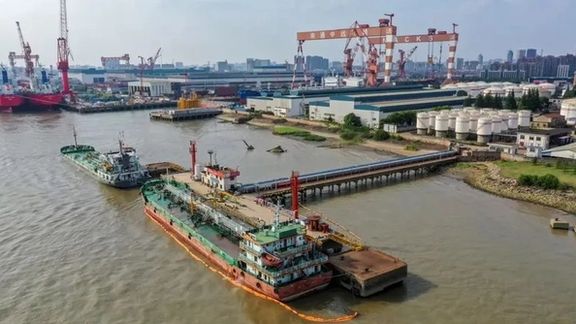
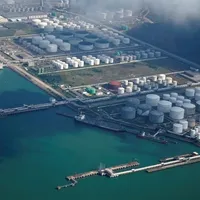
Oil offloading port in China
Sanctioning a Chinese refinery for buying Iranian oil is the first real sign of President Donald Trump’s “maximum pressure” on Tehran, the Wall Street Journal’s Editorial Board said on Sunday.
On March 20, the United States sanctioned Shandong Shouguang Luqing Petrochemical Co, which is known as a “teapot refinery” purchasing Iranian oil shipped by illicit methods to China in violation of US sanctions.
The WSJ said that after years of a lenient approach toward Tehran’s oil exports to China, the Trump administration finally took a step targeting the main source of Iran’s oil revenues. Chinese teapot refineries buy 90% of these exports and provide a lifeline for Tehran, which is financially strapped.
Officially, China buys almost no Iranian oil but its small refineries, not directly linked to government enterprises, unload tankers that wholly or partially carry Iranian cargoes.
“Unlike larger firms with links across the global economy, the teapots are less vulnerable to sanctions. But they tend to have links across the domestic Chinese economy. That’s what makes this move a warning to China,” the editorial said. It added that while Beijing might be willing to tolerate risk with its small refineries, it might not be ready to endanger US punitive measures against its bigger, state enterprises.
“If that’s trouble Mr. Xi could do without, he can make the business and political decision to drop Iran as a supplier. When Iran’s oil exports collapse, you’ll know the regime is feeling the heat. That’s when nuclear talks will have their best chance of success.”
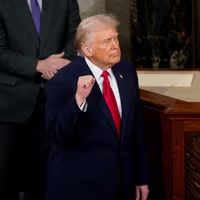
President Trump last month announced the revival of his so-called maximum pressure policy toward the Islamic Republic, demanding talks to dismantle its nuclear program. Iran has responded by saying that it will not negotiate under Mr. Trump’s pressure, although it is facing serious financial pressures to a large extent brought on by US sanctions.
Iranian oil tankers stopped by US forces in the Persian Gulf were using forged Iraqi documents, according to Iraqi Oil Minister Hayan Abdel-Ghani.
"We received some verbal inquiries about oil tankers being detained in the Persian Gulf by US naval forces carrying Iraqi shipping manifests," Abdel-Ghani said on state television late on Sunday.
"It turned out that these tankers were Iranian ... and were using forged Iraqi documents. We explained this to the relevant authorities with complete transparency and they also confirmed this."
Later on Monday, Iran's oil ministry denied the reports about Iranian oil tankers being seized by the United States.
This comes as Washington has been ramping up sanctions on Iran's oil exports, as part of US President Donald Trump renewed "maximum pressure" campaign, aimed at cutting Iran’s oil exports to zero in a bid to force Tehran into talks over its nuclear program.
In December, Reuters reported that a fuel smuggling network using forged documents has generated at least $1 billion annually for Iran and its proxies in Iraq.
The network sells crude exclusively to companies that own refineries and does not supply trading firms, Abdel-Ghani said, adding that several traders were behind the scheme.
Iran Air, the country's flag carrier, has reported significant losses and a severe impact on drug imports following the European Union and UK's flight ban, with the airline's CEO calling for international legal action to restore services.
Hossain Khanlari, CEO of Iran Air (Homa), told ILNA news agency that the suspension of European flights has not only harmed the airline's revenue but also severely affected the supply of essential medicines to Iran amid an already dire health crisis.
EU sanctions have stopped all direct Iran Air flights to Europe. The flight bans impact passenger travel and trade, as Iran Air was the sole Iranian carrier serving Europe.
"Iran Air was a major carrier of pharmaceuticals from Europe, with two-thirds of the 12-ton cargo on each flight being medicine, primarily from Germany," Khanlari said.
The flight ban has disrupted this critical supply chain, creating hardships for patients in Iran. "We are pursuing legal avenues through international bodies to resume these flights, especially to address the current drug shortage," Khanlari stated.
Iran's healthcare system is under severe strain, grappling with critical medicine shortages and rapidly escalating costs with a huge flood of professionals fleeing the country for better opportunities abroad.
Government debt to pharmacies has crippled supply chains, while the plunging value of the Iranian rial has inflated the price of both imported and domestically produced drugs. A black market for essential medications has emerged, and some pharmaceutical companies have ceased production due to financial unviability.
The government's attempts to control drug prices and subsidize costs are failing to counteract the economic pressures, and rising healthcare expenses are driving more families into poverty.
In addition to the drug supply issue, Khanlari highlighted the ban's impact on Iranian citizens living in Europe, students, and academics who relied on Iran Air for travel.
"Many Iranians visited their families in Europe using our flights, and Iranians residing in Europe traveled back home with Iran Air. These individuals are now facing increased travel costs," he said.
To mitigate the financial losses from the European flight cancellations, Iran Air has increased its regional flights and added routes to East and South Asia. "While these new routes are profitable, they cannot fully compensate for the revenue lost from European flights," Khanlari explained.
Despite the new routes, Iran Air remains committed to resuming its European services. "We are eager to restart our European flights to serve our citizens," Khanlari said. "However, in the absence of European routes, we must focus on expanding our operations in Asia."
The European sanctions against Iran’s civil aviation industry announced in September are particularly significant, as Iran Air used to operate an average of 24 weekly flights each way to at least nine European cities, including Paris, London, Frankfurt, and Rome, according to information obtained by Aviacionline via Cirium.
In August, the United States sanctioned Iran Air after accusing Tehran of supplying Russia with short-range ballistic missiles. The US Treasury accused Iran Air of having transported goods "on behalf of Iran’s Islamic Revolutionary Guard Corps (IRGC) and Ministry of Defense and Armed Forces Logistics (MODAFL)."
Iran has been deeply involved in Russia’s war effort in Ukraine since mid-2022, providing drones, spare parts and training.
The Trump administration is seeking full dismantlement of Iranian nuclear program in a way that the entire world can see, White House National Security Advisor Michael Waltz told CBS News on Sunday.
“It is time for Iran to walk away completely from its desire to have a nuclear weapon. And they will not, and cannot be allowed to have a nuclear weapons program, that’s enrichment, weaponization, and its strategic missile program,” Waltz said.
“The President has all options on the table. But we want to be clear, this isn't some kind of, you know, kind of tit for tat that we had under the Obama administration, or Biden. This is the full program. Give it up, or there will be consequences,” he added.
His comments came in contrast to the much more conciliatory tone of Trump’s Middle East envoy, Steve Witkoff, who spoke of the US president's intention to resolve Iran's nuclear dispute diplomatically.
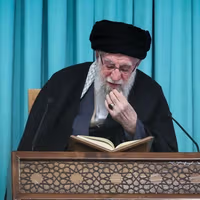
Earlier this month, Trump wrote a letter to Iran’s Supreme Leader Ali Khamenei in an attempt to explore a new nuclear agreement and prevent military escalation, Witkoff told Fox News on Sunday.
"We don't need to solve everything militarily," Witkoff said.
He emphasized that Iran cannot have a nuclear bomb, saying, “It cannot happen and it will not happen.”
"Our signal to Iran is let's sit down and see if we can, through dialogue, through diplomacy, get to the right place. If we can, we are prepared to do that. And if we can't, the alternative is not a great alternative."
On Friday, Witkoff told the Tucker Carlson show, “We should talk. We should clear up the misconceptions. We should create a verification program so that nobody worries about weaponization of your nuclear material."
He also said Trump believes the issue “has a real possibility of being solved diplomatically” and “acknowledged that he's open to an opportunity to clean it all up with Iran.”
His remarks raised questions about the Trump's administration's approach toward Iran, as Trump's Secretary of State, Marco Rubio, and National Security Advisor, Michael Waltz, have taken a much tougher stance, insisting over the past few weeks that Iran's nuclear program must be dismantled and that Iran will face military action unless it complies with US demands.
US President Donald Trump reached out to Iran’s Supreme Leader Ali Khamenei in an attempt to explore a new nuclear agreement and prevent military escalation, his special envoy said on Sunday.
"We don't need to solve everything militarily," Steve Witkoff told Fox News.
"Our signal to Iran is let's sit down and see if we can, through dialogue, through diplomacy, get to the right place. If we can, we are prepared to do that. And if we can't, the alternative is not a great alternative."
Witkoff emphasized that Iran cannot have a nuclear bomb, saying, “It cannot happen and it will not happen.”
On Friday, Witkoff said Iran used indirect channels to respond after the US president sent a letter to Supreme Leader Ali Khamenei earlier this month.
“I’m not at liberty to talk about the specifics,” Witkoff said in an interview released Friday on The Tucker Carlson Show, saying only it was through "back channels through multiple countries".
Last week, an Emirati official brought a letter from Trump proposing nuclear talks with Tehran, which Supreme Leader Ali Khamenei rejected, saying such a proposal was deception from Washington amid crippling sanctions on Iran.
Iran's foreign ministry said Tehran will respond privately to Trump's letter and will not make public its contents.
Witkoff's remarks come as a senior Iranian nuclear official on Sunday said that Iran will not yield to Western pressure regarding its nuclear program, warning that such pressure could have adverse effects on cooperation.
Behrouz Kamalvandi, spokesman for the Atomic Energy Organization of Iran (AEOI), emphasized Iran's determination to advance its nuclear industry and counter what he described as unjust accusations from Western powers.
In an interview on Sunday, Iran's Foreign Minister Abbas Araghchi said talks with the US are currently impossible unless significant changes occur as Washington awaits Tehran's response to its invitation for talks on a new nuclear deal.
President Donald Trump has made one point clear: he is determined to prevent Iran from becoming a nuclear weapons power. However, he has yet to outline the specific conditions or steps he would require from Tehran to achieve that objective.
Will he demand a complete halt to uranium enrichment, or permit Iran to purify uranium to a low level, such as 3.65%? The JCPOA, signed during the Obama administration, set that exact limit.
Enrichment and centrifuges
Tehran is now rapidly enriching uranium to 60%, having accumulated 274.8 kilograms (605.8 pounds) of uranium enriched up to 60% as of February 26. That’s an increase of 92.5 kilograms (203.9 pounds) since the IAEA’s last report in November. The current stockpile can easily be sufficient for further enrichment to produce six nuclear bombs.
Iran maintains that it has the right to enrich uranium as part of its civilian nuclear ambitions. While 3.65% enrichment is used for peaceful energy purposes, 60% has no credible civilian application and is just one step short of weapons-grade enrichment at 90%.
A closely related issue is the number and type of enrichment machines—Iran’s centrifuges. Under the JCPOA, Iran was limited to 6,104 first-generation centrifuges, with no use of advanced models. Today, it operates more than 8,000 centrifuges, including more advanced IR-6 machines, which were explicitly banned under the deal.
Key questions remain unanswered: How many centrifuges, if any, would the US allow Iran to keep? Would decommissioned machines be permitted to stay in the country under international monitoring? Would Washington demand that most, if not all, be dismantled? Could it ask Iran to transfer them to a third country, such as Russia?
These questions are central to understanding what Trump’s plan might be for denying Iran a path to nuclear weapons. So far, no clear answers have emerged.
Is Trump’s plan a total nuclear ban or verification?
If talks resume and the US agrees to let Iran retain some enrichment capacity, a new agreement may not look so different from the JCPOA that Trump abandoned in 2018, calling it a “bad deal.” The key distinction, however, could lie in permanence: a new deal might cap Iran’s enrichment capabilities indefinitely, unlike the JCPOA’s temporary restrictions under sunset clauses.
Still, there is at least a political difference between a permanent ban on all enrichment and formally recognizing Iran’s right to enrich—however limited that right may be.
There is also the issue of somewhat differing statements coming from the President and some of his top officials. According to Axios, Trump’s letter to Ali Khamenei included a two-month deadline for reaching a new nuclear agreement and warned of consequences if Iran expanded its nuclear program. The letter was described by sources as “tough” in tone.
However, Trump’s Middle East envoy, Steve Witkoff, framed the message differently in an interview released Friday on The Tucker Carlson Show. Referring to the letter, he said: “It roughly said, I'm a president of peace. That's what I want. There's no reason for us to do this militarily. We should talk. We should clear up the misconceptions. We should create a verification program so that nobody worries about weaponization of your nuclear material.”
This tone stands in stark contrast to statements by the Secretary of State and the National Security Advisor, who have called for the dismantling of Iran’s nuclear program—not just verification.
Multilateral or bilateral talks?
The Obama administration, building on the approach of the Bush era, dealt with Iran in coordination with European allies while also involving Russia and China in the JCPOA negotiations. This multilateral strategy gave international legitimacy to the pressure on Tehran and, for a time, resulted in UN-imposed economic sanctions—until the 2015 agreement was signed and sanctions were subsequently lifted.
However, this approach also gave Iran some room to maneuver, as China and Russia provided support during the JCPOA negotiations. The temporary nature of the agreement and its allowance for Iran to retain its uranium enrichment capability may have stemmed from the fact that the US was not only negotiating with Tehran but also balancing the interests of Beijing and Moscow.
The question now is whether the Trump administration will face pressure to once again include Russia and China in any future talks—or whether it will insist on negotiating directly with Tehran, without outside involvement.
Both Russia and China have signaled that any negotiations should focus solely on Iran’s nuclear program, excluding other US demands such as restrictions on ballistic missiles or curbing regional influence. Iran will almost certainly seek to involve both powers—especially Russia—believing that President Vladimir Putin may hold some sway with Trump.
Although bilateral talks may be preferable from the US perspective, the reality remains that if Washington seeks UN endorsement for any future agreement, it will need the backing of both Russia and China.
Another JCPOA?
Although the Trump administration has issued an ultimatum of “negotiations or else” to Tehran, it remains unclear whether it intends to impose strict demands for dismantling key elements of Iran’s nuclear program or enter into bargaining over critical issues such as the right to uranium enrichment, the level of enrichment, and the number and type of centrifuges.
In the latter case, and if Iran is able to salvage its right to enrichment, the resulting agreement will be somewhat similar to the 2015 JCPOA.