Iran says Russia and China agreed talks will focus only on nuclear issue | Iran International
Iran says Russia and China agreed talks will focus only on nuclear issue
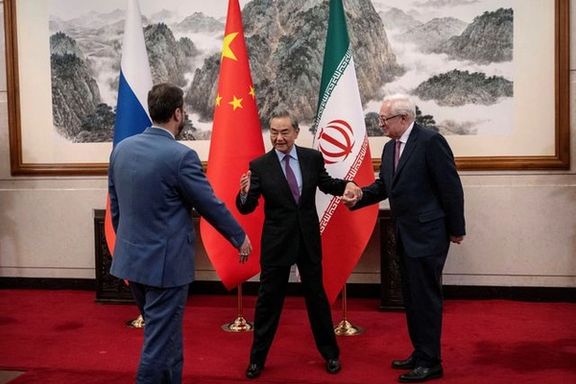
Chinese Foreign Minister Wag Yi welcomes Russian and Iranian deputy foreign ministers Sergey Ryabkov and Kazeem Gharibabadi on March 14, 2025 in Beijing, China.
A top Iranian diplomat said on Friday that the Islamic Republic had agreed with China and Russia that any future talks over Iran's nuclear program must not stray into other issues.
The remarks appear to set a high bar for any new negotiations with United States, which has expressed deep misgivings with Iran's support of armed allies in the Middle East, missile program and domestic dissent.
China and Russia did not immediately confirm the alleged consensus.
"Any future talks must be nuclear talks only," Iran's deputy foreign minister Kazem Gharibabadi said in Beijing, where he was attending a trilateral meeting with Russian and Chinese counterparts.
"We made our position clear and China and Russia take the same position and have always maintained that non-nuclear issues won’t be part of the nuclear talks," he added. "This is the position of all three countries."
The three countries in an earlier joint statement emphasized the need to address the root causes of the nuclear standoff. They condemned unilateral sanctions as illegal and underscored Iran's right to the peaceful use of nuclear energy.
China's foreign ministry on Friday made no mention of the understanding on the scope of talks to which Gharibabadi referred.
"The situation of the Iranian nuclear issue is grim and has once again reached a critical crossroads," it said in a statement.
"China is willing to work with all parties to promote a fair, balanced and sustainable solution to the Iranian nuclear issue, safeguard the international nuclear non-proliferation mechanism, and promote international and regional peace and stability."
US President Donald Trump revealed on Friday that he had sent a letter to Iran's Supreme Leader Ali Khamenei offering negotiations but has warned of military action if talks failed, saying last week the standoff with Tehran was in its "final moments".
Iran's veteran theocrat rejected those overtures again this week, citing Trump's pullout from a 2015 international nuclear deal which involved Russia and China.
In his first term, Trump's administration had cited the deal's alleged leniency on Iran's military activities but the president has more recently repeatedly cited the nuclear program as the sole point of disagreement.
"I really want to see peace ... (but) they cannot have a nuclear weapon", Trump said last month. "It's very simple. I'm not putting restrictions. They cannot have one thing."
Trump, who has taken a hard line on Iran but broadly opposes foreign wars, made the remarks while reimposing harsh sanctions on the country, which were described in official documents as aiming to undermine Iran's broader military activities.
The United States is undermining its diplomatic overtures to Iran by making threats, a senior Iranian cleric said on Friday, a week after US President Donald Trump's demanded Iran strike a nuclear deal or face military attack.
The remarks represent another strong official rejection by the theocracy of Trump's bid for a renewed nuclear deal.
"Today, you can clearly and explicitly see threats coming from US leaders. In practice, they issue threats, while in words and writing, they call for negotiations, two completely contradictory behaviors," Tehran's Friday Prayer Imam Mohammad-Hassan Abutorabi-Fard told worshippers during his weekly sermon.
Citing Iran's perceived resilience despite punishing military blows on Iran and its allies, Abutorabi-Fard said armed affiliates of Iran in the region remained strong.
"Today, Iraq, Palestine, Yemen, Lebanon, and the Hezbollah-led resistance axis stand as symbols of dignity in the face of infidels. This great achievement is the result of the Islamic Revolution, which has brought major victories for the Muslim community."
Khamenei has not publicly responded to the letter but has repeatedly voiced skepticism over US intentions, arguing that past experience shows Washington cannot be trusted. In his speech this week, he said Washington's calls for negotiations are a tactic to deceive global public opinion.
"The US President saying 'we are ready to negotiate with Iran' and calling for negotiations is meant to deceive global public opinion," Khamenei said. He also questioned the value of engaging with the US, recalling Trump's 2018 withdrawal from the 2015 nuclear deal.
"We sat down and negotiated for several years, and this very person took the completed, finalized, and signed agreement off the table and tore it up," Khamenei added.
Despite rejecting threats, Iran has left the door open for indirect diplomacy. Foreign Minister Abbas Araghchi on Thursday hinted at the possibility of engaging through Oman, though officials have maintained that Tehran will not negotiate under pressure.
"We reject talks under threats. Iran's dignity does not allow for submission," Araghchi said in an earlier statement.
US-Iran tensions have been steadily escalating. Trump signaled last week that the standoff has reached a crescendo, saying, "There are two ways Iran can be handled: militarily or through a deal. I would prefer to make a deal."
Khamenei said Iran would retaliate if attacked. "The United States is threatening militarization. This threat is irrational because war is not a one-sided blow; Iran is capable of retaliating and will certainly do so," he said.
As the standoff mounts, the UN's nuclear watchdog recently reported a sharp increase in Iran's stockpile of highly enriched uranium, though Tehran denies any intention of developing nuclear weapons. "If the Islamic Republic intended to build nuclear weapons, the United States would not be able to stop it," Khamenei added.
Foreign ministers from the G7 grouping of wealthy democracies criticized Iran for destabilizing the Middle East and urged it to resume negotiations over its nuclear program, according to a draft statement cited by Reuters.
The top diplomats were gathered in La Malbaie, Canada, to discuss a common strategy as the return of President Donald Trump has upended the relationship of de facto G7 leader the United States with its peers.
Their statement cited by Reuters said Iran was a principal driver of instability in the Middle East and urged Tehran to resolve the standoff over its disputed nuclear program through diplomacy.
The G7 nations include the United States, Britain, France, Canada, Germany, Italy and Japan. The final draft of the foreign ministers' statement awaits formal approval ahead of expected publication later on Friday.
Iran denies seeking a nuclear weapon, but the UN's nuclear watchdog last week pointed to a sharp rise in Tehran's stockpile of highly enriched uranium.
The United States and European Union said Iran's activities serve no credible civilian purpose and demanded it immediately desist.
Iran’s Supreme Leader on Wednesday said President Trump's past withdrawal from a nuclear deal renders diplomacy with him pointless now and vowed harsh retaliation to any attack by the United States or its allies.
China and Russia have reaffirmed their support for Iran amid US pressure over Tehran's nuclear program, urging a return to dialogue based on mutual respect and calling for the lifting of all sanctions against Iran.
Following trilateral talks in Beijing on Friday, senior diplomats from China, Russia, and Iran issued a joint statement emphasizing the need to address the root causes of the nuclear standoff. They condemned "unlawful" unilateral sanctions and underscored that Iran's right to the peaceful use of nuclear energy must be fully respected.
The meeting was not held at the highest diplomatic level but was led by deputy foreign ministers. Russia's Sergei Ryabkov, Iran's Kazem Gharibabadi, and China's Ma Zhaoxu attended the talks at the Diaoyutai State Guest House on Friday.
"(China, Russia, and Iran) emphasized that the relevant parties should be committed to addressing the root cause of the current situation and abandoning sanctions, pressure, or threats of force," said China's Vice Foreign Minister Ma Zhaoxu.
Iran says Russia and China back limiting talks to nuclear issue
Iran, Russia, and China have agreed that future negotiations will focus solely on Iran's nuclear program and the lifting of sanctions, with no other issues on the table, Iran’s Deputy Foreign Minister for Legal and International Affairs, Kazem Gharibabadi, announced after the trilateral meeting in Beijing.
"Any negotiations and discussions will be exclusively centered on the nuclear issue and the removal of sanctions," Gharibabadi said during a press conference following the meeting.
A major point of contention in the broader negotiation process has been whether discussions should expand to include Iran's missile program and its regional activities—issues that Washington insists must be addressed in any future agreement. However, Tehran and Moscow have firmly rejected this approach.
"Negotiations should not include Iran’s missile program or its regional influence," Russia’s envoy to the Vienna talks, Mikhail Ulyanov, said last week in an interview with BBC Persian. "Adding these topics would complicate the process and make it unmanageable."
Russian Foreign Minister Sergei Lavrov also criticized Washington's stance, warning that efforts to attach additional conditions to the agreement would fail. "This is not going to fly," Lavrov said, emphasizing Moscow's position that negotiations must remain limited to the original nuclear framework.
Trump says talks or risk of military action
The meeting comes as tensions rise between Tehran and Washington. The US has recently pushed for Iran to resume nuclear talks, but Iran has resisted, citing ongoing sanctions and perceived threats.
Last week, US President Donald Trump reiterated his stance on how to deal with Iran, saying, "There are two ways Iran can be handled: militarily, or you make a deal." In response, Iranian President Masoud Pezeshkian firmly rejected any dialogue under pressure, saying Iran "would not bow to US orders to talk."
Iran's Foreign Minister Abbas Araghchi, however, indicated Tehran's openness to indirect negotiations via Oman. "Indirect negotiation is feasible... What is important is that the will to negotiate and reach a fair and just agreement comes up in equal conditions," Araghchi said in an interview. Oman has historically served as a diplomatic channel between Tehran and Washington.
However, Araghchi emphasized that "entering negotiations under maximum pressure will lead to negotiations from a position of weakness."
Meanwhile, concerns over Iran's nuclear activities have grown. The International Atomic Energy Agency (IAEA) recently warned that Tehran has dramatically accelerated uranium enrichment, approaching weapons-grade levels. Iran has denied seeking nuclear weapons but acknowledged increased enrichment as a response to US pressure.
A closed-door UN Security Council meeting on Wednesday, requested by six members including the US, Britain, and France, discussed Iran's compliance with nuclear regulations. Tehran criticized the meeting as a "misuse" of the Security Council.
China and Russia, both key stakeholders in the 2015 Joint Comprehensive Plan of Action (JCPOA), have reiterated their commitment to restoring the deal, which Trump withdrew from in 2018. Russian Foreign Minister Sergei Lavrov criticized Washington's efforts to attach additional conditions to a future agreement, warning that it "is not going to fly."
China's Foreign Ministry spokeswoman Mao Ning emphasized restraint. "In the current situation, we believe that all parties should maintain calm and restraint to avoid escalating the Iran nuclear situation or walking towards confrontation and conflict," she said on Thursday.
As diplomatic tensions escalate, Beijing has called for enhanced cooperation to "increase mutual trust and dispel misgivings," while Russia has positioned itself as a potential mediator.
Foreign Minister Abbas Araghchi’s suggestion on Thursday about pursuing indirect talks with the United States may signal a sudden shift in Supreme Leader Ali Khamenei’s previously uncompromising stance on negotiations.
This apparent change came shortly after Tehran acknowledged receiving a letter from President Donald Trump, which reportedly outlined the terms of a possible agreement on Iran’s nuclear program and, potentially, other issues, including Tehran’s regional proxies.
As these developments gain momentum, many seem to have overlooked Iran’s scheduled participation in trilateral negotiations with Russia and China in Beijing on Friday. Meanwhile, Russia’s offer to mediate between Tehran and Washington remains on the table, with neither side having rejected it thus far.
Araghchi’s suggestion that indirect negotiations would be a “natural solution” for reaching a deal with Washington may also indicate that Iran is aiming to buy time. The strategy could be to push past the October deadline for the reactivation of the UN trigger mechanism, which would reinstate all previous international sanctions against Iran. Additionally, Iran may be looking ahead to the 2028 US election, hoping to outlast the Trump administration, with which it remains reluctant to engage in direct talks.
Araghchi’s suggestion of Oman as a possible mediator may lead observers to overlook why Qatar, the UAE, and possibly Russia have been sidelined as potential mediators—and why Tehran is now proposing indirect talks in Muscat.
Qatar’s leaders may already be preoccupied with issues related to Gaza, Syria, and Afghanistan, leaving little capacity to take on another complex diplomatic challenge. At the same time, Iran’s handling of Qatar’s recent mediation efforts suggests a degree of distrust. When the Qatari emir delivered a message to Tehran earlier this month, Khamenei largely dismissed it, instead questioning why Qatar has not released Iran’s oil revenues from South Korea frozen in Doha under a US arrangement.
Meanwhile, Iran is unlikely to trust the UAE as a diplomatic intermediary, given its close alliance with Saudi Arabia and the ongoing territorial dispute over three islands in the Persian Gulf.
Furthermore, many politicians in Tehran, including Heshmatollah Falahatpisheh, the former head of the parliament's Foreign Policy and National Security Committee, as well as several centrist and conservative newspapers such as Jomhouri Eslami, have repeatedly questioned Moscow's goodwill as a mediator. They argue that Russia is primarily focused on its own interests rather than genuinely helping Iran navigate a major foreign policy and economic crisis.
Notably, Nour News, a media outlet close to Iran’s Supreme Council of National Security, revealed that Russia refused to deliver Trump's message to Tehran, reportedly objecting to its content. Instead, Moscow passed the task on to the UAE.
At the same time, Iranian officials see indirect negotiations as an effective way to buy time and wait for a more favorable international climate. With the Iranian delegation in one room and US representatives in another, and Omani mediators shuttling messages between them, the process could stretch on for months, if not years. Meanwhile, shifting developments and ad-hoc decisions in Tehran and Washington could continuously delay and extend the talks.
Iranian media have made it clear over the past week that China and Russia have little interest in finalizing a deal between Tehran and Washington. Meanwhile, the low level of officials participating in the upcoming talks further diminishes any hope for a breakthrough.
Instead of sending a senior negotiator like career diplomat Majid Takht-Ravanchi, Iran is dispatching Deputy Foreign Minister Kazem Gharibabadi to Beijing—a lower-profile figure with less influence to advance the discussions.
Whether Iran can navigate multiple diplomatic channels to buy time remains uncertain. Its ability to do so depends on whether it can manage the country’s worsening economic crisis, stave off a major socio-political upheaval, and counter the growing pressure from European countries, some of which have signaled their intent to activate the UN trigger mechanism—all while the clock continues to run out.
Iran’s foreign minister on Thursday signaled Tehran's willingness to engage in indirect negotiations with the United States through Oman, just a day after the Supreme Leader publicly ruled out talks.
During an interview with the Iran newspaper, Araghchi, when asked about using indirect channels like those in Muscat, said, "Yes, it is not a strange method, and it has happened repeatedly throughout history."
"Therefore, indirect negotiation is feasible... What is important is that the will to negotiate and reach a fair and just agreement comes up in equal conditions, and the form of it does not matter."
His remarks coincides with a trip by Anwar Gargash, diplomatic advisor to the UAE president, who delivered a letter from US President Donald Trump to Iranian authorities on Wednesday.
However, Supreme Leader Ali Khamenei, in a public address on the same day, dismissed the possibility of talks, saying that Trump's offer was aimed at deceiving public opinion.
"The US president's claim that 'we are ready to negotiate with Iran' is a deception aimed at misleading global public opinion," Khamenei said in a speech to student supporters, who, as usual, repeatedly chanted "Death to America!"
Talks of Muscat mediating between Tehran and Washington follows earlier reports of Omani Foreign Minister Badr Albusaidi's visit to Tehran in December, during which he was said to have carried a message from the Sultan of Oman to President Masoud Pezeshkian.
At the time, Araghchi deniedthat any message from Washington had been relayed. Oman has historically served as a diplomatic channel between Tehran and Washington.
Araghchi added that multiple countries are now involved, with close consultations taking place with Russia and China. "Negotiations are ongoing indirectly, and the channel with the three European countries remains open," he said.
Araghchi stressed that while the United States must ultimately lift sanctions, Iran will only engage in direct negotiations free from pressure and threats, and with assurances that national interests will be protected.
"If we enter negotiations in a situation where the other side is imposing maximum pressure, we will enter negotiations from a position of weakness and will not achieve any results," Araghchi explained.
Trump reinstated his "maximum pressure" campaign in February, aiming to reduce Iran’s oil exports to zero—reviving Washington’s hardline approach from his first term.
In 2018, during his first term, Trump pulled out of the 2015 nuclear deal known as the Joint Comprehensive Plan of Actions or JCPOA, and imposed 'maximum pressure' sanctions on Tehran, reducing Iran’s oil exports to less than 300,000 barrels per day and implementing international banking sanctions.
Araghchi added, "This is not a matter of stubbornness or idealism, it is a matter of expertise. The other side must be shown that the pressure policy is not effective, so that we can sit at the negotiating table on equal terms."
New idea
Araghchi also said a new idea has been proposed to resolve outstanding nuclear issues between Iran and UN's nuclear watchdog, adding that the two sides are currently examining the proposal to resolve remaining disputes.
"We are cooperating with [IAEA chief Rafael] Grossi and the IAEA, and a new idea has been put forward to resolve the issues, which we are currently reviewing," he said, without elaborating.
Earlier this month, Grossi said Iran has significantly increased its supply of near-weapons-grade uranium in just three months, highlighting Tehran's unique position as the only non-nuclear weapon state enriching to such levels.
"Iran’s stockpile of uranium enriched up to 60% U‑235 has increased to 275 kg, up from 182 kg in the past quarter," Grossi said in his statement to the agency’s Board of Governors on Monday.
Since 2021, when Iran began enriching uranium at higher levels, it has also significantly restricted the UN watchdog's ability to monitor its nuclear activities, including banning one third of the inspectors since 2023.
On Wednesday, the UN Security Council convened amidst escalating pressure on Iran regarding its nuclear program.
The United States urged the Councilto take decisive action, accusing Iran of flagrantly defying resolutions and violating IAEA safeguards. The call came as Britain signaled its willingness to trigger the so-called snapback of UN sanctions if Iran fails to curb its uranium enrichment activities.
The meeting, requested by six Security Council members—France, Greece, Panama, South Korea, Britain, and the US—focused on Iran's persistent non-compliance with IAEA requests for information.
The urgency of the situation was underscored by the approaching October 18th deadline, after which Britain, France, and Germany will lose their ability to unilaterally initiate the reinstatement of international sanctions.
These nations have already informed the Council of their readiness to utilize the snapback mechanism to prevent Iran from developing nuclear weapons.