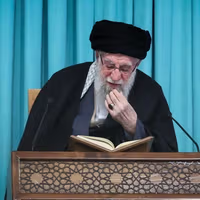
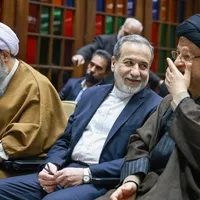
Iran's supreme leader Ali Khamenei in an even with officials and delegates of Muslim countries
In a new twist to Iran’s nuclear saga, the official government newspaper - Iran - said on Monday that Supreme Leader Ali Khamenei’s alleged fatwa against atomic weapons does not necessarily ban their production – only their deployment and use.
“The issue of nuclear weapons generally involves three components: production, stockpiling, and use or deployment,” the newspaper wrote—drawing a distinction that is rarely considered meaningful in academic or military discussions on nuclear strategy. The article went on to assert, “In the modern era, the possession of nuclear weapons—rather than their use—is inherently deterrent in nature.”
It appears that the government’s official newspaper is suggesting that producing and stockpiling atomic bombs is not a big issue as long as Iran says it has a fatwa prohibiting their use.
Iranian diplomats and officials often refer to a statement made by Khamenei in 2010 against weapons of mass destruction, calling their use “haram” or forbidden in Islam. They insist that this constitutes a fatwa, a religious ruling by a senior Shi’ite cleric that has the power of law.
However, Khamenei’s statement was submitted to a disarmament conference, and delivered in the tone of a political address, rather than as a formal religious ruling. It was neither published on Khamenei’s official website as a fatwa nor reiterated by him in subsequent speeches. Even if interpreted as a binding religious edict, a fatwa can be superseded by a new ruling, especially under the principle of expediency—a concept frequently invoked in Shi’ite jurisprudence to adapt religious rulings to changing political and strategic circumstances.
The newspaper argues that the Supreme Leader’s fatwa does not prohibit the production or stockpiling of nuclear weapons, which it claims serve purely as a deterrent, but only bans their use. “If we consider the two reasons cited above for the prohibition of nuclear weapons,” the article states, “it becomes clear that they apply to their use—not their production or storage. The primary objective of developing such weapons is, fundamentally, deterrence.”
The two reasons referenced by Iran daily include a historical account from early Islam prohibiting the poisoning of water, and broad religious teachings said to be emphasizing the preservation of human life, civilians, and the environment.
This also suggests that the Islamic Republic’s stance on nuclear weapons is shaped more by interpretations of early Islamic teachings and the principles of Shi’ite clerical jurisprudence than by universal norms aimed at preventing mass destruction and civilian casualties.
Iran warned regional states hosting US military forces that they could face retaliation if involved in a potential American attack, a senior Iranian official told Reuters.
The official, who spoke on condition of anonymity, added that Supreme Leader Ali Khamenei had placed Iran's armed forces on high alert.
Although US President Donald Trump has demanded direct negotiations, the official said Iran is open to a diplomatic path through intermediaries.
“Indirect talks offer a chance to evaluate Washington's seriousness about a political solution with Iran,” the official said. Talks via Oman could start soon if signals from the US align, though the official warned the path may be rocky.
Iran has issued formal warnings to Iraq, Kuwait, the UAE, Qatar, Bahrain and Turkey that allowing the US to use their airspace or territory during any attack would be treated as an act of hostility. Any such action “will have severe consequences for them,” the official said.
On Wednesday, Iranian state media reported that Kuwait had reassured Iran it would not permit aggression from its soil. Other governments approached by Reuters either declined to comment or did not respond. Turkey’s Foreign Ministry said it was unaware of any warning but suggested such messages could be delivered through alternative channels.
Meanwhile, Iran’s top military commander, Mohammad Bagheri, revealed the details of the Supreme Leader’s response to a letter sent by Trump on March 7.
“Negotiation directly is not acceptable, but indirect negotiation is not a problem,” Khamenei said in the message, according to Bagheri, the Chief of Staff of Iran's Armed Forces.
“You were the most disloyal and untrustworthy party in past negotiations, and thus there is no trust in you. However, we are not closing the door. If you act sincerely, negotiations can happen.”
According to Bagheri, Khamenei also told Trump that Iran is not pursuing a nuclear weapon. “We will respond with all our strength to any threats, but we are not warlike and will not start a war.”
Trump has warned Iran would be bombed if it did not agree to a new nuclear deal, prompting Khamenei to say on Monday that the Islamic Republic would deal a "strong blow" in retaliation for any attack.
Iran has also threatened to target American interests in the region, including its strategic Diego Garcia naval base in the Indian Ocean if it is attacked by the US.
The threats to neighbouring countries have escalated over recent months. In October, in the wake of Iran's attack on Israel which led to a retaliatory Israeli strike, The Wall Street Journal reported at the time that countries given warnings included Jordan, the United Arab Emirates, Saudi Arabia and Qatar, all of which host US forces.
It has since led to a complicating of regional dynamics. "US defense officials acknowledged that some regional partners have told the Pentagon that they don’t want Israeli warplanes flying over their territories or US troops launching offensive operations from inside or over their airspace," the WSJ reported.
"The Arab countries have said the US forces are allowed to conduct self-defense operations, the officials said," it added.
Iran's ultra-hardliners and vigilantes associated with them are increasingly warning that the Islamic Republic risks alienating its staunchest supporters if authorities continue suspending strict hijab enforcement.
In a viral video circulating on social media last week, ultra-hardliner lawmaker Mohammad-Mannan Raisi blasted the Supreme National Security Council (SNSC) for its mid-September decision to halt the implementation of the proposed Hijab and Chastity Law.
The proposed law had been slammed globally for its draconian measures, the UN branding it "gender apartheid".
“The new hijab law marks an intensification of state control over women’s bodies in Iran and is a further assault on women’s rights and freedoms,” the UN said at the time.
Raisi argued that the clerical rule’s “solid core” supporters have endured severe economic hardship out of loyalty to the Islamic Republic, expecting it to uphold the Sharia law. However, by showing indifference to religious beliefs and values, he claimed, authorities are behaving like a secular government and eroding trust among their most devoted base.
“The solid core of the system will be disillusioned if you suspend God’s commandments and fail to implement them based on unjustified expediency,” Raisi warned, suggesting these loyalists could lose their motivation to defend those in power whom they hold responsible for enforcing the Sharia.
The decision of the Supreme National Security Council (SNSC) not to enforce the controversial law could not have been made without the approval of Supreme Leader Ali Khamenei, who has avoided discussing the issue in his speeches for months despite his firm stance in April 2023, declaring that disregarding hijab was “religiously and politically haram (forbidden).”
Authorities appear to be treading carefully, as enforcing the controversial law—punishing violators, including businesses, with hefty fines and prison sentences—could spark fresh anti-government protests.
Defiance of hijab rules has significantly grown among Iranian women since the violently suppressed 2022-2023 protests that followed the death of the 22-year-old Mahsa Amini in the custody of morality police.
The young woman was arrested for not wearing her hijab properly, leading to a tidal wave of opposition to the decades-long law.
Many women now refuse to wear the compulsory head covering, long tunics, and trousers as dictated by the country's Shariah law. They are also now often seen singing and dancing in public in defiance of the religious establishment.
The crackdowns, which led to more than 500 deaths of protesters at the hands of security forces during the initial uprising, and thousands more arrests, have seen Iran levied with global sanctions, which come in addition to sanctions for its nuclear program and support of Russia's invasion of Ukraine.
Sanctions have seen Iran land in its worst economic crisis since the founding of the Islamic Republic, at least one-third of the country now living below the poverty line, and Iran increasingly isolated on the world stage.
Raisi, who led hardliner Saeed Jalili’s campaign in Qom during June’s snap presidential election, is closely aligned with the ultra-conservative Paydari (Steadfastness) Party and its allies, including Jebhe-ye Sobh-e Iran (Iran Morning Front).
His remarks came just days after an unprecedented police crackdown on pro-hijab vigilantes who had camped outside the Iranian parliament for over 45 days. While no arrests were reported, religious vigilante groups claim police used excessive force—an unexpected turn for those who have long operated with impunity and, at times, direct security force backing.
Hossein Allahkaram, a spokesman for the pro-hijab protesters, condemned the police response and vowed that demonstrations would resume after the Iranian New Year holidays.
Vigilante groups have historically played a key role in suppressing opposition movements and even participated in high-profile attacks like the storming of the British embassy in 2011 and the Saudi embassy in 2016—both of which triggered diplomatic crises.
Raisi’s warning has ignited intense debate on social media, with critics, particularly supporters of Parliament Speaker Mohammad-Bagher Ghalibaf, accusing him of issuing veiled threats against the authorities.
So far, most expressions of frustration from vigilante groups are directed at top officials. However, there are also some highly veiled complaints over Khamenei's silence, or approval, of the relative leniency shown in the hijab matter on domestic social media platforms such as Eitaa, a popular forum among ultra-hardliners and their associates.
Their waning influence has not gone unnoticed by those opposing their interference in national governance.
Former IRGC commander turned reformist figure, Ghorbanali Salavatian, wrote in an X post, “They constantly call themselves the ‘solid core’ of the system, as if the country would collapse without them and as if they alone have protected it".
Iran’s Foreign Minister Abbas Araghchi said on Saturday that the removal of US sanctions could serve as a confidence-building measure to pave the way for negotiations with Washington.
Speaking to foreign diplomats in Tehran, Araghchi’s remarks marked a re-emphasis on a position Iranian officials have frequently taken since the US withdrawal from the 2015 nuclear deal (JCPOA) in 2018. It is unclear whether his comments signaled a policy shift or were intended to test the international response ahead of any potential talks.
Following the US exit from the JCPOA under President Donald Trump, senior Iranian officials, including then-Foreign Minister Mohammad Javad Zarif and Supreme Leader Ali Khamenei, maintained that Tehran would not enter into new negotiations unless sanctions were lifted or the US returned to the deal. That stance remained largely consistent throughout the Trump administration’s “maximum pressure” campaign.
Now, with Trump back in office and reportedly considering a tougher approach—including military threats—Iran’s renewed insistence on lifting sanctions before any negotiations may be seen either as a negotiating tactic or as a reaffirmation of a long-standing position.
It is not yet known whether this demand was included in the official letter Tehran sent to President Trump recently. Public discourse has increasingly focused on the format of possible talks, with Iranian officials emphasizing their preference for indirect negotiations over face-to-face meetings. Analysts suggest this preference could be driven by both domestic political considerations—such as preserving the government's image after years of hostile rhetoric toward Trump—and strategic calculations, including buying time in the hope that future developments may shift the diplomatic landscape.
Insisting on sanctions relief as a precondition could also function as a means of slowing down the diplomatic process, allowing Tehran to manage expectations and retain leverage. While such a stance could be seen as obstructive, it may also be calculated to prompt a measured response from Washington. Notably, the Biden administration, which preceded Trump’s return, took a more restrained approach to sanctions enforcement even before formal nuclear talks resumed in April 2021.
Iranian oil exports to China began to rise prior to the 2020 US election and have remained high into 2024. This trend may factor into Tehran’s thinking, with the possibility that pressing the issue of sanctions could influence US decision-making or encourage a pause in new restrictions as a way to facilitate dialogue.
As messaging between Tehran and Washington rapidly evolves, Iranian politicians and media continue to send mixed—and at times irrelevant—signals, while the US stance remains relatively consistent under President Donald Trump, who holds the final say.
His latest remarks on negotiations with Tehran—telling reporters to forget about past letters exchanged with Iran’s Khamenei and suggesting that Iran now seems to favor direct talks—may hint at behind-the-scenes communication between the two sides and possibly some early progress.
An indication of that progress came with the news of President Masoud Pezeshkian telling Saudi Arabia’s Crown Prince Mohammed Bin Salman in a telephone conversation on Friday that "Tehran is prepared to reduce the tensions," and reiterated that "all of Iran’s nuclear activities can be subject to verification."
Meanwhile, the Entekhab website in Tehran quoted “diplomatic sources in Iran” as saying that if the indirect talks in Oman proceed positively, they could be followed by direct negotiations.
Despite a shift in tone from some quarters, harsh rhetoric toward the United States has continued in Iran. Deputy IRGC Commander for Political Affairs Yadollah Javani warned that any attack on Iran’s nuclear facilities—as previously threatened by US officials—would push the country’s nuclear program into a “new phase,” implying potential weaponization. “In that case,” he said, “the West will need to redefine its understanding of Iran and the axis of resistance,” according to Etemad Online.
Javani added that US and Israeli threats would not succeed in destroying Iran’s nuclear knowledge or capabilities and reiterated that nuclear weapons have no place in Iran’s defense doctrine.
His remarks appeared to contrast with those of Supreme Leader Ali Khamenei’s senior adviser, Ali Larijani, who recently said that a military strike could prompt Iran to build nuclear weapons. However, a report on the Rouydad24 website downplayed that aspect of Larijani’s interview with state TV, emphasizing instead his suggestion that there is an opportunity for improved US-Iran trade relations.
The report appeared to frame Larijani’s comments as a pacifist message intended to encourage US investment in Iran. It also quoted Larijani as calling Donald Trump “a very talented man in the area of economy.”
Some Iranians on social media welcomed President Trump’s announcement of a 10% tariff on imports from Iran, framing it as a symbolic gesture of support for the opposition—even though Iran’s exports to the United States are negligible.
In a notably aggressive comment, ultraconservative commentator Mohammad Marandi warned on X that if Iran’s nuclear facilities were attacked, “Iran can destroy Qatar.” His remarks stood in sharp contrast to other hardliners, such as cleric and Majles presidium member Alireza Salimi, who dismissed recent US threats as mere “bluffs,” according to Etemad.
Meanwhile, Chief of Staff of Iran’s Armed Forces, General Mohammad Bagheri, struck a more conciliatory tone. In a video message recorded at the historic ruins of Persepolis, he said Iran seeks friendly relations with all its neighbors—an apparent attempt to reassure the public and ease regional tensions. He was wearing civilian cloths instead of IRGC uniform.
A report in the pro-reform Etemad newspaper said that Iranian lawmakers have drafted two bills related to the country’s nuclear program, with at least one focused on “expanding the peaceful use of nuclear technology.”
Meanwhile, Reformist commentator Abbas Abdi said in an interview with a Tehran-based website that despite President Trump’s threats last week, the United States has not yet made a final decision to launch a military strike against Iran. He added that Iran continues to advance its drone and missile capabilities, now capable of reaching any target in the region.
Another Reformist commentator, Ahmad Zeidabadi, urged figures like Ali Larijani to refrain from discussing the militarization of Iran’s nuclear program, warning that such remarks play into what he described as “a trap set by Israel” to depict Iran as an aggressor.
Under the shadow of US President Donald Trump’s threats to bomb Iran and after over a year of punishing blows at the hands of Israel, a bruised Islamic Republic remains defiant and seeks a comeback.
“Iran is not giving up,” Dr. Eric Mandel, founder of the Middle East Political Information Network (MEPIN) told Eye for Iran. “Iran's proxies—they may be down—Hezbollah, Hamas, the Houthis—but they’re not stopping.”
As the US positions aircraft in the Indian Ocean capable of striking Iran’s nuclear facilities, some Iranian officials have warned it will be forced to develop a nuclear weapon.
Iran has stepped up its production of fissile material in recent years, and the UN nuclear watchdog says it could accumulate enough enriched uranium for a nuclear weapon in less than a week.
Ali Larijani, a senior adviser to Supreme Leader Ayatollah Ali Khamenei, delivered this message on Monday. “If the US or Israel bomb Iran under the nuclear pretext, Iran will be compelled to move toward producing an atomic bomb,” he said.
Mandel, who regularly briefs members of Congress and national security officials, argued that supporting the Iranian people must become a central pillar of US foreign policy.
“America needs to start saying, we are pro-Iranian, pro-Iranian people, and that it becomes American policy that we want, without boots on the ground, regime change.”
In Congress, the bipartisan bill the Maximum Support Act aims at bolstering dissidents within Iran.
Developed with input from the Foundation for Defense of Democracies (FDD) and the National Union for Democracy in Iran (NUFDI), the draft legislation envisions funding opposition groups in Iran.
“I'm ashamed as an American who talks about American national security interests that we were not in 2022 standing strong with the protests,” said Mandel.
In that year the nationwide protest movement dubbed Woman, Life, Freedom was sparked by the death in morality police custody of Mahsa Jina Amini, a young woman.
'Window of opportunity'
“There is a closing window of opportunity to strike Iran, which is particularly vulnerable because of the successful Israeli attacks against their defensive anti-missile array," Mandel said, who also advocates a US strike on vital Iranian economic infrastructure.
"There is also a decreasing window of opportunity for negotiations even if the Iranians believe there is a credible military threat."
A potential ceasefire between Russia and Ukraine could allow Moscow to deliver advanced weapons systems to Iran. That includes the S-400 air defense system—an upgrade from the S-300 system Israel disabled in an Oct. 26 strike in response to Iran’s October 2 missile barrage on Israel.
Putting the Iranian S-300s out of action opens the door to Israeli or American strikes, possibly on a larger scale. But Iran could rebuild with Russian help.
“Those missile defenses will not be down for much longer,” said Mandel, “not only for S-400s and even more evolved system, but for the SU-35 jets that the Russians have promised. And again, the Russians owe the Iranians because they've been very helpful to them during their Ukraine war.”
Moscow has publicly tried to dissuade Trump from bombing Iran’s nuclear facilities, warning of “catastrophic consequences.”