Attack will push Iran toward nuclear weapons, Khamenei advisor says
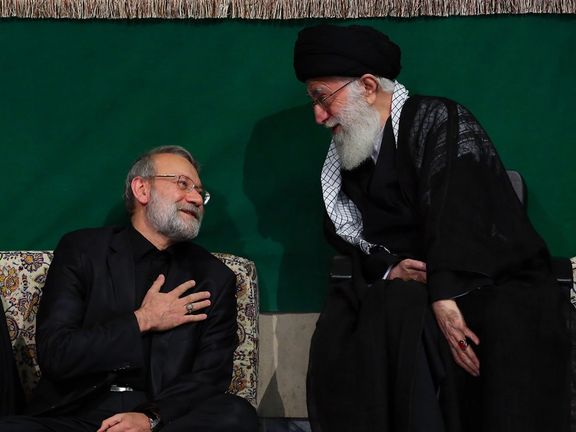
Ali Larijani sitting next to supreme leader Ali Khamenei in a religious ritual, October 10, 2016
An attack threatened by US president Donald Trump would push Iran toward acquiring nuclear weapons to ensure its defense, a veteran nuclear negotiator and advisor to the Supreme Leader said on Monday.
The remarks by Ali Larijani to the state news broadcaster were among the clearest yet by a senior political figure indicating Tehran could pursue a bomb if threatened.
"If you make a mistake on the nuclear issue, you will force Iran to move toward nuclear weapons because it must defend itself," Larijani told IRIB.
"Iran does not want to take this path, but when you apply pressure, it finds a secondary justification and has no other choice. The people will push for it, arguing that it is necessary for the country’s security."
Larijani has served as speaker of the parliament, national security chief, nuclear negotiator and head of the state broadcaster. His views broadly represent those of Iran's hardline establishment and Iran's ultimate decision-maker, Ali Khamenei.
The US director of national intelligence Tulsi Gabbard said last week that Washington assessed Iran is not building nuclear weapons but that a taboo in Iran on discussing nuclear weapons in public was eroding.
Recent discourse in Tehran urging the acquisition a bomb, Gabbard added, is emboldening advocates for such a move in decision-making circles.
"Israel alone is not capable of confronting Iran and has always acted as a tool of the United States in the region," Larijani continued. "This regime seeks to draw Washington into direct conflict with Iran by exaggerating the situation."
Tensions have ramped up between Iran and the United States in recent days, with US President Trump threatening to bomb the country if it fails to reach a nuclear deal.
Iran has rejected direct negotiations amid US threats and a senior military commander warned on Monday that Iran could retaliate against US bases in the region in the event of an attack.
Tehran denies seeking nuclear weapons and Khamenei has issued a religious injunction against them, but the United Nations nuclear watchdog says Iran has enriched more uranium than any state lacking a bomb.
The US military has deployed long range bombers at a strategic Indian Ocean airbase, a spokesperson told Iran International last week, a move which presaged major bombing campaigns against Afghanistan in 2001 and Iraq in 2003.
Iran summoned the Swiss envoy in Tehran on Monday to deliver a formal warning following US President Donald Trump’s threat of bombing Iran if a nuclear deal is not reached, according to state media.
The Swiss diplomat was told that Iran would respond decisively to any such threats, according to IRGC-affiliated Tasnim News website.
The report referred to the envoy in Iran as the "caretaker of the embassy," implying the absence or unavailability of the Swiss ambassador.
Switzerland represents US interests in Iran since Washington and Tehran cut ties shortly after the 1979 Islamic Revolution. The Swiss embassy in Tehran has been consistently relaying diplomatic communications between the Islamic Republic and the United States.
Earlier in the day, Iran's foreign ministry spokesman condemned Trump's threat of bombing Iran if the country failed to reach a new nuclear deal with Washington, calling it a "shocking affront" to the core principles of international peace and security.
Iran's Supreme Leader Ali Khamenei also warned that the United States would face a strong blow if it follows through on Trump’s threat to bomb the country.
Khamenei's warning, delivered in a televised speech marking the end of Ramadan, came a day after Trump told NBC News that if a deal was not reached, "there will be bombing — and it will be bombing the likes of which they have never seen before."
Iran International has put a request for comment to the Swiss foreign ministry.
US President Donald Trump on Sunday warned of bombing Iran if Tehran fails to reach a deal over its nuclear program.
"If they don't make a deal, there will be bombing — and it will be bombing the likes of which they have never seen before," Trump was quoted as saying during a phone interview with NBC News' Kristen Welker.
"The response by the Supreme Leader to Trump's letter was delivered to the US contact in Oman...In that response, direct negotiations have been rejected, but regarding indirect talks, Iran has always been involved in such talks, and the Supreme Leader has emphasized that indirect talks can still continue," Pezeshkian said.
Also on Sunday, government spokeswoman Fatemeh Mohajerani said that "Iran's response to the sent letter was prepared and delivered," as Iran's foreign ministry stressed the confidentiality of the exchanged letters.
Trump on Friday also warned that “bad, bad things” would happen if Tehran did not agree to a nuclear deal.
While Iran denies seeking a nuclear weapon the UN's nuclear watchdog says it has enriched more uranium than any state lacking a bomb.
Last month, Trump signed a directive restoring the so-called maximum pressure policy on Iran of his first term and warned of "catastrophic" consequences if Tehran does not make a deal on its nuclear program.
Trump's maximum pressure approach in his first term beginning in 2018 pummeled Iran's economy, causing a dramatic decline in oil exports and skyrocketing inflation.
Earlier this week, Khamenei's senior adviser Ali Larijani, as well as prominent economists in Tehran said that Iran needs to address its problems with the United States urgently in a bid to lift or reduce US sanctions and give the ailing economy a chance to grow after many years of crises and stagnation.
While Iran’s Foreign Minister Abbas Araghchi has repeatedly emphasized that Tehran is committed to holding indirect talks with Washington, a prominent politician in Tehran argues that President Donald Trump is unlikely to accept such negotiations.
Araghchi, widely seen as representing Supreme Leader Ali Khamenei’s position, has stated in multiple interviews and statements that Iran’s current strategy is to engage with the US through intermediaries.
However, Heshmatollah Falahatpisheh, former head of the Iranian parliament’s Foreign Relations and National Security Committee, told the conservative Nameh News website: “Trump will not accept negotiations through intermediaries.”
He also criticized President Massoud Pezeshkian for “lacking a clear foreign policy strategy,” arguing that while Trump appears to have a plan for every possible scenario, Iran’s president has yet to outline a vision for Tehran’s future relations with Washington.
Since Pezeshkian is widely known to have limited authority over foreign policy, the criticism may have been aimed at Khamenei, though the politician would not have dared to address him directly.
“Currently, Trump's plan is to force Iran to the negotiating table through maximum pressure,” Falahatpisheh said, adding that “diplomacy will have a chance if Trump moderates his stance.” He also made it clear that Trump seeks direct talks with Iran.
Falahatpisheh further noted that apart from some Persian Gulf states, most international players are focused on their own interests rather than easing tensions between Iran and the US. He pointed to the recent trilateral meeting between Iran, China, and Russia in Beijing, saying that both China and Russia were primarily advancing their own agendas rather than working to resolve Iran’s standoff with Washington.
Earlier this week, Khamenei's senior adviser Ali Larijani, as well as prominent economists in Tehran said that Iran needs to address its problems with the United States urgently in a bid to lift or reduce US sanctions and give the ailing economy a chance to grow after many years of crises and stagnation.
Iranian economist Mehdi Pazouki, an academic in Tehran told the press that Iran's economy is hostage to the country's failing foreign policy and Iran's inability to have amicable relations with the world.
Ali Ghanbari, another Iranian economist, told Iranian media that the country’s economy is under strain due to its foreign policy, which is not controlled by the Pezeshkian administration. Without explicitly stating that Khamenei, rather than Pezeshkian, oversees Iran’s foreign policy—particularly Tehran’s relations with Washington—Ghanbari described it as “a structural problem beyond the control of Pezeshkian’s government.”
Given this reality, Falahatpisheh outlined two possible scenarios for the future of Iran-US dynamics: “Either a war breaks out between Iran and Israel, with the United States carrying out precision strikes on targets in Iran—an escalation that would not stop there but spread across the region—or there will be no war, but additional countries will join the United States in its maximum pressure campaign against Iran.”
He noted that even China and Russia will cautiously support the United States in this case if Washington guarantees their interests.
Falahatpisheh noted that “Iran has not identified its opportunities in this situation or considered the consequences of what might unfold.” He blamed Pezeshkian’s passivity and inaction for the current state of affairs, suggesting that the president should begin the new year with concrete operational plans. Meanwhile, Pezeshkian’s stated approach has been to push forward Khamenei’s impractical vision of domestic investment as a path to economic recovery—without explaining how it would be implemented.
As inaction continues and unrealistic economic projections persist, the exchange rate for the US dollar in Tehran’s markets has surpassed one million rials. According to former Central Bank governor Mohammad Hossein Adeli, every Iranian household is effectively paying 180 million rials ($180) per month as a hidden cost of US sanctions. He warned that with each Iranian losing money to the sanctions’ impact on non-oil trade, the situation could become a serious security issue for the country before 2029.
Iran’s formal response to US President Donald Trump’s recent letter reaffirms longstanding positions: no negotiations on its ballistic missile program or regional allies, and no nuclear talks beyond the framework of the 2015 nuclear deal, The New Arab reported Saturday.
According to the Qatari outlet quoting anonymous sources in Iran, Tehran responded “line by line” to Trump’s message, mirroring its tone and structure. The reply rejected demands viewed as unreasonable and emphasized that any talks on the nuclear file must be based on the Joint Comprehensive Plan of Action (JCPOA) and mutual respect.
Issues addressed by Tehran
The Iranian reply addressed four main areas: the nuclear program, missile and defense capabilities, Iran's ties with regional militant groups, and US threats of more sanctions and military action.
On defense matters, the response rejected any discussion of Iran’s ballistic missile arsenal, which Tehran considers non-negotiable. It also reaffirmed that its military capabilities are essential to national defense and not subject to external bargaining.
In the nuclear section, Iranian officials reiterated that they are open to talks, but only within the original terms of the 2015 JCPOA. They rejected any attempt to expand the scope of negotiations or impose new restrictions on the program, which Iran continues to describe as peaceful.
The letter also addressed regional issues, pushing back on US efforts to curb Iran’s backing of militant groups. “These relationships are based on bilateral agreements,” the sources said. “The allies are independent and do not take orders from us. Any agreement reached with these parties would be welcomed by Iran.”
This position had already been outlined publicly by Iran’s ambassador to Iraq, Mohammad Kazem Al-Sadegh, who said Thursday that Tehran’s support for what it calls the “axis of resistance” in Lebanon, Iraq, and Yemen is non-negotiable. Iran has rejected US conditions seeking to limit its regional influence and missile program. “We only negotiate the nuclear file,” Al-Sadegh said, adding that such talks would only take place if Iran’s full rights were respected. “We do not negotiate our missiles. We do not negotiate our regional alliances.”
The final section of the reply responded to what Iranian officials described as threats included in Trump’s letter. In its reply, Tehran linked any future direct talks to a change in Washington’s tone. The letter said that dialogue would require “dealing with Tehran on the basis of respect, without threats or maximum pressure,” according to The New Arab.
Iran’s decision to send the reply through Oman, rather than the United Arab Emirates—which had delivered Trump’s original letter—was a deliberate one, The New Arab reported. Iranian sources said the move reflected Tehran’s trust in Oman’s longstanding role as a neutral mediator and a rejection of what it saw as an attempt to bypass established channels.
Iran reiterates policy positions in official comments
Iranian officials have since confirmed the delivery and broad content of the response. Foreign Minister Abbas Araghchi said Thursday that the reply had been conveyed “appropriately” through Muscat. He reiterated that Iran remains unwilling to engage in direct talks under what he described as maximum pressure and military threats. “Our policy remains not to negotiate directly with the United States under pressure,” Araghchi said on state television. “Indirect talks can continue, as they did in previous administrations.”
Senior Iranian figures also addressed the letter publicly during Friday’s Quds Day rallies. Parliament Speaker Mohammad Bagher Ghalibaf accused the United States of using nuclear diplomacy to push for Iran’s disarmament. “When the US says negotiation, it means disarmament,” he said. “No wise nation accepts talks under threat.”
Ali Shamkhani, former head of Iran’s Supreme National Security Council, described the response as “restrained” and confirmed it was prepared by multiple institutions. He said indirect negotiations remained possible, but only if conducted on equal terms. “If negotiations are based on parity, we are prepared to proceed,” he said.
Trump’s letter included a two-month deadline for reaching a new nuclear agreement, Axios reported.
The United States reimposed its maximum pressure campaign against Iran in February, seeking to reduce the country’s oil exports to zero and force a broader deal. Alongside calls for limits on Iran’s nuclear and missile programs, Washington has also demanded that Tehran scale back its support for armed groups in the region.
Speaking earlier this month, Trump said Iran would have to return to talks or face consequences. “They’re going to have to speak to us one way or another,” the US president told Fox Business. “We can’t let this happen.”
US president Donald Trump warned Iran on Friday that “bad, bad things” would happen if Tehran did not agree to a nuclear deal, a day after Iran declined to have direct talks under his stepped-up sanctions.
“My big preference ... is we work it out with Iran. But if we don't work it out, bad, bad things are going to happen to Iran,” Trump told reporters in the Oval Office.
This is what Trump said he conveyed in his letter to Iran's supreme leader Ali Khamenei last week.
Tehran confirmed on Wednesday that a response to the letter had been sent via Oman.
"Our policy remains not to engage in direct negotiations under maximum pressure and military threats. However, indirect negotiations as existed in the past can continue," foreign minister Abbas Araghchi said.
Iran denies seeking a nuclear weapon but the UN's nuclear watchdog says it has enriched more uranium than any state lacking a bomb. While Washington assesses Tehran is not actively building one, it doubts Iranian intentions.
Trump last month reinstated the "maximum pressure" campaign of sanctions on Iran from his first term, with the stated aim of driving its oil sales to zero.
Trump's remarks come as Iran’s parliament speaker on Friday accused the US of using nuclear talks to pressure Tehran into relinquishing its defense capabilities.
“The US means disarmament when it says negotiation,” Mohammad Bagher Ghalibaf said in a speech during Quds Day rallies in Tehran on Friday. “Our people understand that talks under threat are just a show to impose their will. No wise nation would accept that.”
His comments were echoed by other senior Iranian officials speaking at Quds Day events showcasing Tehran's solidarity with Palestinians, including Foreign Minister Abbas Araghchi and senior adviser to Iran's Supreme Leader Ali Larijani.