Responding to Trump letter, Iran says open to mediation
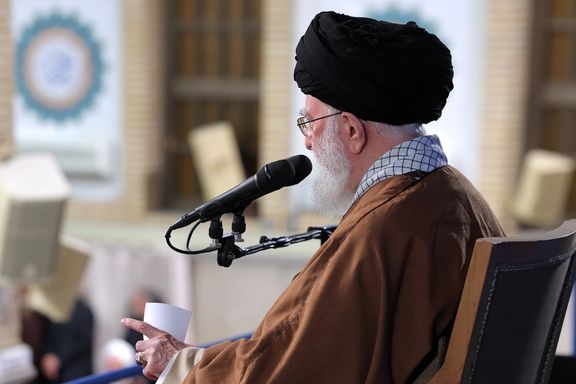
Iran's Supreme Leader Ali Khamenei speaking to supporters, Tehran, Iran, March 22, 2025
Iran officially responded to a letter from US President Donald Trump to Iran's Supreme Leader Ali Khamenei on Wednesday seeking a nuclear deal, saying his stepped-up sanctions made direct talks impossible but expressing openness to third-party mediation.
Tehran conveyed the response via Oman on Wednesday, Iran’s official IRNA news website quoted Foreign Minister Abbas Araghchi as saying.
"Our policy remains not to engage in direct negotiations under maximum pressure and military threats. However, indirect negotiations as existed in the past can continue," Araghchi said.
"Indirect negotiations had taken place both under the administration of Mr. Rouhani and Martyr Raisi," he said referring to Iran's previous two presidents.
The remarks largely repeat his previous public statements on engagement with Washington.
Iran denies seeking a nuclear weapon but the UN's nuclear watchdog says it has enriched more uranium than any state lacking a bomb. While Washington assesses Tehran is not actively building one, it doubts Iranian intentions.
Trump last month reinstated the "maximum pressure" campaign of sanctions on Iran from his first term, with the stated aim of driving its oil sales to zero.
Signing the initiative, Trump said: "It's very simple. I'm not putting restrictions. They cannot have one thing. They cannot have a nuclear weapon."
A senior Emirati official personally conveyed the letter to Tehran urging a nuclear deal which Khamenei - without specifically referencing the missive - rejected, calling the overture a deception while Washington's sanction policy hurts Iran.
Trump withdrew from a 2015 international nuclear agreement with Iran in his first term after bashing it as too lenient. Khamenei said talks were pointless if a new deal could easily be broken.
The previous deal, inked under President Barack Obama, was mediated in part by Oman.
Trump's letter gave Iran a two-month deadline for reaching a new nuclear deal, Axios has reported citing one US official and two sources briefed on the letter.
"You've got a lot of stuff going on with Iran, and we sent a letter to Iran," Trump said this week. "You're going to have to be speaking to us one way or the other pretty soon, because we can't let this happen."
Russian President Vladimir Putin has formally submitted the comprehensive strategic partnership treaty with Iran to the State Duma for ratification, a significant step in the deepening ties between Moscow and Tehran.
The treaty was signed in January, during Iranian President Masoud Pezeshkian’s visit to Moscow, and aims to institutionalize long-term cooperation between the two nations.
Iranian Ambassador to Moscow Kazem Jalali said that the agreement consists of 47 articles covering a broad spectrum of collaboration, including "advanced technologies, cybersecurity, peaceful nuclear energy, military-defense cooperation, counterterrorism, and anti-money laundering measures".
He said the latest treaty now moves beyond the scope of a previous 20-year strategic pact signed in 2001 which was automatically extended for five years in 2021.
The leaders of both countries agreed that the existing agreement was outdated and insufficient to cover the current breadth of their evolving relationship, Jalali said.
While the specifics have not been publicly disclosed by either Tehran or Moscow, mirroring the secrecy surrounding Iran's 25-year agreement with China, Russia has indicated that the 2001 pact involved collaboration in industry and technology, security projects, energy, and the construction of nuclear power plants.
Russian state-run TASS news agency reported that the pact includes a security clause saying that "in the event of an attack on one party, the other party will under no circumstances support the aggressor."
Moscow and Tehran have leveled up their military cooperation in recent years, particularly in Syria, where both have backed former President Bashar al-Assad.
Additionally, Russia has deployed Iranian-made drones and missiles in Ukraine, despite Tehran’s official denials.
One of the key components of the agreement is energy cooperation, Putin announcing that Russia is moving forward with plans to export natural gas to Iran, with projections reaching 55 billion cubic meters per year.
However, he acknowledged delays in Russia’s nuclear infrastructure projects in Iran, saying, "We have a major project in the nuclear power industry. One unit is already operational, and we are discussing the possibility of building additional units."
The strengthening of ties between Russia and Iran has accelerated in recent years, driven by mutual isolation stemming from Western sanctions – imposed on Russia for its invasion of Ukraine and on Iran for its nuclear program, support for regional armed groups, and human rights abuses – as well as a shared strategic interest in countering US influence in the region.
Both countries are also seeking ways to circumvent the sanctions, with recent discussions exploring the expansion of trade using national currencies and alternative financial mechanisms.
Analysts suggest that the timing of the ratification process may also be influenced by the return of Donald Trump to the White House.
According to a presidential decree released Wednesday, Deputy Foreign Minister Andrey Rudenko will serve as Putin’s official representative when presenting the treaty for consideration in the Russian Federal Assembly.
Iran has not closed the door to dialogue with the US, a senior advisor to Supreme Leader Ali Khamenei said on Thursday, though said the pressure being placed on Tehran amounts to what he called psychological warfare.
Kamal Kharrazi, who heads Iran’s Strategic Council on Foreign Relations and previously served as foreign minister, said: “Recent US behavior is psychological warfare—alternating between threats and offers of negotiation,” he said, referring to what he described as conflicting remarks from American officials and media coverage of a message sent by US President Donald Trump to Supreme Leader Ali Khamenei, earlier this month.
According to a report by Axios, the message from the US was described as “tough,” with a two-month deadline to reach a new nuclear deal and a warning of consequences if Iran expanded its nuclear program.
But Trump’s Middle East envoy, Steve Witkoff, offered a more conciliatory version, saying the letter proposed peaceful dialogue and trust-building.
“They've reached back out,” Witkoff said in an interview last week, referring to indirect Iranian responses via multiple channels. “Trump believes this has a real possibility of being solved diplomatically.”
Kharrazi said such gestures appear designed to pressure Iran into accepting unfavorable terms. “This is not real negotiation—it is an attempt to impose one side’s will through coercion,” he said, adding that Iran’s experience with past agreements has made it wary of US commitments.
His remarks come after Iran’s foreign minister said direct talks with the US are currently impossible without major policy shifts. Iranian officials have acknowledged ongoing indirect communication through intermediaries, including Oman and European nations.
Last year, Kharrazi said Iran had the technical capability to build nuclear weapons but was restrained by a religious decree banning them. He warned that an existential threat could prompt a change in military doctrine.
Iran branded comments by European Union foreign policy chief Kaja Kallas as reckless after she described the Islamic Republic as a serious threat during a visit to Israel earlier this week, the foreign ministry said on Wednesday.
“Unlike her predecessors, who tried to reflect EU positions with at least some regard for international legal principles, Ms. Kallas speaks recklessly,” Baghaei said. “Even if her words stem from inexperience, they still harm Europe’s image in the eyes of any neutral observer.”
Kallas, speaking at a press conference in Jerusalem alongside Israeli Foreign Minister Gideon Sa’ar on Monday, said Iran posed a grave danger to both the region and the world.
“On Iran, we agree the immense threat Iran poses to the region and global stability. Iran is a threat also supporting Russia's war in Ukraine,” she said. “Iran must never be allowed to acquire or build a nuclear weapon. And EU supports all diplomatic efforts to that effect.”
Sa’ar called for European support against Iran and its regional allies, including Hamas, Hezbollah and the Houthis. “We are now fighting the war of the free world,” he said. “The war is against Western civilization—against its values and its ways of life.”
Earlier this month, Kallas called for a renewed international nuclear agreement with Iran, similar to the 2015 Joint Comprehensive Plan of Action (JCPOA), just days after former US President Donald Trump raised the possibility of military action to dismantle the deal.
Speaking at a United Nations Security Council session on EU-UN cooperation, Kallas said: “The constant expansion of Iran’s nuclear programme fully contradicts Iran’s own commitments as endorsed by the Security Council.”
The back-and-forth between Iranian and US leaders over Tehran’s nuclear program and the prospect of negotiations has changed little since at least 2016.
That was when US author and scholar Ray Takeyh published his book Hidden Iran: Paradox and Power in the Islamic Republic. According to Takeyh, since 1979, “getting Iran wrong is the single thread that has linked American administrations of all political persuasions.”
On January 31, 2006, “President George W. Bush described Iran as a nation held hostage by a small clerical elite that is isolating and repressing its people,” and warned that, “The nations of the world must not permit the Iranian regime to gain nuclear weapons.” That sounds all too familiar, doesn’t it?
According to Iran’s official news agency, as quoted by Takeyh, President Mahmoud Ahmadinejad responded swiftly and defiantly, denouncing Bush as someone "whose arms are smeared up to the elbow in the blood of other nations," and threatening: "God willing, we shall drag you to trial in the near future at the courts set up by nations."
That was 19 years ago, when Khamenei was still a relatively restrained Supreme Leader, delegating much of the incendiary rhetoric to his firebrand president. In 2025, he presides over a timid president who adds little to the official line — a line that is always dictated by Khamenei himself. In fact, Iran's rhetoric toward the current US President is notably more restrained.
Yet, as many observers have noted over the past 46 years, Iran and the United States have a tendency to address each other at the wrong times and in the wrong ways. Bush’s labeling of Iran as part of the "axis of evil" was just one moment that derailed budding cooperation in Iraq and Afghanistan and sent both sides back into confrontation — a dynamic that persists to this day.
In last week’s exchange between Washington and Tehran over Iran’s nuclear program, Trump delivered bold and harsh remarks on live television — remarks that Khamenei denounced as "bullying." But Trump also sent more conciliatory messages, according to his Middle East envoy, Steve Witkoff, in a private letter to the Supreme Leader.
Given Khamenei’s well-known sensitivities, he might have better tolerated the harsh language in a private message and possibly even welcomed the friendlier overtures had they been made in public.
Similarly, Tehran’s responses over the past week — starting with a flat rejection of negotiations, moving to an openness to "indirect talks," and concluding with a vague “for the time being” — send a clear signal to US diplomats: Iranian officials are not interested in a public handshake with their American counterparts. Especially not after Khamenei has already set the tone with stern, uncompromising statements.
By contrast, Trump appears to want exactly that public moment — a warm handshake in front of cameras — to distinguish himself from his predecessors. This mismatch in the style and optics of diplomacy makes it difficult for either side to envision a path out of the current impasse.
As with traditional bargaining in Persian bazaars, Iranian negotiators prefer drawn-out talks, complete with repeated withdrawals from and returns to a draft agreement — all to eventually close the deal at the very moment when observers begin to believe it's off the table for good.
What’s different today is that some of those observers — both in the region and beyond — may not want a deal at all, at least not one that allows any form of nuclear capability to survive. For countries like Israel and Saudi Arabia, a weak agreement that merely delays the threat is less acceptable than no deal at all. They would rather see Iran’s nuclear ambitions completely capped than postponed.
Iran is not building nuclear weapons but recent discourse in Tehran urging the acquisition a bomb is emboldening advocates for such a move in decision-making circles, US director of national intelligence Tulsi Gabbard said on Tuesday.
"The intelligence community continues to assess that Iran is not building a nuclear weapon and Supreme Leader Khamenei has not authorized the nuclear weapons program that he suspended in 2003," Gabbard told a congressional hearing.
"The IC continues to monitor closely if Tehran decides to reauthorize its nuclear weapons program," she added. "In the past year, we've seen an erosion of a decades long taboo in Iran on discussing nuclear weapons in public, likely emboldening nuclear weapons advocates within Iran's decision-making apparatus."
A top foreign policy advisor to Khamenei and former foreign minister said last year that Iran is capable of producing nuclear weapons and an existential threat could cause a rethink of the Supreme Leader's religious injunction against them.
Kamal Kharrazi's remarks were among the clearest by a senior official mooting the possibility of a nuclear deterrent after over a year of direct and proxy combat with US-allied Israel dealt the Islamic Republic some of its biggest ever military setbacks.
Tehran denies seeking nuclear weapons but US President Donald Trump has demanded the Islamic Republic come to a new deal over its disputed nuclear program or face a military intervention.
"Iran will likely continue efforts to counter Israel and press for US military withdrawal from the region by aiding arming and helping to reconstitute its loose consortium of like minded terrorists and militant actors, which it refers to as its Axis of Resistance," Gabbard continued.
"Although weakened, this collection of actors still presents a wide range of threats," she added, citing Israel, US military personnel in the Middle East and commercial shipping as potential targets.
Gabbard's appearance alongside other senior US intelligence leaders comes amid dismay in Washington about the inclusion of a prominent journalist in a chat including including some of the officials discussing sensitive military plans.
The inclusion of The Atlantic editor Jeffrey Goldberg in the discussion over commercial messaging app Signal about forthcoming US attacks on Iran-backed Houthi fighters in Yemen has stoked criticism over their handling of intelligence.
Asked how stepped-up sanctions under Trump might affect Iran's behavior, Gabbard said the president's "maximum pressure" campaign had yet to be fully felt.
"These sanctions have just begun to be reinstated, so the full effects are not yet, have not yet borne fruit," she said. "But the message that the President has sent with his maximum pressure campaign is certainly heard."