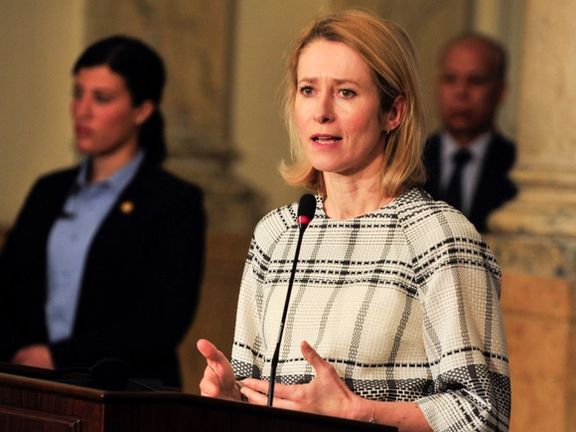
EU says Iran threatens global order, supports talks to stop nuclear armament
European Union foreign policy chief Kaja Kallas warned on Monday that Iran poses a serious threat to global stability and must never be allowed to obtain a nuclear weapon, during a press conference in Jerusalem with Israeli Foreign Minister Gideon Sa’ar.
"On Iran, we agree the immense threat Iran poses to the region and global stability. Iran is a threat also supporting Russia's war in Ukraine," Kallas said.
"Iran must never be allowed to acquire or build a nuclear weapon. And EU supports all diplomatic efforts to that effect," she added.
Sa’ar said it was “only natural” for Israel to expect European backing in the ongoing conflict the country is fighting against Iran's allies, and framed the war as part of a broader global struggle.
“We are now fighting the war of the free world,” he said. “Iran, Houthis, Hamas, and Hezbollah attack us because we are nearby", he said after last week saw three of Iran's allies once again firing on the Jewish state as ceasefires collapsed.
"But make no mistake, the war is against Western civilization—against its values and its ways of life," he added.
Earlier this month, the European Union's top diplomat called for an international nuclear deal with Iran along the lines of the 2015 JCPOA agreement, days after US President Donald Trump mooted military action to dismantle it.
High Representative Kaja Kallas told a United Nations Security Council session on EU-UN cooperation: "The constant expansion of Iran’s nuclear programme fully contradicts Iran’s own commitments as endorsed by the Security Council."
Steve Witkoff’s suggestion that he or another member of President Donald Trump’s team could potentially visit Iran for talks has received widespread coverage in Iranian online media.
At the end of an interview with Tucker Carlson on Friday, President Trump’s special envoy to the Middle East expressed hope that he or someone else from the administration might visit Tehran, as Carlson had suggested. Witkoff acknowledged the complexity of the Iran issue due to its nuclear dimension and the need for technical expertise. “I’m going to welcome that opportunity if I’m involved,” he stated.
So far, there has been no official Iranian reaction to Witkoff’s remarks. However, Nour News, a media outlet close to Iran's Supreme National Security Council, said in a tweet in English on Sunday that Witkoff’s tone “won’t clear up misunderstandings as no behavioral changes have occurred,” referring to US policies toward the Islamic Republic. Nour News added that the US is still pursuing talks while exerting pressure on Tehran. “If Washington wants a new nuclear verification process, it must first present real evidence of Iran's intent to obtain nukes!”
The lack of more commentary in online publications may be due to limited resources during the Nowruz holidays. Some public figures, however, have also commented on the interview via social media, where high engagement suggests significant public interest.
Throughout the lengthy interview, Witkoff reiterated that President Trump was open to negotiating a resolution with Iran, allowing the country to reintegrate into the global economy without the burden of sanctions. He emphasized Trump’s preference for diplomacy over military action and suggested that a verification program could be established to ensure Iran’s nuclear program remains peaceful.
Speaking on Fox News on Sunday, Witkoff reinforced the administration’s message to Iran, urging diplomatic engagement to resolve ongoing tensions. “And if we can't, the alternative is not a great alternative,” he warned, stressing that the U.S. would not allow Iran to develop nuclear weapons.
Diverging perspectives within the Trump administration
Witkoff’s remarks—particularly his focus on controlling Iran’s nuclear program through verification—contrast with statements from President Trump and other senior officials, who have called for the complete dismantling of Tehran’s nuclear program. White House National Security Advisor Michael Waltz reiterated on Sunday that the Trump administration seeks the full dismantlement of Iran’s nuclear program in a transparent manner that satisfies the international community.
Reactions from Iranian figures
“Dear friends in the Foreign Ministry, Witkoff has expressed interest in visiting Iran!” wrote Nosratolah Tajik, a relatively moderate politician and former diplomat, in a brief post on X on Saturday. He suggested that Tehran should invite Witkoff before formally responding to President Trump’s letter to Supreme Leader Ali Khamenei—both as a gesture of diplomatic goodwill and a display of political savvy, while also helping to deflect public criticism.
“It’s not just me saying this—former senior diplomats from the Foreign Ministry also advise against rejecting Witkoff’s expression of interest in visiting Iran,” wrote senior reformist journalist Mohammad Sahafi, referencing Tajik’s post.
An expatriate dissident, Akbar Ganji, echoed this sentiment, advocating for direct talks between Iran and the US, starting with a meeting between Iranian officials and Witkoff and eventually progressing to a summit between the Iranian and US presidents to finalize an agreement.
Former Reformist diplomat and political editor Abdolreza Raisi also backed the idea of hosting Witkoff in Iran. “How can we refuse to host him now that he’s expressed interest in visiting, especially to verify such claims and put the ball in their court?” he wrote in a post on X.
Skepticism from US analysts
Jason Brodsky, Policy Director at United Against Nuclear Iran (UANI), suggested in a post on X that certain Iranian officials and regime sympathizers may be attempting to exploit perceived divisions within the Trump administration. According to Brodsky, these figures are bypassing Secretary of State Marco Rubio and National Security Advisor Mike Waltz while engaging with officials they believe are more receptive to negotiations.
The Trump administration is seeking full dismantlement of Iranian nuclear program in a way that the entire world can see, White House National Security Advisor Michael Waltz told CBS News on Sunday.
“It is time for Iran to walk away completely from its desire to have a nuclear weapon. And they will not, and cannot be allowed to have a nuclear weapons program, that’s enrichment, weaponization, and its strategic missile program,” Waltz said.
“The President has all options on the table. But we want to be clear, this isn't some kind of, you know, kind of tit for tat that we had under the Obama administration, or Biden. This is the full program. Give it up, or there will be consequences,” he added.
His comments came in contrast to the much more conciliatory tone of Trump’s Middle East envoy, Steve Witkoff, who spoke of the US president's intention to resolve Iran's nuclear dispute diplomatically.
Earlier this month, Trump wrote a letter to Iran’s Supreme Leader Ali Khamenei in an attempt to explore a new nuclear agreement and prevent military escalation, Witkoff told Fox News on Sunday.
"We don't need to solve everything militarily," Witkoff said.
He emphasized that Iran cannot have a nuclear bomb, saying, “It cannot happen and it will not happen.”
"Our signal to Iran is let's sit down and see if we can, through dialogue, through diplomacy, get to the right place. If we can, we are prepared to do that. And if we can't, the alternative is not a great alternative."
On Friday, Witkoff told the Tucker Carlson show, “We should talk. We should clear up the misconceptions. We should create a verification program so that nobody worries about weaponization of your nuclear material."
He also said Trump believes the issue “has a real possibility of being solved diplomatically” and “acknowledged that he's open to an opportunity to clean it all up with Iran.”
His remarks raised questions about the Trump's administration's approach toward Iran, as Trump's Secretary of State, Marco Rubio, and National Security Advisor, Michael Waltz, have taken a much tougher stance, insisting over the past few weeks that Iran's nuclear program must be dismantled and that Iran will face military action unless it complies with US demands.
US President Donald Trump reached out to Iran’s Supreme Leader Ali Khamenei in an attempt to explore a new nuclear agreement and prevent military escalation, his special envoy said on Sunday.
"We don't need to solve everything militarily," Steve Witkoff told Fox News.
"Our signal to Iran is let's sit down and see if we can, through dialogue, through diplomacy, get to the right place. If we can, we are prepared to do that. And if we can't, the alternative is not a great alternative."
Witkoff emphasized that Iran cannot have a nuclear bomb, saying, “It cannot happen and it will not happen.”
On Friday, Witkoff said Iran used indirect channels to respond after the US president sent a letter to Supreme Leader Ali Khamenei earlier this month.
“I’m not at liberty to talk about the specifics,” Witkoff said in an interview released Friday on The Tucker Carlson Show, saying only it was through "back channels through multiple countries".
Last week, an Emirati official brought a letter from Trump proposing nuclear talks with Tehran, which Supreme Leader Ali Khamenei rejected, saying such a proposal was deception from Washington amid crippling sanctions on Iran.
Iran's foreign ministry said Tehran will respond privately to Trump's letter and will not make public its contents.
Witkoff's remarks come as a senior Iranian nuclear official on Sunday said that Iran will not yield to Western pressure regarding its nuclear program, warning that such pressure could have adverse effects on cooperation.
Behrouz Kamalvandi, spokesman for the Atomic Energy Organization of Iran (AEOI), emphasized Iran's determination to advance its nuclear industry and counter what he described as unjust accusations from Western powers.
In an interview on Sunday, Iran's Foreign Minister Abbas Araghchi said talks with the US are currently impossible unless significant changes occur as Washington awaits Tehran's response to its invitation for talks on a new nuclear deal.
President Donald Trump has made one point clear: he is determined to prevent Iran from becoming a nuclear weapons power. However, he has yet to outline the specific conditions or steps he would require from Tehran to achieve that objective.
Will he demand a complete halt to uranium enrichment, or permit Iran to purify uranium to a low level, such as 3.65%? The JCPOA, signed during the Obama administration, set that exact limit.
Enrichment and centrifuges
Tehran is now rapidly enriching uranium to 60%, having accumulated 274.8 kilograms (605.8 pounds) of uranium enriched up to 60% as of February 26. That’s an increase of 92.5 kilograms (203.9 pounds) since the IAEA’s last report in November. The current stockpile can easily be sufficient for further enrichment to produce six nuclear bombs.
Iran maintains that it has the right to enrich uranium as part of its civilian nuclear ambitions. While 3.65% enrichment is used for peaceful energy purposes, 60% has no credible civilian application and is just one step short of weapons-grade enrichment at 90%.
A closely related issue is the number and type of enrichment machines—Iran’s centrifuges. Under the JCPOA, Iran was limited to 6,104 first-generation centrifuges, with no use of advanced models. Today, it operates more than 8,000 centrifuges, including more advanced IR-6 machines, which were explicitly banned under the deal.
Key questions remain unanswered: How many centrifuges, if any, would the US allow Iran to keep? Would decommissioned machines be permitted to stay in the country under international monitoring? Would Washington demand that most, if not all, be dismantled? Could it ask Iran to transfer them to a third country, such as Russia?
These questions are central to understanding what Trump’s plan might be for denying Iran a path to nuclear weapons. So far, no clear answers have emerged.
Is Trump’s plan a total nuclear ban or verification?
If talks resume and the US agrees to let Iran retain some enrichment capacity, a new agreement may not look so different from the JCPOA that Trump abandoned in 2018, calling it a “bad deal.” The key distinction, however, could lie in permanence: a new deal might cap Iran’s enrichment capabilities indefinitely, unlike the JCPOA’s temporary restrictions under sunset clauses.
Still, there is at least a political difference between a permanent ban on all enrichment and formally recognizing Iran’s right to enrich—however limited that right may be.
There is also the issue of somewhat differing statements coming from the President and some of his top officials. According to Axios, Trump’s letter to Ali Khamenei included a two-month deadline for reaching a new nuclear agreement and warned of consequences if Iran expanded its nuclear program. The letter was described by sources as “tough” in tone.
However, Trump’s Middle East envoy, Steve Witkoff, framed the message differently in an interview released Friday on The Tucker Carlson Show. Referring to the letter, he said: “It roughly said, I'm a president of peace. That's what I want. There's no reason for us to do this militarily. We should talk. We should clear up the misconceptions. We should create a verification program so that nobody worries about weaponization of your nuclear material.”
This tone stands in stark contrast to statements by the Secretary of State and the National Security Advisor, who have called for the dismantling of Iran’s nuclear program—not just verification.
Multilateral or bilateral talks?
The Obama administration, building on the approach of the Bush era, dealt with Iran in coordination with European allies while also involving Russia and China in the JCPOA negotiations. This multilateral strategy gave international legitimacy to the pressure on Tehran and, for a time, resulted in UN-imposed economic sanctions—until the 2015 agreement was signed and sanctions were subsequently lifted.
However, this approach also gave Iran some room to maneuver, as China and Russia provided support during the JCPOA negotiations. The temporary nature of the agreement and its allowance for Iran to retain its uranium enrichment capability may have stemmed from the fact that the US was not only negotiating with Tehran but also balancing the interests of Beijing and Moscow.
The question now is whether the Trump administration will face pressure to once again include Russia and China in any future talks—or whether it will insist on negotiating directly with Tehran, without outside involvement.
Both Russia and China have signaled that any negotiations should focus solely on Iran’s nuclear program, excluding other US demands such as restrictions on ballistic missiles or curbing regional influence. Iran will almost certainly seek to involve both powers—especially Russia—believing that President Vladimir Putin may hold some sway with Trump.
Although bilateral talks may be preferable from the US perspective, the reality remains that if Washington seeks UN endorsement for any future agreement, it will need the backing of both Russia and China.
Another JCPOA?
Although the Trump administration has issued an ultimatum of “negotiations or else” to Tehran, it remains unclear whether it intends to impose strict demands for dismantling key elements of Iran’s nuclear program or enter into bargaining over critical issues such as the right to uranium enrichment, the level of enrichment, and the number and type of centrifuges.
In the latter case, and if Iran is able to salvage its right to enrichment, the resulting agreement will be somewhat similar to the 2015 JCPOA.
Iran will not yield to Western pressure regarding its nuclear program, a senior Iranian nuclear official said, warning that such pressure could have adverse effects on cooperation.
Behrouz Kamalvandi, spokesman for the Atomic Energy Organization of Iran (AEOI), emphasized Iran's determination to advance its nuclear industry and counter what he described as unjust accusations from Western powers.
"The Islamic Republic of Iran is firm and resolute in asserting its rights," Kamalvandi said in an interview with the AEOI's public diplomacy and information center on Sunday.
He criticized what he called negative propaganda against Iran's nuclear activities, asserting that Iran is subject to the most extensive inspections globally and maintains a transparent program.
He defended Iran's decision to suspend some JCPOA commitments, citing the US withdrawal from the deal in 2018 and the failure of other parties to uphold their obligations.
"Fifteen consecutive IAEA reports confirmed Iran's compliance with its commitments," Kamalvandi said. "We waited a year after the US withdrawal, but ultimately, we exercised our rights."
While Tehran has reduced IAEA inspections since 2021 and in 2023 barred a third of the inspectors, it continues to argue that its nuclear activities are peaceful.
IAEA Director General Rafael Grossi recently said the UN body was willing to assist Iran in proving it was not seeking nuclear weapons.
Kamalvandi warned Western nations that pressuring Iran would be counterproductive. "We hope that Western countries, who have tested Iran many times, have now realized that pressure on the Islamic Republic of Iran is ineffective and may even have the opposite effect," Kamalvandi noted.
"A nation with a history of thousands of years cannot be addressed with force," he added. "We have endured and overcome numerous pressures throughout history, and we will emerge victorious from the current ones."
Kamalvandi highlighted Iran's achievements in nuclear technology, including advancements in reactor and power plant construction, and strengthened relations with countries like China and Russia.
He also pointed to the successful hosting of an international nuclear science and technology conference in Isfahan, attended by International Atomic Energy Agency (IAEA) officials.
Iran's uranium stock refined to up to 60% grew by 92.5 kilograms (kg) in the past quarter to 274.8 kg, one of the IAEA reports said. According to an IAEA yardstick, the amount is enough in principle for six nuclear bombs if enriched further.