Trump warns of ‘bad, bad things’ for Iran if nuclear deal not reached
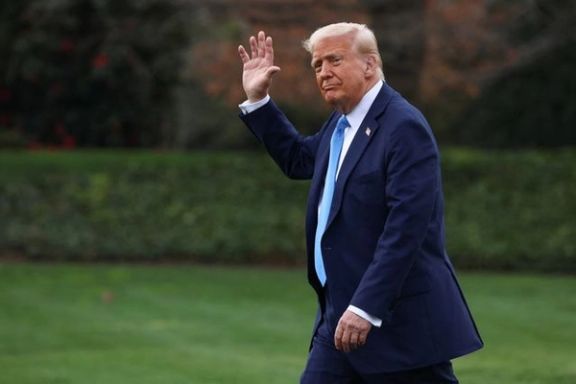
US President Donald Trump waves at reporters at the White House, March 28, 2025.
US president Donald Trump warned Iran on Friday that “bad, bad things” would happen if Tehran did not agree to a nuclear deal, a day after Iran declined to have direct talks under his stepped-up sanctions.
“My big preference ... is we work it out with Iran. But if we don't work it out, bad, bad things are going to happen to Iran,” Trump told reporters in the Oval Office.
This is what Trump said he conveyed in his letter to Iran's supreme leader Ali Khamenei last week.
Tehran confirmed on Wednesday that a response to the letter had been sent via Oman.
"Our policy remains not to engage in direct negotiations under maximum pressure and military threats. However, indirect negotiations as existed in the past can continue," foreign minister Abbas Araghchi said.
Iran denies seeking a nuclear weapon but the UN's nuclear watchdog says it has enriched more uranium than any state lacking a bomb. While Washington assesses Tehran is not actively building one, it doubts Iranian intentions.
Trump last month reinstated the "maximum pressure" campaign of sanctions on Iran from his first term, with the stated aim of driving its oil sales to zero.
Trump's remarks come as Iran’s parliament speaker on Friday accused the US of using nuclear talks to pressure Tehran into relinquishing its defense capabilities.
“The US means disarmament when it says negotiation,” Mohammad Bagher Ghalibaf said in a speech during Quds Day rallies in Tehran on Friday. “Our people understand that talks under threat are just a show to impose their will. No wise nation would accept that.”
His comments were echoed by other senior Iranian officials speaking at Quds Day events showcasing Tehran's solidarity with Palestinians, including Foreign Minister Abbas Araghchi and senior adviser to Iran's Supreme Leader Ali Larijani.
Canada’s main opposition leader Pierre Poilievre ruled out ever negotiating with Tehran, telling Iran International that the Islamic Republic cannot be trusted.
"I'm not interested in negotiating with the Islamic Republic," said Poilievre. "I don't trust them. I think they are liars."
The federal Conservative leader was on the campaign trail Thursday in Surrey, British Columbia addressing what he called “another attack by President Trump” on the Canadian economy.
His comments followed the US President’s announcement of additional tariffs on Canadian goods.
Poilievre is a frontrunner in the upcoming federal election to unseat current Prime Minister Mark Carney. The election is set to take place next month as a trade dispute sparked by Trump's tariffs has upended Canada's close alliance with the superpower to its south.
Despite similarities in their hardline stance against Iran, Poilievre and Trump appear to diverge significantly in their approaches.
Trump recently sent a letter to Iran’s Supreme Leader, Ayatollah Ali Khamenei, urging a nuclear deal. The outreach came after Washington imposed harsh new sanctions as part of the president's renewed “maximum pressure” campaign.
Trump’s letter reportedly laid out a deadline of two months to begin negotiations on the nuclear issue, with the warning that the alternative to a nuclear deal was a military attack. Iran responded by saying they are open to indirect talks but will not engage directly amid threats.
“I believe they (Iran) will promise anything you want them to get their oil and gas back on the world market,” Poilievre told Iran International. “Then they will use all the revenues from those sales to fund terrorism and attempt to obliterate our values.”
While Poilievre did not name Trump in his remarks, it was evident that he would not follow his US counterpart's Iran policy.
Poilievre dismissed the prospect of negotiating with Iran, arguing the theocracy would make promises to secure sanctions relief only to funnel the gains into funding terrorism.
“I think it's a terrible regime," said Poilievre. "It's the most dangerous sponsor of terror anywhere in the world."
The Conservative leader went on to accuse Iran’s government of exploiting Canada as a haven for their agents, threatening the lives of anyone they perceive as a critic. He vowed to deport any non-citizen or non-permanent resident with ties to the Islamic Republic.
In October 2024, Poilievre, in response to a reporter's question, said potential preemptive Israeli strikes on Iran's nuclear facilities would be a "gift to humanity."
A senior Iranian commander on Friday called on the country and its regional allies to prepare for what he described as a “major operation,” warning that the United States and Israel were at their weakest point in decades.
“Everyone must be ready for the big operation,” said Brigadier General Mohammad Reza Naqdi, deputy coordinator of Iran’s Islamic Revolutionary Guard Corps (IRGC), during a speech in Karaj. “The US and the Zionist regime are at their weakest point in history. We must bring the mission we started 46 years ago to a proud conclusion — and that moment is near.”
Naqdi’s comments follow a letter sent by US President Donald Trump to Iran’s Supreme Leader, giving Tehran two months to accept a new nuclear agreement or face the prospect of a military response. Foreign Minister Abbas Araghchi confirmed on Thursday that Iran had issued a formal reply and sent it through Oman.
Speaking again on Friday during Quds Day rallies, Araghchi said Washington's letter had been carefully reviewed. “Some parts of it were threatening,” he said. “We will not allow anyone to speak to the Iranian people in the language of threats.” He added that efforts had been made to keep a diplomatic window open.
Quds Day, marked across Iran on the last Friday of Ramadan, saw officials delivering a range of messages in response to growing US and Israeli pressure over Tehran’s nuclear and regional activities — with military commanders adopting a combative tone, while others struck a more measured stance.
Major General Abdolrahim Mousavi, commander of Iran’s army, described the day as “a global stand against oppression,” saying more people each year were opposing the actions of the United States and Israel. “The key message of Quds Day is that the end of the Zionist regime is near, and that the rights of the oppressed will be restored,” he said.
Iran has rejected Trump’s ultimatum and maintains that it will not negotiate under pressure. Meanwhile, regional tensions continue to rise. On Thursday, Israel said it intercepted two missiles launched from Yemen, where the Iran-aligned Houthi movement has claimed responsibility for multiple drone and missile attacks in support of Hamas.
The United States has responded with ongoing airstrikes on Houthi targets since mid-March and has warned it will hold Tehran accountable for any further attacks.
To reinforce its regional posture, the US military has deployed B-2 stealth bombers, C-17 cargo planes, and aerial refueling tankers to its base on Diego Garcia in the Indian Ocean — a move seen as preparing for sustained long-range operations.
Iran’s ambassador to Iraq, Mohammad Kazem Al-Sadegh, said this week that Iran’s regional allies remain active. “The resistance in Lebanon is still strong and capable. The resistance in Yemen is active,” he said. “The axis of resistance remains and is alive.”
Iran’s parliament speaker on Friday accused the US of using nuclear talks to pressure Tehran into relinquishing its defense capabilities, amid tensions over a recent letter from President Donald Trump demanding missile restrictions.
“The US means disarmament when it says negotiation,” Mohammad Bagher Ghalibaf said in a speech during Quds Day rallies in Tehran on Friday. “Our people understand that talks under threat are just a show to impose their will. No wise nation would accept that.”
His comments were echoed by other senior Iranian officials speaking at Quds Day events, including Foreign Minister Abbas Araghchi and senior adviser to Iran's Supreme Leader Ali Larijani.
“The letter was carefully examined and discussed in detail,” Araghchi said. “Parts of it contained threats. We will not allow anyone to speak to the Iranian people in the language of threats.” He added that while diplomacy remains possible, Iran would not negotiate under pressure. However, he noted that in its reply Iran "made an effort to keep a diplomatic window open.”
Larijani also weighed in, saying any agreement with Washington would require mutual acceptance of terms. “Both sides must agree,” he said. “Right now, they state their position, and we state ours.”
Responding to Trump’s recent threats of military action if Iran refuses to negotiate, Larijani added: “Someone who really intends to act doesn’t talk this much.”
Ali Shamkhani, former secretary of Iran’s Supreme National Security Council, also said on Friday that Iran had delivered a "restrained" response to Trump’s letter. He noted that the reply was prepared by multiple relevant institutions and emphasized that while Iran remains open to indirect negotiations, any talks must be conducted on equal terms. “If negotiations are conducted from a position of parity, we are prepared to take further steps,” Shamkhani said.
These remarks came a day after Iran said it has formally responded to a letter from US President Donald Trump to Supreme Leader Ali Khamenei, in which Trump reportedly set a two-month deadline for a new nuclear deal. The response, delivered via Oman, rejected direct talks under tightened sanctions but signaled openness to continued indirect negotiations.
“In the latest letter, there’s no serious discussion about lifting sanctions,” Ghalibaf said. “The US behavior in that letter reflects classic American bullying.”
Tensions between Tehran and Washington have escalated since Trump reinstated his so-called maximum pressure sanctions campaign in early February, aimed at cutting Iran’s oil exports to zero. Trump has demanded that Iran agree to a more comprehensive nuclear deal or face military consequences.
Trump also has mentioned restrictions on some of Iran's conventional weapons, such as ballistic missiles that threaten Israel and other regional countries. Washington has also warned that Tehran must stop its support for militant groups in the region.
Iran denies seeking nuclear weapons but has enriched uranium well beyond the limits set by the 2015 JCPOA nuclear deal, which Trump abandoned in his first term. The International Atomic Energy Agency says Tehran has accumulated more enriched uranium than any state without a declared weapons program.
Iran maintains that it will only negotiate over its nuclear program if its rights are respected. Its ambassador to Iraq, Mohammad Kazem Al-Sadegh, said on Thursday that Iran’s ballistic missile program and regional influence are not up for discussion.
“The resistance in Lebanon is still strong and capable. The resistance in Yemen is active,” Al-Sadegh said. “The axis of resistance remains and is alive.”
Ghalibaf echoed that position, warning that any US military action would ignite a wider conflict. “If the Americans violate Iran’s sovereignty, it will be like a spark in a powder keg that sets the whole region ablaze. In such a scenario, American bases and allies will not be safe.”
Iran's ambassador to Iraq said on Thursday Tehran would negotiate with Washington only over its nuclear file if its rights were respected but said its ballistic missiles and dismantling Shi'ite militias were not up for discussion.
The remarks by Mohammad Kazem Al-Sadegh in an interview with the Iraqi Alsharqiya TV channel come after Iran officially responded to US President Trump's letter to Supreme Leader Khamenei saying Tehran would not negotiate directly under his stepped-up sanctions.
"We only negotiate the nuclear file," Al-Sadegh said. "On ballistic (missiles) we are not negotiating about them. What remains is the nuclear file. If they expressed conditions and just speech which provide Iran its full rights, then we're ready to negotiate."
Trump has demanded Tehran come to a deal or face a military intervention and warned any attack by Yemen's Houthis would be treated as emanating from Iran, upping the rhetoric against its Mideast foe.
Iran denies seeking a nuclear bomb but the United States and Israel doubt its intentions. Over a year of military blows by Israel on Iran and its armed allies in the region, which it dubs the axis of resistance, have diminished Tehran's sway.
"The resistance in Lebanon is still strong and capable. The resistance in Yemen is active," Al-Sadegh said. "The axis of resistance remains and is alive."
The senior diplomat whose mandate covers one of Iran's most strategic neighbors rejected as unacceptable to Baghdad and Tehran a US demand that a grouping of Iran-aligned Shi'ite militias in Iraq be dissolved or wrapped into the armed forces.
"It talks about the resistance, about the (Popular Mobilization Front). We say the Mobilization is a legal organization and played a big role in the war against Islamic State." He added, "This is unacceptable for both Iran and Iraq. The Hashd al-Shaabi is a legal entity."
The United States and Israel both see Iran as weakened, especially after an Oct. 26 Israeli air attack both say knocked out the country's air defenses.
Al-Sadegh said the axis of resistance was undiminished but that the regional confrontation had eased but could flare again.
"This is a war, there are setbacks and victories," he said.
"The situation now is there is a calming in the region. Developments dictate whether there is action or a response."
Iran officially responded to a letter from US President Donald Trump to Iran's Supreme Leader Ali Khamenei on Wednesday seeking a nuclear deal, saying his stepped-up sanctions made direct talks impossible but expressing openness to third-party mediation.
Tehran conveyed the response via Oman on Wednesday, Iran’s official IRNA news website quoted Foreign Minister Abbas Araghchi as saying.
"Our policy remains not to engage in direct negotiations under maximum pressure and military threats. However, indirect negotiations as existed in the past can continue," Araghchi said.
"Indirect negotiations had taken place both under the administration of Mr. Rouhani and Martyr Raisi," he said referring to Iran's previous two presidents.
The remarks largely repeat his previous public statements on engagement with Washington.
Iran denies seeking a nuclear weapon but the UN's nuclear watchdog says it has enriched more uranium than any state lacking a bomb. While Washington assesses Tehran is not actively building one, it doubts Iranian intentions.
Trump last month reinstated the "maximum pressure" campaign of sanctions on Iran from his first term, with the stated aim of driving its oil sales to zero.
Signing the initiative, Trump said: "It's very simple. I'm not putting restrictions. They cannot have one thing. They cannot have a nuclear weapon."
A senior Emirati official personally conveyed the letter to Tehran urging a nuclear deal which Khamenei - without specifically referencing the missive - rejected, calling the overture a deception while Washington's sanction policy hurts Iran.
Trump withdrew from a 2015 international nuclear agreement with Iran in his first term after bashing it as too lenient. Khamenei said talks were pointless if a new deal could easily be broken.
The previous deal, inked under President Barack Obama, was mediated in part by Oman.
Trump's letter gave Iran a two-month deadline for reaching a new nuclear deal, Axios has reported citing one US official and two sources briefed on the letter.
"You've got a lot of stuff going on with Iran, and we sent a letter to Iran," Trump said this week. "You're going to have to be speaking to us one way or the other pretty soon, because we can't let this happen."