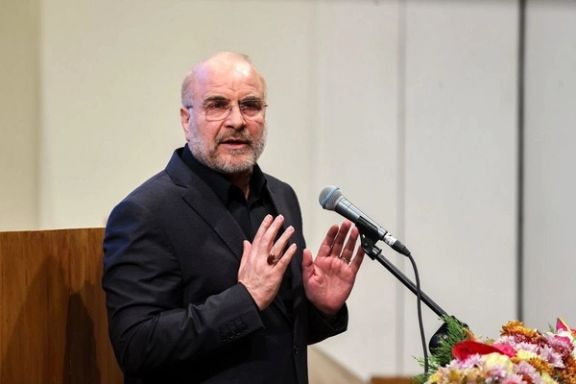
Iran’s parliament speaker on Friday accused the US of using nuclear talks to pressure Tehran into relinquishing its defense capabilities, amid tensions over a recent letter from President Donald Trump demanding missile restrictions.
“The US means disarmament when it says negotiation,” Mohammad Bagher Ghalibaf said in a speech during Quds Day rallies in Tehran on Friday. “Our people understand that talks under threat are just a show to impose their will. No wise nation would accept that.”
His comments were echoed by other senior Iranian officials speaking at Quds Day events, including Foreign Minister Abbas Araghchi and senior adviser to Iran's Supreme Leader Ali Larijani.
“The letter was carefully examined and discussed in detail,” Araghchi said. “Parts of it contained threats. We will not allow anyone to speak to the Iranian people in the language of threats.” He added that while diplomacy remains possible, Iran would not negotiate under pressure. However, he noted that in its reply Iran "made an effort to keep a diplomatic window open.”
Larijani also weighed in, saying any agreement with Washington would require mutual acceptance of terms. “Both sides must agree,” he said. “Right now, they state their position, and we state ours.”
Responding to Trump’s recent threats of military action if Iran refuses to negotiate, Larijani added: “Someone who really intends to act doesn’t talk this much.”
Ali Shamkhani, former secretary of Iran’s Supreme National Security Council, also said on Friday that Iran had delivered a "restrained" response to Trump’s letter. He noted that the reply was prepared by multiple relevant institutions and emphasized that while Iran remains open to indirect negotiations, any talks must be conducted on equal terms. “If negotiations are conducted from a position of parity, we are prepared to take further steps,” Shamkhani said.
These remarks came a day after Iran said it has formally responded to a letter from US President Donald Trump to Supreme Leader Ali Khamenei, in which Trump reportedly set a two-month deadline for a new nuclear deal. The response, delivered via Oman, rejected direct talks under tightened sanctions but signaled openness to continued indirect negotiations.
“In the latest letter, there’s no serious discussion about lifting sanctions,” Ghalibaf said. “The US behavior in that letter reflects classic American bullying.”
Tensions between Tehran and Washington have escalated since Trump reinstated his so-called maximum pressure sanctions campaign in early February, aimed at cutting Iran’s oil exports to zero. Trump has demanded that Iran agree to a more comprehensive nuclear deal or face military consequences.
Trump also has mentioned restrictions on some of Iran's conventional weapons, such as ballistic missiles that threaten Israel and other regional countries. Washington has also warned that Tehran must stop its support for militant groups in the region.
Iran denies seeking nuclear weapons but has enriched uranium well beyond the limits set by the 2015 JCPOA nuclear deal, which Trump abandoned in his first term. The International Atomic Energy Agency says Tehran has accumulated more enriched uranium than any state without a declared weapons program.
Iran maintains that it will only negotiate over its nuclear program if its rights are respected. Its ambassador to Iraq, Mohammad Kazem Al-Sadegh, said on Thursday that Iran’s ballistic missile program and regional influence are not up for discussion.
“The resistance in Lebanon is still strong and capable. The resistance in Yemen is active,” Al-Sadegh said. “The axis of resistance remains and is alive.”
Ghalibaf echoed that position, warning that any US military action would ignite a wider conflict. “If the Americans violate Iran’s sovereignty, it will be like a spark in a powder keg that sets the whole region ablaze. In such a scenario, American bases and allies will not be safe.”
Iran's ambassador to Iraq said on Thursday Tehran would negotiate with Washington only over its nuclear file if its rights were respected but said its ballistic missiles and dismantling Shi'ite militias were not up for discussion.
The remarks by Mohammad Kazem Al-Sadegh in an interview with the Iraqi Alsharqiya TV channel come after Iran officially responded to US President Trump's letter to Supreme Leader Khamenei saying Tehran would not negotiate directly under his stepped-up sanctions.
"We only negotiate the nuclear file," Al-Sadegh said. "On ballistic (missiles) we are not negotiating about them. What remains is the nuclear file. If they expressed conditions and just speech which provide Iran its full rights, then we're ready to negotiate."
Trump has demanded Tehran come to a deal or face a military intervention and warned any attack by Yemen's Houthis would be treated as emanating from Iran, upping the rhetoric against its Mideast foe.
Iran denies seeking a nuclear bomb but the United States and Israel doubt its intentions. Over a year of military blows by Israel on Iran and its armed allies in the region, which it dubs the axis of resistance, have diminished Tehran's sway.
"The resistance in Lebanon is still strong and capable. The resistance in Yemen is active," Al-Sadegh said. "The axis of resistance remains and is alive."
The senior diplomat whose mandate covers one of Iran's most strategic neighbors rejected as unacceptable to Baghdad and Tehran a US demand that a grouping of Iran-aligned Shi'ite militias in Iraq be dissolved or wrapped into the armed forces.
"It talks about the resistance, about the (Popular Mobilization Front). We say the Mobilization is a legal organization and played a big role in the war against Islamic State." He added, "This is unacceptable for both Iran and Iraq. The Hashd al-Shaabi is a legal entity."
The United States and Israel both see Iran as weakened, especially after an Oct. 26 Israeli air attack both say knocked out the country's air defenses.
Al-Sadegh said the axis of resistance was undiminished but that the regional confrontation had eased but could flare again.
"This is a war, there are setbacks and victories," he said.
"The situation now is there is a calming in the region. Developments dictate whether there is action or a response."
Iran officially responded to a letter from US President Donald Trump to Iran's Supreme Leader Ali Khamenei on Wednesday seeking a nuclear deal, saying his stepped-up sanctions made direct talks impossible but expressing openness to third-party mediation.
Tehran conveyed the response via Oman on Wednesday, Iran’s official IRNA news website quoted Foreign Minister Abbas Araghchi as saying.
"Our policy remains not to engage in direct negotiations under maximum pressure and military threats. However, indirect negotiations as existed in the past can continue," Araghchi said.
"Indirect negotiations had taken place both under the administration of Mr. Rouhani and Martyr Raisi," he said referring to Iran's previous two presidents.
The remarks largely repeat his previous public statements on engagement with Washington.
Iran denies seeking a nuclear weapon but the UN's nuclear watchdog says it has enriched more uranium than any state lacking a bomb. While Washington assesses Tehran is not actively building one, it doubts Iranian intentions.
Trump last month reinstated the "maximum pressure" campaign of sanctions on Iran from his first term, with the stated aim of driving its oil sales to zero.
Signing the initiative, Trump said: "It's very simple. I'm not putting restrictions. They cannot have one thing. They cannot have a nuclear weapon."
A senior Emirati official personally conveyed the letter to Tehran urging a nuclear deal which Khamenei - without specifically referencing the missive - rejected, calling the overture a deception while Washington's sanction policy hurts Iran.
Trump withdrew from a 2015 international nuclear agreement with Iran in his first term after bashing it as too lenient. Khamenei said talks were pointless if a new deal could easily be broken.
The previous deal, inked under President Barack Obama, was mediated in part by Oman.
Trump's letter gave Iran a two-month deadline for reaching a new nuclear deal, Axios has reported citing one US official and two sources briefed on the letter.
"You've got a lot of stuff going on with Iran, and we sent a letter to Iran," Trump said this week. "You're going to have to be speaking to us one way or the other pretty soon, because we can't let this happen."
Australia's former ambassador to Iran was the target of an assassination plot in 2019 in Tehran, the Australian news outlet SBS reported citing leaked Iranian judicial documents.
The plot, which had not previously been reported, did not appear to involve the Iranian state in any way despite its fraught relationship with US-allied countries.
An Iranian man whom SBS News identified as Kamran - a pseudonym used for privacy reasons - attacked the Australian embassy in Tehran with a Molotov cocktail and later followed the ambassador Ian Biggs with the intent to kill him.
Kamran was arrested before carrying out the attack and was later jailed for 17 months although he was released on parole in 2020, the report said.
The leaked documents, provided to SBS by the Iranian hacktivist group Edaalate Ali, come from a cache of over three million files detailing cases tried in Tehran's Revolutionary Court between 2008 and 2023.
Among these included documents relating to the plot against Biggs, revealing that Kamran’s actions began with setting off a firecracker, followed by throwing two Molotov cocktails and then attempting to purchase a handgun with the intent to murder the ambassador, the report added.
According to the documents cited by SBS, Kamran was charged with “collusion and conspiracy with the intent to act against national security through a plot to commit an act of terror and murder Australia's Ambassador.” While Kamran hired two accomplices, the report said they were later released due to insufficient evidence.
Assailant’s sentence and release
Despite the severity of the charges, Kamran’s sentence was reduced from six years to under four years after he requested a pardon, the report said. However, the decision to reduce the sentence was later withdrawn. Kamran was ultimately paroled after serving just under 18 months in 2020, the report added.
While Kamran’s motivations are not fully clear, the report said he claimed personal grievances related to his time in Australia, including allegations of sexual harassment and financial struggles.
Biggs served as Australia's ambassador to Iran from May 2016 until 2019. During this period, the relationship between Australia and Iran was affected by the Joint Comprehensive Plan of Action (JCPOA), the 2015 nuclear deal aimed at limiting Iran's nuclear program in exchange for sanctions relief.
According to the report, Biggs publicly backed the nuclear deal, and Australia’s position on the deal was aligned with much of the international community at the time.
In May 2023, Biggs assumed the role of Australia's Ambassador to Austria. He also took on responsibilities as Australia's Resident Representative and Governor on the IAEA Board of Governors, Permanent Representative to the United Nations in Vienna, and to the Comprehensive Nuclear-Test-Ban Treaty Organization (CTBTO) Preparatory Commission.
The Australian government, including the Department of Foreign Affairs and Trade (DFAT) and the Australian Federal Police, declined to comment on the incident, the report said.
An ongoing US military campaign must defeat Houthi fighters in Yemen to prove Washington's resolve to their Iranian backers, US Senator John Hoeven told Iran International.
"We need to take out the Houthis. We need to stop the Houthis from these attacks. It's not good enough to just play defense. We actually have to take out their ability to make these attacks," the Republican senator from North Dakota said.
"They are a proxy for Iran. They are funded by Iran. They are armed by Iran," he added. "It's not only important we take out the Houthis so that we can have safe, safe shipping in the Red Sea, in the Gulf of Aden. It's also important to send very clear message to Iran that we know their proxies are armed and funded by Iran and doing Iran's bidding."
President Donald Trump on Mar. 15 ordered large-scale military strikes against dozens of Houthi targets in Yemen, warning Iran not to keep supporting the group.
'Offshoot of Iran'
A Shi'ite religious militia, the Houthis seized much of the war-torn country beginning in 2014 and have been provided advanced drone and missile technology by Iran.
Following an attack by Iran-backed Hamas militants on Israel on October 7, 2023 and Israel's incursion into Gaza, the Houthis began attacking commercial and military vessels in the waterways astride Yemen in what they called solidarity with Palestine.
Following this week's attacks on the Houthis, Trump asserted once more that the Yemen group was Tehran's offshoot.
"They make their own missiles. They get their missiles also from Iran. It's an offshoot of Iran, another offshoot," he told reporters at the White House on Tuesday.
"You've got a lot of stuff going on with Iran, and we sent a letter to Iran. You're going to have to be speaking to us one way or the other pretty soon, because we can't let this happen," he added.
Senior Iraqi politicians opposed to Iranian influence in the country have called for Tehran-backed militias to disarm and disband now that the Islamic Republic's sway over the region has diminished.
“Armed groups supported by Tehran have no choice but to accept change,” said Sheikh Abdullah al-Jaghifi, Secretary-General of the Ahrar al-Furat Movement.
Al-Jaghifi said Syria was a cautionary tale of how geopolitical transformations can unravel entrenched alliances. Tehran lost its oldest Arab ally there, the Assad dynasty, to hardline Islamist-led rebels close to Turkey.
Speaking to Iran International, al-Jaghifi predicted 2025 would bring major changes across Iraq and the broader region, with Iran's influence continuing to wane.
The remarks come after discussions over integrating the militias into the Popular Mobilization Forces (PMF) – a move presented as a means to depoliticize Iraq’s paramilitary landscape. Yet critics question the sincerity and effectiveness of the initiative.
Mithal al-Alusi, founder of the Democratic Party of the Iraqi Nation, dismissed the proposed merger as a semantic maneuver.
“Iran is using wordplay to maintain its grip on Iraq and is turning the country into a base for extremist operations,” he told Iran International. He warned that Iran-backed networks are involved in transferring funds, passports and weaponry under the guise of Iraqi state structures.
Al-Alusi argued that Hezbollah and Hamas are being financed with dollars funneled through Iraqi channels, calling the practice “a serious crime against Iraq and the region – against people killed whether Israelis, Palestinians, Lebanese, Syrians and Yemenis alike.”
The leadership in Baghdad is pressuring Tehran-aligned armed groups not to attack Israeli targets to avoid a punishing military response, The New Arab news outlet reported on Wednesday.
The move follows a reported effort by a senior Iranian military commander to urge Tehran's armed allies in Iraq and Yemen to stand down attacks on their Mideast nemesis, potentially signaling an Iranian desire for detente in the region.
Iran faces an ultimatum by US President Donald Trump to ink a new nuclear deal or face attack after its home front and armed allies in the region have been dealt historic military blows from Israel in over a year of war.