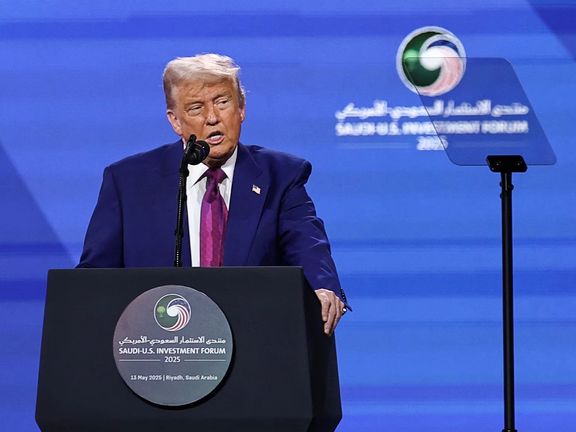
US President Donald Trump speaks at the Saudi-US Investment Forum, Riyadh, Saudi Arabia, May 13, 2025.
When US President Donald Trump torched Iran’s leadership in a long speech in front of Saudi Arabia’s crown prince in Riyadh on Tuesday, he likely didn’t anticipate how warmly his words would resonate with many Iranians—or perhaps he did.
Across Persian-language social media, many users were almost in awe, surprised with both the content and tone of Trump’s speech. Even journalists inside Iran couldn’t help risking reprimand by praising a US president.
“It was so intelligent of Trump to highlight issues such as the destruction of monuments and the water mafia,” renowned journalist Sadra Mohaqeq wrote on X. "And what a coincidence that he said all this on the same day he lifted US sanctions on Syria."
In his speech in Riyadh, Trump described the Islamic Republic as a “destructive” force, accusing the rulers in Tehran of “stealing their people’s wealth to fund terror and bloodshed abroad,” just as neighboring Arab leaders were building their countries.
"No one could have described the situation of a plundered country in a few sentences better than Trump," Middle Eastern Studies student Masoud Paydari posted on X.
"He uttered the harshest and most bitter words with complete politeness," a classmate commented under his post.
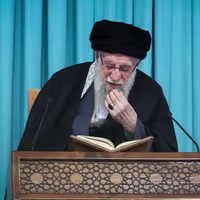
Trump had no good words for Iran’s supreme leader Ali Khamenei but all the world’s praise for Mohammad Bin Salman. Still, he left the door open for a “better and hopeful future” if Tehran chose to change course.
"He spoke as if he were a fellow Iranian chatting with a friend. His words were so clear. Iran’s officials should die of shame," user Maryamgh wrote on X. Many agreed, suggesting that an Iranian writer may have helped draft the US President’s speech.
Trump’s comments on Iran’s nuclear program were largely overlooked by Iranians on social media. It was his lengthy and detailed remarks about mismanagement, economic waste and cultural neglect that clearly struck a nerve.
"In a country on the southern part of the Persian Gulf, major international investors line up to offer cooperation, while another country on the northern part of the same gulf is left with no trade partners,” a user posting as Cryptosamz wrote on X, “because all its officials, from top to bottom, are thieves."
While social media users reacted with rare openness, Tehran’s major dailies remained conspicuously silent. Under apparent pressure not to credit Trump in Iran's tightly-controlled media landscape, they avoided the speech altogether.
Hardliners largely ignored it as well.
Kayhan, whose chief is appointed by Khamenei, was the only paper to address the speech directly, dismissing it as "reckless" with little elaboration. The IRGC-linked Javan stuck to its combative line. "We won’t negotiate if they insist on zero enrichment," read the headline.
State media covered Trump’s visit without pointing out its economic significance.
The wealth being amassed on the other side of the Persian Gulf was derided as mere "petrodollars," with no words of self-reflection on why they freely sell oil, reinvest profits, and fund global ventures as Iran—sitting on comparable if not superior natural resources—struggles to meet basic needs like water and electricity.
President Donald Trump’s high-profile trip to Saudi Arabia has drawn renewed attention to the often fraught relationship between the Middle East’s main heavyweights: Sunni Saudi Arabia and its Shi'ite rival Iran.
While Trump’s trip may not have fundamentally shifted the course of Iran-Saudi relations, it underlines how central their evolving dynamic remains to the region’s future especially as nuclear negotiations between Tehran and Washington continue to unfold.
On Wednesday, Saudi Foreign Minister Faisal bin Farhan underscored the importance of the US-Iran nuclear talks, saying the kingdom fully supports them and hopes for a positive outcome.
Iran's Foreign Minister Abbas Araghchi, in turn, visited Saudi Arabia on Saturday before the fourth round of talks with the US to brief them on the latest developments. He had said last Wednesday that Tehran seeks regional consensus on the talks and any potential deal.
Rivalry and diplomatic tension
The two regional powerhouses have long been vying for influence across the Middle East. Their rivalry has played out in a series of proxy conflicts over the past two decades — from Iraq and Bahrain to Syria and Yemen — where the two sides supported opposing factions.
One of the most acute flashpoints came in 2015, when Riyadh launched a military campaign in Yemen against the Iran-backed Houthi rebels. Although Tehran has always denied direct military involvement, it has been widely accused of supplying weapons and political support.
Relations deteriorated further in 2016 after Saudi Arabia executed prominent Shia cleric Sheikh Nimr al-Nimr. The move sparked violent protests and attacks on Saudi diplomatic missions in Tehran and Mashhad, prompting Riyadh to sever diplomatic ties. This marked one of the lowest points in bilateral relations in decades.
Aramco attack
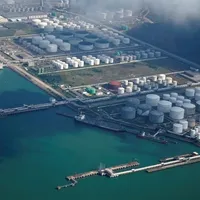
A September 2019 drone and missile attack on the state-owned Saudi Aramco oil hub that disrupted about five percent of global oil supply marked one of the most significant escalations in the Tehran-Riyadh relations in recent years.
Although the Houthis claimed responsibility and Iran denied any involvement, the sophistication of the weaponry used in the attacks led not only Riyadh and Washington but also European powers to directly blame Iran.
Riyadh appeared to change tack away from years of direct and indirect confrontation with Tehran gradually after the assault on its economic lifeline, paving the way for detente.
Signs of a diplomatic thaw
The recent years have seen a cautious thaw in relations. After the initiation of direct talks in April 2021, a breakthrough came in 2023 with Chinese-brokered talks that led to the restoration of diplomatic relations. Since then, both sides have tentatively explored cooperation and re-engagement, even as deep-seated mistrust remains.
From early 2025 to now, Iranian and Saudi officials have held multiple high-level meetings.
Diplomatic momentum picked up pace in October 2024, when the newly appointed Araghchi visited Riyadh and met with Crown Prince Mohammed bin Salman and foreign minister amid growing the growing Gaza conflict.
The timing — just days before another round of Tehran-Washington nuclear talks — underscored Saudi Arabia’s possible diplomatic involvement.
Araghchi returned to Riyadh on May 10, ahead of the fourth and most recent round of nuclear talks in Doha. Iranian media reported that he delivered a response to the Saudi king’s letter, continuing what appeared to be an unprecedented backchannel of direct communication.
Toward a regional nuclear consortium?
During Trump’s meetings in Riyadh, the possibility of a civil nuclear agreement between the US and Saudi Arabia was reportedly discussed.
The initiative, not officially confirmed by either Tehran or Riyadh so far, may have been pitched as a confidence-building measure designed to reassure the West about Iran’s nuclear intentions while embedding regional powers and the United States in a shared framework.
Saudi Arabia, long intent on developing its own civilian nuclear capabilities, may view such a proposal as an opportunity to gain influence over regional nuclear policy while maintaining checks on Iran’s activities. However, significant technical and political obstacles would need to be overcome.
Iran’s Expediency Council has conditionally approved the country’s accession to the Palermo Convention, one of the two key legislative items tied to the Financial Action Task Force (FATF) standards aimed at addressing money laundering and terrorism financing.
The move could ease Iran’s exit from the international money laundering blacklist and restore access to global banking should Western sanctions against it be lifted.
In a brief statement, the council's spokesman Mohsen Dehnavi announced it had agreed to join the UN convention against transnational organized crime, “within the framework of the Constitution and domestic laws.”
The decision marks a cautious step toward meeting FATF requirements but falls short of full endorsement.
The council also confirmed that discussions on the related Countering the Financing of Terrorism (CFT) bill will continue in upcoming sessions.
In a letter to Expediency Council chairman Sadeq Amoli Larijani, they argued that any approval—conditional or not—should wait until the risk of the UN “snapback” sanctions mechanism is entirely eliminated.
The snapback mechanism, which allows for the automatic reimposition of UN sanctions under the 2015 nuclear deal, is set to expire in October 2025 unless triggered by a signatory.
While Larijani recently hinted that conditional approval might be viable, conservative MPs have warned that even limited compliance could make Iran vulnerable to external pressure and economic penalties.
The FATF has kept Iran on its blacklist due to its failure to adopt international standards on money laundering and terror financing.
Hardliners in Tehran are pushing back against the broader optimism surrounding talks with Washington, insisting that the negotiations are going nowhere and merely dragging on to avoid collapse.
“It is unclear what was discussed over the past month. There is no detail on substance or format, nor any indication of whether an agreement is likely,” Vatan Emrooz wrote in its editorial following the fourth round of talks in Oman last weekend.
“The US’s repeated calls to halt enrichment cast doubt on its seriousness … Perhaps the only objective at this point is to ensure the talks do not collapse,” the editorial added.
While the ultra-conservative daily was more subdued than usual, the message was clear: the process, not the outcome, is what matters.
Kayhan, a hardline paper closely aligned with the Supreme Leader’s office, also struck a defiant tone, giving a rare front-page place to foreign minister Abbas Araghchi who said Tehran will not negotiate enrichment.
Muted optimism, missing details
Other outlets—across both reformist and conservative camps—offered a more coordinated and cautiously positive framing, though still with limited substance. Etemad and Jomhouri Eslami both described the talks as successful but provided no insight into what had actually transpired.
The only notable detail was Etemad’s assertion that the latest round of talks were both direct and indirect, clearly contradicting the official line that the negotiations had been strictly indirect.
Two prominent political commentators, Mohammad Sadeq Javadi-Hesar and Heshmatollah Falahatpisheh, acknowledged the information vacuum but urged against equating public messaging with actual policy.
"The outcome of the fourth round of talks has isolated warmongers and opponents of Iran," Javadi-Hesar wrote in Etemad on Monday.
Falahtpisheh went one step further, commenting on US politics. “If both sides have decided to continue negotiations, it means that Steve Witkoff’s statement before the talks, about ending enrichment in Iran, was aimed at silencing opposition within the US.”
A Consortium on the Table?
One potentially significant development came via Khorassan, a conservative daily, which reported that Oman’s Foreign Minister Badr bin Hamad Al Busaidi had proposed a regional “nuclear consortium” involving Iran, Saudi Arabia, and the UAE—with the United States as a symbolic shareholder.
Khorasan quoted Witkoff as describing the idea as “a surprise that can be considered.” Such an arrangement, the paper asserted, could address regional security concerns about Iran’s nuclear transparency and dilute fears of its technological monopoly.
Most upbeat was the Reform-aligned daily Sharq, which described the talks in Oman as a new life to diplomacy. And most eloquent, perhaps, was the centrist outlet Ham-Mihan, printing “back to square one” on its front page.
Iran will not accept zero enrichment or transfer of its enriched uranium abroad, the daily wrote in its editorial, unless there is a phased agreement and verifiable US sanctions relief.
As Iran grapples with a worsening electricity crisis, the government has resolved to prioritize power supply to industries, sacrificing residential comfort and daily public services in a bid to avert economic collapse.
“There will be no such thing as production if we cut off the supply of gas in winter and electricity in summer to industries,” government spokeswoman Fatemeh Mohajerani said on Monday, justifying the decision to shield factories and major production centers from the worst of the power cuts.
“So instead of imposing power cuts solely on industries, we have directed some of it to domestic consumption.”
Iran is currently facing a peak-hour electricity deficit of around 20,000 megawatts. With the summer heat intensifying and water levels in hydropower dams at historic lows due to years of drought, power outages—both scheduled and unexpected—have become routine.
The government of President Masoud Pezeshkian blames inherited problems for the shortage. In parliamentary hearings for his cabinet approval in August last year, energy policy dominated the debate.
Lawmakers voiced concern at the time that the growing electricity gap could bring more severe blackouts and industrial shutdowns than before.
Economic survival over public comfort
The move to protect industry over residential demand is a calculated risk. Iran's manufacturing sector, already battered by sanctions, inflation, and a volatile exchange rate, is considered too critical to fail.
If industries grind to a halt, Iran risks deeper economic stagnation. But if public resentment continues to grow amid daily blackouts, the political costs could be just as severe.
Many industries, including cement plants and steel factories, which require uninterrupted energy for their kilns and machinery, are particularly vulnerable to power cuts.
The total annual loss from power cuts to the steel industry last year, according to the head of the Isfahan Chamber of Commerce, Amir Kashani, was estimated at around $4 billion.
Power cuts affecting daily lives
Widespread dissatisfaction is mounting, as daily life for millions is disrupted by blackouts as the daily power cuts are more than an inconvenience—they are a source of hardship, danger, and economic loss in the lives of millions of ordinary Iranians.
Social media is filled with videos and reports of people trapped in elevators, traffic lights failing and causing massive jams, and water not reaching upper floors of apartment buildings due to non-functional pumps.
Mobile phone signals have also been affected, as network operators are forced to shut down towers to prevent equipment damage when backup batteries run out.
Many small businesses, including bakeries, restaurants and cafes and grocery stores, report spoilage of perishable goods, compounding their financial strain.
Adding to the frustration, the government has shifted working hours for state offices to 6:00 AM in an effort to avoid peak hours, a move that has caused widespread disruption for employees and service recipients alike.
On Monday, authorities announced that school hours would also be adjusted to follow this new schedule.
A long-term crisis years in the making
Experts argue that Iran’s electricity shortage is not a sudden development but the result of decades of mismanagement and underinvestment.
Despite having the world’s second-largest reserves of natural gas, Iran has failed to expand its generation capacity or modernize its energy infrastructure.
“This crisis did not arise overnight, nor can it be solved in the short term,” Mehdi Masaeli, secretary of the Electricity Industry Syndicate, recently told Zaman-e Eghtesad, warning that officials should not downplay the severity of the situation.
Resolving the crisis would take at least three years, he said, citing the need for significant financial investment, equipment procurement, and coordinated management.
Earlier this week, Energy Minister Abbas Aliabadi said illegal use of miners has expanded and is responsible for around 1,000 megawatts of energy consumption.
Iranian commentators are floating a long-standing proposal to break the impasse in its nuclear negotiations with Washington: the formation of a regional nuclear consortium involving Iran, Arab states and the United States.
If Tehran has indeed introduced this idea in the fourth round of talks, it may represent new flexibility on the sticky point of enrichment and explain the positive assessment of both Iranian and American officials on the latest round of talks.
A commentary in the conservative Khorasan daily on Mondaysaid the idea of creating a consortium may have been among what Omani Foreign Minister Badr al-Busaidi referred to as “useful and original ideas reflecting a shared wish to reach an honorable agreement” after the completion of the fourth round of talks on Sunday.
Some signals suggest this idea may have been quietly floated in diplomatic channels: ahead of the Muscat talks on April 11, Iran’s Foreign Minister Abbas Araghchi visited Riyadh and Doha, followed by a trip to the UAE after the talks.
The idea was originally proposed by former Iranian nuclear negotiator Seyed Hossein Mousavian and Princeton physicist Frank von Hippel long before the current Tehran-Washington talks in an October 2023 article in the Bulletin of the Atomic Scientists.
Such a body consisting of Iran, Saudi Arabia,and other interested Middle Eastern countries would oversee enrichment under international safeguards and ensure that the enriched uranium it produced would be used only for peaceful purposes, they argued.
On the eve of the April 11 nuclear talks in Muscat, Mousavian addressed the risk of failure if the US refused to acknowledge Iran’s rights under the Nuclear Non-Proliferation Treaty (NPT).
“Steve Witkoff recently made an unreasonable statement, saying that Iran cannot benefit from the right to peaceful uranium enrichment technology. This stance is a clear violation of the NPT treaty. If this is the final US position, tomorrow's negotiations... will end in failure,” he warned.
In the same post, Mousavian again floated the consortium idea: “The solution is ... the establishment of a joint nuclear consortium among the Persian Gulf countries.” He argued this would resolve the US’s contradictory stance of supporting enrichment in Saudi Arabia while denying the same to Iran.
He also hinted at a broader vision: an Iran-US economic agreement worth up to $1 trillion, involving American investment in Iran’s nuclear, fossil, and renewable energy sectors. Such a deal, he suggested, could help “open the deadlock in US–Iran relations.”
Some commentators have described the idea as a possibility for a breakthrough.
“Araqhchi's visit to Saudi Arabia and the UAE is probably not unrelated to the proposal to create a joint regional enrichment consortium,” Rahman Ghahremanpour, a commentator and analyst of Middle East politics in Tehran, posted on X.
“Iran is trying to break the deadlock on zero enrichment, and if the countries in the region agree to this proposal, perhaps the Trump administration will change its position. This is an important confidence-building measure in arms control,” he added.
Abdolreza Davari, a conservative politician who supports Pezeshkian, also supported the idea in a post on X on May 10. This, he said, would be “similar to the model implemented in Europe that supplies fuel even to the United States.”
“This consortium could be the center of regional cooperation in the areas of nuclear technology exchange, safety, environment, production of fresh water and radiopharmaceuticals, and also include a regional non-proliferation regime," Reza Nasri, another commentator in Tehran, wrote on X before Araghchi’s visit to Riyadh.
Hossein Aghaei, a Turkey-based senior security and geopolitics analyst, referred to Saudi Arabia’s wish to create a consortium in collaboration with the US and possibly Russia in a post on X on May 8. He said Iran could be a participant in the consortium to ensure it will not be able to build nukes.
However, he warned that Israel’s vision is completely different. “In the nuclear matter, Israel may not even trust Saudi Arabia, let alone the Islamic Republic.”