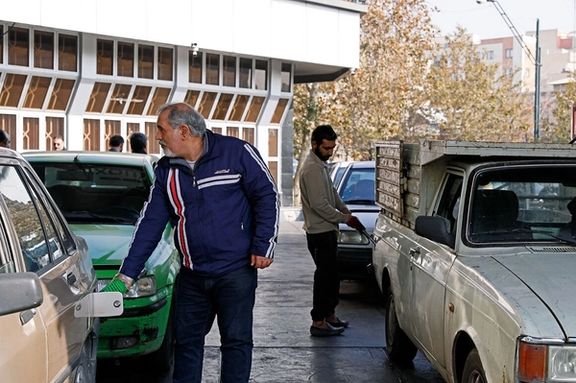
Iranian drivers at a gas station in Tehran, December 18, 2023.
A confidential report from Iran’s oil ministry appears to show a widening gap between domestic fuel production and consumption, highlighting growing pressure on the country’s energy infrastructure.
According to the ministry’s confidential annual report obtained by Iran International, diesel consumption in March 2025—the final month of the Iranian calendar year—hit a record 146 million liters per day, exceeding national production by 30 million liters.
The surge was largely driven by a severe and ongoing shortage of natural gas, which forced power plants and heavy industry to burn more diesel and fuel oil (mazut) to meet energy demands.
Diesel use rose 16% year-on-year in March, while production grew by just 1%. Daily mazut consumption also climbed 30%.
Despite holding the world’s second-largest natural gas reserves, Iran has faced persistent shortages since last year, especially during the winter months. The government’s failure to expand gas output has pushed annual mazut consumption up.
In total, Iran consumed 57 billion liters of mazut and diesel in the last year—roughly 1.28 million barrels per day. More than a third was used for power generation while the rest was absorbed by the industrial and transportation sectors.
Barter deals and toxic additives
Gasoline consumption also rose by almost 8% in a year.
To make up the shortfall, the government imported nearly 5 billion liters of gasoline and diesel over the past year, doubling the volume of fuel imports compared to the year before.
With cash and resources constrained by sanctions, Iran has leaned heavily on barter to meet fuel demand—trading part of its mazut exports for gasoline and diesel, particularly with the United Arab Emirates.
The report notes that of the 290,000 barrels per day of mazut exported last year, 40% was bartered for refined fuel, while the rest was sold to the UAE, China and other Asian buyers.
The report also sheds light on gasoline quality, revealing that Iran does not produce any gasoline that fully meets international standards.
Around 80% fails to comply with Euro 4 or Euro 5 benchmarks. The rest, labeled as “Euro gasoline,” contains the petrochemical additive MTBE (methyl tert-butyl ether), which is banned in many countries due to environmental and health risks.
Public spin versus internal figures
Iran continues to blend 2 million liters of MTBE into its gasoline daily.
Refinery output rose by 4.5% to 101 million liters per day, but the government raised that to 121 million by adding 20 million liters of MTBE and other chemical additives—a fourfold increase in additive use in recent years.
In March, Mohammad Sadegh Azimifar, CEO of the National Iranian Oil Products Distribution Company, said diesel output had risen by the equivalent of a 300,000-barrel-per-day refinery and that fuel production had increased by 11% overall.
However, the Oil Ministry’s internal report contradicts these statements, showing actual growth was closer to one-third of what Azimifar posited.
The discrepancy reflects a broader pattern of officials overstating achievements to project control despite mounting evidence that Iran’s energy crisis is worsening.
Supreme Leader Ali Khamenei has publicly rebuked Iran’s parliament for excessive oversight and political infighting, urging lawmakers to ease off ministers and help the country strike a united front.
The rare criticism, delivered during a June 11 meeting with members of the Majles, was widely seen as an attempt to rein in hardline MPs amid growing tensions with President Massoud Pezeshkian’s administration.
"Not all these questions are necessary. Not all these summonses are necessary," Khamenei said. "When you summon a minister to a commission, it takes up time—two, three hours. Reduce the number of these. Cooperation with the government means minimizing such actions."
His remarks come as the United Nations nuclear watchdog rebuked Iran over alleged proliferation failings, the resumption of UN sanctions looms and President Trump warned on Thursday of a potential Israeli attack and "massive conflict".
The comments come amid ongoing efforts by hardliners to derail Pezeshkian’s cabinet appointments. Conservative MPs have targeted his nominee for economy minister, Ali Madanizadeh, under a law barring dual nationals or officials with immediate family holding foreign citizenship from senior posts.
Khamenei asserted that the Majles retains the right to question and investigate, but keeps it to a necessary minimum and not bring political or ideological differences into open conflict.
“On fundamental issues, the country must speak with one voice. Our nation and all its institutions—our political class, our management structure—must act as one hand,” he said.
Iran faces a delicate moment in its foreign policy with US nuclear talks stuck in a rut, while the UN’s nuclear watchdog is expected to issue a resolution declaring Iran non-compliant.
Khamenei made no direct reference to the nuclear stand-off, but appeared to have it in mind when saying public clashes at this time were “more harmful than ever.”
Domestic front
In recent weeks, hardliners have also called for Vice Presidents Mohammad Reza Aref and Mohammad Jafar Ghaempanah to resign under the same statute.
The hardline daily Hamshahri quoted MP Hamid Rasai insisting their cases were "more problematic" than that of former Foreign Minister Mohammad Javad Zarif, who stepped down under similar pressure.
Khabar Online accused Rasai and his allies of weaponizing the law to obstruct the government, while parliamentary vice president Majid Ansari said Khamenei himself believes the law needs revision.
Meanwhile, several hardline MPs have filed formal complaints against former Economy Minister Abdolnasser Hemmati, who accused some parliamentarians of seeking bribes to halt his impeachment in March.
The IRGC-linked Javan daily warned the complaints could further damage public trust, while former MP Davoud Mohammadi defended political deal-making as standard practice.
Though sidelined from nuclear negotiations and broader foreign policy, parliament hardliners remain intent on asserting influence. But Khamenei’s intervention may complicate their efforts.
A senior Iranian lawmaker has issued a rare and sharply worded rebuke of the country’s entrenched corruption and perceived cronyism, warning that public anger over inequality and elite privilege is growing.
“People see the children of officials—those who just a few years ago couldn’t even afford a motorcycle—now owning ships, planes and industry monopolies. It raises serious questions,” national security committee member Mohammad Mehdi Shahriari was quoted as saying by Iran’s labour news outlet, ILNA.
“This behavior has created widespread distrust in society,” the relative moderate and Iran's former envoy to Germany added.
The remarks come amid a growing backlash over the arrest of the son and daughter-in-law of Tehran’s interim Friday prayer leader, Kazem Sedighi, in a high-profile corruption case.
The couple were detained by the Revolutionary Guard’s intelligence unit for alleged misconduct related to property transfers.
“One of the public’s main grievances with the system is the perception of discrimination,” Shahriari said.
“When there are economic hardships, people expect everyone to bear the burden equally. But when they see that’s not the case—when they see privilege and monopoly—they react.”
Sedighi is an appointee and close associate of supreme leader Ali Khamenei. Apart from leading the capital’s Friday prayers, he heads the state body promoting behavior deemed Islamic—the Committee for the Promotion of Virtue and the Prevention of Vice—which includes Iran’s police chief and the ministers of intelligence and interior.
The cleric first came under fire in March 2024, when a whistleblower accused him and his sons of unlawfully acquiring a $20 million plot of land in Tehran. He apologized publicly—to the supreme leader and the Iranian people—once his claim of innocence was proved to be false.
Sedighi was neither prosecuted nor formally investigated.
“What added insult to injury was that he remained Tehran’s interim Friday prayer leader,” Shahriari said, linking what he described as growing mistrust and a broader sense of discrimination and unequal treatment.
“If legal action is taken fairly and equally, people will have confidence in the judiciary,” he concluded. “But when people see that there is discrimination and the hardships are not shared equally, frustration builds.”
Faezeh Hashemi, a prominent critic of Iran’s ruling system and daughter of former president Akbar Hashemi-Rafsanjani, has stunned many by saying she would prefer Mojtaba Khamenei as Supreme Leader—if there must be one after his father.
“If a leader is to be chosen after Mr. Khamenei, which will be the case because that’s the law now, I would personally prefer it to be Mojtaba,” she said in a YouTube interview with Abdi Media.
Though she acknowledged his lack of public legitimacy, Hashemi argued that Mojtaba is young, potentially flexible, and better placed than others to push reforms—drawing comparisons to Saudi Arabia’s crown prince Mohammed bin Salman and his top-down modernization drive.
The idea of Mojtaba succeeding his father has long circulated in conservative circles, often raised by hardliners or figures close to the security apparatus. But hearing it from Hashemi—who is outspokenly secular, reformist, and opposed to clerical rule—has taken many by surprise, triggering fierce debate across the political spectrum.
When asked to choose between Mojtaba Khamenei and exiled prince Reza Pahlavi as a future leader, she declined, saying that decision belongs to the Iranian people and that she advocates a secular government and social democracy.
Her refusal to endorse Pahlavi sparked backlash from some of his supporters on social media, who accused Hashemi of drawing false equivalence between the clerical establishment and the monarchy.
The obscure ‘heir’
Mojtaba Khamenei remains an elusive figure to most Iranians. He has never occupied a formal political role, and little is publicly known about his views.
In September 2024, he unexpectedly suspended his online khārij (advanced jurisprudence) classes, ending a 13-year teaching stint attended by a few hundred students. He claimed the decision had no political motive and said he had not informed his father in advance, but the move nonetheless fueled speculation about his future ambitions.
On the streets, opposition to hereditary succession has been vocal and sustained. Protesters have repeatedly chanted slogans such as “Mojtaba, may you die before becoming Leader,” turning his name into a symbol of unease over dynastic power in a system that claims to reject monarchy.
Still, the idea of him succeeding his 86-year-old father is floated by Tehran’s commentariat from time to time, with frequent references to Mohammed bin Salman.
One vocal advocate of the idea is Abdolreza Davari, a former adviser to Mahmoud Ahmadinejad, who has repeatedly called for an “authoritarian development model” centered on Khamenei’s son.
In interviews and social media posts, Davari has argued that such a model could bridge Iran’s generational divide, revive the economy, and offer limited social liberalization without upending the political order.
But the vision he outlines is deeply polarizing—and widely seen as implausible by critics.
“Is it really possible for someone who has never given a speech, never held public office, and is largely unknown to suddenly become the leader of a nation?” one user, @Mhd1889, posted in response to Davari.
The arrest of a top cleric’s family members has done little to convince many Iranians that the judiciary’s anti-corruption drive is more than symbolic, despite praise from conservatives and some reformists.
The IRGC-affiliated Fars News Agency reported Sunday that the Revolutionary Guard’s Intelligence Organization had detained two sons of Tehran’s Friday imam, Kazem Sedighi, two weeks earlier.
The report said they were arrested on charges of misconduct and collusion, without further details. On Monday, the outlet issued a correction, saying the detainees were Sedighi’s son and daughter-in-law.
Sedighi responded soon after, saying he would submit to the law if wrongdoing were proven.
Appointed by Supreme Leader Ali Khamenei in 2009, Sedighi previously chaired the Supreme Disciplinary Court for Judges.
He now heads a state body promoting behavior deemed Islamic—the Committee for the Promotion of Virtue and the Prevention of Vice—which includes Iran’s police chief and the ministers of intelligence and interior.
Serious or symbolic?
While some conservatives argue the arrests show corruption is being addressed, many others see them as symbolic.
"Some actions have been taken against corruption, but don’t talk about 'decisive measures'—because the people have not seen any truly decisive action in the fight against economic corruption so far," a popular comment on the conservative Alef website read.
“Even in systemic corruption, some cases are (occasionally) dealt with on a case-by-case, symbolic basis,” reformist journalist and politician Mohammad Sahafi posted on X.
The post echoed a widely held belief that crackdowns lack seriousness.
“(This was) a kind of belated, superficial surgical removal of the countless tumors of corruption within the circle of power,” psychoanalyst Mohammad Reza Ebrahimi wrote on X.
Chief judge wins praise
Since his 2021 appointment, judiciary head Gholam-Hossein Mohseni-Ejei has made anti-corruption central to his image.
Conservatives framed the move as a sign of resolve and an attempt to restore public trust.
Hardliner lawmaker Mojtaba Zarei thanked Mohseni-Ejei on X for “revitalizing the judicial system to combat corruption.”
“The fight against corruption is not a stage for theatrical exposés; the judicial system of the Islamic Republic of Iran is itself at the forefront of the battle against corruption,” he wrote.
Former reformist vice president Mohammad-Ali Abtahi echoed the praise:“Mr. Ejei’s transparency, integrity, persistence, and courage can promote a model of worthy governance.”
“The head of the judiciary, by the nature of his job, is generally not expected to be respected and trusted—but Ejei is. He deserves praise for his impartial fight against the corruption of officials and their relatives,” he added.
Calls for Sedighi to step down
Unlike Ejei, Sedighi faces mounting pressure over the revelations, with many conservatives and some ultra-hardliners urging him to resign.
“Resign from all responsibilities and seek forgiveness for the rest of your life; perhaps you can save your hereafter,” conservative journalist Ahmadreza Danesh posted on X.
Sedighi claimed his signature had been forged. After this proved false, he apologized to Khamenei and the Iranian people in a Friday sermon, calling it negligence.
He was neither prosecuted nor formally investigated.
“Resign unconditionally now if you believe in even a fraction of what you have preached,” conservative politician Seyed Ali Hashemi wrote on X.
“Not because of proven guilt, but out of respect for the people, to preserve the clergy’s reputation, and to prevent the collapse of social trust,” he added.
People in Iran are often accused of contributing to the country’s economic woes through wasteful habits—not just by officials, but by one another. But how much truth is there to these claims?
People in Iran are often accused of contributing to the country’s economic woes through wasteful habits—not just by officials, but by one another. But how much truth is there to these claims?
One common claim is that Iranians use far more electricity than other nations. But data from Iran’s Energy Ministry shows that per capita household electricity consumption is about 1,100 kilowatt-hours per year—40% lower than the EU average, and well below usage in the US, Canada, Japan, or even many neighboring countries.
It’s the same story with food.
Iran’s agriculture minister recently criticized Iranians for “excessive consumption” of sugar and cooking oil, asserting that government subsidies are being squandered.
But that assertion appears to contradict data from the UN’s Food and Agriculture Organization (FAO), which shows that Iran’s per capita consumption of both items is below the global average and significantly lower than in nearby countries like Turkey.
Last year, Iranians consumed 2.3 million tons of cooking oil, compared to 3.5 million tons in Turkey, which has a similar population. On a per capita basis, Iranian consumption is 30% lower than the global average.
The minister also claimed that 90% of Iran’s cooking oil is imported at subsidized rates, yet FAO data puts the figure closer to 56%, with imports steadily declining over the past three years.
Sugar tells a similar story. Iranians consume about 10% less than the global average, and nearly half as much as Turks. Far from being excessive, these levels reflect increasing constraints on household consumption.
Chasing the basics
These accusations also overlook a crucial fact: food inflation in Iran is out of control. The price of cooking oil surged 20% in just three months, according to a report by economic outlet Tejarat News on Monday.
Iran’s Statistical Center reports annual inflation of 31% for cooking oil and 41% for sugar.
Such price spikes make basic goods increasingly unaffordable for most households. And the toll is visible in declining food security.
FAO data shows that per capita meat consumption in Iran has fallen by 40% over the past decade, while dairy consumption has dropped by 30%.
A senior food industry official said last week that the average Iranian now consumes 7–10 kilograms of meat per year—consistent with FAO’s estimate of just over 8 kilograms, down from 12 kg just a few years ago.
“Meat consumption in Iran is deeply unequal—some eat nothing, while others manage 20 kilograms a year,” said Masoud Rasouli, secretary of the Meat Production and Packaging Association, adding that the global average is 32 kilograms.
The figures don’t lie: Iranians are not consuming too much—they’re getting by with less.
Contrary to the official line—and even public opinion—excess is not a national trait. It’s an alien concept to the majority chasing the basics.