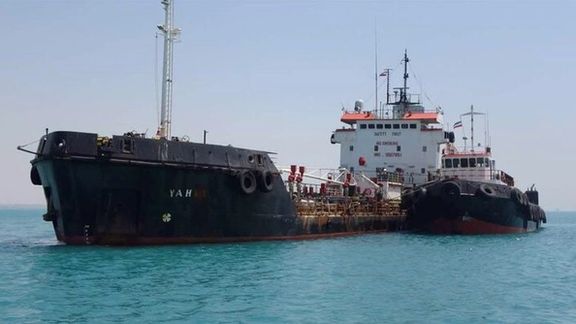
Iran seizes foreign tanker accused of smuggling 2 million liters of fuel
Photo of the seized tanker as released by Iranian state media.
Iran has seized a foreign oil tanker in the Gulf of Oman for allegedly smuggling 2 million liters of fuel, the chief justice of Hormozgan province said on Wednesday, according to state-linked media.
“In the course of monitoring suspicious fuel smuggling activity in the country's maritime borders in the Sea of Oman, a foreign oil tanker was inspected and seized due to incomplete legal documents related to its cargo,” Mojtaba Ghahremani said, according to a statement carried by the judiciary’s public relations office.
Ghahremani said a criminal case has been opened in the public and revolutionary prosecutor’s office in Jask and legal proceedings are ongoing. “Based on the report of the authorities, a case has been filed, and judicial investigation into the charges continues,” he said.
He added that 17 people, including the ship’s captain and crew, were arrested. “Seventeen suspects, including the captain and crew of this foreign tanker, are currently in detention for further investigation and legal procedures,” Ghahremani said.
Authorities are now collecting evidence to verify the total volume and nature of the cargo. “Sampling and relevant testing of the tanker’s fuel cargo, and inquiries into the authenticity of its documents, are underway,” he said. Results will be announced by the judiciary when the investigation concludes, he added.
Iran has not named the ship or its country of origin.
Iran has stepped up maritime enforcement in recent months, especially in waters near the Strait of Hormuz and the Persian Gulf, where fuel smuggling remains a persistent issue. In April, Iran’s Revolutionary Guard Corps (IRGC) Navy said it had seized a tanker carrying 100,000 liters of smuggled fuel and detained six people, according to Fars News Agency. That followed a separate operation in which two tankers allegedly transporting more than 3 million liters of diesel were intercepted and taken to the port of Bushehr.
The IRGC regularly announces such seizures as part of what it calls efforts to curb fuel trafficking in the region, a key route for global oil shipments. Iran has also seized tankers over maritime disputes or in response to international sanctions enforcement.
United Nations sanctions on Iran will be restored via the so-called "snapback mechanism" if no nuclear deal is reached by end of August, the US, British, French and German foreign ministers agreed in a Monday call, according to a report by Axios.
The European countries now plan to engage with Iran in the coming days and weeks with the message that Iran can avoid the snapback sanctions if it takes steps to reassure the world about its nuclear program, the report said citing two informed sources.
The snapback mechanism is part of UN Security Council Resolution 2231, which endorsed the 2015 Joint Comprehensive Plan of Action, or JCPOA. It allows any participant in the nuclear agreement to reimpose sanctions if Iran is deemed non-compliant. If no resolution to maintain sanctions relief is passed within 30 days, all previous UN measures return automatically.
The Trump administration supports activating snapback mechanism and sees it as leverage in the talks with Iran, the report added citing a US official.
The US official said Trump is highly frustrated that the Iranians haven't come back to the table yet, adding that US Special Envoy to the Middle East Steve Witkoff has made it clear to the Iranians that any future talks must be direct, rather than mediated by a third party, to avoid misunderstandings and expedite the process.
The FBI on Tuesday added three alleged Iranian intelligence officials including Tehran's current ambassador to Pakistan to its Most Wanted list over their alleged role in the disappearance of retired FBI agent Robert Levinson, who is believed to be dead.
The FBI’s Washington Field Office identified the three individuals as Reza Amiri Moghadam, Taghi Daneshvar and Gholamhossein Mohammadnia.
All three are linked to Iran’s Ministry of Intelligence and Security (MOIS), according to the FBI, which the United States has labeled a key player in hostage-taking operations and plots targeting Americans abroad.
The individuals were already under US sanctions and listed in connection with cases of alleged hostage-taking and the wrongful detention of American nationals in Iran.
“The FBI is leading the way in holding Iran accountable for the abduction of Bob Levinson, a devoted father and patriotic American,” Senator Jim Risch wrote on X.
“These new posters are seeking information related to his kidnapping. We will never forget Bob and his family, and we will hold those responsible to account for their crimes.”
Levinson disappeared in 2007 while on an unauthorized CIA mission to Iran’s Kish Island. US officials believe he died in Iranian custody, although Tehran has never acknowledged detaining him and continues to deny any involvement.
In 2020, Levinson’s family released a statement saying they had concluded, based on information from US officials, that he had died while in Iranian custody.
Iran may now decide to develop nuclear weapons following the US attacks on its main nuclear sites last month, former US Secretary of State Antony Blinken said in an interview.
“To the best of our analysis, Iran had not decided to weaponize. Now the danger is they might — burying the program deep underground and choosing to weaponize,” Blinken told Christiane Amanpour’s podcast on Tuesday.
Blinken said Iran had been rendered weaker than ever by the attacks, paving the way for a diplomatic breakthrough, but the situation could be even worse than before the conflict if Tehran decided to weaponize its nuclear activities.
“The strike that President Trump ordered clearly set back the program. But here’s the question — for how much, how long, and in what ways?” Blinken said.
The US attacked the Isfahan, Natanz and Fordow nuclear sites with long-range bombers and submarine-launched missiles on June 22, in strikes Trump said "obliterated" the program.
“Every analysis we and previous administrations conducted suggested that, if military action was taken, it might delay Iran’s nuclear program by up to two years — maybe less," Blinken said. "And during that time, Iran could decide to move the program deeper underground and make the decision they’ve so far avoided."
Blinken said that past intelligence assessments concluded Iran had not yet decided to build a nuclear weapon.
The administration under Trump's predecessor Joe Biden initially sought to bring Iran back into the nuclear deal, aiming for a longer, stronger agreement. However, nearly two years of indirect negotiations failed to yield results.
Blinken revealed that, prior to the Israeli and US strikes on Iran’s nuclear facilities, Tehran had presented a series of proposals to European officials — including reducing uranium enrichment to below one percent and opening talks on its ballistic missile program.
“They should put those offers back on the table,” Blinken said. “In fact, I think President Trump now has an opportunity to secure the better deal he wanted from the beginning.”
Negotiations under the Trump administration began with a 60-day ultimatum to Iran. On the 61st day, Israel launched a surprise military campaign.
On June 13, Israel began a series of strikes targeting Iranian military and nuclear sites, killing senior commanders and hundreds of civilians. In response, Iranian missile attacks killed 27 Israeli civilians.
Iran alongside Russia and China is behind a growing number of life-threatening operations on UK soil including assassination and kidnapping plots carried out by criminal proxies and even teenagers, senior British counter terrorism officers said on Tuesday.
“We are increasingly seeing these three states ... undertaking threat-to-life operations in the United Kingdom,” said Dominic Murphy, who heads London’s Counter Terrorism Command.
Iran, Murphy told reporters, continues “to try and sow violence on the streets of the United Kingdom ... They too are to some extent relying on criminal proxies to do that.”
Vicki Evans, the UK’s Senior National Coordinator for Counter Terrorism Policing, said proxies were typically criminals acting “quite often for small amounts of cash,” but also included vulnerable individuals such as disgruntled teenagers.
“We are concerned that they might find themselves in an online environment where they're encouraged or egged on to do something and don't understand what they're being asked to do,” Evans said.
The report highlighted Tehran’s increased willingness to carry out assassinations, espionage, and cyberattacks within the United Kingdom, and calls for a fundamental shift in British strategy toward the Islamic Republic.
Since January 2022, there have been at least 15 attempts at murder or kidnap against British nationals or UK-based individuals, according to the report.
Defection from within Iran’s armed forces could become a serious threat to the Islamic Republic—but only if defectors are given protection, a clear pathway to safety, and a structure they can trust, experts told Iran International.
“There was a moment—those 12 days of Israeli and US military strikes—where the regime was on the run,” said Michael Pregent, a former US intelligence officer.
“People were watching closely. There was momentum.” But in the absence of a safe haven or real backing, Pregent said, “those who might have defected were left with nowhere to go.”
This renewed focus on potential defections comes amid a social media statement by exiled Prince Reza Pahlavi, who says that more than 20,000 members of Iran’s military have contacted his office through a digital registration platform expressing interest in defecting.
While the figure has not been independently verified, it has intensified questions about the loyalty of Iran’s security forces and the conditions under which they might break ranks.
Iran’s track record of retaliation remains one of the most significant obstacles to defection.
“The biggest problem usually” is “how are the defectors going to get their families out and their friends out?” said Patrick Clawson of the Washington Institute.
“The Islamic Republic has a long history of taking hostages who are quite unrelated to the offenses... I think we can assume that in the case of defectors, the Islamic Republic would go out to family and friends," Clawson told Iran International.
Defections are unlikely to gain momentum unless members of the security apparatus believe they have a viable future outside the regime, noted Alireza Nader, a senior Iran analyst.
'Safe zones'
What could shift that equation, according to Pregent, is the creation of safe zones—physical or operational—where defectors can seek protection and regroup.
Drawing on his experience in Iraq, where he worked with tribal leaders and defectors during the US counterinsurgency campaign, he described how trust was built by offering defectors equipment, radio support and armed backing.
That model, he argued, could be adapted to support Iranians who are ready to break with the ruling system.
Trust, he added, depends on action—not words—and on the presence of those “willing to sacrifice their own skin in the game.”
“We’ve seen that with the Israelis... the underground inside of Iran," Pregent added, referring to armed cells who have carried out assassinations and nuclear sabotage in league with Israel. "That’s where the trust is—people that were willing to fight for this, willing to put their lives on the line," Pregent told Iran International.
Insiders helping Israel
Israel’s assassinations of IRGC commander Ali Shadmani and Hamas leader Ismail Haniyeh in Tehran make one thing clear: Iranians inside the country are cooperating with Israel. These operations would be impossible without human assets on the ground.
Haniyeh was killed on July 31, 2024, along with his bodyguard, inside a military-run guesthouse in Tehran shortly after attending the inauguration of President Masoud Pezeshkian. The strike, like others before it, demonstrated not only Israel’s superior intelligence-gathering capabilities but also the existence of local informants within sensitive Iranian security and political circles.
When asked how Israel managed to target individuals in their bedrooms in remote parts of Tehran, he replied: "I mean, what would you guess? I think the answer is in the question, and I think it goes back to the original question about how to overcome fear. There are many, many Iranians that are overcoming fear right now. They've overcome fear in the past. They've worked in, in close tandem with forces of good, and they will continue to do so," Yechiel Leiter told Iran International.
Leiter's language—deliberately indirect—nonetheless strongly implies collaboration between Israeli intelligence and Iranian dissidents or insiders.
Legal and diplomatic ambiguity is another deterrent. Potential asylum countries must make clear that not only the defectors, but also their families, would be protected and welcomed. That clarity is missing, both in law and in practice, according to Clawson.
In many cases, intelligence agencies view double agents as more practical and valuable than outright defectors. Rather than extract a source, agencies often persuade them to remain in place and feed intelligence from within, Clawson added.
Nader added that exiled political figures must be judged by action, not intention. Those hoping to gain the trust of Iranians must show they’ve delivered meaningful results—particularly during this moment of regional and domestic upheaval.
Without external support and a clear exit plan, a viable counter-insurgency from within Iran remains unlikely. The regime will continue to maintain its grip so long as those within its ranks see no path out. “That cannot happen if it doesn’t have a safe haven,” said Pregent.