Iran, Russia start joint drills as defense chiefs meet to boost military ties
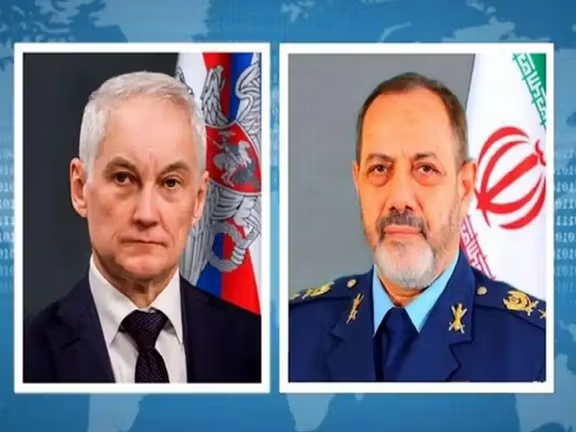
Iranian Defense Minister Aziz Nasirzadeh met with his Russian counterpart in Moscow on Monday to discuss strengthening military ties as the two countries began a joint naval drill in the Caspian Sea.
Iranian state news agency IRNA quoted Tehran's ambassador to Moscow Kazem Jalali as saying that that the meeting between the defense chiefs focused on “reinforcing bilateral cooperation in the defense and military fields.”
The meeting comes after Moscow, an ally of Tehran, appeared to offer no material support to Iran during its 12-day conflict with Israel last month.
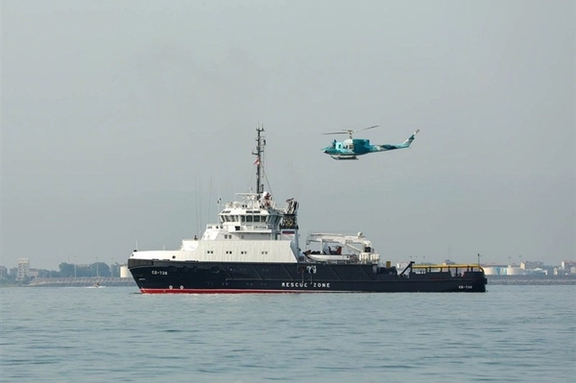
Iran and Russia began their three days of joint drills aimed at boosting maritime safety and regional cooperation, Revolutionary Guards-affiliated Tasnim News reported.
According to Tasnim, a Russian Navy vessel entered Iranian waters on Monday to take part in the exercise, codenamed CASAREX 2025, or
The agreement, initially signed by Russian President Vladimir Putin and Iranian President Masoud Pezeshkian on January 17, was ratified by Russia’s State Duma in April.
While the pact does not include a mutual defense clause, it commits both nations to enhanced military-technical cooperation, joint military exercises, and coordination in the face of what they define as shared security threats.
The launch of the joint military exercise follows a high-level political meeting held a day earlier in which Ali Larijani, advisor to Iran’s Supreme Leader Ali Khamenei, met with Russian President Vladimir Putin at the Kremlin.
Larijani briefed Putin on the Iranian officials’ view regarding the crisis in the Middle East and developments related to Iran’s nuclear program, Russian state news agency RIA said citing Kremlin spokesperson Dmitry Peskov.
Iran carried out a suborbital test of its Qased satellite carrier on Monday, aiming to evaluate new technologies under development in the country's space program, the IRGC-affiliated Tasnim news agency reported.
According to the report, the launch was designed to assess emerging capabilities in Iran’s aerospace sector.
"The results of this test will be used to improve the performance of Iran’s satellites and broader space systems," it said.
Such tests by Iran have previously drawn Western concern due to the dual-use potential of the launch vehicle, capable of delivering satellites or, potentially, ballistic payloads.
"The same rocket that launches satellites can launch missiles; it's the identical technology," Yemeni-American policy analyst Fatima Al-Asrar told Iran International.
"The Islamic Republic calls this space research, but every test improves their ability to hit targets at long range. There's no meaningful difference between a space launcher and a ballistic missile in this instance."
Iran’s space endeavors began in 2009 with the launch of the Omid (Hope) satellite. The government insists that its space activities are solely peaceful, yet the dual-use nature of space technology—capable of supporting both civilian and military operations—has raised alarms, particularly among the United States and its allies.
In a joint statement, the E3 expressed concern over Iran's ongoing missile tests, highlighting that the Qaem 100 launcher uses the same technology as Iran’s long-range ballistic missiles.
These launches enable Iran to test technologies that could potentially advance its ballistic missile program, the statement said.
The US has also consistently criticized Iran's satellite launches, citing violations of Security Council resolutions due to perceived connections with its ballistic missile program.
In September 2023, Iran deployed the Noor-3 imaging satellite into orbit, positioned at an altitude of 450 kilometers, utilizing a Qased launch vehicle.
The European Union has sanctioned the son of an advisor to Iran's Supreme Leader for his role in Russia's oil trade, as part of a crackdown on the Kremlin's energy revenues.
Hossein Shamkhani -- the son of Ali Shamkhani, a long-time defense minister and former head of Iran's Supreme National Security Council - was branded “a central player” in Russia’s so-called “shadow fleet".
An EU statement released on Friday accused him of using Dubai-based firms to conceal the origin of Russian crude.
“Hossein Shamkhani is involved in an economic sector providing a substantial source of revenue to the Government of the Russian Federation,” the bloc said.
Shamkhani was sanctioned alongside his companies Milavous Group Ltd and Admiral Shipping.
“He uses the company Milavous Group Ltd to blend crude oil with various petroleum products from Russia and to rebrand for exporting purposes, thereby concealing their origin,” the statement read.
“As Director of the company Admiral Shipping, he is involved in transporting and selling Russian crude oil.”
A 2024 Bloomberg investigation reported that the Shamkhani network is at the heart of a sanctions-evading secret trade with Russia, in which Iran provides Moscow with weapons in exchange for oil, helping Russia's war on Ukraine.
The investigation alleged that the network had become a major actor in the export of Iranian and Russian oil and had launched a hedge fund with offices in cities including London, Dubai, and Singapore to manage proceeds.
Shamkhani has denied Bloomberg report.
The Shamkhani family has faced repeated accusations of corruption and abuse of power. Iran International’s Mojtaba Pourmohsen reported on their alleged ownership of foreign assets and ties to the fatal 2022 building collapse in Khuzestan, linked to a businessman associated with the family.
The oil magnate's father, Ali, was seriously wounded in an Israeli strike on his residence in June. Initial reports said he had been killed, but state-linked outlets later confirmed he had survived. He remains a close confidant and advisor of Ali Khamenei.
The EU’s latest sanctions also included a move to lower the price cap on Russian crude in a bid to further constrain Moscow’s energy income.
Iran will host a high-level meeting with Russian and Chinese officials in Tehran on Tuesday, part of a diplomatic effort to shield the country from the threat of reimposed UN sanctions under the 2015 nuclear deal’s snapback mechanism.
“We are in constant consultation with these two countries to prevent activation of the snapback or to mitigate its consequences,” Foreign Ministry spokesman Esmail Baghaei said at a weekly press briefing on Monday. “We have aligned positions and good relations.”
The trilateral talks, which will take place at director-general level, are aimed at coordinating a response to growing pressure from the West over Iran’s nuclear program, Baghaei said.
Tehran has long portrayed Russia and China as reliable allies, citing their support in trade, defense, and diplomatic arenas.
Iran leans on allies as E3 threat looms
The meeting comes as the three European parties to the 2015 nuclear deal—France, Germany, and the UK—have warned they will trigger the snapback mechanism by the end of August unless Iran returns to substantive nuclear negotiations. The mechanism, part of UN Security Council Resolution 2231, allows any JCPOA participant to restore UN sanctions if Iran is deemed non-compliant.
“There is no legal, moral, or political basis for reinstating sanctions that were lifted under the JCPOA,” Baghaei added. “We have been engaged in consultations with Russia and China on this issue for the past year.”
Western nations cite multiple reasons for Iran's non-compliance, including enriching uranium to near weapons level and expelling the UN's nuclear inspectors.
A separate meeting between Iran and the European trio is scheduled for Friday in Istanbul. Baghaei said Monday that the deputy EU foreign policy chief is expected to attend, without naming the official. The Iranian diplomat said the talks would “seriously address sanctions relief and Iran’s nuclear program.”
“We will clearly state our demands,” he added.
Tehran has grown increasingly critical of European governments in recent months, accusing them of siding with the United States and Israel.
“European countries not only failed to condemn the attacks on Iran and its nuclear facilities, they supported them,” Baghaei said. “They must be held accountable.”
Nuclear talks with US remain off the table
Asked about the prospect of renewed engagement with Washington, Baghaei said there were currently no plans for talks.
“I explained today about Iran’s talks with Europe; at the moment, we have no plans for talks with the United States.”
However, he said diplomacy remains “a tool and opportunity to safeguard Iran’s national interests, and that Tehran would not hesitate to use it when necessary.”
Iran and the United States had held multiple rounds of nuclear talks via Omani mediation before Israel launched its 12-day war on Iran, but Washington’s decision to strike Iranian nuclear sites brought the negotiations to an end.
However, in Washington ,US President Donald Trump expects Iran to return to nuclear negotiations, saying that diplomacy is in Tehran's best interest, according to the State Department Spokeswoman Tammy Bruce.
“I know that he expects them to begin to negotiate because that's in their best interest,” Bruce said in an interview with Fox News last week. “He has believed and continues to believe that diplomacy will work here."
Baghaei also dismissed recent remarks by former US Secretary of State Antony Blinken, who told CNN that Iran had agreed to cap enrichment below one percent and discuss weaponization assurances.
“Such a thing did not happen,” he said, calling the remarks “part of US domestic disputes”.
“We are not satisfied with the agency’s approach or with Director General Grossi,” he said. “The Iranian people are angry.”
He added that future cooperation would follow a new framework approved by Iran’s Supreme National Security Council.
Following Israeli and US strikes, Iran passed legislation restricting cooperation with the IAEA unless its security conditions are met.
Iranian officials have since escalated attacks on the agency, including threats to put its chief, Rafael Grossi on trial, with calls in hardline media for his arrest and execution. France, Germany, and the UK jointly condemned the threats in a recent statement.
Israel-backed hackers wiped out $90 million in Revolutionary Guards crypto wallets during last month's war, calling it a landmark campaign to cripple Iran’s financial backbone, The Wall Street Journal reported.
Predatory Sparrow, the group believed to be aligned with Israeli intelligence, demonstrated “surgical precision and total freedom of access,” erasing data and destroying wallets linked to the Islamic Revolutionary Guards Corps (IRGC), according to a report published Sunday.
By targeting Bank Sepah—the Guards’ central financial institution—hackers rendered Iran’s military payroll inoperative and triggered cascading disruptions. “Automated teller machines went dark, and online and in-branch services shut down,” the report said. “Salary and pension payments halted.”
The hackers also penetrated Nobitex, Iran’s dominant cryptocurrency exchange, extracting and burning stablecoins tied to IRGC operational funds.
Nearly 90 percent of the country’s crypto transactions pass through Nobitex, and the group extracted approximately $90 million in stablecoins linked to IRGC funds. These were then burned by transferring them to inaccessible blockchain addresses, permanently removing them from circulation.
“Predatory Sparrow reportedly extracted $90 million from wallets linked to the Islamic Revolutionary Guard Corps, then burned the assets by transferring the funds to addresses where they could not be retrieved, thereby permanently removing them from circulation,” the article said.
The strike ignited a broader panic. Though not directly attacked, Iran’s largest commercial bank, Bank Melli, couldn’t meet demand for cash. The Central Bank of Iran attempted to contain the collapse by injecting liquidity, but confidence evaporated. The rial fell more than 12 percent, and authorities suspended trading on the Tehran Stock Exchange.
The attack denied officials and security personnel access to their own money, directly challenging the government’s ability to sustain loyalty through financial means.
The report also said that the success of the cyber campaign has reframed US strategy. While President Trump said at the NATO summit, “We want [Iranians] to be prosperous, we want them to do well, but they can’t have nuclear weapons," it was a message to Iran's Supreme Leader that he must relinquish the nuclear program or face economic collapse.
The report said that sanctions that drive the Islamic Republic finances into vulnerable channels such as crypto and informal banking will likely be part of that strategy, in addition to shifting US cyber policy from passive backing to active involvement in offensive operations alongside Israel.
“Cyber warfare also rewards live-fire experience," the article said. "The more Washington and Jerusalem operate together in combat, the stronger their alliance grows. And when the next big test comes—as it surely will—the nations that have trained together under fire will dominate the field."
Iran’s top air defense commander said the country's skies are being vigilantly guarded “day and night” following the recent 12-day conflict with Israel.
Brig. Gen. Alireza Sabahifard, who leads the Khatam al-Anbia Air Defense Base, said Iran’s air defense forces are operating with “open eyes and full strength” and will, in his words, “rub the nose of aggressors into the dirt” backed by military capabilities and “trust in God.”
The Khatam al-Anbia Central Headquarters, Iran’s highest operational military command, oversees planning, coordination, and operational supervision of all armed forces. Its air defense base is responsible for coordinating and operating air defense activities across both the Army and the Revolutionary Guards (IRGC).
On Sunday, Mahmoud Mousavi, the army’s deputy for operations, said Iran has replaced air defense systems damaged during last month's conflict with Israel.
"Some of our air defenses were damaged, this is not something we can hide, but our colleagues have used domestic resources and replaced them with pre-arranged systems that were stored in suitable locations in order to keep the airspace secure," Mousavi added.
During the June conflict, Israel's air force took control of Iranian airspace, delivering a significant blow to the country's air defenses, while Iran's armed forces responded with successive waves of missile and drone attacks on Israeli territory.
Israeli military officials say that 120 air defense systems were destroyed or disabled since the first wave of attacks—around a third of Iran’s pre-war total. Long-range systems, including Russian-supplied S-300s and Iran’s Bavar-373 batteries, were among those targeted.